



船舶作为能源开采和运输行业中的重要设备,其在海洋环境中的腐蚀防护尤为重要。海水是一种成分复杂的腐蚀性电解质溶液[1],其中不仅含有多种氯盐和硫酸盐,而且存在溶解氧、颗粒有机物和微生物等腐蚀性介质,使得腐蚀成为船体钢材结构最常见的失效形式之一,每年造成的损失高达国民经济总产值的1.5%~5.2%[2]。钢材表面的孔隙、裂纹及夹杂等微观结构缺陷为微生物的附着与繁殖提供了有利位点,进而促进生物膜的形成。特别是在船体内部的水箱、油箱等封闭或半封闭区域,由于营养物质易于积聚,往往成为微生物富集的重要区域。此外,海水中的侵蚀性离子能够降低钢材基体表面的保护性能,导致腐蚀性介质持续侵入基材内部,从而加剧腐蚀过程[3~5]。AH36船体钢作为船体构件主要使用的钢材之一,其在海洋环境中的耐蚀性能备受关注。海洋腐蚀性微生物主要包括细菌、真菌、古菌及藻类等[6],其中细菌引起的微生物腐蚀最为严重,所以目前金属微生物腐蚀(MIC)研究多聚焦于细菌腐蚀。有关调查显示,超过65%的海洋船舶压载舱底部含有大量沉积物,其中厌氧菌与古生菌类可以在舱内缺氧的环境下长期存活[7],硫酸盐还原菌(SRB)作为海洋环境中典型的厌氧腐蚀性细菌、广泛存在于海洋沉积物、海水以及海洋生物体内,其消耗硫酸盐并生成低价硫化物的过程会加快金属表面的腐蚀速率[8]。SRB代谢产生的酸性产物H2S及硫化物对MIC具有协同作用[9]。研究表明,SRB代谢的硫化物会吸附于碳钢表面提升Fe原子能量、降低Fe溶解所需的活化能,从而加速微生物腐蚀反应[10]。此外,SRB产生的氢化酶能够消耗金属阴极反应中析出的氢,有效促进Fe的氧化,即加速Fe到Fe2+的转化过程,同时SO
本文针对AH36船体钢在海洋环境中SRB腐蚀问题开展系统性腐蚀实验研究。通过SRB浸泡实验,结合腐蚀失重、腐蚀形貌与产物分析、电化学测试,深入探讨SRB对AH36船体钢的腐蚀机理及其对材料性能的影响。研究结果不仅为实际工程中的金属表面微生物腐蚀防控提供理论基础,更为海洋工程中船体钢材的防腐蚀设计和维护提供科学依据,具备重要的实际工程应用价值。
1 实验方法
1.1 实验材料
本文微生物腐蚀实验选用的基材是AH36船体钢,热处理状态为热轧态,主要化学成分(质量分数,%)为:C 0.21,Si 0.27,Mn 1.31,Ni 0.004,Cu 0.006, P 0.007,S 0.005,Cr 0.025,其余为Fe。由于钢材表面粗糙度对腐蚀结果的影响很大,所以对基材进行前处理以保证试样表面无明显缺陷。首先采用丙酮去除AH36船体钢试样表面残余油污及杂质,然后使用去离子水清洗,再使用60#、120#、200#、400#、600#、800#、1200#的砂纸逐级打磨并抛光,经水洗和无水乙醇超声清洗后取出试样,最后氮气吹干备用。本文腐蚀失重实验采用的试样尺寸为50 mm × 25 mm × 3 mm,微观分析实验的试样尺寸为15 mm × 10 mm × 3 mm,电化学测试则使用10 mm × 10 mm × 10 mm的立方体试样,顶部开槽铆接Cu导线,露出一个面积为1 cm2的工作面,其余面用亚力克树脂固化密封,以上每组测试实验均设置3个平行试样。
1.2 SRB培养
实验菌种SRB来自中国普通微生物菌种保藏管理中心(CGMCC),编号为:1.5190;SRB菌种在4 ℃下冷藏保存,需要接种时将冷藏的菌种取出。SRB菌种培养采用Postgate C液体培养基,培养基成分均为分析级化学用品;其成分组成为: K2HPO 0.5 g、NH4Cl 1.0 g、CaCl2 1.0 g、Na2SO4 1.0 g、MgSO4 2.0 g、酵母粉1.0 g、FeSO4·7H2O 0.2 g、乳酸钠4 mL及去离子水1000 mL。首先用2.5 mol/L NaOH溶液调节培养基pH到7.2 ± 0.2,通入氮气除氧20 min;然后将培养基放入立式高压蒸汽灭菌锅,在115 ℃的温度和0.1 MPa的压力环境下灭菌30 min后取出放凉备用。按10%的比例在培养基中接入提前活化好的SRB,在30 ℃下恒温恒湿培养箱中培养待用。
1.3 SRB生长代谢检测
采用最大可能数法(MPN)对不同时段的细菌数量进行测定,通过数学理论推算,以置信区间描述细菌浓度,实验方法参照GB/T 14643.5-2009[15]。由于SRB的代谢过程中,SO
1.4 腐蚀失重实验
腐蚀失重测量时间为第5、10、15、20和30 d,值得说明的是,为保证SRB在整个腐蚀周期内保持良好的代谢活性,在实验第15 d更换了新配制的SRB溶液,并继续浸泡试样至第30 d。依据GB/T16545-2015使用由500 mL盐酸、500 mL去离子水和3.5 g六次甲基四胺配制的除锈剂清除试样表面的腐蚀产物。随后用无水乙醇进行超声清洗,干燥后称量试样质量,通过对比腐蚀前后试样的质量变化计算腐蚀速率,失重法计算如
式中,V为均匀腐蚀速率(年腐蚀深度),mm/a;Δm为金属腐蚀前后质量损失,g;t为浸泡时间,h;A为试样在溶液中的暴露表面积,为1 cm2;ρ为钢材的密度,取7.85 g/cm3。
1.5 腐蚀产物及形貌检测
取出达到预定腐蚀时间的AH36船体钢小挂片试样,在5%戊二醛的磷酸缓冲溶液中固化30 min,然后采用质量分数分别为25%、50%、75%和100%的乙醇溶液对试样逐级脱水干燥。利用VEGA-3型扫描电子显微镜(SEM)观察试样表面腐蚀产物的微观形貌,并利用仪器配带的能谱仪(EDS)对其元素组成进行分析;随后观察去除腐蚀产物后的表面形貌。最后使用软毛刷收集试样表面的腐蚀产物,并进行冷冻干燥研磨处理,采用D2 Phaser型X射线衍射仪(XRD)分析腐蚀产物的组成,XRD测试角度扫描范围为10°~90°,扫描速度为5 (°)/min。辐射源Cu靶,靶电流30 mA,靶电压40 kV。
1.6 电化学测试
电化学测试采用CS350M型电化学工作站,使用三电极体系,其中工作电极(WE)为AH36船体钢试样,参比电极(RE)为饱和甘汞电极(SCE),辅助电极(CE)为铂电极。测量试样浸泡不同时间的电化学开路电位(OCP)、电化学阻抗谱(EIS)以及动电位极化曲线,其中OCP的测试时间为1800 s、采样间隔为0.1 s;阻抗谱测试频率范围为105~10-2 Hz,施加5 mV正弦波扰动电压信号;极化曲线电位扫描范围为-0.5~0.5 V (vs. SCE),扫描速率为1 mV/s。
2 结果与讨论
2.1 SRB生长代谢检测
图1
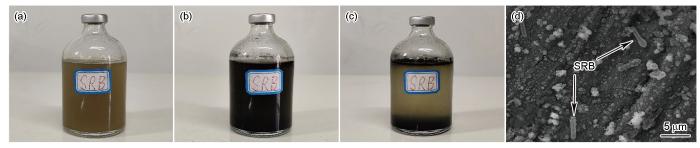
图1
SRB培养过程中培养基外观及细胞形貌变化
Fig.1
Temporal changes in medium appearance and SRB cell morphology during culture: (a) initial inoculation, (b) cultured for 1 d, (c) cultured for 4 d, (d) morphology of SRB after centrifugation
图2所示为15 d内SRB生长代谢变化情况,由图2a可知,1~4 d内溶液中SRB数量呈对数增长趋势;第1~6 d内溶液的SO
图2
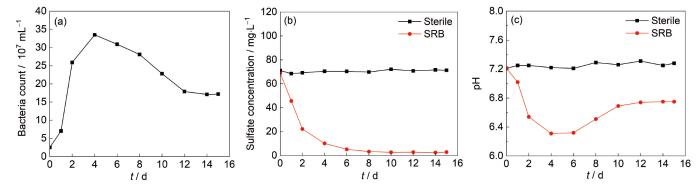
图2
SRB在15 d内的生长代谢变化
Fig.2
Growth and metabolic profiles of SRB over 15 d: (a) SRB cell count, (b) sulfate concentration in the solution, (c) pH variation of the solution
2.2 腐蚀失重测试
图3

图3
AH36船体钢在无菌和SRB溶液中的腐蚀速率
Fig.3
Corrosion rate of AH36 hull steel in sterile and SRB solutions
表1 NACE SP 0775-2018 SG腐蚀速率评价要求[18]
Table 1
| Corrosion degree | Uniform corrosion rate / mm·a-1 |
|---|---|
| Mild corrosion | < 0.025 |
| Moderate corrosion | 0.025~0.12 |
| Severe corrosion | 0.12~0.25 |
| Very severe corrosion | > 0.25 |
2.3 腐蚀产物形貌及成分分析
AH36船体钢试样在无菌和SRB溶液中浸泡腐蚀后表面微观形貌(图4)显示,无菌溶液中浸泡10 d后的试样表面较为平整,有些许小颗粒产物;SRB溶液中浸泡10 d后的试样表面形成了较为复杂的生物膜且产物呈现网状结构。第30 d的无菌溶液中试样表面腐蚀产物略有增多,存在一些碎屑絮状物、分布比较稀疏,而SRB溶液中试样表面腐蚀产物大量增多,产生了大颗粒和团簇状混合物,附着较为密集。
图4
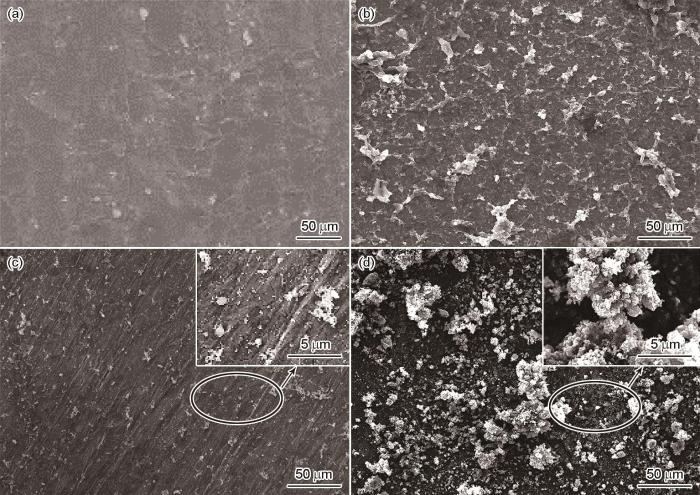
图4
AH36船体钢在无菌和SRB溶液中腐蚀10和30 d后的表面腐蚀产物形貌
Fig.4
Surface morphologies of corrosion products on the AH36 hull steel after 10 and 30 d of exposure in sterile (a, c) and SRB (b, d) solution
图5
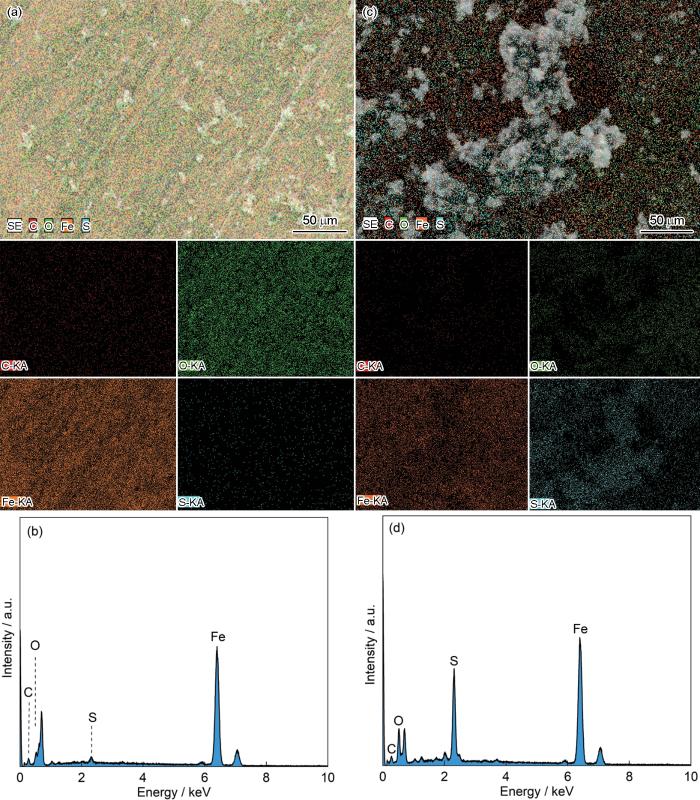
图5
AH36船体钢试样表面腐蚀产物的EDS扫描结果
Fig.5
EDS analysis of corrosion products on the substrate surface of AH36 hull steel in sterile (a, b) and SRB (c, d) solution
表2 AH36船体钢试样表面腐蚀产物主要元素选区分析结果
Table 2
| System | S | Fe |
|---|---|---|
| Sterile | 0.81 | 44.46 |
| SRB | 9.86 | 35.60 |
AH36船体钢在无菌和SRB溶液中的腐蚀产物的XRD图谱分析结果如图6所示,无菌溶液中腐蚀产物以Fe的氧化物为主,主要包含Fe2O3及FeSO4,其原因可能是Fe基体溶解产生的Fe2+和溶液中OH-结合生成Fe(OH)2,而不稳定的Fe(OH)2又会消耗基体表面以及溶液中残留的氧,进而转化为Fe2O3。SRB溶液中形成腐蚀产物的相关化学反应式如表3所示[19],SRB体系产物除了Fe2O3和FeSO4外,主要包含FeS和FeS2,其中FeS通常被认为是SRB腐蚀Fe基体的标志性产物;根据阴极去极化理论和生物催化硫酸盐阴极还原理论[20,21],阴极反应主要表现为H+的还原过程,伴随SRB的阴极去极化和氢化酶作用,SRB通过分泌氢化酶消耗吸附于阴极表面的氢原子,将SO
图6

图6
AH36船体钢在无菌与SRB溶液中形成的腐蚀产物XRD图谱
Fig.6
XRD patterns of corrosion products formed on the AH36 hull steel in sterile (a) and SRB (b) solution
表3 AH36钢在SRB溶液中的腐蚀反应
Table 3
| Reaction type | Reaction process |
|---|---|
| Anode reaction | |
| Ionization of water | |
| Cathode reaction | |
| Cathodic depolarization reaction | |
| Corrosion product generation reaction | |
2.4 基体腐蚀形貌
AH36船体钢基体形貌如图7所示。由图7a可知,在无菌体系浸泡5 d后的试样基体表面平坦、腐蚀痕迹轻微,第10 d时其表面有少许较小的蚀坑出现。在SRB溶液中腐蚀5 d后的试样表面出现了明显腐蚀坑,且部分蚀坑连接成片,坑底平坦,腐蚀坑边缘呈现阶梯状,这与金属SRB腐蚀特征吻合[24];第10 d后SRB溶液中试样的腐蚀缺陷增大,局部的点蚀开始扩展成片。第15 d后的无菌体系试样表面也出现了较多腐蚀坑,但蚀坑尚未全部连接成片,腐蚀深度也较浅;而SRB溶液中试样表面发生严重腐蚀破坏、蚀坑持续扩大加深。究其原因,一方面是因为SRB的阴极去极化作用促进阳极腐蚀反应发生;另一方面,在SRB腐蚀体系中,腐蚀形貌主要受到宏观电偶效应的控制。SRB代谢产生的FeS腐蚀产物具有半导体特性,其电极电位通常高于Fe基体金属,因此FeS更易作为阴极,而Fe基体作为阳极发生溶解反应,形成以FeS为阴极、Fe为阳极的宏观腐蚀电偶。这种电偶效应是导致SRB诱发点蚀的主要驱动力之一[25]。
图7
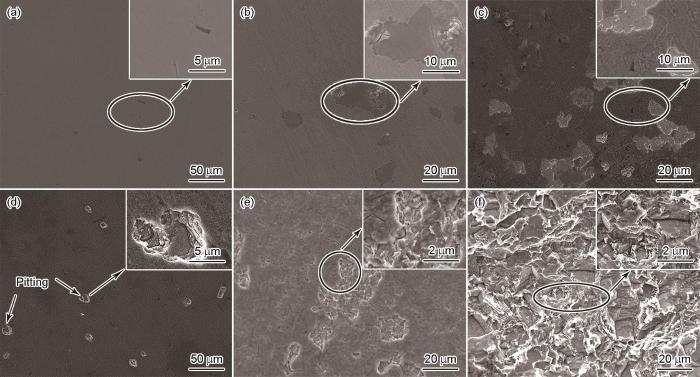
图7
两种体系下不同腐蚀时间AH36钢基体表面形貌
Fig.7
Surface morphologies of the AH36 steel substrate after 5 (a, d), 10 (b, e), 15 d (c, f) corrosion time under sterile solution (a-c) and SRB solution (d-f)
2.5 OCP
图8为AH36船体钢试样在无菌和SRB体系不同时间的OCP的变化情况。无菌体系试样在前5 d内OCP持续负移34 mV,这是因为试样表面初期生成的保护膜在被破坏,使得基体腐蚀趋势增强;随后在6~15 d内OCP整体略有上升,由-0.67 V增加至-0.65 V左右后趋于平稳,其原因可能是试样表面腐蚀产物迅速堆积,在基体表面形成带屏蔽保护作用的产物膜层,阻隔了腐蚀介质侵蚀基体,使得腐蚀趋势减小,随着腐蚀产物增厚致密,OCP变化不明显。SRB体系浸泡周期内整体的OCP存在较大波动,腐蚀前期SRB体系试样电位远低于无菌体系,这可能归因于有菌体系内SRB繁殖生长、数量增多,细菌附着在基体表面形成生物膜[26],随着膜下细菌开始大肆腐蚀基体,导致金属腐蚀倾向增大,使得前3 d内的OCP呈现整体降低的趋势。后期SRB体系试样OCP开始上升到-0.61 V后趋于稳定。根据胞外电子转移理论,SRB能以Fe基体为电子供体,通过持续还原SO
图8

图8
AH36船体钢在无菌与SRB溶液中OCP变化
Fig.8
Variation of open circuit potential (OCP) of AH36 hull steel in sterile and SRB solution
2.6 EIS
EIS谱是一种高效、破坏性较小的测试,非常适合表征金属与生物膜界面之间电化学腐蚀反应信息[28],AH36船体钢试样在两体系中15 d内的EIS谱如图9所示。图9a为AH36船体钢试样在无菌体系中的Nyquist图,可见无菌体系下阻抗弧半径和模值随腐蚀时间增加而增大,第15 d阻抗弧最大,低频阻抗模值最高可达15680 Ω·cm2左右。这是因为无菌溶液中的析出物和基体的腐蚀产物覆盖在工作电极表面、形成了致密的保护膜层,导致Nyquist图阻抗弧更大,这会对钢材具有保护作用,反之则说明形成的产物膜有缺陷或已经被破坏[29,30];测试结果说明无菌体系下随着浸泡时间的进行腐蚀介质难以进一步侵蚀基体。SRB体系试样的阻抗弧半径和模值变化表现前期减小、后期增大,但整体都远小于无菌体系,从Bode图中可见,第1 d时的低频阻抗模值最大为1159 Ω·cm2,前期低频阻抗模值降低最小后到腐蚀中后期又有所增大,且腐蚀前期相位角峰值向高频区移动。其原因可能是SRB数量增多、在基体表面形成了生物膜,从而有利于SRB附着代谢,导致微生物腐蚀加剧;而后期腐蚀产物复合膜层积聚变厚,对腐蚀介质屏蔽作用有所增强。
图9

图9
AH36船体钢在无菌与SRB溶液中的EIS图谱
Fig.9
Nyquist (a, d) and Bode plots (b, c, e, f) of AH36 hull steel in sterile (a-c) and SRB (d-f) solution
基于溶液电阻、电荷转移电阻及生物膜与腐蚀产物复合膜层电阻等3个要素分析SRB对工作电极电化学反应的影响,采用如图10所示的R(Q(R(QR)))型等效电路模型,在ZSimpWin软件中对试样在两体系中阻抗测试结果进行拟合。电路元件Rs代表溶液电阻、Rf和Qf代表试样表面膜层电阻及膜电容、Rct和Qdl分别表示电荷转移电阻和双电层电容。
图10
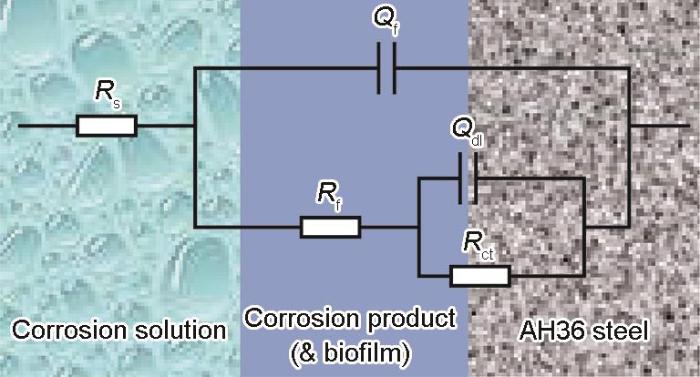
EIS拟合结果列于表4,图9中拟合曲线与原始数据图重合良好,拟合结果可靠。AH36钢在无菌溶液中15 d内的溶液电阻Rs均大于SRB溶液中,且SRB中的Qf明显大于无菌溶液中,这是由于SRB的腐蚀作用使工作电极表面粗糙度增加、导致腐蚀产物和生物膜表现出的电容较大;AH36钢在无菌溶液中的电荷转移电阻Rct值持续增大,第15 d增大至13430 Ω·cm2,这是由于基体表面产生的腐蚀产物堆积变厚。在SRB体系中Rct则表现为先减小后增大,随着SRB细菌含量和生物膜的形成,工作电极表面腐蚀加速;4 d后基体表面形成腐蚀产物层对基体表面有一定防护作用,一定程度上抑制点蚀的发生[31]。AH36船体钢在SRB溶液中的Rct值15 d内始终小于无菌溶液中,表明SRB体系试样表面电荷转移阻力低于无菌体系,更易发生腐蚀。
表4 两种体系等效电路元件拟合参数
Table 4
| System | t / d | Rs / Ω·cm2 | Qf / F·cm-2 | nf | Rf / Ω·cm2 | Qdl / F·cm-2 | nd1 | Rct / Ω·cm2 |
|---|---|---|---|---|---|---|---|---|
| Sterile | 1 | 35.99 | 1.029 × 10⁻³ | 0.9954 | 1589 | 5.074 × 10⁻⁵ | 0.8061 | 5016 |
| 3 | 40.57 | 1.298 × 10⁻³ | 0.9968 | 3598 | 9.982 × 10⁻⁵ | 0.7971 | 7408 | |
| 5 | 35.40 | 1.599 × 10⁻³ | 0.9587 | 5469 | 1.273 × 10⁻⁴ | 0.8137 | 9921 | |
| 10 | 35.10 | 1.359 × 10⁻³ | 0.9654 | 6982 | 1.276 × 10⁻⁴ | 0.8917 | 10310 | |
| 15 | 38.99 | 1.584 × 10⁻³ | 0.9854 | 6591 | 1.311 × 10⁻⁴ | 0.8765 | 13430 | |
| SRB | 1 | 30.92 | 3.428 × 10⁻³ | 0.8756 | 249.9 | 2.578 × 10⁻³ | 0.7894 | 964.4 |
| 3 | 24.35 | 4.042 × 10⁻³ | 0.7865 | 145.7 | 6.124 × 10⁻³ | 0.7512 | 730.8 | |
| 5 | 25.72 | 3.385 × 10⁻³ | 0.7984 | 106.8 | 2.766 × 10⁻³ | 0.6574 | 684.7 | |
| 10 | 26.77 | 3.499 × 10⁻³ | 0.8169 | 136.6 | 2.932 × 10⁻³ | 0.8176 | 731.9 | |
| 15 | 26.65 | 3.305 × 10⁻³ | 0.7589 | 153.2 | 2.515 × 10⁻³ | 0.7456 | 814.6 |
极化电阻Rp(Rp = Rf + Rct)常用于衡量金属的耐蚀性能,通常Rp值越低表示腐蚀速率越高[32,33],两体系的Rp变化如图11所示。无菌体系Rp值一直呈现上升的趋势,这表明无菌体系的腐蚀速率持续降低,这是由于无菌体系工作电极腐蚀产物层不断加厚,造成腐蚀介质难以侵入。SRB体系中的Rp则整体呈现先减小后稳定的趋势,可能是前期生物膜下的无氧环境利于SRB代谢,加剧了细菌对金属的微生物腐蚀。后期随着SRB体系工作电极表面由生物膜、腐蚀产物及溶液析出物构成的复合膜层稳定,溶液pH升高,使得SRB体系腐蚀速率趋于稳定。总的来说,AH36船体钢试样在15 d的腐蚀周期内,无菌体系中的Rp值远大于SRB体系,说明试样在无菌体系中的耐蚀性更好。
图11
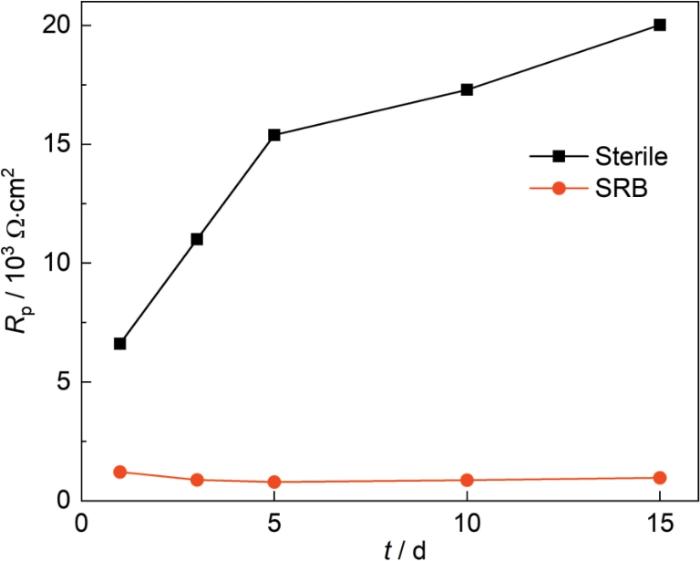
图11
AH36船体钢在无菌和SRB溶液中的极化电阻
Fig.11
Polarization resistance of AH36 hull steel in sterile and SRB solutions
2.7 动电位极化曲线
图12为AH36船体钢试样在无菌环境和SRB环境中浸泡15 d后的极化曲线测试结果,可见两体系在阴极区的极化曲线差异不大,这是由于前期溶液中含有少量的氧气、阴极反应均由吸氧反应控制;SRB体系的极化曲线位于无菌体系的右下方,表明试样在SRB体系中腐蚀倾向更大。采用Tafel外推法对极化曲线进行拟合,结果见表5。试验中两组溶液的阳极Tafel斜率(βa)均高于阴极斜率(βc),表明阳极过程具有更显著的极化特性。SRB溶液中βa更大,可能与其在代谢过程中通过促进阴极反应(如SO
图12
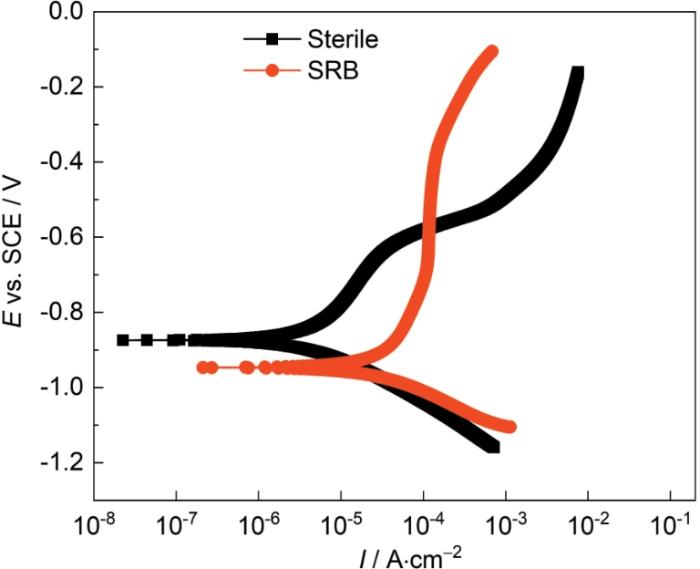
图12
AH36船体钢在无菌与SRB溶液中腐蚀15 d后的极化曲线
Fig.12
Polarization curves of AH36 hull steel after 15 d of corrosion in sterile solution and SRB solution
表5 AH36船体钢在无菌与SRB溶液中的极化曲线拟合结果
Table 5
| System | βa / mV·dec | βc / mV·dec | Ecorr / V | Icorr / A·cm-2 |
|---|---|---|---|---|
| Sterile | 314.57 | 132.75 | -0.8739 | 4.5537 × 10⁻⁶ |
| SRB | 596.48 | 124.04 | -0.9465 | 5.0134 × 10⁻⁵ |
式中,V为腐蚀速率,g/(cm2·s);A为原子质量,g/mol;n为电极反应中电子转移数;F为Faraday常数,取96485 C/mol;Icorr为腐蚀电流密度,A/cm2。
根据表5拟合结果,试样在SRB溶液中第15 d时的Icorr为5.0134 × 10⁻⁵ A·cm-2,大于无菌体系的4.5537 × 10⁻⁶ A·cm-2,根据Icorr与腐蚀速率成正相关的规律可知SRB溶液中工作电极的腐蚀更严重[35]。一方面是因为SRB前期代谢产生的酸性物质使溶液pH降低,使得基体腐蚀加剧;另一方面是因为SRB的阴极去极化和生物阴极催化作用将硫酸盐被还原成了S2-,且SRB消耗附着在电极表面的氢,导致大量氢原子离开金属表面,使得电流密度的增大、腐蚀速率上升[36]。工作电极电荷转移阻力减小,导致SRB体系的Ecorr相对无菌体系负移了72.6 mV,Icorr增大了近一个数量级,表明SRB促进AH36船体钢腐蚀作用显著,这与前文挂片的腐蚀失重分析结果相符。
2.8 SRB腐蚀机理
AH36船体钢在SRB环境中的腐蚀进程可分为3部分,如图13所示。第一阶段表现为AH36船体钢基体表面形成以各类有机物、无机盐、SRB细胞及其胞外聚合物(EPS)等物质组成的生物膜,为微生物的生长代谢提供了有利环境[37],形成了MIC的先决条件。第二阶段表现为硫酸盐还原菌在试样表面形成致密的生物膜,并在EPS内大量繁殖。由于EPS屏障效应及SRB代谢活动对氧的持续消耗,膜内逐渐形成贫氧环境,从而在膜内外之间产生氧浓度梯度,导致基体表面局部形成氧浓差电池。此外,SRB通过生物阴极催化硫酸盐还原并发生阴极去极化作用,在厌氧环境中,部分H+与SRB代谢产物S2-结合生成H2S,进一步加剧局部腐蚀过程[38]。生成腐蚀产物的过程如表3所示,AH36船体钢基体溶解产生的Fe2+与溶液中S2-反应生成黑色的铁硫化合物,而无菌体系产物中则没有发现该腐蚀反应。FeS作为半导体型腐蚀产物,具有较高电极电位,其与Fe基体之间形成明显的电化学不均匀性,从而在宏观尺度上形成腐蚀电偶,加速阳极区域的溶解过程。与无菌条件下主要形成Fe氧化物产物不同,SRB环境下的FeS沉积不仅降低了产物层致密性,也进一步促进电子在腐蚀体系中的迁移,诱导局部阳极溶解反应的持续进行。第三阶段,SRB继续分泌大量EPS附着于基体表面,增强其生物附着能力,同时不断代谢生成有机酸,使局部环境酸化。疏松状腐蚀产物大量堆积破坏了原有产物层的致密性,导致其阻隔作用下降,腐蚀介质得以深入接触基体内部,从而显著降低电荷转移阻力,提升腐蚀电流密度。上述机制使得金属表面电化学特性持续演化,腐蚀微电池不断被激活和扩大,SRB菌液中的腐蚀性离子与基体持续作用,这些都是导致基体腐蚀加剧的主要原因。
图13

图13
AH36船体钢在SRB环境下的腐蚀过程示意图
Fig.13
Schematic diagram of the corrosion process of AH36 hull steel in SRB environment
3 结论
(1) 伴随SRB将SO
(2) SRB体系的AH36船体钢试样腐蚀失重速率30 d内可达无菌体系的5倍左右;SRB体系试样表面腐蚀产物膜层除Fe氧化物外,还生成了FeS为主的铁硫化合物。
(3) SRB体系试样的电荷转移电阻和极化电阻始终小于无菌体系,且相对无菌体系腐蚀电流密度的增大约一个数量级,SRB破坏了工作电极表面电化学平衡;SRB的生物阴极催化硫酸盐还原和阴极去极化作用加速基体表面的电子转移和阳极Fe溶解,使基体呈现不均匀的局部腐蚀特征。
参考文献
A rapid evaluation method for corrosion resistance of galvanized steel layer for transmission tower materials
[J].
输电杆塔材料镀锌钢层耐腐蚀性的快速评价探究
[J].
Research progress of pipe corrosion situation and corresponding solutions
[J].
腐蚀现状与解决理论研究进展
[J].
Research on the marine environmental impact on reef structures maintenance
[J].
南海海洋环境对岛礁工程结构与设施影响研究
[J].
Corrosion behavior and mechanism of Ni-Mo low alloy steels in tropical marine atmosphere
[D].
Ni-Mo低合金钢热带海洋大气环境腐蚀行为和机理研究
[D].
Effects of disinfectant and biofilm on the corrosion of cast iron pipes in a reclaimed water distribution system
[J].
The effects of disinfection and biofilm on the corrosion of cast iron pipe in a model reclaimed water distribution system were studied using annular reactors (ARs). The corrosion scales formed under different conditions were characterized by X-ray diffraction (XRD), energy dispersive spectroscopy (EDS), and scanning electron microscopy (SEM), while the bacterial characteristics of biofilm on the surface were determined using several molecular methods. The corrosion scales from the ARs with chlorine included predominantly α-FeOOH and Fe2O3, while CaPO3(OH)·2H2O and α-FeOOH were the predominant phases after chloramines replaced chlorine. Studies of the consumption of chlorine and iron release indicated that the formation of dense oxide layers and biofilm inhibited iron corrosion, causing stable lower chlorine decay. It was verified that iron-oxidizing bacteria (IOB) such as Sediminibacterium sp., and iron-reducing bacteria (IRB) such as Shewanella sp., synergistically interacted with the corrosion product to prevent further corrosion. For the ARs without disinfection, α-FeOOH was the predominant phase at the primary stage, while CaCO3 and α-FeOOH were predominant with increasing time. The mixed corrosion-inducing bacteria, including the IRB Shewanella sp., the IOB Sediminibacterium sp., and the sulfur-oxidizing bacteria (SOB) Limnobacter thioxidans strain, promoted iron corrosion by synergistic interactions in the primary period, while anaerobic IRB became the predominant corrosion bacteria, preventing further corrosion via the formation of protective layers.Copyright © 2011 Elsevier Ltd. All rights reserved.
MIC of carbon steel in Amazonian environment: Electrochemical, biological and surface analyses
[J].
Study on corrosion behaviors of carbon steel in the presence of Citrobacter farmeri in artificial seawater
[D].
海水环境下柠檬酸杆菌对碳钢Q235的腐蚀行为研究
[D].
Study on the corrosion behavior of sulfate-reducing bacteria in X52 oil pipeline
[D].
X52输油管道硫酸盐还原菌腐蚀行为研究
[D].
Microbiological corrosion rules of x80 pipeline steel in three simulated soil solutions
[J].
X80管线钢在三种土壤模拟溶液中的微生物腐蚀规律
[J].
Roles of sulfur-containing metabolites by SRB in accelerating corrosion of carbon steel
[J].
硫酸盐还原菌的含硫代谢产物在加速碳钢腐蚀中的作用
[J].
Microbially mediated metal corrosion
[J].A wide diversity of microorganisms, typically growing as biofilms, has been implicated in corrosion, a multi-trillion dollar a year problem. Aerobic microorganisms establish conditions that promote metal corrosion, but most corrosion has been attributed to anaerobes. Microbially produced organic acids, sulfide and extracellular hydrogenases can accelerate metallic iron (Fe) oxidation coupled to hydrogen (H) production, as can respiratory anaerobes consuming H as an electron donor. Some bacteria and archaea directly accept electrons from Fe to support anaerobic respiration, often with c-type cytochromes as the apparent outer-surface electrical contact with the metal. Functional genetic studies are beginning to define corrosion mechanisms more rigorously. Omics studies are revealing which microorganisms are associated with corrosion, but new strategies for recovering corrosive microorganisms in culture are required to evaluate corrosive capabilities and mechanisms. Interdisciplinary studies of the interactions among microorganisms and between microorganisms and metals in corrosive biofilms show promise for developing new technologies to detect and prevent corrosion. In this Review, we explore the role of microorganisms in metal corrosion and discuss potential ways to mitigate it.© 2023. Springer Nature Limited.
Characterizing the effect of carbon steel exposure in sulfide containing solutions to microbially induced corrosion
[J].
Effect of H2S on the corrosion behavior of pipeline steels in supercritical and liquid CO2 environments
[J].
Ship ballast tanks a review from microbial corrosion and electrochemical point of view
[J].
Corrosion failure analysis of X52 gas pipeline
[J].
X52输气管道腐蚀失效分析
[J].
Microscopic methods for identification of sulfate-reducing bacteria from various habitats
[J].
Recent advancements of nanomaterials as coatings and biocides for the inhibition of sulfate reducing bacteria induced corrosion
[J].The control of microbiologically influenced corrosion (MIC) is of great significance in many industrial applications. Attention has been devoted to emerging nanomaterials as 'green' biocides for their remarkable antimicrobial function and relatively low environmental risk. Understanding the antimicrobial inhibition mechanisms is the key to increase the efficiency of nanoparticles and enhance the feasibility of their application against various MIC microorganisms under different environmental conditions. This study gives an overview of the recent advancements of different nanomaterials and nanocomposites used as biocides for the inhibition of MIC. The potential and associated challenges in developing NPs as effective biocides are highlighted.
Effect of temperature on corrosion of pipeline steel in SRB/CO2 environment
[J].
温度对管线钢在SRB/CO2环境中的腐蚀影响
[J].
Gemini surfactant as multifunctional corrosion and biocorrosion inhibitors for mild steel
[J].Biocorrosion is an important type of corrosion which leads to economic losses across oil and gas industries, due to increased monitoring, maintenance, and a reduction in platform availability. Ideally, a chemical compound engineered to mitigate against biocorrosion would possess both antimicrobial properties, as well as efficient corrosion inhibition. Gemini surfactants have shown efficacy in both of these properties, however there still remains a lack of electrochemical information regarding biocorrosion inhibition. The inhibition of corrosion and biocorrosion, by cationic gemini surfactants, of carbon steel was investigated. The results showed that the inhibition efficiency of the gemini surfactants was high (consistently >95%), even at low concentrations. Gemini surfactants also showed strong antimicrobial activity, with a minimum inhibitory concentration (0.018 mM). Corrosion inhibition was investigated by electrochemical impedance spectroscopy (EIS) and linear polarisation resistance (LPR), with biocorrosion experiments carried out in an anaerobic environment. Surface morphology was analysed using scanning electron microscopy (SEM).Copyright © 2019 Elsevier B.V. All rights reserved.
Corrosion behavior of X65 steel in seawater containing sulfate reducing bacteria under aerobic conditions
[J].The corrosion behavior of X65 steel was investigated in the seawater inoculated with sulfate reducing bacteria (SRB) under the aerobic environment by electrochemical impedance techniques and immersion tests. The corroded morphologies and the composition of the corrosion products were investigated. The variation of the solution parameters including the bacterium number, the pH value and the soluble iron concentration were also investigated. The results indicated that in the SRB-containing system, the impedance responses presented a depressed semi-circle in the initial period, which then turned into the blocked electrode characteristic during the later immersion. The biofilm, mainly composed of extracellular polymeric substances, Fe(OH), γ-FeOOH and α-FeO, formed and degraded with the SRB growth. The soluble iron concentration initially increased, then rapidly decreased and later slowly increased. In the SRB-containing seawater under the aerobic environment, the X65 steel was corroded in the initial immersion. The corrosion became inhibited with the forming of the biofilm during the subsequent immersion. The inhibition efficiency rapidly increased in the logarithmic phase, remained stable in the stationary phase and then decreased in the declination phase. In the corrosion process, the biofilm metabolized by SRB played a key role in the corrosion inhibition of X65 steel.Copyright © 2018 Elsevier B.V. All rights reserved.
Effect of sulfate-reducing bacteria on corrosion behavior of the low-alloy bare steel for hull
[J].
硫酸盐还原菌对船体低合金裸钢腐蚀行为的影响
[J].
Research on corrosion failure rule and control method of buried pipeline under SRB
[D].
埋地管道在SRB作用下的腐蚀失效规律及控制方法研究
[D].
Effect of SRB on corrosion behavior of X80 pipeline steel
[J].
X80管线钢在硫酸盐还原菌作用下的腐蚀行为
[J].
Corrosion of iron by sulfate-reducing bacteria: New views of an old problem
[J].
Effects of influences of Fe3C and pearlite on the electrochemical corrosion behaviors of low carbon ferrite steel
[J].The microstructure of X80 pipeline steel welding joint, consisted of Fe<sub>3</sub>C and degenerated pearlite, was simulated by carburizing treatment. The effects of Fe<sub>3</sub>C and pearlite on the electrochemical properties of bainitic ferrite steel and localized corrosion occurrence regularity in Yingtan soil simulation solution were investigated by scanning Kelvin probe (SKP), scanning vibrating probe (SVP) and local electrochemical impedance spectroscopy (LEIS), combined with immersion test. It is demonstrated that the corrosion potential of degenerated pearlite is lower than bainitic ferrite, and decreases with increasing Fe<sub>3</sub>C content. Localized corrosion occurs on the surface of the carburized sample in Yingtan soil simulation solution. The anodic oxidation process is observed to be initiated on the carburized degenerated pearlite, whereas the cathodic reaction involving dissolved H<sup>+</sup> is on bainitic ferrite, and the anodic current density increases with increasing Fe<sub>3</sub>C concentration. As the ion contents of the soil simulation solution doubled, the anodic dissolution of degenerated pearlite increases, and the local impedance of the electrode decreases.
Fe3C和珠光体对低碳铁素体钢腐蚀电化学行为的影响
[J].通过对X80管线钢进行固体渗碳模拟焊接接头区域的Fe<sub>3</sub>C和退化珠光体组织,采用扫描Kelvin探针(SKP)、扫描振动参比电极(SVP)和局部电化学交流阻抗谱(LEIS)结合浸泡实验分析了Fe<sub>3</sub>C和珠光体对铁素体钢表面电化学性能以及在鹰潭土壤模拟溶液中的局部腐蚀发生规律的影响. 结果表明, 退化珠光体组织在空气(湿度为40\%, 温度为22 ℃)中的腐蚀电位低于贝氏体铁素体, 并且随着Fe<sub>3</sub>C含量的增加, 腐蚀电位降低; 渗碳试样在鹰潭模拟溶液中发生局部腐蚀,中心铁素体区为整个材料电偶腐蚀的阴极, 退化珠光体和退化珠光体/贝氏体铁素体区为阳极, 随着Fe<sub>3</sub>C含量的增加, 阳极溶解电流密度增大;模拟溶液各离子含量成倍增加后, 退化珠光体的阳极电流密度升高, 电化学交流阻抗值降低, 局部腐蚀效应增大.
Effects of sulfidation of passive film in the presence of SRB on the pitting corrosion behaviors of stainless steels
[J].
Bioenergetics of sulphate-reducing bacteria in relation to their environmental impact
[J].The cellular physiology of the sulphate-reducing bacteria, and of other sulphidogenic species, is determined by the energetic requirements consequent upon their respiratory mode of metabolism with sulphate and other oxyanions of sulphur as terminal electron acceptors. As a further consequence of their, relatively, restricted catabolic activities and their requirement for conditions of anaerobiosis, sulphidogenic bacteria are almost invariably found in nature as component organisms within microbial consortia. The capacity to generate significant quantities of sulphide influences the overall metabolic activity and species diversity of these consortia, and is the root cause of the environmental impact of the sulphidogenic species: corrosion, pollution and the souring of hydrocarbon reservoirs.
Electrochemical impedance spectroscopy applied to microbial fuel cells: A review
[J].
Research on corrosion mechanism of L360 steel in H2S-CO2-Cl- system
[D].
L360钢在H2S-CO2-Cl-体系中的腐蚀机理研究
[D].
Corrosion resistance of 028 nickel-based alloy in ultra high temperature containing CO2 environment
[J].
028镍基合金在超高温含CO2环境中的耐腐蚀性能
[J].
Microbiologically influenced corrosion and mechanisms
[J].
微生物腐蚀及腐蚀机理研究进展
[J].
The study on mechanisms of typical microorganisms on corrosion of EH40 steel at the seawater/air interface
[D].
海洋水气交界环境典型微生物对EH40钢腐蚀影响机制研究
[D].
Passivation and electrochemical behavior of 316L stainless steel in chlorinated simulated concrete pore solution
[J].
Effects of bovine serum albumin on the corrosion behaviour of AISI 316L, Co-28Cr-6Mo, and Ti-6Al-4V alloys in phosphate buffered saline solutions
[J].
Effect of temperature on corrosion behavior of copper-nickel alloys by sulphate-reducing bacteria in anaerobic environment
[J].
温度对厌氧环境中硫酸盐还原菌所致铜镍合金腐蚀行为的影响
[J].
Research on the corrosion mechanism of sulfate-reducing bacteria under cathodic protection
[D].
阴极保护下硫酸盐还原菌腐蚀机理研究
[D].
Effect of compound bactericidal corrosion inhibitor on corrosion behavior of N80 steel at different temperatures
[J].The effect of sulfate-reducing bacteria (SRB) on the corrosion behavior of N80 steel in SRB containing solution at 20, 37 and 50 oC, and for this case the effectiveness of a compound bactericidal corrosion inhibitor in the bactericidal effect and corrosion inhibition performance of N80 steel were comparatively investigated via biological culture technique, weightlessness measurement electrochemical testing, and surface analysis etc. The results showed that the corrosion rate of N80 steel was proportional to the SRB activity at different temperatures. The SRB activity was the highest at 37 oC, the polarization resistance Rp of N80 steel was the smallest, and the corrosion rate (0.03553 mm/a) was the largest, which was 1.53 times of that at 20 oC and 1.16 times of that at 50 oC, thus the corrosion was the most serious. However, after adding the compoundbactericidal corrosion inhibitor, the Rp value of N80 steel at 20 and 37 oC were increased significantly, and the corrosion of the steel was effectively inhibitedwith corrosion inhibitionefficiency of 65.45% and 64.79%, respectively. This is mainly due to that the lipophilic group hydroxymethyl of the bactericide tetrahydroxymethyl phosphate sulfate (THPS), as one of the components of the compound bactericide corrosion inhibitor, enters the bacterial cell membrane, changes its protein properties, then resulting in bacteria death; Meanwhile the dimethyl sulfoxide promotes the hydroxymethyl of THPS to enter the bacterial cell membrane and enhances the bactericidal effect. As a signal molecule, D-tyrosine, a bactericidal enhancer, promotes the decomposition of biofilm, destroys the surrounding concentration difference, thus slows down the corrosion. The Chitosan in the corrosion inhibitor combined with Fe2+ to produce a protective film to protect the substrate, thereby, reducing the corrosion rate. However, at 50 oC, the corrosion inhibition efficiency for N80 steel was only 0.26%, which is due to that the excessive temperature intensifies the movement of corrosion inhibitor molecular, increase in the molecular desorption rate adsorbed on the surface of N80 steel and the dissociates the adsorption film, resulting in a very low corrosion inhibition efficiency.
复配杀菌缓蚀剂对N80钢在SRB环境中微生物腐蚀行为的影响
[J].采用生物培养技术、失重实验、电化学测试和表面分析等手段研究了硫酸盐还原菌(SRB)在不同温度对N80钢腐蚀行为的影响和在SRB环境中复配杀菌缓蚀剂对N80钢缓蚀性能的影响。结果表明,N80钢在不同温度的腐蚀速率与SRB的活性成正比,37 ℃活性最高的SRB使N80钢表面的极化电阻R<sub>p</sub>最小,腐蚀最严重,腐蚀速率(0.03553 mm/a)最高,分别是20和50 ℃时的1.53倍和1.16倍。加入复配杀菌缓蚀剂使N80钢20和37 ℃的R<sub>p</sub>值显著增大,腐蚀受到抑制,缓蚀率分别高达65.45%与64.79%。其原因是,复配杀菌缓蚀剂中的杀菌剂四羟甲基硫酸磷(THPS)中的亲油基团羟甲基进入细菌细胞膜改变了蛋白质的特性而使细菌死亡;增效渗透剂二甲基亚砜促进THPS的羟甲基进入细菌细胞膜内提高了杀菌效果;而杀菌增强剂D-络氨酸作为信号分子使生物膜分解脱落,破坏了浓差环境,使腐蚀减缓;缓蚀剂中的壳聚糖与Fe<sup>2+</sup>结合生成一层保护膜保护了基体,从而降低了腐蚀速率。N80钢在50 ℃的缓蚀率仅为0.26%,因为过高温度使缓蚀剂分子的运动加剧,使吸附在N80钢表面的分子解吸率提高和吸附膜解离,导致缓蚀率下降到极低。
Study on microbiologically influenced corrosion behavior and mechanism of stainless steel by Shewanella algae based on microdomain characterization technology
[D].
基于微区表征技术的不锈钢海藻希瓦氏菌微生物腐蚀行为及机理研究
[D].


