



在全球气候变暖和人类对自然资源需求日益增长的背景下,南极和北极地区已逐渐成为世界各国进行科学研究、资源勘探、航道开发等项目的重要海洋区域。寒带地区的北冰洋区域占全球海洋面积的3.6%,蕴藏着丰富的自然资源,并逐渐成为连接欧亚两大洲的新通道。随着我国“冰上丝绸之路”倡议的提出和寒带海域资源开发的持续推进,海工用金属材料在寒带海洋环境下的安全性和耐久性成为保障我国海洋战略的重要基础。
由于寒带海洋区域纬度较高,海水表层温度常年维持在0 ℃左右,部分海域冬季大气温度低至-50 ℃以下。极端的低温环境,与寒带海域的高湿、强紫外辐射等极端条件共同构成了复杂的环境体系,对金属材料在服役期间的耐环境腐蚀性和稳定性提出了严苛的要求[1~4]。与中低纬度的海洋区域相比,通常认为寒带海域的的低温环境会减缓金属材料的腐蚀速率,并且金属表面覆盖的冰层会减缓大气中的氧气到达金属表面,从而抑制金属材料的腐蚀失效。然而,随着俄罗斯、挪威、瑞典等诸多国家对寒带地区一系列金属材料的腐蚀研究发现,寒带海洋环境中金属的局部腐蚀及应力腐蚀开裂等问题尤为突出[5,6]。我国对寒带海洋地区金属材料的腐蚀研究起步较晚,但是随着我国寒带地区科学考察站的相继成立以及科考船的竣工服役,国内多家科研机构和高校积极开展寒带海洋环境多种金属材料的腐蚀试验。研究结果证实了金属材料在寒带极端海洋环境中腐蚀速率和腐蚀机制相较于其他海洋环境具有独特性[7]。寒带海洋环境的低温、冰雪冻融循环、紫外辐射等多种极端环境的耦合作用对海工装备材料结构安全性和服役寿命带来极大威胁,严重制约了寒带海洋工程技术的持续发展[8~10]。因此,深入研究寒带海洋环境中金属材料的腐蚀行为与防护技术,已成为当前南极和北极地区工程材料领域的重要研究方向,并对海工装备的安全服役和避免经济损失具有重要意义。
1 寒带海洋大气环境下的金属腐蚀
以南极和北极为代表的寒带海洋大气是一种极端且复杂的自然环境,具有低温、高湿、大气污染物种类特殊和紫外辐射强等特征。与温带或热带海洋大气环境相比,两极地区特殊的大气环境对金属材料的腐蚀行为具有独特的影响。本节从大气温度、大气污染物、紫外线辐射3个方面,介绍金属材料在寒带海洋大气典型环境因素作用下的腐蚀研究进展。
1.1 寒带低温对金属材料腐蚀的影响
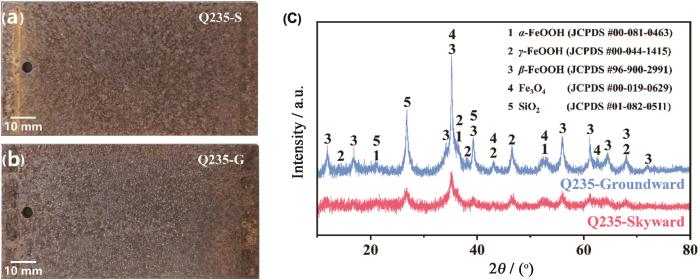
在寒带海洋大气环境中,温度是影响金属材料腐蚀行为最关键的因素之一[13~16]。两极地区常年处于低温状态,极端的低温条件不仅影响金属材料的力学性能,还对金属的腐蚀速率以及腐蚀产物的形成和转化行为具有显著的影响[17~20]。20世纪80年代,西班牙、葡萄牙、智利等国家联合开展了常规金属材料在南极沿海地区的大气暴露腐蚀试验[21]。21世纪后,我国研究工作者在南极中山站也相继开展了多种金属材料在南极沿海大气环境下的腐蚀研究工作[21]。国内外研究者在南极沿海的科考站获得的典型金属材料的大气腐蚀数据如表1所示,可以看出寒带低温环境下金属材料仍发生较严重的大气腐蚀。与温带海洋环境相比,寒带低温环境中金属材料的腐蚀具有其独特的特征。冷文俊等[22]比较了Ni-Cr-Mo-V钢在南极中山站大气暴露试验和室内加速试验的腐蚀结果表明,南极低温环境中Ni-Cr-Mo-V钢的腐蚀产物主要为Fe3O4、γ-FeOOH、α-FeOOH和β-FeOOH,而且低温造成β-FeOOH含量显著增加,导致Ni-Cr-Mo-V钢形成的锈层保护性较差。寒带低温环境中温度的变化会造成钢材表面的腐蚀产物层开裂,导致腐蚀性离子的侵入从而引发金属表面的点蚀现象。Choi等[23]通过在循环腐蚀试验中加入-40 ℃低温冷冻环节探究了寒带海洋环境对焊接低碳钢腐蚀的影响,研究表明金属锈层会在剧烈温度变化过程中出现裂纹,促进氧气和水分扩散到金属表面,从而加速低碳钢的腐蚀。
| Material | Exposure site | Test period / a | Corrosion rate / μm·a-1 |
|---|---|---|---|
| Mild steel | Jubany base | 1 | 38.1 |
| Marsh base | 1 | 24.1 | |
| Artigas base | 1 | 65.8 | |
| Steel St3 | Mirnyi station | 1 | 7.8 |
| Q235 | Zhongshan station | 1 | 16.3 |
| Q460 | Zhongshan station | 1 | 10.8 |
| Q960 | Zhongshan station | 1 | 15.8 |
| Ni-Cr-Mo-V steel | Zhongshan station | 1 | 13.0 |
| Aluminium | Jubany base | 1 | 4.03 |
| Marsh base | 1 | 3.65 | |
| Artigas base | 1 | 2.49 | |
| Copper | Jubany base | 1 | 2.03 |
| Artigas base | 1 | 2.16 | |
| Mirnyi station | 1 | 1.1 | |
| Zinc | Jubany base | 1 | 1.89 |
| Artigas base | 1 | 2.11 |
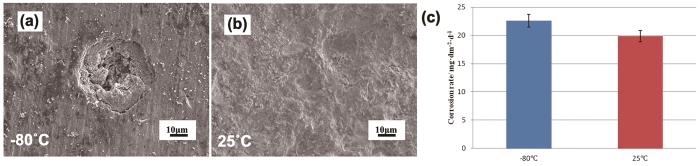
相较于温带海洋环境下温湿度变化引起的干湿交替现象,寒带大气温度的变化会造成金属材料表面冰雪的冻融循环,导致冰层覆盖下的金属表面存在一层薄液膜,进而腐蚀电化学过程会在金属与冰层界面处的薄液膜内发生。在低温冻融条件下,钢材会随着冻融周期的的增加从局部腐蚀发展为均匀腐蚀[24]。Li等[25]研究了低温冷冻处理后低温钢EH40在人造海水环境中耐腐蚀性能的变化。图1为经过-80 ℃深冷处理和未经深冷处理的EH40钢在0 ℃左右的人造海水中浸泡3 d后的SEM像和腐蚀速率变化结果,可以看出经过深冷处理后EH40钢在浸泡试验后出现了明显的点蚀现象,而未经深冷处理的EH40钢表现为均匀腐蚀特征。与未经深冷处理的样品相比,-80 ℃深冷处理造成了EH40钢在人造海水中腐蚀速率增加。彭文山等[26]研究了冰覆盖条件下恒温和变温环境对Ni-Cr-Mo-V钢腐蚀的影响,发现钢的腐蚀速率随温度升高而增大。在-45、-45~-5和-5 ℃ 3种低温环境下,Ni-Cr-Mo-V钢的腐蚀产物主要为γ-FeOOH、α-FeOOH、β-FeOOH和Fe3O4/γ-Fe3O4,温度对腐蚀产物成分的影响较小。
图1
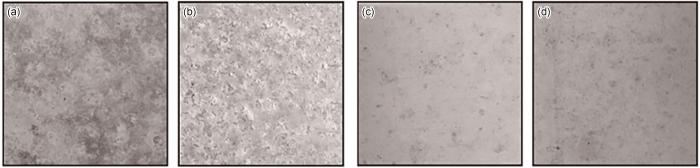
有色金属材料在寒带大气低温环境中同样表现出独特的腐蚀行为。在寒带大气环境中,雪的沉积和金属表面冰的形成并不会阻碍金属和冰雪界面处形成高浓度的氯化物溶液。随着寒带大气温度的变化,冰层和金属基体界面的薄液层会引起Zn、Cu、Al发生局部腐蚀。Morcillo等[21]通过南极沿海科考站的大气暴露试验发现Zn和Cu出现了类似其他海洋区域的腐蚀形貌特征,但是Zn和Cu在寒带大气环境下的腐蚀速率要低于温带和热带大气环境。然而,Al在寒带大气环境中则呈现不同的腐蚀特征。图2为Al在南极Jubany和Artigas工作站暴露1 a和2 a后的表面腐蚀形貌,可以看出仅暴露1 a后Al表面就出现了明显的局部腐蚀。通过对比Al在其他海域的腐蚀特征,Morcillo等[21]研究表明Al在南极沿海大气环境中腐蚀速率更高,并且腐蚀形貌更接近于海水浸泡环境下的结果。Esmaily等[27]研究了温度对AM50镁合金大气腐蚀的影响。结果表明,镁合金在-4 ℃下会发生腐蚀,并且腐蚀速率与温度存在明显正相关关系。相较于0 ℃以上的环境,镁合金中Al的存在以及低温环境中CO2在电解液中溶解度的增加造成了腐蚀产物组成和性质的改变。在-4 ℃条件下,AM50镁合金表面无法形成结晶的碳酸镁羟基化合物,而是生成一种非晶态腐蚀产物,造成了低温环境下镁合金腐蚀行为的差异。
图2
当前研究进展表明,与常温海洋环境相比,寒带海洋大气环境中长期暴露会造成钢、Cu、Zn的腐蚀速率降低,但Al的腐蚀速率升高。寒带大气环境中温度变化过程中金属材料的腐蚀机制相比其他海洋大气环境有所不同。常温海洋环境下金属材料的大气腐蚀过程通常表现为随大气温湿度变化的干湿循环腐蚀,而寒带海洋大气环境下温度变化引起的冰雪冻融过程对金属材料的腐蚀具有重要影响。温度降低引起的金属表面水分冻结会造成冰层下腐蚀性离子的浓度升高,导致局部腐蚀现象的发生。另一方面,低温环境下腐蚀产物相较于常温海洋环境更加疏松且易发生应力破坏,造成寒带海洋大气环境中腐蚀性介质更容易侵入到金属基体,从而引发金属材料发生局部腐蚀。
1.2 寒带大气污染物对金属材料腐蚀的影响
图3
1.3 寒带紫外辐射对金属材料腐蚀的影响
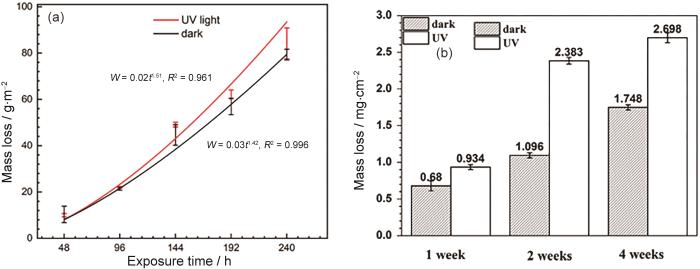
与常温海洋环境相比,紫外辐射(UV)是寒带海洋大气环境的典型特征。由于两极地区大气稀薄和臭氧层空洞的存在,导致地表接收到的紫外线强度远高于中纬度地区。寒带海洋环境中UV对金属材料的影响通常伴随着大气腐蚀共同进行,高强度的UV会对金属表面造成物理与化学的双重破坏[31,32]。Li等[33]研究了EH36钢在模拟寒带海洋大气环境中的腐蚀行为。图4a为EH36钢在黑暗和UV下腐蚀失重变化的拟合曲线,可以看出两种环境下失重曲线在暴露96 h后开始出现偏离。但在暴露240 h后,有无UV环境下EH36钢的失重结果并无明显差异。研究认为,在短时间的暴露环境中UV对EH36钢腐蚀失重的影响较小。Song等[34]研究了UV对Q235钢大气腐蚀的影响。图4b为Q235钢在黑暗和UV下腐蚀失重变化,可以看出UV相较于黑暗环境能够显著促进钢的腐蚀速率。研究表明,UV对Q235钢大气腐蚀行为的影响随着辐射周期的延长而增强。UV能够促进Q235钢表面β-FeOOH的形成,并加速γ-FeOOH向α-FeOOH的转变。在UV条件下,由于Q235钢表面腐蚀产物具有半导体特性,其光电效应产生的电子和空穴会参与大气腐蚀过程中的阴阳极反应,导致Q235钢大气腐蚀速率增加。
图4
2 寒带海水环境造成的金属材料腐蚀
海水作为寒带地区一种极端环境下的自然腐蚀介质,其对金属材料腐蚀的影响与温带或热带海洋环境相比展现出显著的差异。两极地区的低温海水、高盐度、溶解氧变化剧烈以及特殊的微生物生态系统共同构成了复杂的腐蚀体系。这些环境因素的协同作用导致金属材料在寒带海水环境中的腐蚀机理呈现特殊性。本节从寒带海水温度和海洋环境微生物两个主要方面,介绍其对金属腐蚀行为影响机制的研究进展。
2.1 海水温度对金属材料腐蚀的影响
寒带海域环境的海水参数与常规海洋环境存在显著差异,其特有的环境参数体系构成了独特的腐蚀介质环境,其中水温是影响金属腐蚀行为的核心参数之一[35~37]。北极和南极海域的表层海水温度常年维持在0 ℃左右。低温不仅直接影响金属材料的电化学腐蚀动力学,还会改变海水的物理化学性质,如溶解氧含量、盐度分布以及冰-水界面的离子传输过程[38,39]。Shen等[40]研究了EH40钢在低温3.5%NaCl溶液中的腐蚀行为。结果表明,EH40钢在浸泡14 d后腐蚀速率高于室温人造海水。低温海水会造成EH40钢表面形成疏松多孔的腐蚀产物层(Fe(Cl x O y )和Fe3O4),使得腐蚀介质更容易侵入金属表面并造成金属发生点蚀。而在室温海水环境中,EH40钢表面的腐蚀产物层主要由Fe3O4组成,具有一定的保护作用。
与常温海水环境相比,碳钢和低合金钢的腐蚀过程受低温影响显著。Rajput等[41]探究了低碳钢(A级)和高强钢(A级和D级)在-10、0和18 ℃ 3种温度的淡水和海水浸泡条件下的腐蚀特性,结果显示低碳钢和高强钢(A级)在海水中的腐蚀速率最大,并且随着温度升高腐蚀加快,但是高强钢(D级)在-10 ℃海水中的腐蚀速率高于0 ℃条件。研究表明海水温度的降低会抑制低碳钢和高强钢(A级)的腐蚀,但过低的海水温度会加速高强钢(D级)的腐蚀行为。Fu等[42]采用Zn和316L不锈钢在冷冻3.5% (质量分数) NaCl溶液中模拟寒带海水环境下镀锌钢结构的腐蚀过程,并对冷冻盐溶液的电导率和锌的腐蚀进行了表征。图5是Zn分别连接和不连接316L不锈钢后在-23 ℃下3.5%NaCl中腐蚀后的能谱分析结果。结果表明,完全冷冻的3.5%NaCl溶液仍然具有导电性和腐蚀性,并且电偶效应在低温环境下加速了Zn的腐蚀。
图5

图5
锌连接和不连接316L不锈钢后在-23 ℃下3.5%NaCl中腐蚀后EDS分析[42]
Fig.5
EDS analysis on the surfaces of the Zn coupled (a) and uncoupled (b) with 316L stainless steel in 3.5%NaCl solution at -23 ℃: (a1, b1) SEM images, (a2, b2) Zn EDS-mapping, (a3, b3) O EDS-mapping, (a4, b4) atomic percentage of Zn and O elements[42]
2.2 寒带海洋环境微生物对金属材料腐蚀的影响
寒带海洋环境中微生物群落的特殊性也是金属腐蚀的重要影响因素。尽管两极地区海水温度较低,但研究表明寒带海洋中存在众多类型的嗜冷微生物。同时由于船舶在不同海域之间航运的原因,嗜热微生物也存在于寒带海洋环境。这些微生物具有独特的代谢机制和环境适应性,能够在冰下的金属表面生存、附着并形成生物膜[43,44]。微生物在金属腐蚀中的作用主要通过改变氧浓度和环境pH、分泌腐蚀性代谢产物等方式对金属材料的腐蚀造成影响。Atalah等[45]利用电化学方法和表面分析技术研究了两种南极地区的嗜热细菌(厌氧芽孢杆菌Anoxybacillus和葡萄球菌Staphylococcus)对7075-T6铝合金腐蚀行为的影响。结果显示嗜热细菌群落产生的过氧化氢酶和过氧化物酶会参与铝合金的腐蚀过程并促进了腐蚀。
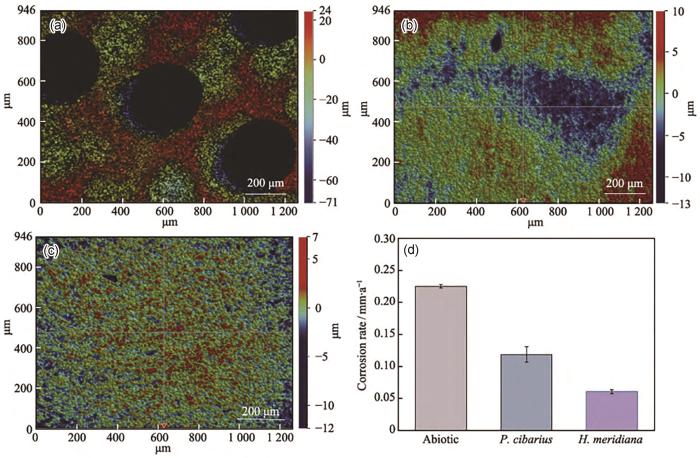
相较于南极地区的嗜热细菌对铝合金腐蚀的加速作用,也有研究报道了寒带海水中微生物抑制金属材料腐蚀的现象。毛晓敏等[46]研究了两株典型寒带海冰水中的微生物(养料嗜冷杆菌P. cibarius和南方盐单胞菌H. meridiana)在4 ℃条件下对EH40钢腐蚀行为的影响。图6为在EH40钢在实验溶液中浸泡30 d后点蚀坑的光学轮廓图及失重速率图,可以看出空白对照组中EH40钢的均匀腐蚀和点蚀最严重,两种寒带低温菌液中的钢样腐蚀相对较轻。在4 ℃下,两株低温菌附着于EH40钢表面与腐蚀产物共同形成了具有一定防护效果的生物膜,其中H. meridiana分泌的可溶性多糖量更大,细菌附着更加均匀连续,其在样品表面形成的生物膜的致密性更高,防护效果也好于P. cibarius。
图6
3 寒带海洋环境下金属材料的防腐技术
在寒带海洋环境中,低温、冻融循环、大气污染物、紫外辐射以及微生物群落共同构成了独特的腐蚀性海洋体系,严重制约着金属材料的结构安全性和服役寿命。当前针对寒带海洋环境的腐蚀防护研究可以分为3个主要方向:一是通过新型抗低温和紫外的涂层技术,实现对腐蚀介质的有效阻挡;二是开发低温适应性强的牺牲阳极材料以实施电化学防护;三是利用金属表面改性技术,提升材料自身对极端海洋环境的抗腐蚀能力。
3.1 涂层防护
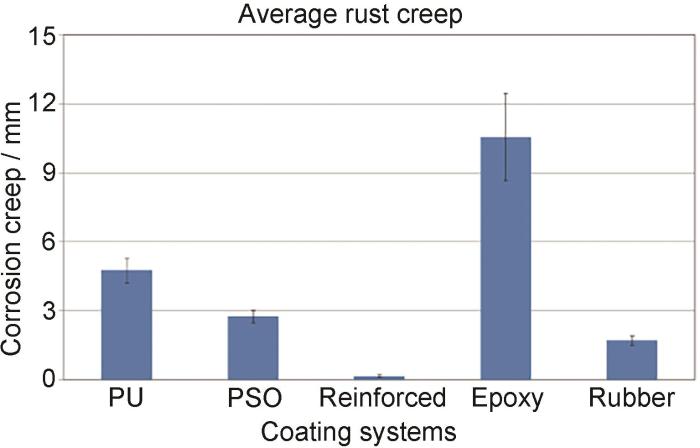
由于寒带海洋环境的特殊性,传统的有机涂层、无机涂层以及复合涂层,在两极地区条件下均表现出不同程度的局限性。在北极地区,涂层必须能够承受极低的温度,抗开裂和脆化,并且在冻融循环环境下也保持良好的稳定性[47~50]。此外,它们还必须承受结冰造成的机械应力、冰块运动造成的磨损以及浮冰的潜在冲击[51,52]。Momber等[53,54]通过加速防腐/老化试验、涂层附着力试验、霜冻积聚测量、抗冲击试验、磨损试验和润湿性试验评价了六种有机涂层体系在北极近海低温环境中的性能表现。结果表明,低温会造成涂层耐腐蚀、耐冲击和耐磨性能下降,而涂层附着力增加。Bjørgum等[55]研究了5种防护涂层系统(聚氨酯PU、聚硅氧烷PSO、增强聚酯Reinforced、橡胶Rubber、环氧树脂Epoxy)在北极环境(低至-60 ℃)下的性能。图7为5种涂层体系在低温环境下老化后的腐蚀扩展结果。研究表明,低温环境会造成涂层更硬及柔韧性更低/更脆,其中增强聚酯涂层具有优异的抗腐蚀扩展性能。Kim等[56]开发的水性聚二甲基硅氧烷改性聚氨酯(WPU-PDMS)树脂在-40 ℃下仍保持高拉伸强度和伸长恢复率(90%),适用于海洋环境下需耐寒性的应用场景。
图7
相较于传统的防腐涂层,防冰涂层是目前寒带海洋环境腐蚀防护中重要的研究领域。由于传统的机械除冰、化学防/除冰等技术存在效率低、易造成环境污染等问题,具有高效防冰能力的超疏水涂层在防/除冰领域获得了普遍的关注[57,58]。超疏水涂层的原理是通过微纳米粗糙结构和低表面能修饰,在金属表面构建出具有高接触角的超疏水结构,使金属表面与水的接触角大于150°且滚动角小于10°,从而减少水在金属表面的停留和结冰,实现防水、防结冰和抗腐蚀等功能[59]。Zhang等[60]利用喷涂法制备了具有多级粗糙结构的超疏水涂层,由多壁碳纳米管和SiO2构成,能够显著提升铝合金的长期防腐和防冰性能。近年来,超疏水涂层与电热型、光热型等主动除冰技术的结合也进一步推动了防冰涂层发展。Hou等[61]通过将电热层与超疏水层相结合的方式制备了基于石墨烯纳米板的电热超疏水涂层,在具备优异的防水、防冰性能同时涂层能源效率也得到了提升。刘亚华等[62]通过超疏水涂层和多壁碳纳米管的结合,制备出的光热超疏水涂层具有出色的抗结冰和光热转换能力。在寒带海洋环境中,金属材料的腐蚀过程通常伴随海水中海冰和大气中冰粒造成的金属表面摩擦磨损危害。因此,适用于寒带海洋环境的超疏水涂层在具备良好的抗冰抗腐蚀功能外,还应提高涂层的耐磨能力。Gu等[63]设计了一种细胞状超疏水涂层,由微壳和纳米种子组成基本单元,其自身充当保护性屏障的同时可以加强涂层和材料基底之间的化学结合力,使得该超疏水涂层在耐腐蚀性能优异的同时具有强大的耐磨性。
当前寒带海洋环境中的涂层防护技术正逐步向多功能、高耐久、绿色环保方向发展,不仅需要满足传统的耐低温、耐磨损和防冰性能,还需具备优异的UV能力与生态环境友好性。由于寒带地区UV强度较高,传统有机涂层中常见的环氧、聚氨酯体系在长期UV环境下易发生老化失效,进而导致涂层防腐性能快速衰减。与传统单一涂层材料相比,通过引入多重防护添加剂的方式逐渐成为提升涂层抗UV老化性能的重要途径。Sun等[64]通过对添加剂进行适当的改性,利用添加剂中各组分的协同作用,显著提高了复合涂层在紫外线照射后的水接触角、光泽度、吸水率和拉伸性能。在超疏水涂层的改进方面,Guo等[65]利用一种氟硅烷改性氧化锌作为纳米填料,成功制备了具有耐UV性能的超疏水复合涂层。同时,为应对两极地区生态系统敏感、污染物降解周期长的环境保护问题,近年来防护涂层体系在原材料选择与制备工艺方面也趋于绿色可持续发展[66]。例如在超疏水防冰涂层研制过程中,通过替换含氟类污染物制备无氟的超疏水复合涂层[67]。尽管当前具备多功能的涂层研究已经取得了一定进展,但面向寒带极端海洋环境具备防冻、防磨损、防冲击、防冰、耐UV等多功能涂层的适用性仍是亟待解决的问题。
3.2 牺牲阳极合金设计
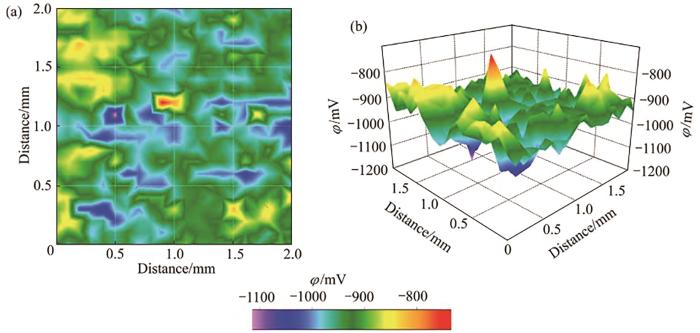
张一晗等[77]对寒带低温环境专用的Al-Zn-In-Mg-Ti-Ga-Mn牺牲阳极材料在模拟寒带环境下进行了电化学性能测试,结果显示开路电位约为-1.04 V,电流效率平均值达到了84.9%。图8为Al-Zn-In-Mg-Ti-Ga-Mn牺牲阳极表面微区电位分布,可以看出寒带低温牺牲阳极表现出良好的电化学性能,表面溶解和电位微区分布均匀,牺牲阳极整体保持了良好的活化溶解性能。另一方面,牺牲阳极通常与外加电流阴极保护系统结合共同实现极端海洋环境的金属腐蚀防护。通过布设可调控电位的辅助电极系统,实现结构全寿命周期内腐蚀电位的动态控制,从而显著延长结构服役寿命。Stavitsky等[78]开发了适用于寒带破冰船的PtNb牺牲阳极材料。该抗冰阳极材料作为破冰船阴极保护系统的一部分,通过在工作电极上采用结构化Pt涂层,降低了Pt阳极溶解速度,并提高了Pt涂层与Nb基体的结合强度,从而将阳极的使用寿命延长至25 a或更长。
图8
3.3 金属表面改性技术
金属表面改性作为提升材料本体耐蚀性的关键手段,在极端海洋环境防腐研究中占据重要地位。不同于依赖外部防护层的传统方法,表面改性通过调控材料最表层微结构、化学成分或能态结构,在根本上改变材料与环境界面的腐蚀反应过程。当前主流表面改性手段包括激光熔覆、等离子体喷涂、表面合金化、微弧氧化、激光冲击强化等,其在寒带海洋中的应用研究日益深入[79~81]。Wang等[82]在EH40钢表面制备Ni-15%WC熔覆层,-40 ℃下腐蚀电流密度较小,且钝化膜中Cr、W氧化物有效阻隔Cl-渗透。王超逸等[83]研究了新型F级船用低温钢表面氧化物的耐磨耐腐蚀性能,可见钢表面Fe3O4氧化层的耐磨性和耐腐蚀性最佳,而γ-FeOOH氧化层因结构疏松,耐磨性和耐腐蚀性较差。研究结果表明,通过控制钢表面氧化物类型可显著改善钢材的耐腐蚀和耐磨性能。
4 总结与展望
在寒带海洋环境中,低温、大气污染物,强紫外线辐射、冰雪冻融以及寒带海洋微生物等复杂因素对金属材料的安全和耐久性提出了严峻挑战。通过对金属材料在寒带大气和海水两种典型极端海洋环境下的腐蚀研究进展进行梳理可见,寒带海洋环境下金属材料的腐蚀问题具有显著的环境耦合特征,腐蚀机制呈现出多因素驱动、多尺度演化与多模式协同的复杂性。针对寒带海洋环境特征,金属材料在涂层技术、牺牲阳极材料设计和金属表面改性3个主要方面已经取得了一定的进展。寒带海洋环境下金属材料的腐蚀与防护研究不仅关乎海工装备的服役安全与寿命,更是我国战略实施的重要技术支撑,是一项复杂的系统工程,涉及材料科学、环境化学与力学的交叉融合,仍存在若干关键问题亟待解决:
(1) 传统海洋工程金属材料虽具备优异的低温韧性,但其在寒带复杂环境中的长期腐蚀行为尚未明确。我国对寒带海洋环境下金属材料腐蚀的系统研究起步较晚,相关环境数据积累有限。因此,建立寒带海洋环境腐蚀数据库,涵盖不同金属材料在典型极端工况下的长期服役数据是当前研究工作的重点之一。
(2) 现有研究多基于实验室模拟,室内加速试验谱也多基于中纬度海洋环境,缺乏对寒带环境特殊冻融循环与冰盖效应的精确模拟,难以掌握真实的寒带海洋环境动态过程对金属材料腐蚀的影响。未来研究需进一步整合寒带海洋现场暴露试验与实验室模拟试验,深化对寒带海洋多环境因素耦合下金属材料腐蚀机理的理解。
(3) 寒带海洋环境中金属材料的防腐研究正从传统单一手段向多策略集成、多尺度协同的方向发展。涂层防护技术应面向寒带海洋环境服役场景,开发具有多功能集成、环境响应调控与长效稳定特性的智能化防护材料体系,强化防护手段之间的协同效应,如实现涂层与阴极保护的功能互补、表面改性与抗微生物附着的协同增效,探索环境适应性与自适应调节能力兼具的新一代极端海洋环境防腐材料。
(4) 在当前人工智能高速发展和多学科交叉的背景下,面向寒带海洋环境的金属材料腐蚀与防护研究应融合人工智能、大数据分析、材料基因组等先进工具和平台,通过室内和现场金属腐蚀数据融合建模,实现寒带海洋环境下金属材料腐蚀寿命预测与防护方案优化配置,提升寒带海洋环境金属材料腐蚀防护策略的前瞻性与智能化水平。
参考文献
Analysis of polar class ship development
[J].
极地冰区船舶发展分析
[J].
Arctic materials science: Current state and prospects
[J].
Research progress on wear resistance of low-temperature steel for ships in polar regions
[J].
极地船舶用低温钢耐磨性的研究进展
[J].
Research progress in tribology of materials in polar marine environment
[J].
极地海洋环境服役材料的摩擦学研究进展
[J].
Limit state design and methodologies in ice class rules for ships and standards for arctic offshore structures
[J].Sea ice poses hazards to ships and offshore structures which create challenges for designers. Designers have to take into account the ice actions resulting from the various ice conditions, interactions and operational scenarios which may occur during the lifetime of structures. In this paper the methodologies used in ship and offshore structure standards, such as the Finnish Swedish Ice Class Rules, International Association of Classification Societies Polar Class rules and ISO 19906, are considered with respect to Limit State Design principles and design air temperature definitions. The paper presents an overview of the design approach used in these standards and especially the criteria for the structural limit used. Case study examples based on ship measurements in the Baltic, as well as design air temperature data from the Russian Arctic, are used to highlight the different approaches and their implementation. The analysis shows clearly that explicit design ice action and structural limit are required for the rational basis in the future development of Limit State definitions in standards accounting for ice actions. (C) 2017 Elsevier Ltd.
An overview of maintenance management strategies for corroded steel structures in extreme marine environments
[J].
Preparation and study of accelerated corrosion test spectrum of low alloy high strength steel in polar environment
[J].
低合金高强钢极地环境加速腐蚀试验谱编制与研究
[J].
Polar offshore engineering equipment: Development status and key technologies
[J].
极地海洋工程装备的应用现状及关键技术分析
[J].极地海洋工程装备是我国参与北极海洋油气开发的主要平台与实力象征。我国极地海洋工程装备设计建造与配套能力难以得到认可,这与造船大国地位不匹配,迫切需要寻求解决方法。本文分析了我国对极地海洋工程装备的发展需求,梳理了极地海洋工程装备的应用现状,提炼极地海洋工程装备的关键技术,总结我国极地海洋工程装备存在的问题。最后,本文提出成立“北极海上油气勘探开发共性关键技术研发及应用创新”专项,设立“极地海洋油气工程技术国际研发中心”,成立“中俄北极能源合资公司”等发展建议。围绕北极开发能力与环境保护能力的协调发展,本文研究为我国发展极地海洋工程装备提供参考,为我国跻身俄罗斯北极油气开发业务提供指导。
Review on research progress of key basic technologies of polar ship equipment
[J].
极地船舶装备关键基础技术研究进展综述
[J].
Improving the reliability of metal structures of transport and technological machines during operation in the Arctic
[J].
New challenges on corrosion and protection of polar steel
[J].
极地钢铁材料的腐蚀与防护面临新挑战
[J].
Design of polar climate environment laboratory
[J].
极地气候环境实验室设计
[J].
Electrochemical investigation on atmospheric corrosion of carbon steel under different environmental parameters
[J].
Fatigue strength of EH36 steel welded joints and base material at low-temperature
[J].
The analysis of 390 MPa clad steel plate adaptability to polar low-temperature environment
[J].
390 MPa级复合钢板极地低温环境适应性分析
[J].
Effects of low temperature overload and cycling temperature on fatigue crack growth behavior of ship steels in Arctic environments
[J].
Dissimilar welded joints operating in sub-zero temperature environment
[J].
Estimation of the long-term corrosion resistance of typical metals in the coastal regions of the Russian Federation
[J].
Corrosion mechanism of materials in three typical harsh marine atmospheric environments
[J].
几种苛刻海洋大气环境下的海工材料腐蚀机制
[J].以南极低温高辐照冰雪凝-融环境、南海高温高湿高盐雾环境以及滨海氯-霾耦合环境3种典型环境为研究对象,开展了典型海工材料的腐蚀行为研究。结果表明,南极低温环境下冰层、雪层覆盖下电化学腐蚀过程依然可以发生,冰雪凝-融过程导致液膜长周期存在促进了腐蚀的进行且加速局部腐蚀。南海高温高湿高盐雾环境下有色金属材料表面存在化学氧化和电化学腐蚀协同作用机制,不同铝合金的局部腐蚀萌生扩展驱动力不同 (即扩散与电荷转移、氢致沿晶裂纹、腐蚀产物楔入效应),表面润湿时间和Cl<sup>-</sup>协同作用导致腐蚀动力学偏离幂函数规律。滨海氯-霾耦合环境下NH<sub>4</sub><sup>+</sup>加速腐蚀的关键控制因素为缓冲效应导致的持续供H<sup>+</sup>,Cl<sup>-</sup>、NH<sub>4</sub><sup>+</sup>、NO<sub>3</sub><sup>-</sup>协同作用下镁合金发生“类自催化点蚀”。
Prediction model of metal mechanical properties under the coupling effect of low temperature and corrosion
[D].
低温腐蚀耦合作用下钢力学性能预测模型
[D].
Atmospheric corrosion of reference metals in Antarctic sites
[J].
Correlation of corrosion information aquired by indoor acceleration testing and by real low temperature marine atmosphere exposure in polar region for Ni-Cr-Mo-V steel
[J].
极地低温海洋大气环境下Ni-Cr-Mo-V钢腐蚀行为与室内外相关性研究
[J].
Corrosion behaviour of welded low-carbon steel in the arctic marine environment
[J].
Corrosion behavior of high-strength steel under polar low-temperature freeze-thaw cycle environment
[J].
极地低温冻融循环环境下高强钢的腐蚀行为研究
[J].
Influence of cooling treatment on corrosion behaviour of steel EH40 in extremely cold seawater
[J].
Effect of variable- and constant-temperature on corrosion behavior of high strength steel under polar ice cover
[J].
极地冰覆盖下变温和恒温对高强钢腐蚀影响研究
[J].极地气候环境特殊,金属材料可能长期暴露在冰层覆盖下,为研究冰覆盖腐蚀条件下恒温和变温环境对高强钢腐蚀的影响,采用室内模拟实验。在-45~-5 ℃温度下进行1个月的周期性冰覆盖变温腐蚀测试,与同周期恒温条件下-5和-45 ℃的腐蚀行为进行比较。结果表明:冰层覆盖下,随着温度升高,高强钢的腐蚀速率增加;在冰层覆盖下,温度的变化对高强钢的腐蚀形貌影响较小;电化学测试发现高强钢的容抗弧半径较大,变化范围较小,-5 ℃低温条件下,其自腐蚀电位最低,但是与变温条件下相差不大;XRD和拉曼光谱分析说明腐蚀产物由α-FeOOH、β-FeOOH、γ-FeOOH和Fe<sub>3</sub>O<sub>4</sub>/γ-Fe<sub>2</sub>O<sub>3</sub>构成,温度从-45 ℃到-45~-5 ℃,再到-5 ℃,腐蚀产物种类呈增加趋势。
Influence of temperature on the atmospheric corrosion of the Mg-Al alloy AM50
[J].
Atmospheric corrosion of metals in regions of cold and extremely cold climate (a review)
[J].
Aerosol salt particle deposition on metals exposed to marine environments: A study related to marine atmospheric corrosion
[J].
Characterization of corrosion products formed on Q235 carbon steel and T2 copper in the antarctic atmosphere
[J].
Influence of ultraviolet light irradiation on the corrosion behavior of carbon steel AISI 1015
[J].
Anticorrosion behavior of organic offshore coating systems in UV, salt spray and low temperature alternation simulated Arctic offshore environment
[J].
Initial corrosion behavior of EH36 marine steel in simulated polar marine environment
[J].
The role of UV illumination on the NaCl-induced atmospheric corrosion of Q235 carbon steel
[J].
Research on the influence of arctic navigation on the navigation performance of submarine
[J].
北极航行对潜艇航行性能影响研究
[J].
Tribocorrosion coupling effect of novel polar marine steel in simulated low temperature seawater
[J].
新型极地船用钢在模拟低温海水中的磨损-腐蚀耦合作用研究
[J].
Wear properties of ultra-high strength polar ship steel in sea-ice medium at low temperature
[J].
超高强极地船舶用钢低温海冰介质磨损性能
[J].
The synergistic effect of wear-corrosion in stainless steels: A review
[J].
Effect of low temperature on the fatigue crack propagation behavior of underwater manned vehicle rudder materials in arctic environments
[J].During polar navigation, adverse environmental conditions like cold temperatures, fatigue, and corrosion can affect surface and underwater manned vehicles (UMVs). Understanding the fatigue fracture growth behavior of polar ship steel is crucial for ensuring safety. This study investigates the mechanical properties and fatigue fracture propagation of steel used in underwater vehicle rudders under various low-temperature conditions through experimental research. It compares and analyzes the static mechanical characteristics, fatigue crack growth rate, and fracture morphology of underwater manned vehicle rudder steels at different low temperatures. Findings show enhancements in yield strength, tensile strength, elastic modulus, and fatigue crack propagation life of steel 925A, steel 20#, and their welded parts under low-temperature conditions. The tensile strength of 925A steel, 20# steel, and their welded parts increases by 6.87%, 14.61%, and 12.55%, respectively, as the temperature decreases from 20 to -60 °C. The yield strength also increases by 14.17%, 29.09%, and 15.76%, respectively. Fatigue crack propagation rate experiments were conducted under different constant low-temperature conditions. This study offers direction for future modeling and experimental testing.© 2024 The Authors. Published by American Chemical Society.
The influence of low temperature on the corrosion of EH40 steel in a NaCl solution
[J].
Fresh and sea water immersion corrosion testing on marine structural steel at low temperature
[J].
Corrosion damage in frozen 3.5wt.%NaCl solution
[J].
Progress on the corrosion mechanism of sulfate-reducing bacteria in marine environment on metal materials
[J].
海洋环境硫酸盐还原菌对金属材料腐蚀机理的研究进展
[J].硫酸盐还原菌 (SRB) 是一类广泛存在于自然环境中可以利用硫酸盐类物质作为呼吸代谢电子受体的厌氧类微生物,是造成金属腐蚀破坏和设备故障的主要原因之一,已经成为一个重要的研究课题。由于微生物活动的复杂性,生物膜内SRB与金属表面的相互作用缺乏深入的研究,其诱导腐蚀机理和腐蚀过程尚不清楚,难以进行有效的腐蚀预测。基于此,本文从SRB生物膜的呼吸代谢角度介绍了其诱导金属腐蚀的研究进展。介绍了SRB的生态特征和厌氧呼吸过程,重点综述了SRB腐蚀机理,包括阴极去极化、代谢产物腐蚀、浓差电池作用和胞外电子传递等理论,最后简要介绍了微生物腐蚀 (MIC) 研究的方法与技术手段。
Biological characteristics of polar microbial polysaccharides and corresponding mechanism of metal corrosion
[J].
极地微生物多糖的生物学特征及对金属的腐蚀影响机制
[J].
Study of an antarctic thermophilic consortium and its influence on the electrochemical behavior of aluminum alloy 7075-T6
[J].
Corrosion behavior of marine EH 40 steel by polar cryogenic microorganisms
[J].
极地低温微生物对船用EH 40钢的腐蚀行为研究
[J].
Effects of nano-fluorocarbon coating on icing
[J].
The anti-corrosion performance of the epoxy coating enhanced via 5-Amino-1,3,4-thiadiazole-2-thiol grafted graphene oxide at ambient and low temperatures
[J].
Photothermal and superhydrophobic composite coatings with sandwich and interlocking structure for effective anti-icing and de-icing
[J].
Polymeric protective films as anticorrosive coatings—Environmental evaluation
[J].The behavior of two polymeric protective paint coatings (epoxy and polyurethane) applied over an epoxy primer coating on steel plates was investigated in this study, focusing on their role in providing anticorrosive protection against various climatic stress factors. Among the numerous climatic factors that can affect the lifetime of anticorrosive coatings, the following were selected for this work: dry heat, UV radiation, humidity, and extreme conditions such as salt fog, marine atmosphere, and alpine atmosphere. The objective was to determine the remaining lifetime of these protective coatings before replacement is needed to prevent damage to the equipment they protect. The behavior of these polymeric materials under the mentioned factors was analyzed based on the variation in the tangent of the dielectric loss angle (tg δ) with frequency. From the interpretation of the experimental results, it was found that the polyurethane paint coating (P2) exhibits superior resistance to climatic degradation compared to the epoxy paint coating (P1). Furthermore, a comparison of tg δ values for the P1 and P2 coatings revealed that the initial (unaged) P2 coating performs better as an insulator (dielectric) than the P1 coating. Comprehensive information is provided to the users of polymeric anticorrosive protection materials, highlighting the extent to which climatic factors can affect the performance of the equipment they protect and determining the appropriate timing for replacing the coatings.
Design and application of icebreaker coating in ice area
[J].
破冰船冰区涂料的设计应用
[J].
A unique graphene composite coating suitable for ultra-low temperature and thermal shock environments
[J].
Performance characteristics of protective coatings under low-temperature offshore conditions. Part 1: Experimental set-up and corrosion protection performance
[J].
Performance characteristics of protective coatings under low-temperature offshore conditions. Part 2: Surface status, hoarfrost accretion and mechanical properties
[J].
Corrosion protecting coating systems in arctic areas
[A].
Low-temperature flexible WPU-PDMS copolymers for cold-resistant coating applications
[J].
Research progress of anti-icing/deicing with superhydrophobic coating
[J].
超疏水涂层在防除冰领域的研究进展
[J].
Research progress of super-hydrophobic coatings in field of metal corrosion protection
[J].
超疏水涂层在金属防腐领域的研究进展
[J].
Research progress on application of functional superhydrophobic coatings for anti-icing in polar regions
[J].
功能性超疏水涂层在极地抗冰领域的应用研究进展
[J].
Constructing carbon nanotube (CNTs)/silica superhydrophobic coating with multi-stage rough structure for long-term anti-corrosion and low-temperature anti-icing in the marine environment
[J].
Scalable high-efficiency multilayered anti-icing/de-icing coating: Superhydrophobic upper layer boosts the performance of the electrothermal system
[J].
Anti/de-icing performance and stability of durable photothermal superhydrophobic coatings
[J].
耐用光热超疏水涂层的防/除冰性能及其稳定性研究
[J].
Ultra-durable superhydrophobic cellular coatings
[J].Developing versatile, scalable, and durable coatings that resist the accretion of matters (liquid, vapor, and solid phases) in various operating environments is important to industrial applications, yet has proven challenging. Here, we report a cellular coating that imparts liquid-repellence, vapor-imperviousness, and solid-shedding capabilities without the need for complicated structures and fabrication processes. The key lies in designing basic cells consisting of rigid microshells and releasable nanoseeds, which together serve as a rigid shield and a bridge that chemically bonds with matrix and substrate. The durability and strong resistance to accretion of different matters of our cellular coating are evidenced by strong anti-abrasion, enhanced anti-corrosion against saltwater over 1000 h, and maintaining dry in complicated phase change conditions. The cells can be impregnated into diverse matrixes for facile mass production through scalable spraying. Our strategy provides a generic design blueprint for engineering ultra-durable coatings for a wide range of applications.© 2023. Springer Nature Limited.
A smart composite coating with photothermal response, anti-UV and anti-corrosion properties
[J].
A novel composite protective coating with UV and corrosion resistance: Load floating and self-cleaning performance
[J].
Research progress and development trend of green and environmental friendly superhydrophobic coating
[J].
绿色环保型超疏水涂层的研究进展
[J].
Fabrication of durable fluorine-free superhydrophobic polyethersulfone (PES) composite coating enhanced by assembled MMT-SiO2 nanoparticles
[J].
Electrochemical behavior of Al-Zn-In sacrificial anode in low temperature environment
[J].
Al-Zn-In系牺牲阳极低温电化学性能研究
[J].研究了三种Al-Zn-In牺牲阳极在低温下的电化学性能,其中Al-Zn-In-Cd牺牲阳极在低温时电流效率为84%左右,阳极溶解呈非均匀状,腐蚀产物不脱落,不适用于低温环境;Al-Zn-In-Mg-Ti牺牲阳极在低温时电流效率为90%左右,表面呈均匀状溶解,腐蚀产物脱落,具有较好的电化学性能.
Evaluating the performance of zinc and aluminum sacrificial anodes in artificial seawater
[J].The cathodic protection of the metallic structure buried/immersed in the aggressive media depends on the electrochemical properties of the sacrificial anode. The objective of this work is to evaluate the performance of the sacrificial anodes i.e. aluminum and zinc alloys developed in our laboratory. The microstructural analysis of the aluminum and zinc anodes revealed the formation of pure alpha and eta phases, respectively. However, in Al few precipitates were accumulated along the grain boundaries of alpha phase whereas the typical intragranular twin bands and dendrite structure was evident in the case of Zn anode. The performance of the anode materials was evaluated according to the standard test procedure (TM0190) as recommended by NACE. The mass loss and hydrogen evolution tests were conducted to determine the current efficiency of these sacrificial anode materials in artificial seawater. The current efficiency of the aluminum and zinc anode from the mass loss measurement was measured to be 93.3 and 66.6%, respectively. The anode capacity of Al and Zn was 2784.8 and 519.36 A h kg(-1) which was high as reported earlier. However, according to the hydrogen evolution test, the current efficiency was 86.2 and 95.3% for aluminum and zinc anodes, respectively. The open circuit potential of both anodes was also shifted to more negative potential (active state) within 336 h exposure to artificial sea water. (C) 2019 Elsevier Ltd.
Electrochemical performance of Al-Zn-In-Mg sacrificial anode in cold seawater
[J].
Al-Zn-In-Mg阳极低温海水环境电化学性能研究
[J].通过恒电流极化、动电位扫描、电化学阻抗、金相组织观察、扫描电镜和能谱分析等方法和腐蚀失重实验,研究了Al-Zn-In-Mg牺牲阳极在低温和常温环境的电化学性能和腐蚀过程,结果表明:Al-Zn-In-Mg阳极在低温和常温环境下都具有良好活化性能,在3和20 ℃天然海水中电容量分别达到2678和2571 Ahkg<sup>-1</sup>,阳极表面溶解均匀,低温环境阳极开路电位和工作电位负移,其电化学性能达到阴极保护材料性能要求。通过极化曲线、电化学阻抗和腐蚀失重实验证明Al-Zn-In-Mg阳极在低温环境下阳极自腐蚀速率降低,自身消耗降低,从而导致了阳极低温海水中电化学性能优于常温环境。
Study on electrochemical properties of aluminum alloy sacrificial anodes under the conditions of low temperature and high pressure in the deep sea
[J].
深海低温高压条件下铝合金牺牲阳极电化学性能研究
[J].
Influence of alloying elements and microstructure on aluminium sacrificial anode performance: Case of Al-Zn
[J].
Effect of alloy elements on electrochemical performance of aluminum sacrificial anode
[J].
合金元素对铝基牺牲阳极性能的影响
[J].

通过合金化方法,在Al-Zn-In三元牺牲阳极中依次添加Mg、Ti、Ga、Mn、Sn等元素,炼制不同成分的铝合金牺牲阳极。采用电化学性能测试、极化曲线测量及扫描电子显微镜分析等手段分析了合金元素对铝合金牺牲阳极性能的影响。结果表明,随着添加元素种类的增加,牺牲阳极电化学性能提高。在Al-Zn-In三元阳极中加入Mg和Ti,阳极溶解形貌更加均匀;加入Ga与Sn后,阳极的开路电位与工作电位负移;加入Mn后阳极的电流效率提高。
Effects of cerium on performance of Al-Zn-Sn sacrificial anode alloy
[J].
Ce对Al-Zn-Sn牺牲阳极合金性能的影响
[J].
Influence of silicon on the corrosion behavior of Al-Zn-In sacrificial anode
[J].Steel structures used in offshore sectors are often exposed to adverse weather conditions, and thus, require the application of efficient and safe corrosion protection techniques. The application of sacrificial anodes with aluminum alloys for cathodic protection is a viable anticorrosive protection alternative for long-term wet conditions owing to its low density, galvanic economy, better performance, availability, and recyclability. This study aims to evaluate the effect of different percentages of silicon in commercial Al-Zn-In alloys, used in aluminum sacrificial anodes, on the electrochemical properties of the alloys. The DNVRP-B401 standard was used to analyze the electrochemical performance and manufacturing of commercial matrix alloys according to the prescribed chemical composition. They were characterized by optical emission spectrometry, electrochemical performance, electrochemical polarization assay, macrography, and scanning electron microscopy. The results revealed greater work efficiency and corrosion uniformity for aluminum cathodic protection anodes with the addition of 0.10% by weight of silicon, which resulted in disk shape precipitation and reduced grain size and smaller spacing between dendritic arms. Therefore, with this percentage of silicon, the anodes exhibit less automatic corrosion of the anode mass, that is, greater anticorrosive protection, smaller amounts of corrosion residues in the medium, less anode disposal with exhausted life, and greater application sustainability for the aluminum anode. (c) 2021 The Author(s). Published by Elsevier B.V. This is an open access article under the CC BY-NC-ND license (http://creativecommons.org/licenses/by-nc-nd/4.0/).
Effect of Mg content on the properties of Al-Zn-In-Mg-Ti-Ga-Mn sacrificial
[J].
Mg含量对Al-Zn-In-Mg-Ti-Ga-Mn牺牲阳极性能的影响
[J].
Electrochemical performance of Al-Zn-In-Mg-Ti-Ga-Mn sacrificial anode in polar low temperature environment
[J].
Al-Zn-In-Mg-Ti-Ga-Mn牺牲阳极在极地低温环境中的电化学性能
[J].
New ice-resistant platinum-niobium anodes for cathodic protection systems against erosion-corrosion damage of icebreakers and offshore structures
[J].
Low-temperature mechanical behavior of super duplex stainless steel with sigma precipitation
[J].Experimental studies in various aspects have to be conducted to maintain stable applications of super duplex stainless steels (SDSS) because the occurrence rate of sigma phase, variable temperature and growth direction of sigma phase can influence mechanical performances of SDSS. Tensile tests of precipitated SDSS were performed under various temperatures to analyze mechanical and morphological behavior.
Effect of Mo on microstructure of ultra-high strength polar marine steel
[J].In order to clarify the effect of Mo on the microstructure and low-temperature toughness of polar marine steel,two billets (containing Mo and without Mo) were rolled,and the experiments were carried out to study the microstructure and properties of plates by means of SEM,EBSD and low-temperature impact tests.The results showed that Mo promotes bainite formation and decreases ferrite content by increasing the hardenability of austenite at a higher cooling rate and low final cooling temperature,which ultimately leads to a decrease in the proportion of high angle grain boundary (HAGB) and an uneven distribution of effective grains.The addition of Mo decreases the diffusion of C element,so that C can only diffuse in a short range,and eventually leads to the enrichment of a large number of tapered or strip cementites at the bainite lath boundary,reduces the interfacial bonding force between grain boundaries or sub-grain boundaries,and enhances the stress concentration during impact test.The decrease of HAGB proportion and the enrichment of irregular cementite are the important reasons for deteriorating the impact toughness at low temperature.<br>
Mo对超高强极地船舶用钢显微组织的影响
[J].
Correlation between low-temperature anticorrosion performance and mechanical properties of composite coatings reinforced by modified Fe3O4
[J].
Low-temperature corrosion behavior of laser cladding metal-based alloy coatings on EH40 high-strength steel for icebreaker
[J].\n In this paper, four kinds of coatings Ni + 30% WC, Ni + 15% WC, Ni, and Co are prepared on EH40 steel by laser cladding technology. Electrochemical experiment tests at a simulating low-temperature (–40°C) environment in 0.5 mol·L\n −1\n hydrochloric acid (HCl) solution and 3.5 wt% NaCl solution were conducted, and the polarization curve and electrochemical impedance spectroscopy (EIS) impedance spectrum were obtained. The results show that the Ni + 15% WC coating has the smallest corrosion current and 0.5 mol·L\n −1\n HCl solution and 3.5 wt% NaCl solution have the maximum polarization resistance and impedance arc. Coatings will be treated in a 0.5 mol·L\n −1\n HCl solution and 3.5 wt% NaCl solution at –40°C immersion for 30 days; finally, X-ray photoelectron spectroscopy (XPS) and scanning electron microscope (SEM) were used for test passivation films of Ni + 15% WC samples and sample surface morphology after corrosion. XPS results show that Fe, Mo, and Ni elements can form metal oxides in the 0.5 mol·L\n −1\n HCl solution, and Cr, Fe, Mo, Ni, and W elements can form metal oxides in the 3.5 wt% NaCl solution. SEM results display that relatively severe corrosion appeared on the substrate near tungsten carbide in a 0.5 mol·L\n −1\n HCl solution, and coating will be corroded form inside of the coating owing to the corrosive solution will penetrate the substrate. In 3.5 wt% NaCl solution, severe corrosion of the substrate has not been observed; however, the binding part has been obviously corroded.\n
Effect of surface oxides on wear resistance of new F-class marine low temperature steel
[J].
新型F级船用低温钢表面氧化物对其耐磨性能影响研究
[J].分别测试了新型F级船用低温钢板表面生成不同氧化物后的往复摩擦行为,并结合白光干涉仪以及扫描电子显微镜分别对钢样的显微组织形貌和磨痕形貌进行了表征。结果表明:γ-FeOOH氧化层钢样、原始钢样、Fe<sub>3</sub>O<sub>4</sub>氧化层钢样的耐磨蚀性能依次变高。其中,致密完整的Fe<sub>3</sub>O<sub>4</sub>氧化层钢样的磨损量最低,磨痕轮廓深度和尺寸都最小,表面以粘着磨蚀为主,耐蚀性也最好;γ-FeOOH氧化层微观结构较为疏松,摩擦系数最小,但是在摩擦腐蚀的协同作用下磨损量最大,磨损机理皆以磨粒磨损为主;未处理钢样的耐磨蚀性能处于两种预氧化钢样之间,以磨粒磨损为主,且表面有更多的犁沟和凹坑。


