



金属凭借其良好的导电性、延展性、导热性等优点,成为生产生活中不可缺少的材料。金属及其合金广泛用于制造业、建筑业、航天航空业等众多领域[1]。但是金属材料在日常使用过程中与环境的相互作用使其易受到腐蚀的影响,导致其本身的性能下降[2]。腐蚀,通常被称为“沉默的破坏者”,会损害金属的完整性,进而可能导致灾难性故障、完全隐患和重大的经济损失[3]。虽然腐蚀是不可能被完全消除的,但是运用腐蚀防护技术能够大大降低其腐蚀速率。这些策略包含多种方法,如使用缓蚀剂、耐腐蚀材料、阴极/阳极保护、环境保护、表面涂层等[4]。传统的缓蚀剂虽然有效,但由于其毒性和不可降解性,会对环境造成不可逆的破坏。因此开发新型环保和可持续的替代品成为必要[5]。
金属有机框架化合物(MOFs)是一类应用广泛的新型多孔材料[6~8]。1995年,Yaghi教授团队[9]首次提出金属有机框架材料的概念,将其定义为有机配体与金属离子通过配位键连接而成的、具有无限网络结构和高度有序性的化合物。1999年,该团队合成了MOF-5[10],这是一种高孔隙率、高稳定性的三维金属有机框架材料,对气体有良好的吸附能力,可用于清洁能源的存储。随着对MOFs形成机理的认识逐渐深入,研究者利用其结构可调、易于功能化的特点,发展出多种不同类型的MOFs[11]。通过将金属离子节点与有机配体桥接构建,MOFs材料的制备方法包括:常温合成(又称沉积法)[12]、水热或溶剂热合成[13]、电化学法[14]、微波法[15]、声化学法[16]、机械化学法[17]等。
本文主要从MOFs材料的结构性质出发,重点介绍了其合成方法、在腐蚀防护中的应用以及作用机制,并对其在防腐蚀领域的发展前景进行了展望,为后续研究提供一些参考。
1 MOFs的结构、性质及合成方法
1.1 结构
MOFs,也被称为多孔配位聚合物(PCPs),是由有机-无机杂化结晶而成[25],其中无机金属离子/簇作为中心,将配体(连接物/支撑物)的分支部分连接起来,在精准的反应条件下形成具有各种几何形状和功能的海绵状框架。金属节点主要为各种过渡金属,包括但不限于Zr[26,27]、Ln[28,29]、Fe[26,30]和Al[31,32],为构建特定的MOFs结构提供了广泛选择。有机配体,包括羧酸盐[33,34]、唑类[35,36]、膦酸盐[37~39]等,作为金属节点之间的连接体,其决定了框架的设计和特性。这些结构的巧妙组合形成了一个开放的晶体框架,具有高孔隙率和显著的表面积特征。MOFs展现出极其大的内表面积,超过6500 m2/g。Farha及其同事[40~42]详细介绍了各种高Brunauer-Emmett-Teller (BET)表面积的MOF材料。并且由于多样的结构(一维、二维或三维结构)[43],使它们具有高孔隙体积(约占释放空间的90%),以及具有重复配位单元的金属,从而提供了多种功能化选择。这些结构特性使得MOFs材料特别适合用于腐蚀抑制应用。
1.2 性质
MOFs具有显著的孔隙率、较高的表面积、优异的导电性和结构可调节性,以及其他可调节的特性。这些特性使它们成为腐蚀防护的绝佳选择。这些特性让MOFs能够吸附到金属表面,或包含缓蚀剂,并耐受腐蚀性环境,从而形成针对腐蚀性化学物质的兼容且稳定的保护层。此外,MOFs可以用于生产一系列基于MOFs的复合材料,其质量优于原始材料以及其他具有可控孔隙率结构的材料。MOFs的孔拓扑使电解质离子能够快速通过,并且它们比传统材料提供更高数量的等间距活性位点。沸石咪唑骨架(ZIFs)是MOFs材料中的一个著名子类,其特点是具有卓越的热稳定性和化学稳定性、规则的孔拓扑结构以及较大的表面积。因此ZIF-8引起了研究人员对其在金属防腐领域应用的极大关注。这些骨架通过产生牢固的保护层,有效地阻止了腐蚀性物质的渗透,从而防止金属被腐蚀。Zafari等[44]运用沉淀法合成ZIF-8和ZIF-8@{Mo132}纳米结构作为盐酸溶液中的高效绿色缓蚀剂,结果表明,在1 mol/L HCl溶液中,二者都明显抑制了碳钢腐蚀,且通过提高两种抑制剂的浓度,缓蚀效率得到明显提高。同时研究了温度对缓蚀效率的影响,发现温度的改变对抑制活性的影响相当小。
1.3 MOFs的合成方法
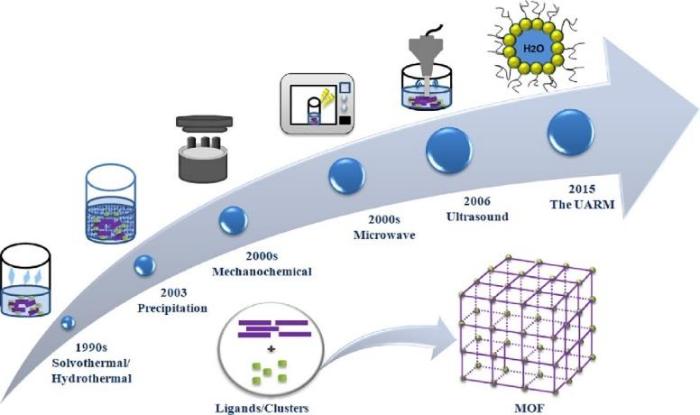
MOFs构筑单元的合成实验条件对这些材料的孔隙率、形态和结晶度产生较大影响[45]。因此,必须仔细选择一种能够调节产品理化特征的合成方法。此外,尤其是在大规模合成的背景下,环境和经济方面至关重要。根据所需的最终用途,可以采用多种合成技术来生产多维MOFs。值得注意的是,与传统的溶剂热合成相比,某些方法(如微波辅助合成和机械化学合成)更加快速和节能,因此它们在工业应用上具有较大的吸引力。微波辅助合成可将反应时间显著缩短至几分钟,而机械化学方法则无需溶剂,从而提高能源效率并且同时减少对环境的影响。用于生产MOFs的合成技术很多,其应用取决于所需的框架和性质。图1展示了MOFs的不同合成方法及时间[46]。
图1
1.3.1 沉积法
沉积合成因其能源效率低和操作安全等优势而备受关注。这种方法的核心在于让配体、金属盐和溶剂充分混合,利用溶剂溶解度和沸点的差异,通过沉淀或结晶生成MOFs,因此无需传统合成所需的高温条件[47]。调整合成参数就能使MOFs的粒径达到纳米尺度。常温下,MOFs的形成与金属源、配体种类、反应物浓度、pH值以及溶剂条件等因素有关。
Lashgari等[48]合成了新的功能性ZIF-67,用来装载腐蚀抑制剂,以此来增强环氧涂层的防腐性能(图2a)。这种ZIF-67纳米颗粒在室温下由钴和2-甲基咪唑制成。同时负载(3-氨基丙基)三乙基硅(APS),研究发现这类ZIF-67纳米颗粒(ZIF-67@APS NPs)可使钢的腐蚀减少81%。Yang等[49]通过一种简便的一锅法在常温下将BTA抑制剂封装到ZIF-8中,进一步通过在水性环氧树脂中引入BTA@ZIF-8@单宁酸(ZBT)构建了具有pH响应能力的亲水性可控释放涂层系统(图2b),该涂层表现出有效的自修复性能。Zhou等[50]在常温下合成ZIF-8,再经两步制得一种智能纳米容器:第一步以ZIF-8为牺牲模板,构建负载BTA的中空介孔二氧化硅颗粒;第二步再用ZIF-8修饰该材料(图2c)。这种纳米容器与环氧基体相容性良好,耐腐蚀性强,且具有突出的自修复能力。Zhao等[51]通过一锅反应合成了GO/MOFs来封装BTA缓蚀剂(GO/ZIF-8在室温下合成),进一步通过将GO/MOF@BTA材料嵌入聚乙烯醇缩丁醛(PVP)中来制造复合聚合物涂层(图2d)。研究表明,该纳米容器同时具备GO和MOFs的有点,因此具有良好的阻隔和吸附性能,这大大提高了PVP涂层的防腐性能。
图2

图2
ZIF-67和ZIF-67@APS纳米材料合成过程[48], ZBT纳米材料合成过程[49], pH响应型HMSN-BTA@ZIF-8合成过程[50]和GO/MOFs纳米容器合成过程[51]的示意图
Fig.2
Schematic diagram of synthesis process of ZIF-67 and ZIF-67 @ APS nanomaterials[48] (a), synthesis process of ZBT nanomaterials[49] (b), synthesis process of pH-responsive HMSN-BTA @ ZIF-8[50] (c) and synthesis process of GO/MOFs nanocontainers[51] (d)
然而,沉淀法也不是缺点全无。其耗时较长,对环境和反应物条件要求比较高,因此不适用于所有MOFs的合成。此外,这类材料在潮湿环境或溶剂中化学稳定性较差,也影响了实际应用。
1.3.2 水热或溶剂热合成
水热法和溶剂热法是制备MOFs最常用的两种方法,其中溶剂热法的使用比例高达70%[52]。水热法指在高于水沸点的温度和高于常压的条件下,有水参与的反应;溶剂热法则采用高沸点有机溶剂,在密闭容器中加热至溶剂沸点以上,利用容器内自生压力进行反应[53]。MOFs的形成受到反应温度梯度、反应物缓慢扩散、溶液分层以及反应物溶液蒸发的支持。水热法和溶剂热法中,溶剂通常需要提供质子氢,并且具有较高的介电常数和极性,因此选择溶剂时要考虑其化学性质。常用溶剂有水、乙醇、甲醇、二甲基亚砜(DMSO)、N,N-二甲基甲酰胺(DMF)、丙酮等[54~59]。使用混合溶剂有助于调节反应物的溶解度[60]。所以,水热或溶剂热法是开发新型MOFs结构的有效手段[61]。
通过水热法,利用不同的金属中心和有机配体,合成了大量用于腐蚀防护的MOFs材料。当基底(金属或合金)表面形成均匀成核位点时,通过水热或溶剂热技术,利用基底和反应溶液中金属阳离子的优势,也可以在基底表面连续形成MOF膜[13]。Zhang等[62]使用双锌源方法,在Zn-Al合金表面直接制得一层致密且疏水的ZIF-90膜,合金表面的锌离子可以为MOF的连续生长提供均匀成核位点。研究表明,这种ZIF-90涂层可以显著提高Zn-Al基体的防腐性能。通过水热或溶剂热法制备MOF基防腐材料的另一种常用方法是合成MOF纳米颗粒,然后将合成的颗粒(例如,填料、容器)用于金属或合金的进一步腐蚀防护。Ramezanzadeh等[63]采用溶剂热法合成了UIO-66、NH2-UIO,以及经甲基丙烯酸缩水甘油酯修饰的NH2-UIO (即GMA@NH2-UIO)等Zr-MOF材料(图3),并用DFT的计算建模和经典MC/MD模块的组合来研究Zr-MOFs的亲和力、界面吸附以及电子结构。作者同时也系统地研究了含Zr-MOFs纳米填料的环氧涂层的金属防腐蚀性能。研究结果证明,Zr离子和有机化合物作为腐蚀抑制剂,并赋予涂层智能的pH敏感控制释放特性和令人满意的力学性能。且填充有GMA@NH2-UIO颗粒的复合环氧涂层(G-UIN/EP)表现出优异的腐蚀防护能力,并表现出极高的缓蚀性能,同时相应的理论计算也验证了配位化合物对受保护的基材具有强吸附力。
图3

1.3.3 电化学合成
电泳沉积法成本低、效率高,而且容易控制膜厚,因此常用于功能涂层的制备[80]。电泳过程中,带电的胶体颗粒在电场作用下移向相反电荷的电极,并沉积在基底表面[81]。Hod等[81]率先采用此法合成了NU-1000、HKUST-1、Al-MIL-53和UiO-66等多种MOF晶体,证明了该方法具有广泛的适用性。然而,与阳极和阴极沉积不同,MOF涂层可以通过金属离子和配体直接获得,而电泳合成是一种两步技术,需要提前制备MOF颗粒。而且MOF颗粒通常具有表面电荷,这是由于MOF缺陷的金属节点和配体缺失以及有机配体存在的自由官能团造成的[79],因此在适当的电场下,可以在图案化基材表面形成MOF涂层。Zhang等[82]在新型La3+掺杂的Ti-MOF(MIL-125-Ti)存在下,在钛植入物上电化学法制备了一种复合涂层,表明该涂层具有理想的抗菌性能和耐腐蚀性。这为创新植入涂层的进展提供了一种新的选择。
电泳沉积方法的合成过程意味着MOF颗粒可以预先进行功能化,在这种情况下,可以容易且高效地制备具有特殊功能的MOF涂层,例如,通过封装腐蚀抑制剂来获得防腐性能。Li等[83]报道了一种混合MOF涂层,该涂层负载有典型的抑制剂十六烷基三甲基溴化铵(CTAB@HKUST-1),通过电泳技术对铜进行腐蚀保护。他们首先通过一锅沉淀法合成了胶体CTAB@HKUST-1材料(图4a),然后通过电泳技术将带电的CTAB@HKUST-1颗粒选择性地沉积在铜表面上,形成有序结构(图4b)。该涂层具有先进的优点,包括疏水性、抑制电解质渗透和高耐腐蚀性。最重要的是,当侵蚀性物质向内迁移时,CTAB的季铵基团可以随着浸泡时间的增加而吸附到金属表面(图4c)。因此,将CTAB缓蚀剂封装到HKUST1晶体中,有助于在缺陷内发挥主动防腐性能,并增强整体涂层的完整性,从而有效地提高涂层耐腐蚀性的持续时间。由此可以推断,电泳沉积可以为扩大MOF涂层在腐蚀防护领域的应用铺平道路,这在研究和实际应用中都具有重要价值。
图4

图4
缓蚀剂掺入的MOF涂层(CTAB-HKUT-1)在铜表面电泳沉积,沉积在铜表面的涂层的表面形态及CTAB@HKUST-1涂层的防腐蚀机理[83]示意图
Fig.4
Schematic diagram of electrophoretic deposition of corrosion inhibitor-incorporated MOF coating (CTAB-HKUT-1) on copper surface (a), coating deposited on the copper surface (left: HKUST-1; right: CTAB @ HKUST-1) (b) and anti-corrosion mechanism of CTAB @ HKUST-1 coating (c)[83]
电化学合成法的优点是显而易见的:(1) 用于MOFs的阳极和阴极沉积等电化学技术非常方便且成本低廉,且高效率。多功能的MOF涂层可以在相对较短的时间内在温和的反应条件下获得,可以有效地避免高温引起的薄膜开裂[79]。(2) 用少量反应物即可形成高密度MOF晶体,也能连续制得MOF薄膜[66]。(3) 电化学方法的局部性质允许形成具有可控厚度的非取向性薄膜,并且基底通常不需要改性[84,85]。然而,不可忽略的是,用于MOFs沉积的电化学技术存在一定的缺点。首先,MOFs的生长被限制在基底的固定区域,这些区域需暴露在溶液中[66]。其次,基底必须是导电材料才能进行电化学沉积,并且因基底表面的电流分布不均匀,通常很难获得均匀的MOF层。第三,由于MOFs的电泳沉积是两步法,因此电化学合成MOFs固有的优点(如更温和的条件和更短的沉积时间)无法体现,并且微裂纹的出现也是不可避免的[79]。当然,由于电泳沉积的两步合成过程,可以通过构建复合MOF结构来最大限度地减少电泳法合成的不连续MOF薄膜结构的问题。电化学沉积法用途广泛、操作简便,因而成为制备MOF涂层的有力手段,可应用于不同领域。因此,通过电化学方法制备的MOF涂层将在未来为金属或合金的腐蚀防护提供更广泛的应用。
1.3.4 声化学合成
声化学合成法简便、成本低且对环境友好,加上操作简单、反应时间短、能耗不高,因此在MOF合成中引起关注[86]。该方法需施加20 kHz~10 MHz的超声辐射,利用液体中气泡的空化效应—即气泡在超声波作用下形成、长大并迅速破裂—来引发分子的化学或物理变化。与传统的水热和溶剂热方法相比,通过声化学合成可以均匀地生成MOFs的成核中心,并大大缩短结晶时间,因此,在过去的几十年中,声化学已被广泛用于合成MOFs,例如HKUST-1[87]、MOF-5[88]、ZIF-8[88]、MOF-177[89]、Fe-MIL-53[90]。据研究报道,可以通过调节超声频率来控制MOFs的排列,并且合成的颗粒表现出较小的粒径[91]。
Mohammadpour等[92]利用声化学技术合成了一种Cu基MOF (Cu-BCT),并将其作为缓蚀剂(2-氨基苯并噻唑(以下简称2-ABT)),以提高Ni二元合金电辅助二氧化硅溶胶-凝胶涂层的防腐性能。研究表明,二氧化硅溶胶-凝胶涂层与溶胶-凝胶@MOF复合涂层相比,后者致密性明显更好。2-ABT缓蚀剂在腐蚀性盐水环境中的释放有效地增强了涂层的耐蚀性,复合涂层在3.5%NaCl溶液中的缓蚀效率约为97%。
1.3.5 微波合成
为了获得用于防腐的取向均匀的MOF涂层,Chen等[102]报道了一种新的合成(110)取向均匀ZIF-7薄膜的方法,即通过微波加热方法(在90 ℃的单模微波炉中进行5 min)进行外延生长。研究表明,单模微波加热可用于制备ZIF-7薄膜,且所得薄膜微观结构良好,能有效防止铝板的腐蚀。该研究为方便制备高质量的MOF薄膜拓展了实验技术,并通过可行的微波合成方法为未来开发新型MOFs防腐材料提供了指导。
微波合成方法的优势主要体现在:(1) 该合成方法加热速度快,合成时间可大大缩短(有时只需要几秒钟),从而呈现出高能效,可以有意义地降低能耗。(2) 关闭微波功率后,合成产物迅速冷却,因此可以精确控制合成过程。(3) 微波合成是一种环境友好的方法,可以大大减少环境污染。然而,微波法也表现出一定的局限性。首先,与传统的热技术相比,微波能源相对昂贵,并且需要先进的设备来产生微波辐射。其次,微波过程通常呈现出较差的再现性,因为这种方法的影响因素较为复杂。需要注意的是,合成产物受到微波功率和频率以及微波场均匀性的显著影响,其中各种器件难以保证相同的条件。微波工艺反应器的材料和尺寸受到限制,因为微波活化受反应器材料的影响,而微波的穿透深度受到吸收介质的限制。
1.3.6 机械化学合成
该合成方法可用于大规模合成,且所得MOFs表现出优异的结晶度和表面积,使其成为各种用途的理想选择,例如气体存储和催化[108]。机械化学方法制备的MOFs在防腐蚀方面的一个重要应用是利用Cu-MOF和氧化石墨烯(GO)创建复合涂层。精确地检验了这种被称为CuMOF/GO的复合材料抑制碳钢腐蚀的能力。在研究中用于电化学实验的3.5%NaCl溶液中,该涂层表现出显著的耐腐蚀性。含有3%Cu-MOF/GO的涂层阻抗值高达23804 Ω·cm2,表现出显著的极化电阻,达到55097 Ω·cm2,即使在浸泡30 d后,也能成功地保护碳钢免受腐蚀。这表明MOF与GO结合可以大大提高涂层的耐腐蚀性,证明了它们在工业应用中预防腐蚀的潜力[109]。
机械化学合成被认为是一种非常快速的合成方法,但它需要工业研磨机来实现量产,容易产生形状不规则的大颗粒。与替代方法相比,结晶度较低。
2 MOFs材料在防腐蚀中的应用
从结构和性能来看,MOFs具备较强的防腐蚀能力。目前其防腐机理仍在探索中,防腐效果取决于金属离子、有机配体、基底类型、复合材料以及腐蚀环境等多种因素。MOFs的纳米材料在抑制剂、纳米填料、纳米容器甚至涂层等方面的多样化设计和改性研究,为实际防腐应用中多样化的需求提供了指导和方法。
2.1 MOFs作为缓蚀剂
在过去的几十年中,已经开发了包括有机和无机缓蚀剂在内的各种缓蚀剂,并应用于金属或合金的腐蚀防护中,这些缓蚀剂能够减缓腐蚀反应速率并减少金属基底的溶解。但无机缓蚀剂(如铬酸盐、硝酸盐衍生物和金属氧化物)的环境毒性以及有机缓蚀剂的低效性极大地限制了其广泛适用性。近年来,MOFs的有机-无机特性和分子与原子层面的可设计性引起了广泛关注,并被用于探索新型缓蚀剂。镧系金属(如稀土)和咪唑或苯并咪唑类衍生物常用作防腐物质,用于金属防护[110~115]。因此,含有这些组分的MOFs (如稀土基或咪唑配体类材料)本身就具备防腐性能。其防腐过程通常是腐蚀性介质进入MOF结构内部,使金属离子与有机配体脱离,进而释放出具有防护作用的成分。
2.1.1 MOFs在酸性环境中的应用
MOFs对酸性环境敏感,遇到酸会快速产生响应。其缓蚀作用主要源于材料本身的超分子结构以及丰富的芳香杂环和π电子体系。以ZIFs为例,晶体中氮杂环官能团和π体系对防腐性能起关键作用。Zafari等[44]制备了ZIF-8@Mo132复合材料,用于盐酸环境中的腐蚀抑制。该材料基于ZIF-8制成,可作为阴极型缓蚀剂,在含Cl-的酸性条件下比单独使用ZIF-8具有更好的抑制效果。同时,含有S、N、O杂原子或π电子的配位型缓蚀剂能吸附于铜表面,可用于铜的防腐。Chen等[116]制造了一种新型的Cu-MOFs作为碳钢的缓蚀剂,表明这些缓蚀剂可以在碳钢表面形成疏水性Cu-MOF薄膜,从而同时阻碍了金属在HCl环境中的阴极和阳极腐蚀过程,并且在50 mg/L Cu-MOF的条件下,抑制效率达到了82.42%。其电化学实验数据及防腐蚀机理如图5所示,从图中可以看出,Cu-MOF主要通过S键吸附在碳钢表面。Etaiw及其同事合成了几种由Ag (I)和含氮配体构成的MOFs,并测试了这几种物质在盐酸溶液中对碳钢和铜的防腐效果[117~121]。Fouda等[122]后续又研究了MOFs对铝腐蚀的抑制效果,主要集中在两种MOFs:未修饰的MOF1和其与TiO2复合的MOF1@TiO2。通过实验测试表明,在1 mol/L HCl溶液中,随着MOFs浓度的增加和温度的降低,这两种MOFs的防腐效率均有所提高。最高效率分别达到88.6%和84.5%。
图5
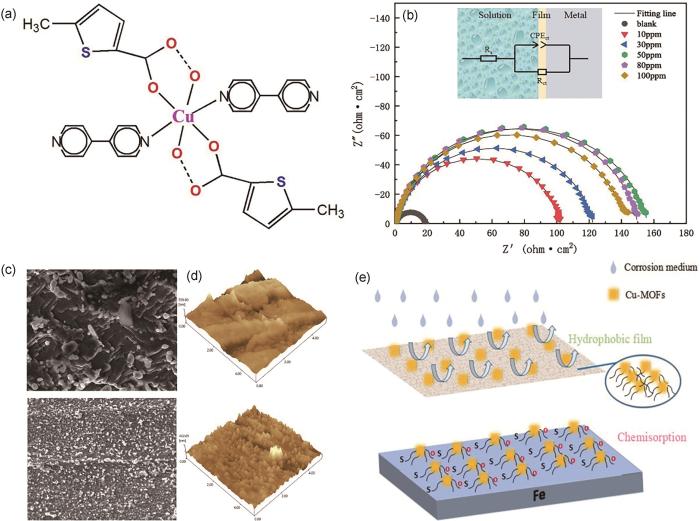
通过实验研究已证实,缓蚀剂可以吸附在金属表面并形成保护膜,从而有效地增强了基材的耐腐蚀性。
2.1.2 MOFs在腐蚀性盐碱环境中的应用
基于MOF缓蚀剂的开发也引起了人们在恶劣盐环境中缓蚀的日益关注。Lashgari等[123]指出,合成的ZIF-67纳米颗粒及其经APS修饰的产物(ZIF-67@APS)在盐溶液中对低碳钢具有明显的缓蚀效果。这种作用来自ZIF-67释放的钴离子和2-甲基咪唑:钴离子与阴极区的OH-发生化学作用,2-甲基咪唑则吸附在阳极区域。Mohamadian-Kalhor等[124]合成了富马酸铝MOF缓蚀剂,用于保护AM60B镁合金在含有0.5 mol/L NaCl的30%乙二醇溶液中的腐蚀,研究表明,在400 mg/L的浓度下,这些MOF缓蚀剂的缓蚀效率可以达到88.35%。Cao等[125]合成了一种ZIF-8衍生物,用作铜的缓蚀剂。实验表明,这种衍生物在铜表面通过物理和化学作用形成疏水膜,能有效阻挡腐蚀物,在最佳浓度下抑制效率达87.5%。Keshmiri等[126]制备的Ce-MOF与氧化石墨烯(GO)的复合材料,可用于增强环氧涂层的防腐性能。其中GO纳米容器装载Ce-MOF作为缓蚀剂,可随缺陷处pH变化而释放。释放后,Ce-MOF的解离和重构能形成致密保护层,从而显著提升环氧涂层的阻挡能力和主动防护能力,对低碳钢表现出很高的防腐效率。在经过7周的腐蚀浸泡实验后,GO@Ce-MOF复合材料表现出优异的屏障性能,其阻抗高达1010 Ω·cm2。复合材料的防腐蚀机理如图6所示。李伟华等[127]发明了一种MOFs缓蚀剂水凝胶复合材料,并将其运用于海水中碳钢防腐蚀,应用表明,该复合材料具有可回收利用、用量低、高灵敏、高辨识度和高选择性的荧光检测,对腐蚀性氯离子Cl-能够进行靶向识别,同时能够对已腐蚀的碳钢进行修复。马骥等[128]发明一种包含负载MOF材料的水滑石纳米粒子,用于海洋工程的防腐,表明其不仅能够有效防护海水的侵蚀,还能抑制海洋中微生物及微生物代谢产物的腐蚀。
图6
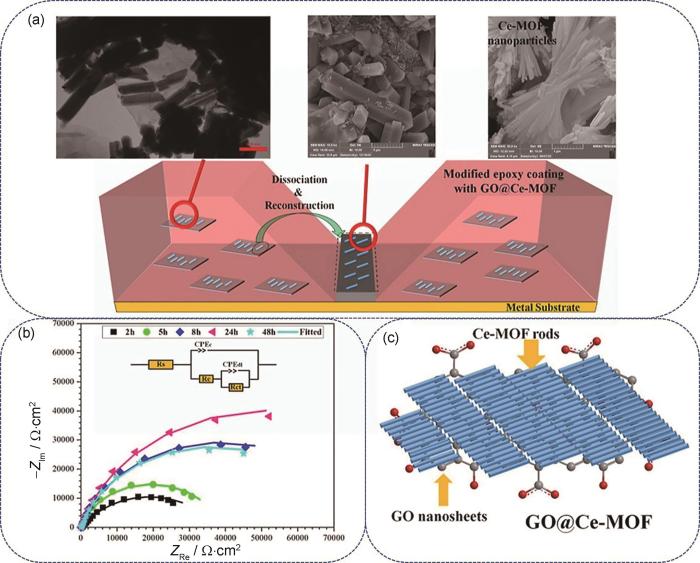
图6
GO@Ce-MOF材料的阻抗及防腐蚀机理[126]
Fig.6
Impedance and corrosion inhibitor mechanism of GO@Ce-MOF materials: (a) The active corrosion inhibition mechanism of the GO@Ce-MOF/EP nanocomposite in the corrosive media, (b) impedance diagram of GO@Ce-MOF/EP coatings immersed in saline solution in various times of immersion, (c) structural diagram of GO@Ce-MOF[126]
总的来说,对基于MOF缓蚀剂的研究为腐蚀防护提供了一个新的研究方向,它主要利用了有机-无机抑制物质的协同效应。
2.2 MOFs作为纳米填料
由无机和有机物质构成的纳米材料,以及金属-有机型纳米材料,常用作混合纳米填料来增强防腐涂层的保护能力[129~132]。已有研究表明,在涂层中加入纳米填料能够改善其阻隔性、抑制效率、热机械性能和长期防护效果[129]。大多数MOFs与无机和有机材料都有良好的相容性,因此制备MOF-聚合物或MOF-无机复合防腐涂层是一个重要的应用方向。MOFs的分子结构具有可设计性,使多数此类材料适合用作防腐复合涂层(聚合物或无机涂层)中的纳米填料,并且通常与涂层基体相容性良好。含有MOFs的聚合物涂层可以结合聚合物的韧性和MOFs的热稳定性等优点,因此可以有效地弥补聚合物的脆性弱点和受限的机械强度以及热机械性能[133,134]。
图7
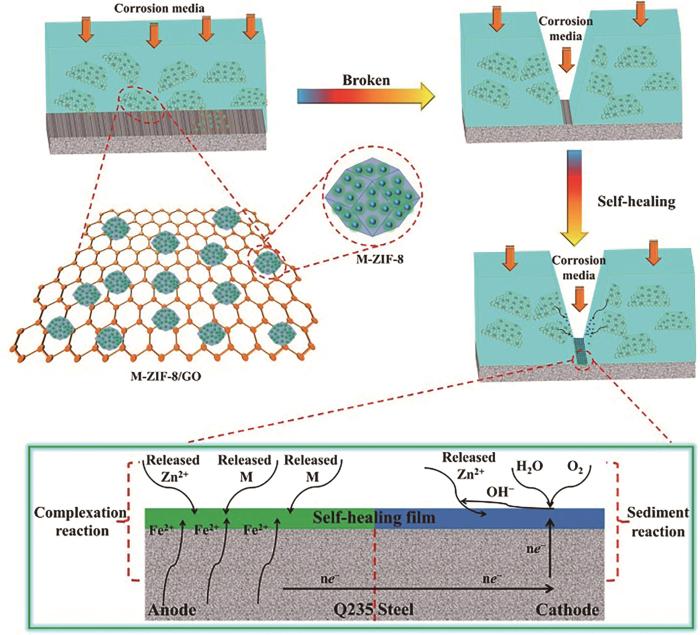
Kumaraguru等[136]合成了三种MOFs,均以均苯三甲酸为配体,金属分别为Cu、Ni和Co。他们在环氧树脂基体中测试了这些MOFs对低碳钢在盐溶液和酸性溶液中的防护效果。防护能力由高到低依次为:Ni-MOF > Co-MOF > Cu-MOF。Ni-MOF填料的高防腐能力主要由于其致密的结构,而具有多孔结构的Cu-MOF不利于抵抗腐蚀性物质。
某些MOFs也在有机-无机杂化涂层中表现出优异的相容性。Tarzanagh等[137]合成了MIL53 (Al) MOF纳米颗粒,并将这些纳米颗粒用作TEOS-GPTMS溶胶-凝胶涂层的纳米填料,用于保护Al 2024合金免受腐蚀。填料在溶胶-凝胶涂层中分散均匀,这显著提高了涂层的热稳定性。在腐蚀性的1哈里森溶液中浸泡24小时后,该复合涂层的耐腐蚀能力明显优于原始溶胶-凝胶涂层,原因在于溶胶-凝胶与MOF填料之间的化学作用形成了致密的SiO2结构。
填料通常被添加到有机涂料中,用来提高涂料的力学性能和耐腐蚀性能。传统的有机填料(例如,酞菁、偶氮、导电聚合物)和无机(例如,锌粉、磷酸锌、金属氧化物)填料在过去几年中已被广泛研究,并且各有优缺点[130,138]。与传统填料相比,MOF纳米填料的结构可调、空隙体积大、活性位点丰富,且易于功能化,因此对无机和有机材料均有良好的亲和力。在这种情况下,MOFs可以与涂层基体很好地匹配。MOF纳米填料自身具有防腐作用(例如含有稀土或咪唑/苯并咪唑衍生物的MOFs),能进一步提升涂层的耐腐蚀性。此外,当MOFs作为纳米填料时,其热稳定性可以补偿涂层的热机械性能,从而有效地提高涂层的机械强度[133]。因此,在涂层材料中加入MOF纳米填料,有助于提高涂层的阻隔效果、抑制效率和热机械性能。例如,MOFs的有机配体有助于与聚合物基体的高度相容性,并且MOFs能够制造有机-无机杂化结构,从而促进其在聚合物中的完全分散[134,139]。然而,MOF纳米填料也存在缺点。首先,MOFs相对复杂的合成增加了制造过程的困难性。第二,也是最重要的,一些MOFs的不稳定性已经在某些环境中被证明是有问题的,并且在长期使用过程中机械稳定性的减弱也需要引起重视。此外,一些MOFs容易随着环境的变化而部分离解,这可能会在涂层基体中产生缺陷和自由体积,从而削弱涂层在长期使用过程中的缓蚀性能[13]。第三,与传统颜料/填料相比,MOFs的成本相对较高,因此限制了其大规模应用。
2.3 MOFs作为纳米容器
当前腐蚀防护领域关注智能防腐材料,其中缓蚀剂的受控释放是一个重要途径。常用的方法是将缓蚀剂装入对环境变化敏感的容器中,当环境条件(如pH、温度或机械损伤)改变时,容器释放缓蚀剂,从而提高防腐效果[140]。MOFs比表面积大、结构可调、功能丰富且活性位点多,适合作为缓蚀剂的纳米容器。由于配位键本身稳定性有限,腐蚀引起的局部pH变化会影响MOF在水性介质中的结构稳定性,因此多数MOFs对pH敏感。
Tian等[143]研究了一种方法,利用ZIF-8作为纳米容器来控制三唑类缓蚀剂ATT的释放,从而防止低碳钢被腐蚀。他们首先合成了ATT缓蚀剂,然后将球磨后的ZIF-8颗粒浸入含有ATT缓蚀剂的甲醇溶液中,从而将ATT负载到MOFs上。实验结果表明,ATT缓蚀剂能够明显影响ZIF-8颗粒的形态,并且ATT@ZIF-8复合材料比简单地使用原始ATT缓蚀剂表现出更好的耐腐蚀性。由于ATT缓蚀剂的释放受到可再生的ZIF-8的控制,这种不溶性薄膜的生长期可以有效地延长,并且薄膜密度可以同时提高。因此,这种ATT@ZIF-8复合材料对低碳钢表现出优异的腐蚀防护能力,抑制效率超过97%。
近年来,人们对用于智能腐蚀防护的多种容器进行了大量的研究,如水滑石(LDH)[145]、埃洛石纳米管(HNT)[146]和介孔SiO2 (MS)[147]。LDH被认为是一种经济且易于制造的容器,因其具有高阴离子交换能力。LDH结构中负载的缓蚀剂与腐蚀性离子发生取代反应,从而促进缓蚀剂的释放,进而减缓腐蚀进程[142]。然而,LDH的负载能力极低,据报道,缓蚀剂的负载能力约为5%~8%[141],因此需要探索提高LDH容器负载能力的方法,以延长其使用寿命。作为一种重要的管状容器,环境友好的HNTs表现出相当大的管径比,并具有较好的热稳定性和机械稳定性,因此在负载缓蚀剂方面引起了广泛关注[148]。然而,HNTs结构中存在的羟基和较大的内部van der Waals力使其难以在有机涂层体系中进行改性和分散[149],这在一定程度上限制了它们的实际应用。MS是一种多孔容器,类似于MOF材料,MS的形态和结构可以通过不同的合成条件(例如,pH、温度、SiO2源)来进行调节。大的比表面积、相当大的空隙体积和灵活的功能化性质是使其成为缓蚀剂容器的主要原因,尤其是在pH依赖性应用中[150]。然而,大多数研究集中在掺杂负载缓蚀剂的MS的有机环氧涂层上,MS纳米容器与涂层基体的相容性需要进一步解决[142]。
与上述纳米容器相比,因MOFs的分子设计性质和可调结构,它们表现出更显著的优势[142]。首先,MOFs的结构和功能可以预先设计用于抑制剂的封装,而且预先设计的MOF纳米容器更能够适应腐蚀性环境。其次,MOFs结构内部的大空间和相当大的比表面积有利于缓蚀剂的负载[151~154],因此可以提高缓蚀剂的负载能力。此外,由于存在额外的空配位点、暴露的缺陷以及MOF功能基团的结合,其独特的表面化学为后续合成处理提供了巨大的机会,因此,腐蚀抑制剂也可以通过配体交换技术接枝到MOF结构中[155]。第三,当MOF用作纳米容器时,其固有的抑制性能也提供了防腐性能。然而,与其他容器相比,MOF纳米容器的主要缺点体现在其相对复杂的结构设计和高成本上。所制造的MOF容器必须在受保护的基材和涂层基体之间表现出令人满意的相容性和粘附性,同时包含适当数量的缓蚀剂,而MOF纳米容器的原材料成本和合成需进一步优化,以实现其实际应用。总而言之,满足修复方法要求的纳米容器和功能涂层的设计和合成是一项精细的任务。
2.4 MOFs作为防护涂层
Liu等[24]报道了一种聚多巴胺(PDA)激发的MOF涂层(ZIF-9,ZIF-90,UiO-66)用于腐蚀防护的方法。PDA层位于基底和MOF之间,能促进MOF涂层的成核与生长。涂层的防腐效果取决于晶体结合程度、结构致密性、表面疏水性以及阻挡腐蚀物的能力,同时晶体尺寸、涂层厚度和基底类型也会影响防护效率。采用PDA辅助制备的UiO-66涂层对铝合金防护效果最佳,腐蚀电流密度低至2.67 × 10⁻⁸ A·cm-2。在3.5%氯化钠溶液中浸泡7天后,薄膜仍能保持良好形态和附着力,表明这种涂层牢固可靠,适合用作防腐涂层。该研究为MOF防腐涂层的开发提供了有益参考,也说明疏水性MOF涂层在腐蚀防护领域具有应用潜力。Zhang等[62]创新性地使用“双锌源”法在Zn-Al合金表面合成了一种ZIF-90涂层,并发现该涂层能显著提高Zn-Al合金的抗腐蚀能力。该涂层由具有致密和完整形态的ZIF-90晶体组成,该涂层的形态表现出捕获大量空气的潜力,因此该涂层呈现出明显的疏水性,水接触角约为112.4°。
上述工作为制备具有良好疏水性的优异MOF基防腐涂层提供了一种新的策略,这对于金属防腐的实际应用具有极其重要的意义。
3 MOFs材料在实际防腐应用中的挑战与展望
尽管MOFs在防腐蚀领域的研究取得显著进展,其在实用化过程中仍面临多重挑战。MOFs合成的复杂性是一个重要挑战。大规模生产由于经常需要精确的参数(如受控的溶剂、压力和温度)而变得更加困难。虽然水热和溶剂热合成等方法在制备高质量MOFs方面取得了成功,但这些方法对于能源和设备的要求极高,使其在大规模商业制造中不切实际。这些程序既费时又费力,大大提高了制造成本而限制了可扩展性。这一经济因素严重阻碍了其更广泛的应用,尤其是在成本敏感型行业中。
关于MOFs在实际操作环境中的长期稳定性和其他性能,也存在一些担忧。尽管实验室研究表明它们对腐蚀的优异防护效果,但仍需进一步研究以确定它们在各种挑战性环境下长期运行的性能。持续暴露于腐蚀性物质可能会削弱MOFs的缓蚀剂释放能力和结构完整性,这可能会降低其长期有效性。因此,长期研究和全面的实地测试是确认其在实际环境中可靠性的必要条件。
为设计能够防止腐蚀的新型MOFs材料,全面掌握MOFs的形成过程及结构特征是至关重要的。某些MOFs,如带有咪唑配体的ZIF,天生具备作为腐蚀抑制剂的潜力,而其他MOFs则可以通过配体交换的方式载入缓蚀剂。多种MOFs适用于一系列防腐蚀应用,并具有不同的腐蚀防护方法。理论计算和模拟有助于理解新型MOFs的形成过程、结构特征以及负载抑制剂的能力。传统方法耗时长、效果有限,借助计算机可以简化防腐材料的设计、制备和筛选过程。建立结构与性能之间的关系,有助于深入了解MOFs的设计及其在防腐方面的应用。
深入了解MOFs的缓蚀机理,有助于优化缓蚀性能,并为其在防腐蚀领域的应用提供理论支撑。通过改变MOFs的孔径大小、表面化学性质等,可以提高其缓蚀性能;也可以将MOFs与其他缓蚀剂结合使用,以实现协同效应,从而提高缓蚀性能,同时可以通过探索MOFs与不同种类缓蚀剂的结合方式,找寻最佳缓蚀剂组合。在设计缓蚀剂协同方案时,需考虑环境因素,如温度、湿度、pH值等,以确保缓蚀剂能够在恶劣的环境中能够保持良好的缓蚀效果。
近年来MOFs在防腐蚀领域的发明专利分析,可以清晰地看出其产业化潜力正在从实验室研究向实际工业应用加速转化。MOFs作为良好的防腐蚀材料,特别适用于海洋工程、航空航天、油气输送等高价值领域,技术附加值高,市场明确;中国企业(如中科院金属所、中海油常州院)已布局相关专利,推动国产化替代。然而,核心原创性专利仍相对不足,其产业化进程仍处于从实验室向中试和初步商业化过渡的关键阶段,潜力巨大但挑战并存。
总而言之,尽管近年来MOF缓蚀剂、MOF纳米填料、功能化MOF纳米容器和防腐MOF涂层的研究日新月异,但MOF基防腐材料仍有很大的发展潜力。在目前阶段,这些MOF基防腐材料仍处于研究阶段,其大规模的实际应用尚未准备好。要满足商业应用对高防腐效率和稳定保护行为的要求,仍然是一个很大的挑战。尽管如此,我们认为比较和研究不同类型的MOFs作为防腐材料的明显优势是有必要的。
4 结论
MOFs凭借其高比表面积、可调控的孔结构、多样的官能团以及良好的负载与释放能力,在缓蚀剂、纳米填料、纳米容器及防护涂层等多个方面展现出显著优势。通过对ZIF-8、MIL系列、UiO-66等典型MOFs在不同腐蚀环境(如酸性介质和盐溶液)中的性能分析,表明其可通过物理屏障、离子释放、pH响应等机制有效延缓金属腐蚀。在制备方法方面,文章详细比较了沉积法、水热/溶剂热法、电化学法、声化学法、微波法及机械化学合成等多种方法的特点及其对MOFs结构与性能的影响。尽管MOFs在防腐蚀应用中表现出巨大潜力,但仍面临稳定性不足、大规模制备困难、成本较高及长期耐久性验证缺乏等挑战。未来研究应致力于通过结构设计、功能化改性及复合材料的开发,进一步提升其缓蚀效率与环境适应性,推动MOF基防腐材料从实验室研究向实际工程应用转化。
参考文献
Active corrosion protection and corrosion sensing in chromate-free organic coatings
[J].
Anticorrosive coatings: A review
[J].
Corrosion-resistant high-entropy alloys: A review
[J].
Corrosion destroys more than three percent of the world’s gross domestic product. Therefore, the design of highly corrosion-resistant materials is urgently needed. By breaking the classical alloy-design philosophy, high-entropy alloys (HEAs) possess unique microstructures, which are solid solutions with random arrangements of multiple elements. The particular locally-disordered chemical environment is expected to lead to unique corrosion-resistant properties. In this review, the studies of the corrosion-resistant HEAs during the last decade are summarized. The corrosion-resistant properties of HEAs in various aqueous environments and the corrosion behavior of HEA coatings are presented. The effects of environments, alloying elements, and processing methods on the corrosion resistance are analyzed in detail. Furthermore, the possible directions of future work regarding the corrosion behavior of HEAs are suggested.
A review of differing approaches used to estimate the cost of corrosion (and their relevance in the development of modern corrosion prevention and control strategies)
[J].To analyze the different approaches used to estimate the cost of corrosion and understand the limitations so as to have proper appropriation in future appraisals.
Research progress and prospects of plant corrosion inhibitors for aluminum
[J].
铝植物缓蚀剂的研究进展与展望
[J].对植物缓蚀剂的研究方法、缓蚀机理和提取方法做了总结,综述了2008年至今酸性、碱性及其它介质中植物缓蚀剂对Al缓蚀作用的研究现状,并对未来植物缓蚀剂的研究方向和重点科学问题进行了展望。
Metal-organic frameworks as potential drug carriers
[J].Nanoparticle-based therapeutics have received increasing attention, as these systems can alleviate many drawbacks of conventional therapy. Metal-organic frameworks (MOFs), a new class of hybrid materials composed of metal ions and organic bridging ligands, have emerged as a promising platform for drug delivery, owing to their high drug loadings, biodegradability, and versatile functionality. The bulk MOF materials can absorb and release large amounts of therapeutics including ibuprofen, procainamide, and nitric oxide. Scale-down of MOFs to the nanoregime yields nanoscale metal-organic frameworks (NMOFs) that are more applicable as delivery vehicles, such as selective delivery of cisplatin prodrugs. Although progress has been made in utilizing NMOFs for drug delivery, many improvements must occur before they can become viable nanotherapeutics.Copyright 2009 Elsevier Ltd. All rights reserved.
Anionic porous metal-organic framework with novel 5-connected vbk topology for rapid adsorption of dyes and tunable white light emission
[J].
Research progress of nanofillers for epoxy anti-corrosion coatings
[J].
纳米填料在环氧防腐涂层中的应用研究进展
[J].
Selective binding and removal of guests in a microporous metal-organic framework
[J].
Reticular synthesis and the design of new materials
[J].
Self-healing mechanisms in smart protective coatings: A review
[J].
One-step room-temperature synthesis of metal (IV) carboxylate metal—organic frameworks
[J].
Inhibition behavior of a Nano-corrosion inhibitor capsule prepared from MOFs and BTA for copper
[J].
一种基于MOFs与BTA的纳米缓蚀胶囊对铜的缓蚀行为研究
[J].通过水热法合成了结构立体、具有明显孔道结构的MOF-5。进一步通过负压法将苯并三氮唑负载进MOF-5形成BTA@MOF缓蚀胶囊。采用TEM、SEM、FT-IR、XRD以及电化学测试等手段对BTA@MOF的结构以及缓蚀性能进行表征评价。结果表明:缓蚀剂分子成功负载进MOF-5内部孔道,制备的缓释剂胶囊具有缓慢释放的特性,能够有效抑制铜的腐蚀。
Electrochemical film deposition of the zirconium metal-organic framework UiO-66 and application in a miniaturized sorbent trap
[J].
Microwave-assisted hydrothermal synthesis of MOFs-derived bimetallic CuCo-N/C electrocatalyst for efficient oxygen reduction reaction
[J].
ZIF-8: A comparison of synthesis methods
[J].
Real-time and in situ monitoring of mechanochemical milling reactions
[J].
Research progress of metal-organic frameworks in the field of metal anticorrosion
[J].
金属有机骨架材料在金属防腐蚀领域的研究进展
[J].
Construction of Mg-doped ZnO/g-C3N4@ZIF-8 multi-component catalyst with superior catalytic performance for the degradation of illicit drug under visible light
[J].
Fluorescent lanthanide metal-organic framework for rapid and ultrasensitive detection of methcathinone in human urine
[J].
Core-shell inorganic NP@ MOF nanostructures for targeted drug delivery and multimodal imaging-guided combination tumor treatment
[J].
Synthesis, characterization, and selective gas adsorption performance of hybrid NH2-MIL-101(Fe)/ZIF-8 metal organic framework (MOF)
[J].
Metal-organic frameworks for high charge-discharge rates in lithium-sulfur batteries
[J].We report a new method to promote the conductivities of metal-organic frameworks (MOFs) by 5 to 7 magnitudes, thus their potential in electrochemical applications can be fully revealed. This method combines the polarity and porosity advantages of MOFs with the conductive feature of conductive polymers, in this case, polypyrrole (ppy), to construct ppy-MOF compartments for the confinement of sulfur in Li-S batteries. The performances of these ppy-S-in-MOF electrodes exceed those of their MOF and ppy counterparts, especially at high charge-discharge rates. For the first time, the critical role of ion diffusion to the high rate performance was elucidated by comparing ppy-MOF compartments with different pore geometries. The ppy-S-in-PCN-224 electrode with cross-linked pores and tunnels stood out, with a high capacity of 670 and 440 mAh g at 10.0 C after 200 and 1000 cycles, respectively, representing a new benchmark for long-cycle performance at high rate in Li-S batteries.© 2018 Wiley-VCH Verlag GmbH & Co. KGaA, Weinheim.
Probe into metal-organic framework membranes fabricated via versatile polydopamine-assisted approach onto metal surfaces as anticorrosion coatings
[J].
Establishing microporosity in open metal-organic frameworks: Gas sorption isotherms for Zn(BDC) (BDC = 1,4-benzenedicarboxylate)
[J].
Sustainable and shaped synthesis of MOF composites using PET waste for efficient phosphate removal
[J].Schematic illustration of the sustainable synthesis of different MOFs using PET waste and the shaping of Fe-MOF into Fe-MOF@PET composite chips for efficient recovery and recycling processes after the removal of phosphate from water.
Asymmetric pore windows in MOF membranes for natural gas valorization
[J].
Lanthanide-organic framework nanothermometers prepared by spray-drying
[J].
In situ electrochemical deposition of compact metal-organic framework thin films for high-resolution X-ray imaging
[J].
Disordered and defective semi-crystalline Fe-MOF as a high-power and high-energy anode material for lithium-ion batteries
[J].
Aluminum-fumarate based MOF: A promising environmentally friendly adsorbent for the removal of phosphate
[J].
High methane storage capacity in aluminum metal-organic frameworks
[J].The use of porous materials to store natural gas in vehicles requires large amounts of methane per unit of volume. Here we report the synthesis, crystal structure and methane adsorption properties of two new aluminum metal-organic frameworks, MOF-519 and MOF-520. Both materials exhibit permanent porosity and high methane volumetric storage capacity: MOF-519 has a volumetric capacity of 200 and 279 cm(3) cm(-3) at 298 K and 35 and 80 bar, respectively, and MOF-520 has a volumetric capacity of 162 and 231 cm(3) cm(-3) under the same conditions. Furthermore, MOF-519 exhibits an exceptional working capacity, being able to deliver a large amount of methane at pressures between 5 and 35 bar, 151 cm(3) cm(-3), and between 5 and 80 bar, 230 cm(3) cm(-3).
Modular chemistry: Secondary building units as a basis for the design of highly porous and robust metal-organic carboxylate frameworks
[J].
Tuning the supramolecular isomerism of MOF-74 by controlling the synthesis conditions
[J].Supramolecular isomerism of metal-organic frameworks (MOFs) is known for several MOF structures, having direct implications on the properties of these materials. Although the synthesis of MOF isomers is mainly serendipitous in nature, achieving controlled formation of a target framework is highly relevant for practical applications. This work discusses the influence of additives and synthesis conditions on the formation of porous isomers containing Zn as nodes and 2,5-dihydroxy-1,4-benzenedicarboxylate (dobdc) as a linker. Using solvent mixtures containing strongly coordinated molecules, e.g. N,N'-dimethylformamide (DMF) and N-methylpyrrolidone (NMP), facilitates the formation of porous structures of type [Zn(dobdc)(S)]·yS (S = DMF, NMP) which are built from dinuclear Zn(O)(CO) secondary building units (SBUs) consisting of two different edge-sharing polyhedra with the Zn ions in a unsaturated coordinative environment. In the presence of water, the Zn dimers are converted to one-dimensional infinite Zn chains, in which the number of Zn-linker bonds increases, therefore giving a hydrolytically more stable coordination environment. The full characterization of the isomers as well as their conversion to the most stable isomer is presented.
Colloidal metal-organic framework particles: The pioneering case of ZIF-8
[J].The production of metal-organic frameworks (MOFs) in the form of colloids has brought a paradigm shift in the design of new functional porous materials. Along with their intrinsic interest as porous solids, and contrary to their bulk powder counterparts, colloidal MOF particles can additionally be dispersed, shaped, functionalized, transformed and assembled in a controlled manner, conferring them further properties and applications. In this regard, zeolitic imidazolate framework-8 (ZIF-8) has become a pioneering MOF constituent of colloidal science. Today, the understanding of the role of synthetic parameters, learned after one decade of research, enables the production of monodisperse colloidal ZIF-8 particles with tunable dimensions and morphologies, offering the opportunity to develop new functional materials and composites with novel and promising functionalities. This tutorial review provides a useful guide to prepare ZIF-8 in its colloidal form, covering the published studies on the synthesis of homogeneous ZIF-8 particles with controlled size and shape. In addition, we present the most relevant advances in the development of colloidal ZIF-8 hybrid single-particles, reflecting the great potential and rapid development of this interdisciplinary research field. Finally, we highlight how formulation of ZIF-8 as colloids has led to the emergence of novel physicochemical phenomena that are useful for practical applications. This review aims at promoting the development of MOFs as colloids, taking ZIF-8 as a pioneering and successful case that clearly shows the benefits of bridging MOF chemistry and colloidal science.
Introduction to metal-organic frameworks
[J].
Metal-Organic Frameworks assembled from tetraphosphonic ligands and lanthanides
[J].
A tetradentate phosphonate ligand-based Ni-MOF as a support for designing high-performance proton-conducting materials
[J].
Porous metal phosphonate frameworks: Construction and physical properties
[J].
Metal-organic frameworks: A new class of porous materials
[J].
Balancing volumetric and gravimetric uptake in highly porous materials for clean energy
[J].A huge challenge facing scientists is the development of adsorbent materials that exhibit ultrahigh porosity but maintain balance between gravimetric and volumetric surface areas for the onboard storage of hydrogen and methane gas-alternatives to conventional fossil fuels. Here we report the simulation-motivated synthesis of ultraporous metal-organic frameworks (MOFs) based on metal trinuclear clusters, namely, NU-1501-M (M = Al or Fe). Relative to other ultraporous MOFs, NU-1501-Al exhibits concurrently a high gravimetric Brunauer-Emmett-Teller (BET) area of 7310 m g and a volumetric BET area of 2060 m cm while satisfying the four BET consistency criteria. The high porosity and surface area of this MOF yielded impressive gravimetric and volumetric storage performances for hydrogen and methane: NU-1501-Al surpasses the gravimetric methane storage U.S. Department of Energy target (0.5 g g) with an uptake of 0.66 g g [262 cm (standard temperature and pressure, STP) cm] at 100 bar/270 K and a 5- to 100-bar working capacity of 0.60 g g [238 cm (STP) cm] at 270 K; it also shows one of the best deliverable hydrogen capacities (14.0 weight %, 46.2 g liter) under a combined temperature and pressure swing (77 K/100 bar → 160 K/5 bar).Copyright © 2020 The Authors, some rights reserved; exclusive licensee American Association for the Advancement of Science. No claim to original U.S. Government Works.
Metal-organic framework materials with ultrahigh surface areas: Is the sky the limit?
[J].We have synthesized, characterized, and computationally simulated/validated the behavior of two new metal-organic framework (MOF) materials displaying the highest experimental Brunauer-Emmett-Teller (BET) surface areas of any porous materials reported to date (~7000 m(2)/g). Key to evacuating the initially solvent-filled materials without pore collapse, and thereby accessing the ultrahigh areas, is the use of a supercritical CO(2) activation technique. Additionally, we demonstrate computationally that by shifting from phenyl groups to "space efficient" acetylene moieties as linker expansion units, the hypothetical maximum surface area for a MOF material is substantially greater than previously envisioned (~14600 m(2)/g (or greater) versus ~10500 m(2)/g).
Coordination polymers of Co(NCS)2 with Pyrazine and 4,4‘-bipyridine: Syntheses and structures
[J].
New MOF-based corrosion inhibitor for carbon steel in acidic media
[J].
Synthesis of metal-organic frameworks (MOFs): Routes to various MOF topologies, morphologies, and composites
[J].
Investigation of metal-organic frameworks (MOFs): Synthesis, properties, and applications - an in-depth review
[J].
Recent advances of metal-organic frameworks in corrosion protection: From synthesis to applications
[J]
Application of nanoporous cobalt-based ZIF-67 metal-organic framework (MOF) for construction of an epoxy-composite coating with superior anti-corrosion properties
[J].
A pH-responsive hydrophilic controlled release system based on ZIF-8 for self-healing anticorrosion application
[J].
Epoxy composite coating with excellent anticorrosion and self-healing performances based on multifunctional zeolitic imidazolate framework derived nanocontainers
[J].
Coatings embedded with GO/MOFs nanocontainers having both active and passive protecting properties
[J].
Crystalline metal-organic frameworks (MOFs): Synthesis, structure and function
[J].
Hydrothermal processing of materials: Past, present and future
[J].
Solvothermal growth of Mg-MOF-74 films on carboxylic functionalized silicon substrate using acrylic acid
[J].
Controlled syntheses of Mg-MOF-74 nanorods for drug delivery
[J].
Solvothermal synthesis of flower-string-like NiCo-MOF/MWCNT composites as a high-performance supercapacitor electrode material
[J].
The growth of high density network of MOF nano-crystals across macroporous metal substrates-Solvothermal synthesis versus rapid thermal deposition
[J].
Yolk-shell Fe3O4@MOF-5 nanocomposites as a heterogeneous Fenton-like catalyst for organic dye removal
[J].
Solvothermal preparation of an electrocatalytic metalloporphyrin MOF thin film and its redox hopping charge-transfer mechanism
[J].A thin film of a metalloporphyrin metal-organic framework consisting of [5,10,15,20-(4-carboxyphenyl)porphyrin]Co(III) (CoTCPP) struts bound by linear trinuclear Co(II)-carboxylate clusters has been prepared solvothermally on conductive fluorine-doped tin oxide substrates. Characterization of this mesoporous thin film material, designated as CoPIZA/FTO, which is equipped with large cavities and access to metal active sites, reveals an electrochemically active material. Cyclic voltammetry displays a reversible peak with E(1/2) at -1.04 V vs ferrocyanide attributed to the (Co(III/II)TCPP)CoPIZA redox couple and a quasi-reversible peak at -1.45 V vs ferrocyanide, which corresponds to the reduction of (Co(II/I)TCPP)CoPIZA. Analysis of the spectroelectrochemical response for the (Co(II/I)TCPP)CoPIZA redox couple revealed non-Nernstian reduction with a nonideality factor of 2 and an E(1/2) of -1.39 V vs ferrocyanide. The film was shown to retain its structural integrity with applied potential, as was demonstrated spectroelectrochemically with maintenance of isosbestic points at 430, 458, and 544 nm corresponding to the (Co(III/II)TCPP)CoPIZA transition and at 390 and 449 nm corresponding to the (Co(II/I)TCPP)CoPIZA transition. The mechanism of charge transport through the film is proposed to be a redox hopping mechanism, which is supported by both cyclic voltammetry and spectroelectrochemistry. A fit of the time-dependent spectroelectrochemical data to a modified Cottrell equation gave an apparent diffusion coefficient of 7.55 (±0.05) × 10(-14) cm(2)/s for ambipolar electron and cation transport throughout the film. Upon reduction of the metalloporphyrin struts to (Co(I)TCPP)CoPIZA, the CoPIZA thin film demonstrated catalytic activity for the reduction of carbon tetrachloride.
A critical review in recent developments of metal-organic-frameworks (MOFs) with band engineering alteration for photocatalytic CO2 reduction to solar fuels
[J].
Synthesis of metal-organic frameworks: A mini review
[J].
Preparation and corrosion resistance of hydrophobic zeolitic imidazolate framework (ZIF-90) film @Zn-Al alloy in NaCl solution
[J].
Development of an active/barrier bi-functional anti-corrosion system based on the epoxy nanocomposite loaded with highly-coordinated functionalized zirconium-based nanoporous metal-organic framework (Zr-MOF)
[J].
Electrochemical synthesis of flower shaped morphology MOFs in an ionic liquid system and their electrocatalytic application to the hydrogen evolution reaction
[J].
Facile directions for synthesis, modification and activation of MOFs
[J].
MOF positioning technology and device fabrication
[J].Metal organic frameworks (MOFs) offer the highest surface areas per gram of any known material. As such, they epitomise resource productivity in uses where specific surface area is critical, such as adsorption, storage, filtration and catalysis. However, the ability to control the position of MOFs is also crucial for their use in devices for applications such as sensing, delivery, sequestration, molecular transport, electronics, energy production, optics, bioreactors and catalysis. In this review we present the current technologies that enable the precise positioning of MOFs onto different platforms. Methods for permanent localisation, dynamic localisation, and spatial control of functional materials within MOF crystals are described. Finally, examples of devices in which the control of MOF position and functionalisation will play a major technological role are presented.
Metal-organic frameworks-prospective industrial applications
[J].
Electrochemical synthesis of thin HKUST-1 layers on copper mesh
[J].
High pressure, high temperature electrochemical synthesis of metal-organic frameworks: Films of MIL-100 (Fe) and HKUST-1 in different morphologies
[J].
Electrochemical synthesis, characterization of Ir-Zn containing coordination polymer, and application in oxygen and glucose sensing
[J].
Electrochemical synthesis of some archetypical Zn2+, Cu2+, and Al3+ metal organic frameworks
[J].
Mechanical properties of electrochemically synthesised metal-organic framework thin films
[J].
Electrochemical fabrication of metal-organic frameworks membranes and films: A review
[J].
Reductive electrosynthesis of crystalline metal-organic frameworks
[J].Electroreduction of oxoanions affords hydroxide equivalents that induce selective deposition of crystalline metal-organic frameworks (MOFs) on conductive surfaces. The method is illustrated by cathodic electrodeposition of Zn(4)O(BDC)(3) (MOF-5; BDC = 1,4-benzenedicarboxylate), which is deposited at room temperature in only 15 min under cathodic potential. Although many crystalline phases are known in the Zn(2+)/BDC(2-) system, MOF-5 is the only observed crystalline MOF phase under these conditions. This fast and mild method of synthesizing MOFs is amenable to direct surface functionalization and could impact applications requiring conformal coatings of microporous MOFs, such as gas separation membranes and electrochemical sensors.
One step cathodically electrodeposited [Tb2(BDC)3(H2O)4] n thin film as a luminescent probe for Cu2+ detection
[J].
An electrodeposited lanthanide MOF thin film as a luminescent sensor for carbonate detection in aqueous solution
[J].
A copper(Ⅱ)-based MOF film for highly efficient visible-light-driven hydrogen production
[J].
Selective formation of biphasic thin films of metal-organic frameworks by potential-controlled cathodic electrodeposition
[J].
Electrochemical deposition of metal-organic framework films and their applications
[J].
Electrophoretic deposition of metal-organic framework derived porous copper oxide anode for lithium and sodium ion rechargeable cells
[J].
Directed growth of electroactive metal-organic framework thin films using electrophoretic deposition
[J].
A novel La3+ doped MIL spherical analogue used as antibacterial and anticorrosive additives for hydroxyapatite coating on titanium dioxide nanotube array
[J].
Excellent efficacy of MOF films for bronze artwork conservation: The key role of HKUST-1 film nanocontainers in selectively positioning and protecting inhibitors
[J].
Metal-organic framework thin films: Electrochemical fabrication techniques and corresponding applications & perspectives
[J].
Preparation of a ZIF-67 derived thin film electrode via electrophoretic deposition for efficient electrocatalytic oxidation of vanillin
[J].The electrophoretic deposition method is employed to deposit uniform metal organic framework thin films. ZIF-67 particles dispersed in isopropanol move to a cathode as an electric field is applied on two conducting glass electrodes, the uniform ZIF-67 thin film can be formed on the conducting glass substrate. As the deposition time is fixed at 1 min, the prepared film thickness can be adjusted from 1.0 to 7.0 μm by applying different electric fields from 20 to 60 V·cm. The deposited ZIF-67 thin film is further converted into porous CoS thin films by the vulcanization with S powder. The porous thin films vulcanized at different temperatures are characterized by the measurements of scanning electron microscope, X-ray photoelectron spectroscopy, X-ray powder diffraction, high resolution transmission electron microscopy, and Fourier transform infrared spectra. The prepared porous CoS thin films are used as the thin film electrode to catalyze the degradation of vanillin. The CoS thin film vulcanized at 500 °C shows better catalytic performance than the bare glassy carbon electrode and the electrodes vulcanized at other temperatures. The electrocatalytic degradation enhancement mechanism is analyzed by the measurements of Tafel curves and electrochemical impedance spectroscopies. It can be developed as a feasible method for the electrocatalytic detection of vanillin.
Metal organic frameworks (MOFs) and ultrasound: A review
[J].Metal-organic frameworks (MOFs) have received a lot of attention due to their unique properties and abundant functionalities. Permanent porosity and high surface area are just a few traits that have made them attractive to researchers. They can be prepared as task-specific materials by exploiting the functional group variety and tuning their size and geometry. The main purpose of this review is to present an alternative method of preparing MOF crystals and underline the advantages of ultrasound assisted (sonochemical) synthesis. State of the art ultrasound assisted techniques for the preparation of MOFs in nanoscale are presented. Optimization of morphology and particle size is highlighted throughout this work, as we discuss the effects of various factors, such as energy input, reagent concentration, adequate solvents, reaction time and more.Copyright © 2018 Elsevier B.V. All rights reserved.
Particle size studies to reveal crystallization mechanisms of the metal organic framework HKUST-1 during sonochemical synthesis
[J].Systematic studies of key operating parameters for the sonochemical synthesis of the metal organic framework (MOF) HKUST-1(also called CuBTC) were performed including reaction time, reactor volume, sonication amplitude, sonication tip size, solvent composition, and reactant concentrations analyzed through SEM particle size analysis. Trends in the particle size and size distributions show reproducible control of average particle sizes between 1 and 4μm. These results along with complementary studies in sonofragmentation and temperature control were conducted to compare these results to kinetic crystal growth models found in literature to develop a plausible hypothetical mechanism for ultrasound-assisted growth of metal-organic-frameworks composed of a competitive mechanism including constructive solid-on-solid (SOS) crystal growth and a deconstructive sonofragmentation.Copyright © 2016 Elsevier B.V. All rights reserved.
Sonochemical fabrication of Cu(II) and Zn(II) metal-organic framework films on metal substrates
[J].
Facile synthesis of MOF-177 by a sonochemical method using 1-methyl-2-pyrrolidinone as a solvent
[J].High quality MOF-177 crystals in the size range of 5-20 microm were successfully synthesized via a sonochemical route in a substantially reduced synthesis time (40 min) in the presence of low-cost NMP (1-methyl-2-pyrrolidone) as a solvent. Microwave heating in NMP also produced MOF-177 under similar conditions (35 min, 5-50 microm) but exhibited inferior crystallinity. In comparison, a conventional solvothermal route in DEF (diethylformamide) took 48 h to produce MOF-177 crystals 0.5-1.5 mm in size. The BET surface areas of the MOF-177 samples decreased in the order of sonochemical (4898 m(2) g(-1)) > conventional (4833 m(2) g(-1)) > microwave route (4197 m(2) g(-1)). In line with this trend, MOF-177 prepared via the sonochemical route resulted in the highest CO(2) adsorption capacity, 1315 mg g(-1) at 30 bar and 298 K. The product yield of MOF-177 synthesized via the sonochemical route was 95.6%, and was significantly higher than the product yields of other methods.
Synthesis of a metal-organic framework material, iron terephthalate, by ultrasound, microwave, and conventional electric heating: A kinetic study
[J].
Control of catenation in CuTATB-n metal-organic frameworks by sonochemical synthesis and its effect on CO2 adsorption
[J].
The role of embedded 2-ABT@Cu-BTC MOF on the anti-corrosion performance of electro-assisted deposited silica sol-gel composite film
[J].
Synthesis of metal-organic frameworks (MOFs) with microwave or ultrasound: Rapid reaction, phase-selectivity, and size reduction
[J].
Realising the environmental benefits of metal-organic frameworks: Recent advances in microwave synthesis
[J].
Microwave-assisted synthesis of honeycomblike hierarchical spherical Zn-doped Ni-MOF as a high-performance battery-type supercapacitor electrode material
[J].
Synthesis and characterization of nano-sized metal organic framework-5 (MOF-5) by using consecutive combination of ultrasound and microwave irradiation methods
[J].Nano-sized metal organic framework-5 (MOF-5) was prepared in the presence of triethylamine (TEA) via consecutive combination of ultrasound (US) and microwave irradiation (MW) methods by exploiting the benefit of obtaining MOF-5 in very short reaction times (similar to 2 min) and high yields (similar to 95%). The surface area of MOF-5 was found to be 1203 m(2)/g. The highly crystalline structure of nano-sized MOF-5 was confirmed by XRD. Vibrational modes and thermal decomposition behavior of nano-sized MOF-5 were verified from ATR FT-IR and TGA results, respectively. Based on SEM and AFM results, MOF-5 nanoparticles are spherical in shape, and their sizes vary in the range of 20-80 nm. The high purity of nanosized MOF-5 was confirmed by XRD and EDS results. A very regular and homogenous distribution of MOF-5 nanoparticles with a size range of 20-30 nm within poly(ethylene oxide) (PEO) electrolyte was clearly observed from SEM results. The reason behind size reduction and homogenous distribution of nano-sized MOF-5 was stated as the elimination of any possible aggregation of MOF-5 nanoparticles due to favorable physical interactions between PEO and surface functional groups of MOF-5 during the solution casting process.
Facile microwave synthesis of zirconium metal-organic framework thin films on gold and silicon and application to sensor functionalization
[J].
Microwave-assisted synthesis of zirconium-based metal organic frameworks (MOFs): Optimization and gas adsorption
[J].
Microwave synthesis and characterization of MOF-74 (M = Ni, Mg) for gas separation
[J].
One pot microwave synthesis of MCM-41/Cu based MOF composite with improved CO2 adsorption and selectivity
[J].
Microwave enhanced synthesis of MOF-5 and its CO2 capture ability at moderate temperatures across multiple capture and release cycles
[J].
Facile fabrication of a highly (110)-oriented ZIF-7 film with rod-shaped seeds
[J].
Nano-sized metal-organic frameworks: Synthesis and applications
[J].
Microwave activation as an alternative production of metal-organic frameworks
[J].
Mechanochemistry: Opportunities for new and cleaner synthesis
[J].The aim of this critical review is to provide a broad but digestible overview of mechanochemical synthesis, i.e. reactions conducted by grinding solid reactants together with no or minimal solvent. Although mechanochemistry has historically been a sideline approach to synthesis it may soon move into the mainstream because it is increasingly apparent that it can be practical, and even advantageous, and because of the opportunities it provides for developing more sustainable methods. Concentrating on recent advances, this article covers industrial aspects, inorganic materials, organic synthesis, cocrystallisation, pharmaceutical aspects, metal complexes (including metal-organic frameworks), supramolecular aspects and characterization methods. The historical development, mechanistic aspects, limitations and opportunities are also discussed (314 references).This journal is © The Royal Society of Chemistry 2012
Mechanochemical synthesis of metal-organic frameworks: A fast and facile approach toward quantitative yields and high specific surface areas
[J].
Insights into the mechanochemical synthesis of MOF-74
[J].Mechanochemical synthesis has recently emerged as a scalable "green" approach for the preparation of MOFs, but current understanding of the underlying reaction mechanisms is limited. In this work, an investigation of the reaction pathway of the mechanochemical synthesis of MOF-74 from ZnO and 2,5-dihydroxyterephthalic acid (HHDTA), using DMF as a liquid additive, is presented. The complex reaction pathway involves the formation of four short-lived intermediate phases, prior to the crystallization of MOF-74. The crystal structures of three of these intermediates have been determined using a combination of single-crystal and powder X-ray diffraction methods and are described here. The initial stages of the reaction are very fast, with a DMF solvate of HHDTA forming after only 2 min of milling. This is followed by crystallization, after only 4 min of milling, of a triclinic one-dimensional coordination polymer, Zn(HDHTA)(DMF)(HO), which converts into a monoclinic polymorph on additional milling. Highly crystalline MOF-74 appears after prolonged milling, for at least 70 min.© 2021 The Authors. Published by American Chemical Society.
Rapid mechanochemical synthesis of metal-organic frameworks using exogenous organic base
[J].
Synthesis of MOFs/GO composite for corrosion resistance application on carbon steel
[J].Two unreported metal-organic frameworks [Cu(6-Me-2,3-pydc)(1,10-phen)·7HO] (namely Cu-MOF) and [Mn(2,2'-bca)(HO)] (namely Mn-MOF) were synthesized by a solvothermal method and their structures were characterized and confirmed by elemental analysis, X-ray single crystal diffraction, Fourier infrared spectroscopy and thermogravimetric analysis. Cu-MOF/graphene (Cu-MOF/GR), Cu-MOF/graphene oxide (Cu-MOF/GO), Mn-MOF/graphene (Mn-MOF/GR) and Mn-MOF/graphene oxide (Mn-MOF/GO) composite materials were successfully synthesized by a solvothermal method and characterized and analyzed by PXRD, SEM and TEM. In order to study the corrosion inhibition properties of the Cu-MOF/GR, Cu-MOF/GO, Mn-MOF/GR and Mn-MOF/GO composite materials on carbon steel, they were mixed with waterborne acrylic varnish to prepare a series of composite coatings to explore in 3.5 wt% NaCl solution by electrochemical measurements and results showed that the total polarization resistance of the 3% Cu-MOF/GO and 3% Mn-MOF/GO composite coatings on the carbon steel surface were relatively large, and were 55 097 and 55 729 Ω cm, respectively, which could effectively protect the carbon steel from corrosion. After immersion for 30 days, the 3% Mn-MOF/GO composite still maintained high corrosion resistance, the || values were still as high as 23 804 Ω cm. Therefore, MOFs compounded with GO can produce a synergistic corrosion inhibition effect and improve the corrosion resistance of the coating; this conclusion is well confirmed by the adhesion capability test.This journal is © The Royal Society of Chemistry.
Novel benzimidazole derivatives as corrosion inhibitors of mild steel in the acidic media. Part I: Gravimetric, electrochemical, SEM and XPS studies
[J].
Ceria nanoparticles vis-à-vis cerium nitrate as corrosion inhibitors for silica-alumina hybrid sol-gel coating
[J].
Epoxy-polyamide nanocomposite coating with graphene oxide as cerium nanocontainer generating effective dual active/barrier corrosion protection
[J].
Corrosion protection mechanism of Ce4+/organic inhibitor for AA2024 in 3.5%NaCl
[J].
Synergism of imidazoline and sodium dodecylbenzenesulphonate inhibitors on corrosion inhibition of X52 carbon steel in CO2-saturated chloride solutions
[J].
Designing a non-hazardous nano-carrier based on graphene oxide@Polyaniline-Praseodymium (III) for fabrication of the Active/Passive anti-corrosion coating
[J].
Preparation of Cu-MOFs and its corrosion inhibition effect for carbon steel in hydrochloric acid solution
[J].
Structure, characterization and inhibition activity of new metal-organic framework
[J].
Metal-organic frameworks based on silver (I) and nitrogen donors as new corrosion inhibitors for copper in HCl solution
[J].
Structure, characterization and anti-corrosion activity of the new metal-organic framework [Ag(qox)(4-ab)]
[J].
Cluster type molecule as novel corrosion inhibitor for steel in HCl solution
[J].
A new metal-organic framework based on cadmium thiocyanate and 6-methylequinoline as corrosion inhibitor for copper in 1 M HCl solution
[J].
Experimental and theoretical studies of the efficiency of metal-organic frameworks (MOFs) in preventing aluminum corrosion in hydrochloric acid solution
[J].Aluminum corrosion inhibitors "{[CuI (CN)(phen) CuII (CN)(phen)]5HO},(MOF1) and {[CuI(CN)(phen)CuII(CN)(phen)]5HO}@TiO (MOF1@TiO) were studied in one molar HCl solution". The ML results for three different temperatures (25-45 °C) were compared with the results of PDP and EIS analyses. The adsorption of inhibitors on Al surfaces has been calculated and discussed by a Langmuir isotherm. The inhibitors that were created showed great effectiveness, with a noticeable increase in their inhibitory efficiency as the dosage was raised and the temperature was lowered. Inhibition efficiency each amounted to 88.6%, 84.5% at 400 ppm and 25 °C for MOF1@TiO and MOF1, respectively. Analyzing the polarization curves of synthesized inhibitors revealed that they were mixed-type inhibitors. Al was found to be surface inhibited when coated with a thin film of inhibitors, and "Al's surface morphology was assessed by different techniques such as scanning electron microscopy (SEM), energy dispersive X-ray (EDX) and atomic force microscope (AFM)". "Theoretical models like quantum chemical and molecular dynamics simulation authenticated the experimental observation". The MOFs exhibit exceptional corrosion resistance against Al when exposed to acidic environments, according to several tests.© 2024. The Author(s).
Unique 2-methylimidazole based Inorganic Building Brick nano-particles (NPs) functionalized with 3-aminopropyltriethoxysilane with excellent controlled corrosion inhibitors delivery performance; Experimental coupled with molecular/DFT-D simulations
[J].
Aluminum fumarate metal-organic framework: Synthesis, characterization, and application as a novel inhibitor against corrosion of AM60B magnesium alloy in ethylene glycol solution
[J].The aluminum fumarate metal-organic framework (MOF) was synthesized for the application as a corrosion inhibitor of AM60B magnesium alloy in 30% ethylene glycol solution containing 0.5 M NaCl. The prepared MOF was characterized using the XRD and FTIR spectra, as well as SEM images and TGA. Electrochemical impedance spectroscopy (EIS) and potentiodynamic polarization techniques were used to evaluate the inhibitor performance in a concentration range of 50-400 ppm. The results indicated that the inhibition efficiency enhanced with increasing inhibitor concentration and reached 88.35% at 400 ppm, indicating the high potential of the proposed MOF.
Inhibition behavior of synthesized ZIF-8 derivative for copper in sodium chloride solution
[J].
Designing an eco-friendly lanthanide-based metal organic framework (MOF) assembled graphene-oxide with superior active anti-corrosion performance in epoxy composite
[J].
Metal-organic frame corrosion inhibitor hydrogel composite material and preparation method and application thereof
[P].
一种金属有机框架缓蚀剂水凝胶复合物材料及其制备方法和应用
[P].
Anticorrosive paint and preparation method thereof
[P].
一种腐蚀涂料及其制备方法
[P].
Applications of hybrid organic-inorganic nanocomposites
[J].
A hybrid dye-clay nano-pigment: Synthesis, characterization and application in organic coatings
[J].
Anti-corrosion and wear-resistant coating of waterborne epoxy resin by concrete- like three-dimensional functionalized framework fillers
[J].
Designing a novel targeted-release nano-container based on the silanized graphene oxide decorated with cerium acetylacetonate loaded beta-cyclodextrin (β-CD-CeA-MGO) for epoxy anti-corrosion coating
[J].
Construction of an epoxy composite coating with exceptional thermo-mechanical properties using Zr-based NH2-UiO-66 metal-organic framework (MOF): Experimental and DFT-D theoretical explorations
[J].
Ce-TA MOF assembled GO nanosheets reinforced epoxy composite for superior thermo-mechanical properties
[J].
2-Mercaptobenzimidazole-inbuilt metal-organic-frameworks modified graphene oxide towards intelligent and excellent anti-corrosion coating
[J].
Influence of cobalt, nickel and copper-based metal-organic frameworks on the corrosion protection of mild steel
[J].
Sol-gel/MOF nanocomposite for effective protection of 2024 aluminum alloy against corrosion
[J].
Active corrosion protection of mild steel by an epoxy ester coating reinforced with hybrid organic/inorganic green inhibitive pigment
[J].
MOF-mixed matrix membranes: Precise dispersion of MOF particles with better compatibility via a particle fusion approach for enhanced gas separation properties
[J].
Self-healing epoxy coating loaded with phytic acid doped polyaniline nanofibers impregnated with benzotriazole for Q235 carbon steel
[J].
Nanocontainer-based self-healing coatings: Current progress and future perspectives
[J].
A comprehensive overview of nano and micro carriers aiming at curtailing corrosion progression
[J].
Dual-action smart coatings with a self-healing superhydrophobic surface and anti-corrosion properties
[J].
Insights into the use of metal-organic framework as high-performance anticorrosion coatings
[J].
Chloride ion capture and responsive corrosion inhibition behavior of ZnAlCe-NO2 hydrotalcite @ silane coating
[J].
ZnAlCe-NO2水滑石@硅烷涂层的氯离子捕获和响应缓蚀行为
[J].水滑石(LDH)独特的阳离子和阴离子层状结构,赋予层间阴离子易于和环境离子交换的特性,从而使其成为一种优异的无机纳米容器。本研究利用一步共沉淀法制备装载NO2-缓蚀剂的ZnAlCe-NO<sub>2</sub> LDH,将其添加到溶胶凝胶硅烷涂层中。涂层服役过程中,除了缺陷处局部水解酸化环境中LDH主板层Ce<sup>3+</sup>响应释放,对基体金属起到缓蚀作用外,处于高能状态ZnAlCe-NO<sub>2 </sub>LDH层间的NO2-与渗入涂层中的Cl<sup>-</sup>亦会自发发生交换响应,不仅将游离的Cl<sup>-</sup>捕获固定在LDH结构内,同时还会释放层间预先负载的缓蚀剂,增强涂层的防护性能,从而起到“一石二鸟”的作用。在0.05 mol/L NaCl溶液中的电化学测试表明,ZnAlCe-NO<sub>2</sub> LDH对碳钢缓蚀效率可达97.57%;与空白溶胶凝胶涂层相比,掺杂2.5 mg/mL ZnAlCe-NO<sub>2</sub> LDH的溶胶凝胶涂层的腐蚀防护性能得到了显著提升。
Research progress on application of halloysite nanotubes for modification of smart anti-corrosion coating
[J].
埃洛石纳米管负载改性及其在智能防腐涂层中的应用研究进展
[J].
Synthesis of polyaniline/mesoporous-silica containers and its application for anticorrosion coatings
[D].
聚苯胺/介孔二氧化硅的制备及其在防腐涂料中的应用
[D].
Halloysite nanotubes based electrochemical sensors: A review
[J].Among the clays, halloysite nanotubes (HNTs) are fabulous hollow tubular type of aluminosilicates due to their interesting properties such as their natural occurrence, high surface area and cytocompatibility. Different ways of functionalization for the inner and surface of HNTs have been used to control their properties for specific applications. Moreover, the modified HNTs are considered a precious carrier for nanomaterials for improving their dispersion and can be designated for electrochemical sensing application due to their high surface area. The free lumen that was in HNTs can be utilized for hosting other compounds for obtaining nanostructures with excellent synergistic properties. The main purpose of this review is for the first time conducting a survey on the reports for engineering the HNTs surface to be used as an electrochemical sensor for identifying various analytes such as hydrogen peroxide, glucose, nitrite, ascorbic acid, surface plasmon resonance, catechol amines, hydrazine, dopamine and uric acid. Moreover, the latest procedures for the modification of HNTs with specified applications have been also described.
Hybrid halloysite nanotubes as smart carriers for corrosion protection
[J].
A focused review on smart carriers tailored for corrosion protection: Developments, applications, and challenges
[J].
Controlled delivery of multi-substituted triazole by metal-organic framework for efficient inhibition of mild steel corrosion in neutral chloride solution
[J].
Improving the corrosion protection properties of PVB coating by using salicylaldehyde@ZIF-8/graphene oxide two-dimensional nanocomposites
[J].
Encapsulating polyaniline within porous MIL-101 for high-performance corrosion protection
[J].
Amino-functionalized Ti3C2Tx loading ZIF-8 nanocontainer@benzotriazole as multifunctional composite filler towards self-healing epoxy coating
[J].
pH-responsive self-healing anticorrosion coatings based on benzotriazole-containing zeolitic imidazole framework
[J].
Photocatalytic conversion of nitrogen to ammonia with water on triphase interfaces of hydrophilic-hydrophobic composite Bi4O5Br2/ZIF-8
[J].
High-hydrophobic ZIF-8@PLA composite aerogel and application for oil-water separation
[J].
Enhanced stability and hydrophobicity of LiX@ZIF-8 composite synthesized environmental friendly for CO2 capture in highly humid flue gas
[J].
A rationale for the large breathing of the porous aluminum terephthalate (MIL-53) upon hydration
[J].
Synthesis of highly stable nanoscale MIL-53 MOF and its application for the treatment of complex mixed dye solutions and real-time dye industry effluent
[J].
A new zirconium inorganic building brick forming metal organic frameworks with exceptional stability
[J].Porous crystals are strategic materials with industrial applications within petrochemistry, catalysis, gas storage, and selective separation. Their unique properties are based on the molecular-scale porous character. However, a principal limitation of zeolites and similar oxide-based materials is the relatively small size of the pores, typically in the range of medium-sized molecules, limiting their use in pharmaceutical and fine chemical applications. Metal organic frameworks (MOFs) provided a breakthrough in this respect. New MOFs appear at a high and an increasing pace, but the appearances of new, stable inorganic building bricks are rare. Here we present a new zirconium-based inorganic building brick that allows the synthesis of very high surface area MOFs with unprecedented stability. The high stability is based on the combination of strong Zr-O bonds and the ability of the inner Zr6-cluster to rearrange reversibly upon removal or addition of mu3-OH groups, without any changes in the connecting carboxylates. The weak thermal, chemical, and mechanical stability of most MOFs is probably the most important property that limits their use in large scale industrial applications. The Zr-MOFs presented in this work have the toughness needed for industrial applications; decomposition temperature above 500 degrees C and resistance to most chemicals, and they remain crystalline even after exposure to 10 tons/cm2 of external pressure.


