



经济的高速发展以及城市化和工业化的快速推进对输电线路的导电材料提出了更为严苛的要求,包括高导电率、高强度和更好的热稳定性[1]。铝合金因其储量大、成本低,被广泛视为是能有效替代价格昂贵的铜合金作为架空输电线路的材料[2]。但铝合金的传统强化机制(如析出强化、加工硬化)是通过合金化提高强度,但它通常会导致电导率下降,同时过量固溶原子会显著降低材料的高温稳定性[3]。Lunn等[4]研究表明对纯铝添加微合金化元素后,其电导率下降至55%IACS (国际退火铜标准)以下。按ASTM B193等标准,将退火的99.99%软铜在20 ℃时的导电率定义为100%IACS。这种强度-导电率的倒置关系已成为制约线路扩容增效的关键瓶颈。此外,导线在运行过程中会因负载增加而导致温度升高,导致在150 ℃以上服役时,铝合金导线的强度保持率不足60%。因此,提升输电导线的导电性和耐热性,以减少线路损耗和增加输电能力,对于充分利用现有输电通道的潜力、保障电力传输的安全性和效率至关重要[5]。
近年来,通过微合金化元素的精准调控与耐腐蚀性能的优化设计,为耐热铝合金导线的发展开辟了新方向。大量研究表明,微量添加Zr、Sc和Er等稀土元素,能有效提升铝合金的耐热性能[6,7]。潘士伟等[8],总结出了Zr在铝中具有低的固态扩散速率且可形成低密度、高熔点、低界面错配度的Al3Zr粒子,提升了铝合金的高温服役潜力。Shao等[9]研究了含Sc的Al-Zr基铝合金,揭示Sc微合金化导致大量细小的Al3(Sc, Zr)粒子析出,能大幅提升合金强度。现有关于应用Er的研究多集中于较高Er含量(质量分数≥ 0.1%)或与其他稀土元素复合添加的体系,重点关注其对晶粒细化和室温强度的提升效果[10,11],但高Er含量易导致合金电导率下降。目前尚缺乏有关Er合金化对铝合金在宽温度范围力学性能与耐腐蚀性能影响的系统研究。本文通过将研究Si,Er等的微合金化对铝合金导线高温拉伸性能和耐腐蚀性能的影响,并采用金相、扫描电子显微镜和背散射电子衍射等技术手段分析了所涉及的机理性问题,Er微合金化的高强度、高耐热铝合金导线的工程应用提供参考。
1 实验方法
本文实验采用直径10 mm的耐热铝合金导线,其名义成分为Al-0.08Si-0.05Er-0.05Fe (质量分数),初始状态为热拉拔态。采用Instron 3369电子万能试验机测定该耐热铝合金导线在不同温度(25、50、100、150和190 ℃)的拉伸性能,拉伸速度为2 mm/min。沿导线拉拔方向取样,取样示意图见图1。拉伸试验参照GB/T228.2-2015进行。为检验耐热铝合金导线在不同温度下对3.5% (质量分数) NaCl溶液的腐蚀性能,参照GB/T7998-2023进行在xxx溶液的浸泡试验,温度分别为30、50和70 ℃。铝合金丝材的横截面为溶液接触面,腐蚀后取其纵截面进行腐蚀形貌观察。
图1

采用Leica DMILM光学显微镜进行金相组织观察。观察表面经机械打磨和抛光处理后在H3BO3和HF混合溶液中进行阳极覆膜处理。阳极覆膜仪的工作电流约为0.1 mA,工作电压约为25 V。采用Regulus 8230 扫描电子显微镜对合金样品进行二次电子(SE)、背散射电子(BSE)和电子背散衍射(EBSD)组织观察,并且用该扫描电子显微镜的能量色散谱仪(EDS)进行元素分析。测试时的加速电压为25 kV,EBSD扫描步长为1 μm。测试的EBSD数据通过OIM软件进行分析。采用PARSTAT 3000APX电化学工作站进行电化学实验,实验温度为25、35和45 ℃。设置扫描速率为1 mV/s,腐蚀介质为3.5%NaCl溶液,使用三电极体系,参比电极为饱和甘汞电极(SCE),对电极为铂片电极,扫描电位区间设置为-0.4~0.6 V(相对于开路电位)。
2 结果与分析
2.1 力学性能及断口形貌
其中,σRT表示室温拉伸强度,σi 表示不同温度的拉伸强度。具体数值也列举在表1中。当拉伸性温度为50 ℃时,合金的屈服强度和抗拉强度分别降低至110和126 MPa,强度损失率分别为4.35%和5.26%。当拉伸性温度升高至150 ℃,合金的屈服强度和抗拉强度分别快速降低至94和98 MPa,强度损失率分别为18.26%和26.32%。继续升高拉伸性温度至190 ℃,合金的强度损失速率放缓,强度损失率分别为26.09%和34.59%。此时,合金的服强度和抗拉强度分别降低至85和87 MPa。此现象说明,所研究的耐热铝合金导线的强度性能随测试温度呈先快速下降后缓慢下降的趋势,并且随测试温度的升高,合金的屈强差(屈服强度和抗拉强度的差值)逐渐减小。此外,当测试温度处于室温和100 ℃时,合金的延伸率区别不大,均为23%左右。而当升高测试温度至150 ℃后,合金延伸率快速升高至35.78%。继续升高拉伸性温度至190 ℃,合金的延伸率又重新降低至25.90%。
图2
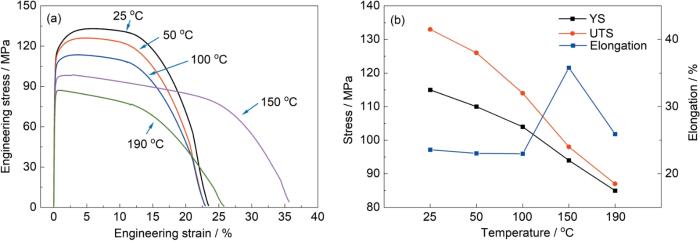
图2
耐热铝合金导线不同温度的应力-应变曲线及力学性能变化曲线
Fig.2
Stress-strain curves and mechanical properties evolution curves of the ultra-heat-resistant Al alloy: (a) stress-strain curves, (b) mechanical properties change curves
表1 不同测试温度下拉伸力学性能数据及强度损失值
Table 1
| Temperature / ℃ | YS / MPa | Loss of YS / % | UTS / MPa | Loss of UTS / % | Elongation / % |
|---|---|---|---|---|---|
| 25 | 113 | - | 133 | - | 23.58 |
| 50 | 110 | 4.35 | 126 | 5.26 | 23.04 |
| 100 | 104 | 9.57 | 114 | 14.29 | 22.99 |
| 150 | 94 | 18.26 | 98 | 26.32 | 35.78 |
| 190 | 85 | 26.09 | 87 | 34.59 | 25.90 |
图3
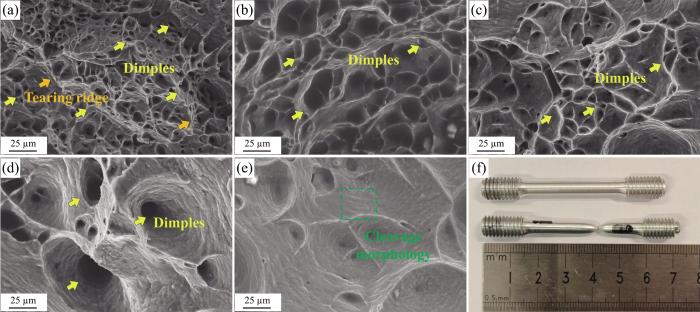
图3
不同温度拉伸性能测试样品的断口形貌
Fig.3
Fracture morphologies of the tensile samples: (a) 25 ℃, (b) 50 ℃, (c) 100 ℃, (d) 150 ℃, (e) 190 ℃, (f) tensile samples
2.2 腐蚀形貌及电化学实验
图4所示为经不同温度的浸泡实验后纵截面的金相照片和BSE照片。由图可见,经30 ℃浸泡实验后,试样的腐蚀较微,可见少量轻微的点蚀形貌。腐蚀深度较浅,仅有4.45 μm,如图4a和d所示。随着浸泡试验的温度逐渐升高,合金试样的腐蚀形貌仍然以点蚀为主,但腐蚀范围逐渐增大,并且腐蚀深度逐渐加深。当浸泡实验温度为50 ℃时,试样金相组织形貌中可以观察到明显的点蚀形貌,并且点蚀深度加深至11.53 μm。继续升高浸泡温度至70 ℃,试样的蚀坑深度进一步加深,深度增加至74.31 μm,同时可以观察到沿晶的腐蚀裂纹,如图4c和f所示。值得指出的是,经30和50 ℃的浸泡后的腐蚀形貌均为局部点蚀形貌,未观察到有晶间腐蚀形貌,而升高到70 ℃浸泡实验后合金的腐蚀行为由点蚀转变为沿晶腐蚀。
图4

图4
不同温度浸泡实验样品的腐蚀形貌
Fig.4
OM (a-c) and SEM (d-f) morphologies of the soak tested samples in 3.5%NaCl solution at 30 ℃ (a, d), 50 ℃ (b, e), 70 ℃ (c, f)
图5所示为不同温度下测量的耐热铝合金极化曲线。可见,在25 ℃时,合金的自腐蚀电位较高,为-0.803 V vs. SCE。随温度升高,合金的自腐蚀电位逐渐负移。当温度为35和45 ℃时,合金的自腐蚀电位分别为-0.840 V vs. SCE和-0.873 V vs. SCE。随着温度升高,阳极溶解的反应速率升高,同时铝基体与第二相的微电偶效应加强,自腐蚀电位会进一步降低。
图5

图5
不同温度测得的极化曲线
Fig.5
Potentiodynamic polarsation curves of the ultra-heat-resistant Al alloy at varying temperatures
2.3 微观组织
对耐热铝合金导线的横截面及纵截面的晶粒组织形貌观察结果如图6所示。由图6a~c可见,导线横截面由大量取向一致的近等轴状晶粒组成,晶粒尺寸较小,平均晶粒尺寸约为1.52 μm。晶粒界面则由大量的小角度晶界组成,占比约为66.3%。由图6c晶粒取向分布(GOS)可见,晶内取向差低于2°晶粒(通常被认为是再结晶晶粒)的分数较少,约为35.1%。合金纵截面则由晶粒纵横比较大的长条状晶粒组成,晶粒尺寸较大,如图6d所示。由图6e所示反极图(IPF)可见,合金纵截面的晶粒取向大部分靠近<111>Al,在铝合金中通常被认为是变形晶粒取向。GOS图片进一步显示,合金纵截面晶粒内部取向差较大,绝大部分晶粒的内部取向差均高于2°,通常被认为是未再结晶晶粒,占比约为91.4%。综上,合金导线的晶粒组织呈典型的拉拔晶粒形貌,纵截面晶粒被拉长,而横截面晶粒被细化。晶粒组织再结晶程度较小,存在较大的回复与再结晶储能。
图6
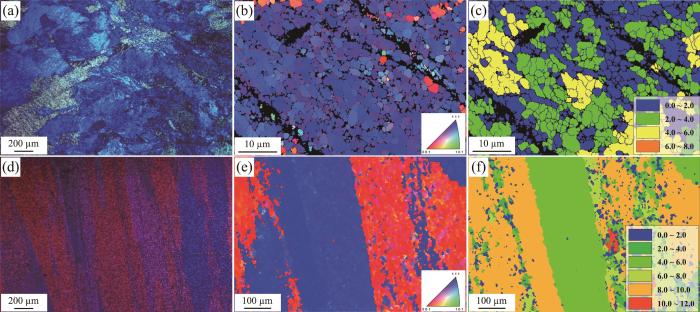
图6
耐热铝合金导线横截面及纵截面的晶粒组织形貌
Fig.6
Grain morphologies of the ultra-heat-resistant Al alloy: (a-c) cross-section morphology, (d-f) longitudinal section morphology, (a, d) OM images, (b, e) IPF maps, (c, f) GOS maps
图7
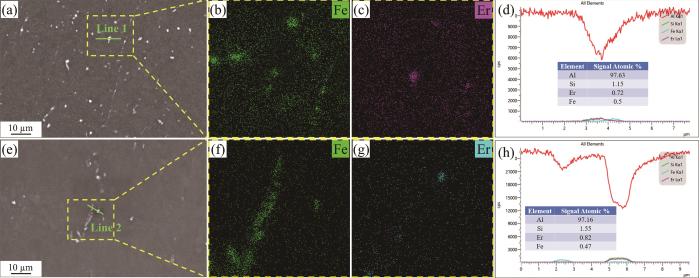
图7
耐热铝合金导线横截面及纵截面的第二相粒子分布
Fig.7
Distribution of secondary phase particles in an ultra-heat-resistant Al alloy: (a-d) cross-section morphologies; (e-h) longitudinal section morphologies, (a, e) BSE figures; (b, c, f, g) EDS mappings; (d, h) line-scan data
3 讨论
3.1 力学性能
综上,耐热铝合金导线的拉伸强度随测试温度的升高而逐渐降低,但强度损失速率随测试温度的升高呈先增加后降低的趋势。根据宋文硕等[11]的报道,铝合金的强度是各项强化应力的相互耦合作用的结果,其中包括晶格对滑移位错的阻碍应力、晶界强化应力、固溶强化应力、位错强化应力等,可以表示为:
其中,σy为屈服强度,σ0为材料基体强度,Δσd、Δσgb、Δσss和Δσppt则分别表示位错强化、晶界强化、固溶强化和第二相强化所引起的材料强度增量。
由于所研究的耐热铝合金导线的微合金化程度较低,且被广泛证明Fe、Si等元素较难固溶进入铝基体[12],因此由固溶强化和第二相强化所引起的材料强度增量在本研究中可忽略不计。而合金中位错密度仅与材料的加工工艺和变形程度有关,和受温度因素的影响不大。因此在本研究中由位错强化所引起的材料强度增量可视为定值。而由晶界强化所引起的材料强度增量则可以用经典的Hall-Petch公式来表示,屈服强度与晶粒尺寸的平方根倒数成线性关系,也有研究证实其与温度的变化无关,因此Δσgb项可以视为不变。
综上所述,Δσd,Δσgb,Δσss和Δσppt均可视为不随温度的变化而改变,材料在不同温度进行拉伸性能测试时,其屈服强度的变化值仅与晶格摩擦应力有关,σ0可以表示为[13]:
其中,
其中,G为剪切模量;
式中,定义
图8
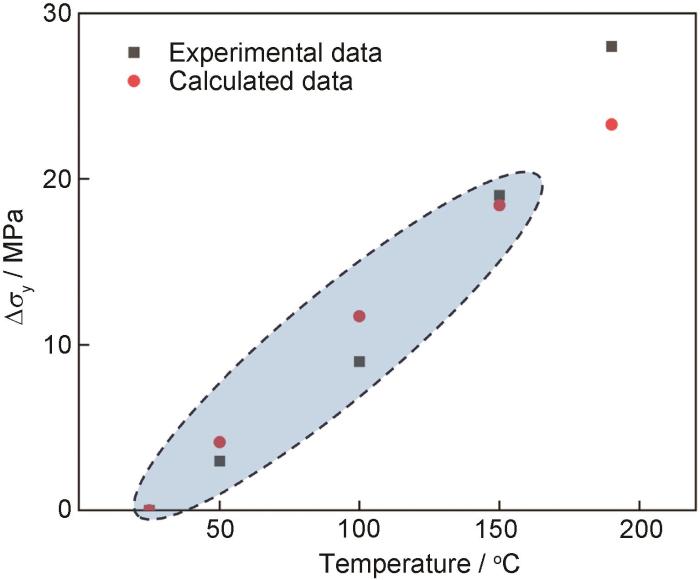
图8
计算强度损失值及实际强度损失值对比图
Fig.8
Comparison diagram of calculated strength loss value and actual strength loss value
同时,本文结果表明当拉伸测试温度为150 ℃,合金试样的延伸率会出现大幅度增加,且韧窝深度加深的现象。这主要是由于铝合金导线的初始状态为热拉拔态,变形量较大,回复与再结晶储能较高 (图6)。在较高温度拉伸性时,合金试样在变形的同时会发生动态回复和动态再结晶,从而消耗部分变形所产生的位错,减少晶粒内部位错缺陷的累积,从而使得单个晶粒能承受的变形量增大,提升合金的延伸率。
3.2 腐蚀性能
耐热铝合金导线试样经不同温度的浸泡试验后,合金的腐蚀形貌均为点蚀。并且随浸泡温度提高,合金腐蚀范围扩大,蚀坑深度加深,但未出现晶间腐蚀形貌。众所周知,铝合金在含Cl-溶液中的腐蚀行为由电偶腐蚀决定[16]。铝基体与其周围的第二相粒子间存在电位差,在含Cl-溶液中会形成微电偶,从而加速合金的腐蚀进程。本文测得的耐热铝合金导线的室温自腐蚀电位为-0.803 V vs. SCE,比SEM图片中观察到的Al-Fe相和Al-Fe-Si相[3,17]的腐蚀电位更负。研究表明,含Cl-溶液中Al-Fe相和Al-Fe-Si相均处于0.65 V vs. SCE~0.75 V vs. SCE区间内。因此,在浸泡试验过程中铝基体会与其周围的Al-Fe相和Al-Fe-Si相形成微电偶,并作为阳极优先发生溶解。而随着浸泡温度的升高,铝基体的自腐蚀电位逐渐负移,与周围Al-Fe相和Al-Fe-Si相的电势差逐渐增大。因此使得腐蚀速率升高,腐蚀深度增加。有研究表明,Al-Fe相和Al-Fe-Si相尺寸较为粗大,相界面处钝化膜薄弱,点蚀临界电位较低,容易诱发早期点蚀的形成[18,19]。
4 结论
(1) 本文所涉低含量Er微合金化的铝合金导线具有较优的耐热性能。低于150 ℃进行拉伸性能测试时,合金导线屈服强度和抗拉强度分别为94和98 MPa,具有较高的强度保持率,强度损失率低于计算值。由于动态回复和动态再结晶的发生,合金导线能保持较大的延伸率。
(2) 不同温度的3.5%NaCl溶液浸泡试验表明,低含量Er低微合金化的铝合金导线均呈现以点蚀为主的腐蚀形貌。随温度升高,合金点蚀范围逐渐扩大,蚀坑深度逐渐加深,并且腐蚀行为由点蚀发展为沿晶腐蚀。Er的添加细化了晶粒及粗大第二相的尺寸,有效提高了铝合金导线的高温耐蚀性能。
参考文献
Corrosion behavior of high strength and high electrical conductivity Al-Mg-Si alloy wires with large area reduction
[J].
大变形量高强高导Al-Mg-Si合金线的腐蚀机制研究
[J].
采用浸泡腐蚀实验和电化学实验相结合的方法,研究了长距离架空导线用高强高导Al-Mg-Si合金线的腐蚀行为与机制。结果表明:经过20 d的浸泡腐蚀,受Al-Fe-Si相和富Si相与基体α相之间微电偶作用,腐蚀首先在Al-Fe-Si相和富Si相与基体α相界面开始,随着腐蚀的发展Al-Fe-Si相和富Si相剥落形成点蚀。统计数据表明:Al-Mg-Si合金线变形量越大,Al-Fe-Si相和富Si相平均颗粒尺寸越小,最大平均点蚀深度越小。可见,Al-Fe-Si相和富Si相尺寸是影响Al-Mg-Si合金线点蚀的关键因素。
Development of heat-resistant aluminum alloy conductor with high conductivity in overhead transmission line
[J].
架空线路用高导电率耐热铝合金导线的研制
[J].
Change in microstructural characteristics of laser powder bed fused Al-Fe binary alloy at elevated temperature
[J].
Thermal and electrical conductivity of aluminum alloys: Fundamentals, structure-property relationships, and pathways to enhance conductivity
[J].
Research and application of heat-resistant aluminum alloy for power transmission: A review
[J].
输电用耐热铝合金研究与应用综述
[J].
Structure and properties of Ca and Zr containing heat resistant wire aluminum alloy manufactured by electromagnetic casting
[J].
Effect of alloying elements on thermal conductivity of aluminum
[J].
Research progress in Zr-microalloying strengthened aluminum alloys
[J].Zr is one of the most deeply investigated and widely used microalloying elements. The low diffusivity of Zr and the formation of thermal-stable Al3Zr dispersoids with the properties of low density, high melting temperature and low interface misfit in Al matrix, making Zr owing a broad prospect of application in developing heat-resistant Al alloys. However, strengthening by Al3Zr has been limited by either low number density or low volume fraction. In addition, the interaction among multiple components is very complex in multi-component Al alloys during solidification, deformation and heat treatment, and it is very difficult to achieve a good combination in strengthening of Al3Zr with the intrinsic phase of each system. In this review, the existing form, the precipitation and coarsening behavior, and the strengthening mechanism of Zr element in Zr-containing Al alloys were summarized. The mechanism of complex microalloying with multiple elements on promoting Al3Zr dispersion was briefly introduced. Finally, the effects of Zr addition on several series of Al-based alloys were summarized. In sum, microalloying with Zr is of great significance for regulating microstructure and improving room temperature/high temperature strength in Al alloys.
锆微合金化增强铝合金的研究进展
[J].锆(Zr)元素是铝合金中研究较为深入、实际应用较为广泛的微合金元素之一。由于Zr在铝中具有低的固态扩散速率且可形成低密度、高熔点、低界面错配度的Al<sub>3</sub>Zr弥散相, 因此合金展现出高温下服役的潜力。然而, Al<sub>3</sub>Zr粒子的弥散强化效果主要受到粒子低数量密度或体积分数的制约; 此外, 多元合金体系凝固、变形、热处理过程中多组元间交互作用复杂, Al<sub>3</sub>Zr弥散强化与各体系中本征相强化作用往往难以兼得, 上述问题均对合金的力学强度造成了不利的影响。本文综合近年来的相关报道, 对含Zr铝合金中Zr的存在形式、析出和粗化行为以及强化机制进行了概述; 简要介绍了复合微合金化促进Al<sub>3</sub>Zr析出机理与最新研究结果; 对某些体系铝合金中Zr微合金化的应用进行了归纳与总结, 结合当前新型耐热铝基合金发展的新趋势, 指出铝合金内Zr的微量添加对调控微结构、提升室温和高温强度的重要意义。
Development of thermal-resistant Al-Zr based conductor alloys via microalloying with Sc and manipulating thermomechanical processing
[J].
The grain refinement mechanism of cast aluminium by zirconium
[J].
Research progress of Er-containing aluminum alloy
[J].
铒微合金化铝合金的研究进展
[J].
Effects of excess Mg and Si on the properties of 6101 conducting wire and its mechanism
[J].
过量Mg、Si元素对6101电工导线性能影响及机制
[J].
Effect of temperature on tensile properties of 6101 Al-alloy wires
[J].Tensile properties of a single-strand conductor of 6101 Al-alloy were investigated in the temperature range from -70℃ to 70℃. It is found that the 6101 Al-alloy wire has high strength and good deformation uniformity at the low temperature (-70℃). However, the yield strength and the ultimate tensile strength of the alloy exhibited a decreasing trend with the increasing testing temperature. The ultimate tensile strength and the yield strength of the alloy at 70℃ decreased by 10.9% and 9.3%, respectively, comparing with those of the counterparts tested at -70℃. From the analysis on the correlation of the work hardening rate and the yield strength with the temperature, it is found that the strain hardening rate of the alloy decreased with the increasing flow stress and the raising temperatures. In addition, the lattice friction stress has a strong correlation with temperature, which is the main factor affecting the yield strength of the alloy. Based on the comparison of the fitting calculated increment of the yield strength of the alloy to the corresponding experimental results, a model about the relation between the yield strength of the alloy and the service temperature was obtained, by which the appropriate yield strength of the alloy at different service temperatures can be predicted.
温度对6101铝合金导线拉伸性能的影响
[J].研究了6101铝合金单股导线在-70℃到70℃温度区间的拉伸性能。结果表明,6101铝合金导线在-70℃低温下具有较高的强度和较好的变形均匀性,但是随着变形温度的提高其屈服强度和强度极限都呈下降趋势。与在-70℃的拉伸性能相比,在70℃合金的强度极限和屈服强度分别降低了10.9%和9.3%。对应变硬化率和屈服强度与温度的相关性分析发现,在拉伸变形过程中合金样品的应变硬化率随着流变应力的增大和温度的升高呈下降趋势。晶格摩擦阻力极大的影响了合金的屈服强度,对比不同温度下6101合金的屈服强度增量的拟合计算结果与实验结果,得到了这种导线屈服强度增量与温度的关系,据此可预测此类导线在不同温度下的服役可靠性。
Temperature dependence of the mechanical properties of equiatomic solid solution alloys with face-centered cubic crystal structures
[J].
Electrochemical performance of a novel Al-Zn-In-Sn-La sacrificial anode alloy in simulated marine environments
[J].
Al-Zn-In系牺牲阳极在模拟海洋环境下的电化学性能研究
[J].在商用Al-Zn-In牺牲阳极基础上,自行设计冶炼了Al-Zn-In-Sn-La牺牲阳极合金,并在模拟浅海和深海环境下,测试了两种合金的开路电位、动电位极化曲线、恒电位极化曲线、腐蚀失重等,对比分析讨论了两种牺牲阳极的放电量和电流效率。结果表明:模拟海洋环境下,冶炼合金放电量较商用合金略有提高,这与In、Zn、Sn协同活化作用破坏钝化膜完整性、增加钝化膜阴阳离子空位促进离子迁移有关。同时,冶炼合金电流效率较商用合金显著提高,浅海环境下电流效率由75.87%提高至90.01%,深海环境下由75.48%提高至82.99%。冶炼合金自腐蚀速率低、晶界偏析相与基体电位差较小导致微电偶作用减弱、稀土元素细化晶界促进均匀溶解等共同作用提高了电流效率。模拟深海环境下,两种合金的放电量较浅海环境大幅降低,这主要是由于低温、低含氧量导致离子溶解沉积速率降低,牺牲阳极活性点减少,Al合金牺牲阳极发生钝化。为克服深海放电量低下的问题,高熵合金的思路也许能显著提高活化合金元素的固溶度,从而提高其深海放电性能。
Characterization of refining the morphology of Al-Fe-Si in A380 aluminum alloy due to Ca addition
[J].
Corrosion behaviors at different temperature based on the ultrafine-grained structure of Al-Fe alloy
[J].
Corrosion behavior of homogenized and extruded 1100 aluminum alloy in acidic salt spray
[J].
Deep-learning potential molecular dynamics study on nanopolycrystalline Al-Er alloys: Effects of Er concentration, grain boundary segregation, and grain size on plastic deformation
[J].Understanding the tensile mechanical properties of Al-Er alloys at the atomic scale is essential, and molecular dynamics (MD) simulations offer valuable insights. However, these simulations are constrained by the unavailability of suitable interatomic potentials. In this study, the deep potential (DP) approach, aided by high-throughput first-principles calculations, was utilized to develop an Al-Er interatomic potential specifically for MD simulations. Systematic comparisons between the physical properties (e.g., energy-volume curves, melting point, elastic constants) predicted by the DP model and those obtained from density functional theory (DFT) demonstrated that the developed DP model for Al-Er alloys possesses reliable predictive capabilities while retaining DFT-level accuracy. Our findings confirm that AlEr, AlEr, and AlEr exhibit mechanical stability. The calculated melting point of AlEr (1398 K) shows a 57 K deviation from the experimental value (1341 K). With the Er content increasing from 0.01% to 0.064 at.% in Al-Er alloys, the grain boundary (GB) concentration of Er atoms increases from 0.03 to 0.07% following Monte Carlo (MC) annealing optimization. The Al-0.05 at.%Er alloy exhibits the highest yield strength, with an increase of 0.128 GPa (6.1%) compared to pure Al. For Al-0.05 at.%Er alloys with varying average grain sizes, the GB concentration of Er atoms increases by about 1.4-1.6 times after MC annealing compared to the average Er content. Additionally, the Al-Er alloys reach the peak yield strength of 2.214 GPa when the average grain size is 11.72 nm. The GB segregation of Er atoms lowers the system energy and thus enhances stability. Notable changes in the segregation behavior of Er atoms were observed with increasing Er concentration and decreasing grain size. These results would facilitate the understanding of the mechanical characteristics of Al-Er alloys and offer a theoretical basis for developing advanced nanopolycrystalline Al-Er alloys.


