



随着全球人口的快速增长,垃圾处理已成为当今社会面临的一大难题。据联合国环境规划署预测,全球废弃物年产生量将持续增加。垃圾焚烧炉作为一种现代化的垃圾处理设备,正逐渐成为解决垃圾问题重要手段之一。然而,垃圾焚烧炉在运行过程中需要承受高温、腐蚀性气体和飞灰颗粒等极端条件,这对设备的材料提出了极高的要求。镍基高温合金是制造现代航空发动机、航天器以及火箭发动机等高温环境下核心部件的重要材料,同时也在高温结构应用中发挥重要作用[1]。镍基合金在650~1000 ℃的高温区间内,展现出较高的强度、较好的抗氧化性能和抗燃气腐蚀能力,其主要成分包括Ni、Co、Cr、W、Mo、Re、Ru、Al、Ta、Ti等元素,其中Ni作为基体元素,含量通常超过50%[2]。由于镍基合金具有优异的耐蚀性能,是保护垃圾焚烧炉关键部件的理想材料[3],故可采用堆焊技术,在低合金钢基材表面制备镍基合金层,有效延长设备的使用寿命并降低维护成本。
Nb常与C形成稳定的NbC,NbC由于其具有高硬度、高模量、较高抗弯强度,以及有效细化晶粒等特点,从而能够提高合金的高温强度和抗蠕变性能,还能改善合金的焊接性能[4]。王诗洋等[5]研究表明,提高Nb含量可以较为有效的降低焊缝样品的焊接裂纹敏感性,接头的持久寿命显著提升。Li等[6]研究表明,随着Nb含量的增加,晶界处的复合沉淀物数量减少,且Nb对TiZrV合金表现出显著的晶粒细化行为。Feng等[7]研究表明,Nb通过固溶于氧化膜中,降低了TiO2中氧空位浓度,抑制了TiO2的生成,从而促进了Cr2O3的优先形成,从而影响钛基激光熔覆涂层的高温抗氧化行为。然而,Nb作为一种昂贵的合金元素,其高成本在一定程度上限制了含Nb镍基合金的广泛应用。期望通过降低或剔除含Nb镍基合金中的Nb,在不降低耐腐蚀性能的情况下,降低生产成本,但目前关于Nb去除对含Nb堆焊涂层制备及耐蚀性能的影响缺乏深入研究。特别是在无Nb条件下制备堆焊涂层时,出现流动性差,堆焊设备难以实现自动化成型等问题,这进一步增加了制造难度和成本。因此,研究Nb去除后对材料堆焊层的成型及耐蚀性能的影响,不仅有助于解决工业生产中的技术难题,还能为优化低成本合金材料的设计提供重要参考。
本研究针对制备的无Nb和含Nb条件下的镍基堆焊涂层,采用金相组织观测、电化学腐蚀测试、氯腐蚀测试、JMatpro模拟计算等手段,系统探究Nb对其堆焊成型制备的影响以及耐蚀性能的影响。通过对比分析,论述Nb去除的可能性,为降低工业生产成本提供理论支持和实践依据。
1 实验方法
将NiCrMo-(0/3.6)Nb丝材堆焊至12CrMoVG基体上,得到无Nb和含Nb的堆焊镍基涂层,其两种堆焊合金的主要成分见表1。
表1 NiCrMo-(0/3.6)Nb堆焊层的主要成分
Table 1
| Alloy | Ni | Cr | Mo | Fe | Nb |
|---|---|---|---|---|---|
| A (0Nb) | 62.13 | 25.39 | 9.63 | 2.85 | - |
| B (3.6 Nb) | 63.97 | 22.60 | 9.27 | 0.49 | 3.67 |
将两种堆焊合金分别记为A (NiCrMo-0Nb)和B (NiCrMo-3.6Nb),通过电火花线切割技术将焊层与基体材料割离,并将涂层切割为尺寸为10 mm × 10 mm × 1 mm的块状样品。为确保样品的表面质量,样品在实验前依次采用180、400、800、1500和2000#SiC砂纸进行打磨,以去除表面氧化层,直至表面光亮。随后,样品进一步采用粒度低至2.5 μm的抛光膏进行精细抛光,以消除微划痕。抛光完成后,将样品置于乙醇中超声清洗以去除残留杂质,随后烘干备用。
本研究采用实验与材料计算模拟相结合的方法,探究Nb对镍基合金对堆焊层制备以及耐蚀性能的影响。在实验过程中,首先通过金相显微镜(RX50M)以及扫描电子显微镜(SEM, Zeiss Sigma)对两种合金的金相微观组织形貌进行表征,结合能谱分析(EDS, Oxford INCA)、X射线衍射(XRD, Bruker D8 Advance)确定合金涂层的组成。在计算模拟过程中,基于JMatpro 7.0材料性能模拟计算软件,计算两种组分的熔点、熔体粘度等参数。
本实验的高温氯腐蚀性能测试采用水平管式炉进行实验,腐蚀装置如图1所示。将试样置于石英坩埚中称重(m0),然后放入水平管式炉中随炉升温,升温速率为3 ℃/min,腐蚀温度为800 ℃,腐蚀气体成分 (mg/L) 为N2-CO2 (29.8 mg/L)-O2 (23.4 mg/L)-HCl (3.53 mg/L),气体总流量为75 mL/min,腐蚀时间为60 h。停止加热并随炉冷却后,将试样取出称重(M)腐蚀过程采用循环方式记录动力学数据,当完成指定腐蚀时间后,腐蚀实验前10 h内,每隔5 h称量一次试样;之后每隔10 h称量一次,直至实验结束。停止加热并随炉冷却后,将试样取出称重(M)。最采用XRD、SEM结合EDS对其进行分析。
图1
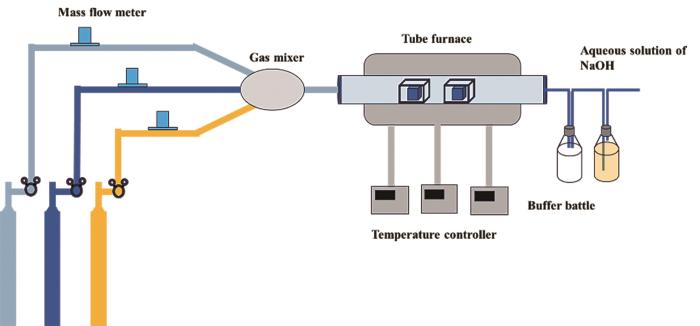
图1
高温氯腐蚀装置示意图
Fig.1
Schematic diagram of high-temperature chlorine corrosion device
2 结果与讨论
2.1 合金物相组成及金相组织
2.1.1 合金物相组成
图2
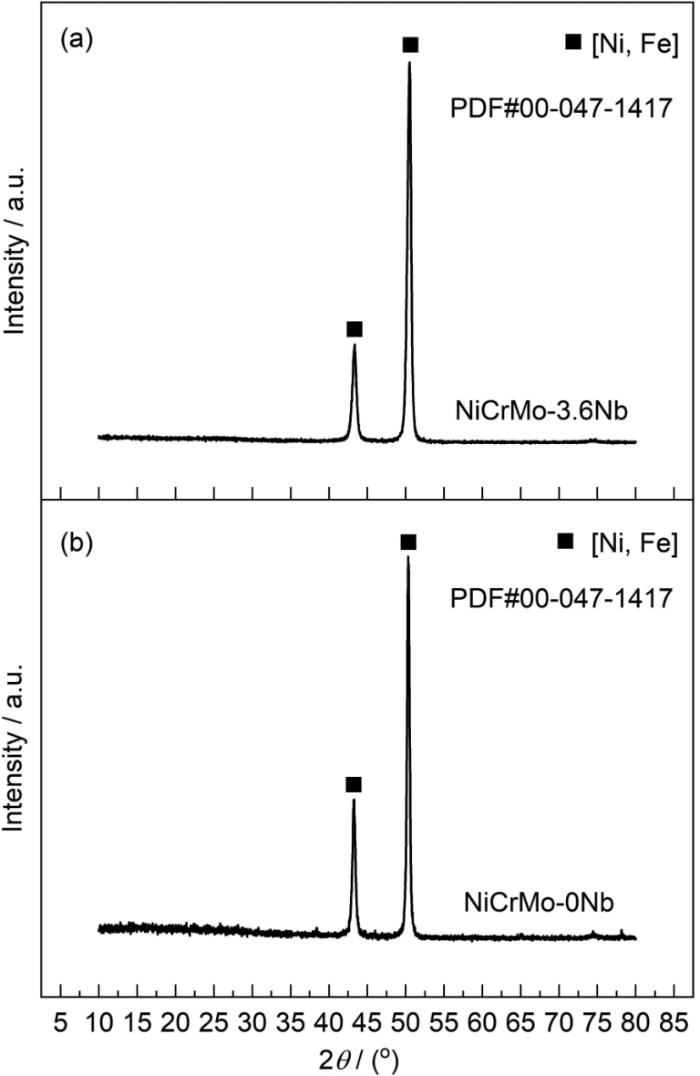
图2
NiCrMo-(0/3.6)Nb堆焊层的XRD谱
Fig.2
XRD patterns of NiCrMo-3.6Nb surfacing (a) and NiCrMo-0Nb surfacing (b)
2.1.2 金相组织及微观形貌
图3
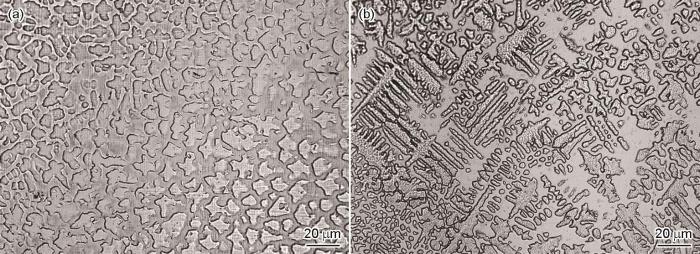
图3
NiCrMo-(0/3.6)Nb堆焊层经王水腐蚀后的表面金相组织
Fig.3
Surface microstructure of NiCrMo-0Nb surfacing (a) and NiCrMo-3.6Nb surfacing (b) after aqua regia etching
图4
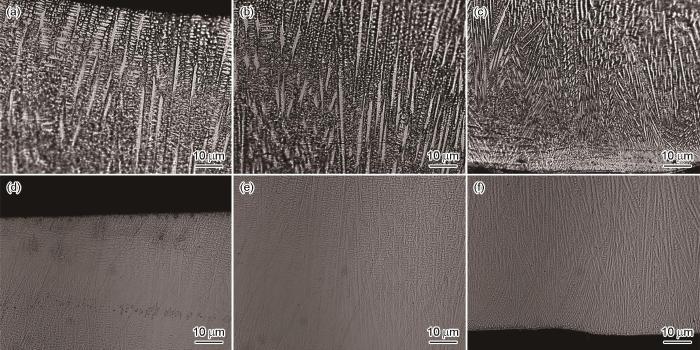
图4
NiCrMo-(0/3.6)Nb堆焊层上中下经王水腐蚀后的截面金相组织
Fig.4
Cross-section microstructure of NiCrMo-0Nb surfacing (a-c) NiCrMo-3.6Nb surfacing (d-f) after aqua regia etching
图5
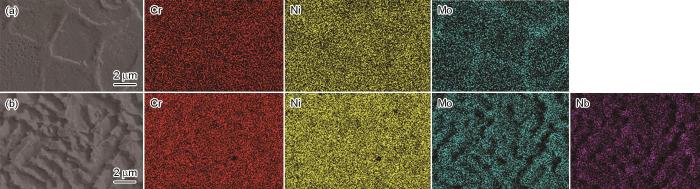
图5
经王水腐蚀后NiCrMo-(0/3.6)Nb堆焊层表面形貌及元素分布
Fig.5
Surface morphology and elemental distribution of NiCrMo-0Nb surfacing (a) and NiCrMo-3.6Nb surfacing (b) after aqua regia etching
2.2 JMatPro模拟计算
将合金导入JMatPro对其进行模拟计算,如图6平衡相图所示,添加3.6% (质量分数) Nb使合金液相线温度从1384.17 ℃ (0Nb)降至1350.42 ℃,发生了约33.75 ℃的下降。从相变过程来看,含Nb合金中γ相的稳定形成温度高于无Nb合金,而NiCrMo-3.6Nb合金的固相线温度(即固相完全转变为液相的温度)低于NiCrMo-0Nb合金。这表明Nb降低了合金的熔点,该变化可能是由于Nb原子在晶格中的溶质拖曳效应以及对合金体系自由能的影响,导致相变驱动力和界面能改变,从而影响了合金的熔点和整体热力学稳定性[14]。结合实际堆焊层结果,可见这与JMatPro的计算结果较为吻合,可知Nb可以在一定程度下降低该镍基合金的熔点。
图6
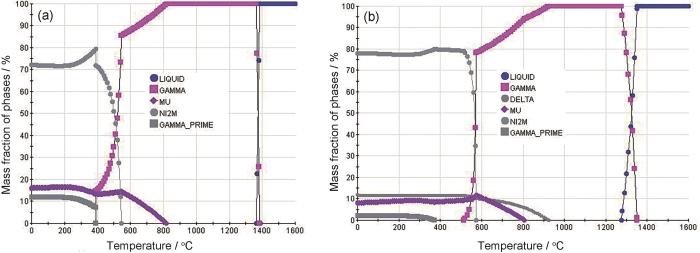
图6
采用JMatPro7.0软件计算的NiCrMo-(0/3.6)Nb平衡相图
Fig.6
Equilibrium phase diagram of NiCrMo-0Nb (a) and NiCrMo-3.6Nb (b) calculated using JMatPro7.0 software
图7为NiCrMo-(0/3.6Nb)焊道宽度对比图,焊道宽度与样品的堆焊流动性密切相关,对相同堆焊参数下两种样品的焊道宽度进行测量;NiCrMo-0Nb的焊道宽度明显小于NiCrMo-3.6Nb,良好的流动性使得熔池能够充分铺展,形成宽而平的焊道;较差的流动性则导致熔池堆积,形成窄而高的焊道。
图7
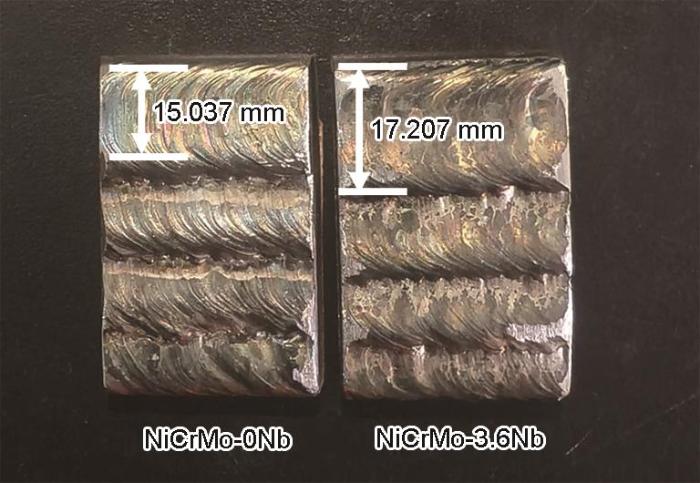
图7
NiCrMo-(0/3.6)Nb焊道宽度对比图
Fig.7
Comparison of bead width for NiCrMo-(0/3.6)Nb
图8为NiCrMo-(0/3.6Nb)的熔体粘度随温度的变化图:尽管NiCrMo-0Nb在液相点(1384.17 ℃)黏度(8.82 mPa·s)低于NiCrMo-3.6Nb (1350.42 ℃,9.67 mPa·s),但其堆焊流动性较NiCrMo-3.6Nb差。JMatPro模拟计算表明,NiCrMo-0Nb合金在1365 ℃时黏度为计算模拟所存在的理论计算最大值9.73 mPa·s,且在1365~1380 ℃时,黏度在NiCrMo-3.6Nb之上。商继祥等[15]研究表明,当在某些特定温度附近,高温金属熔体的黏度会出现突变现象。这表明在特定温度区间,熔体的微观结构发生变化,导致黏度发生突变。采用NiCrMo-3.6Nb合金的制备条件(1350.42 ℃)即同一制备条件下制备NiCrMo-0Nb堆焊涂层时,在1365 ℃以下时,JMatPro计算结果在小于一定温度下NiCrMo-0Nb的熔体粘度不发生变化,此温度下NiCrMo-0Nb的熔体粘度或为其保持“流动能力”的最低理论温度,低于1365 ℃时NiCrMo-0Nb的熔体结构趋于“冻结”,粘度趋于无穷大。结合实际NiCrMo-0Nb堆焊层难以成型的情况,判断此时其熔体粘度过大,且大于NiCrMo-3.6Nb。在堆焊层制备时,对该两种堆焊合金层的温度控制可能还不够精确,可能会导致无Nb堆焊层流动性不佳、难以制备的结果。
图8
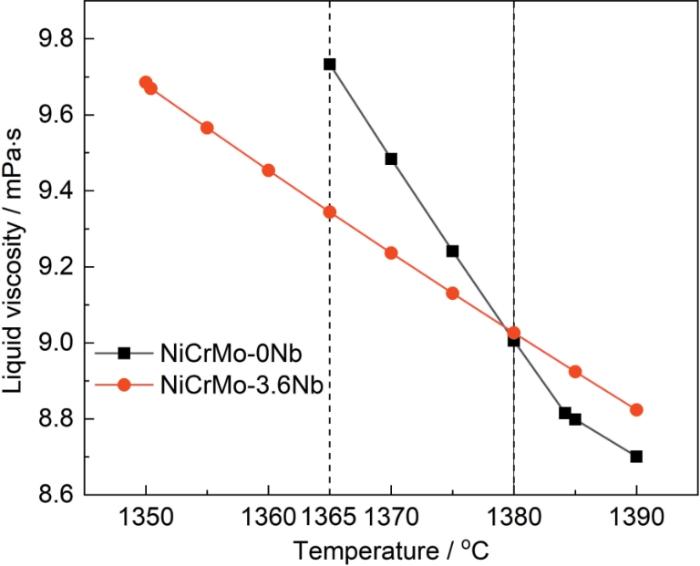
图8
NiCrMo-(0/3.6)Nb合金熔体粘度随温度的变化图
Fig.8
Variation of liquid viscosity of -(0/3.6)Nb alloys with temperature
2.3 Cl腐蚀后两种堆焊层的表面物相组成
图9为两种堆焊层试样在800 ℃,N2-CO2 (29.8 mg/L)-O2 (23.4 mg/L)-HCl (3.53 mg/L)气氛下腐蚀60 h后的表面XRD图谱。对于两种堆焊合金,样品的XRD谱图中均检测到基体(Ni, Fe)相的衍射峰,但含Nb样品基体衍射峰强度明显大于无Nb样品。Nb的有无可能会影响腐蚀层的厚度,导致基体峰的强度存在较大差异,两种样品的腐蚀产物均主要由Cr2O3和少量NiO和NiCr2O4组成。
图9
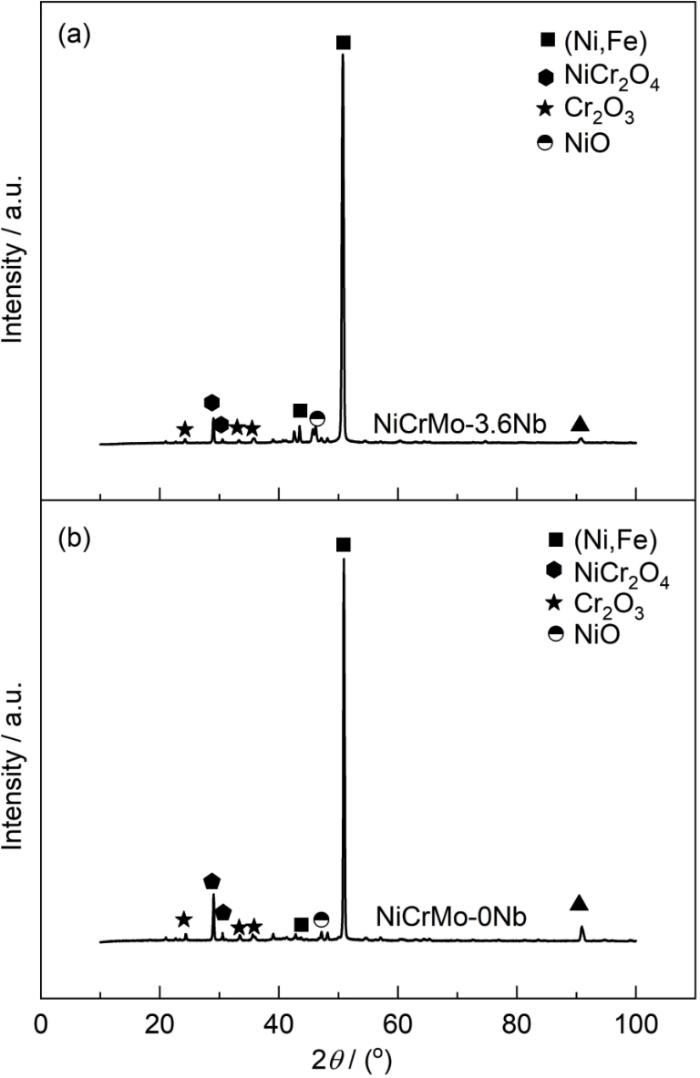
图9
NiCrMo-(0/3.6)Nb堆焊层在800 ℃腐蚀60 h后的XRD谱
Fig.9
XRD patterns of NiCrMo-3.6Nb (a) and NiCrMo-0Nb surfacing (b) after corrosion at 800 ℃ for 60 h
2.4 腐蚀增重柱状图
图10展示了NiCrMo-(0/3.6)Nb堆焊层在N2-CO2 (29.8 mg/L)-O2 (23.4 mg/L)-HCl (3.53 mg/L)混合气氛中800 ℃、60 h时的腐蚀增重柱状图。NiCrMo-0Nb的腐蚀增重(0.0143 mg/cm2)显著低于NiCrMo-3.6Nb合金(0.0520 mg/cm2)。结果表明在此条件下,NiCrMo-0Nb的耐蚀性能优于NiCrMo-3.6Nb。
图10

图10
NiCrMo-(0/3.6)Nb堆焊合金在800 ℃腐蚀60 h后的的增重柱状图
Fig.10
Mass gain bar chart of NiCrMo-(0/3.6)Nb surfacing after corrosion at 800 ℃ for 60 h
2.5 腐蚀后两种堆焊合金的表面形貌及组成
图11给出了含Nb和无Nb堆焊合金经氯腐蚀后的表面形貌,结合EDS以及XRD分析可知,可以看出两种合金表面主要以3种形貌组成:层片状(以较多的NiO组成),较为连续平整的平面状Cr2O3、氯腐蚀影响的Cr2O3岛状区域,及白色球型颗粒状的”小氯球”(氯富集区)。NiCrMo-3.6Nb合金表面相对粗糙,与NiCrMo-0Nb相比片状结构分布更加不均匀,表面存在明显的氯富集区域,呈球状分布。“小氯球”的存在进一步破坏了氧化膜的完整性,导致其氧化膜的保护性能有所下降。另外,Nb与HCl反应生成挥发性NbClₓ,局部破坏Cr2O3,导致氧化膜连续性下降,Cr2O3的剥落使得部分区域出现了一些褶皱、缝隙,这为腐蚀介质的渗透提供了通道,加速了基体的腐蚀。“小氯球”是氯化物腐蚀过程中形成的微小颗粒或团簇,通常由Cl-与氧化膜中的Cr的氧化物或其他氧化物反应生成。Cl通过一些缝隙进入氧化膜与Cr2O3反应生成挥发性的CrCl3[16],破坏了氧化膜的完整性,导致其耐腐蚀性能下降。
图11
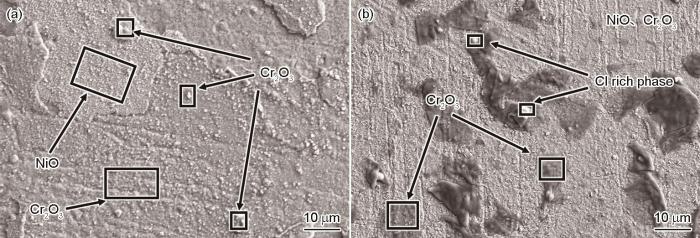
图11
NiCrMo-(0/3.6)Nb堆焊合金在800 ℃,N2-CO2 (29.8 mg/L)-O2 (23.4 mg/L)-HCl (3.53 mg/L)混合气氛中腐蚀60 h后的表面形貌及物相组成
Fig.11
Surface morphology and phase composition of NiCrMo-0Nb surfacing (a) and NiCrMo-3.6Nb surfacing (b) after 60 h corrosion in a mixed atmosphere of N2-CO2 (29.8 mg/L)-O2 (23.4 mg/L)-HCl (3.53 mg/L) at 800 ℃
2.6 腐蚀后截面形貌及组成
图12为NiCrMo(0/3.6)Nb堆焊层在800 ℃,N2-CO2 (29.8 mg/L)-O2 (23.4 mg/L)-HCl (3.53 mg/L)混合气氛中腐蚀60 h后的截面形貌及元素分布图,NiCrMo-0Nb合金截面形貌显示了明显的腐蚀层,腐蚀层较薄。从图中截面形貌及元素分布情况来看,两种材料均呈现出明显的氧化层结构,主要为Cr2O3层和少量的NiO层。对于NiCrMo-0Nb,其Cr2O3层相对较薄,但整体氧化层连续性一般,存在部分氧化膜剥落的现象;而NiCrMo-3.6Nb材料的氧化膜较为连续致密,一定量的Nb能有效促进致密连续Cr2O3层的形成,在一定程度上改善氧化膜的表面形貌,NiCrMo-3.6Nb腐蚀层厚度略微增加。由于Nb与HCl反应生成挥发性NbClₓ,改变氧化层的生长速率和应力分布,使Cl-更容易渗透至基体,加速腐蚀进程,这与氧化层的微观结构和元素迁移行为有关[20,21]。
图12
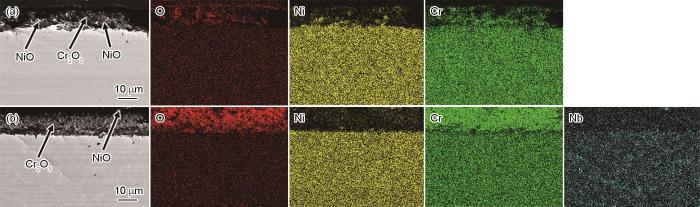
图12
NiCrMo-(0/3.6)Nb堆焊层在800 ℃,N2-CO2 (29.8 mg/L)-O2 (23.4 mg/L)-HCl (3.53 mg/L)混合气氛中腐蚀 60 h 后的元素分布图
Fig.12
Elemental distribution maps of NiCrMo-0Nb (a) and NiCrMo-3.6Nb (b) surfacing after 60 h of corrosion at 800 ℃ in a mixed atmosphere of N2-CO2 (29.8 mg/L)-O2 (23.4 mg/L)-HCl(3.53 mg/L)
3 结论
(1) 在高温氯腐蚀环境下,NiCrMo-0Nb的氧化物分布较为连续,但存在一定的剥落,腐蚀层较薄;NiCrMo-3.6Nb合金表面存在富Cl区域,Nb与HCl反应生成挥发性NbClₓ,影响氧化层的生长和应力分布,使Cl更容易渗透至基体,破坏了氧化膜的连续性,加重了腐蚀程度,且氧化层厚度和表面粗糙度均有所增加。NiCrMo-0Nb、NiCrMo-3.6Nb在N2-CO2 (29.8 mg/L)-O2 (23.4 mg/L)-HCl(3.53 mg/L)混合气氛中800 ℃混合气氛中腐蚀60 h后的结果表明,NiCrMo-0Nb耐腐蚀性优于NiCrMo-3.6Nb。NiCrMo-0Nb镍基合金在高温氯腐蚀环境下具有更好的耐腐蚀性能。
(2) Nb能降低NiCrMo合金的熔点并影响其高温熔态黏度,具有细化堆焊层组织晶粒的作用。
参考文献
Research on processing methods and control strategies of nickel-based superalloy materials
[J].
镍基高温合金材料加工工艺方法现状与发展趋势
[J].
Development of nickel-based superalloys
[A].
镍基高温合金的发展综述
[A].
Hot corrosion of Inconel 625 wrought alloy and weld overlay on carbon steel by gas metal arc welding in 47 PbSO4-23 ZnO-13 Pb3O4-7 PbCl2-5 CdO-5 Fe2O3 molten salt mixture
[J].
Effect of NbC on the microstructure and mechanical properties of electrospark deposited NiCrBSi-NbC abrasive coatings for Ni-based superalloy blade tips
[J].
Effect of wire composition on weldability of a Ni-based superalloy welded by TIG method
[J].
焊丝成分对镍基高温合金TIG焊焊接性的影响
[J].
解决K4951合金的熔焊修复是实现新一代航空发动机机匣研制的关键.针对K4951合金中的难熔元素含量高、可焊性较差的问题,本文根据该合金的成分特点,通过调整母材中的沉淀强化元素和固溶强化元素,设计出7种成分的焊丝,并利用扫描电镜、透射电镜、电子探针和热力学软件等研究手段分析了合金元素对焊接接头的裂纹敏感性和持久性能的影响.结果表明,在母材成分的基础上提高焊丝中B元素含量至0.04%,接头的裂纹敏感性显著增加,焊缝金属加工即断裂;提高Nb元素含量可提升晶界液膜的愈合能力,有效的降低焊缝样品的焊接敏感性,接头的持久寿命由15 h提升至41 h;降低Cr,Mo元素的含量可以在一定程度上提高的合金的裂纹敏感性,使接头的持久寿命提升;提高Al元素的含量,同时调控Nb,Cr,Mo等元素可有效抑制裂纹形成,并提升了焊缝金属的高温服役性能.研究结果可为后续沉淀强化镍基高温合金的焊接性研究提供一定的参考价值.
Effect of Nb content on microstructure and mechanical properties of TiZrVNb x high-entropy energetic alloys
[J].
Microstructure evolution and high temperature oxidation behavior of laser cladded titanium-based composite modified by Nb/Si addition
[J].
Effect of Nb content on microstructure and mechanical properties of porous Ti-Nb alloys
[J].Porous Ti-Nb alloys with different contents of Nb elements were prepared by vacuum sintering technology. The effects of Nb element contents on pore morphologies, porosities, microstructures, elastic modulus, and wear resistances of porous Ti-Nb alloys were investigated. The results show that with the ascent of Nb element contents, the pore morphology of porous Ti-Nb alloys does not change significantly, and the porosities increase gradually. The porous Ti-Nb alloys are mainly composed of α-phase and β-phase, in which, due to the β-phase stabilizing effect of Nb elements, the volume fraction of the β-phase in the alloys increases significantly with the increase of the Nb element content, and the compressive strength and elastic modulus of the alloys decrease gradually. The wear resistance of porous Ti-Nb alloys in simulated body fluid (SBF) is mainly related to the volume ratio of β-phase to α-phase. When the volume ratio of β-phase to α-phase exceeds 61.7/38.3, the wear resistance of the alloy gradually improves.
Nb含量对多孔Ti-Nb合金组织与力学性能的影响
[J].
Temperature gradient mechanism in the heterogeneous nucleation of inoculated alloy: A quantitative phase-field study
[J].
The effect of Nb on microstructure and properties of GH4169 alloy pipe
[J].With the manufacturing process by vacuum induction, electroslag remelting, vacuum self consumption, homogenization heat treatment, forging, hot extrusion, cold rolling, and heat treatment. we can get two types of GH4169 alloy pipes with Nb content of 4.90% and 5.30% respectively. The effect of Nb content on the microstructure and properties of GH4169 alloy pipes was studied while other components remained basically the same. The results show that under the same heat treatment process, with the increase of Nb element content, the Nb content becomes higher and the grain size becomes smaller; At 200 ℃ and room temperature with the tensile strength and yield strength both increase with the increasing of Nb content, And the content of precipitates in GH4169 alloy pipes also increases. Under different solid solution heat treatments and the same aging heat treatment process, the grain size of GH4169 alloy pipes is in the range of 4.0-7.0. The smaller the grain size, the higher the tensile strength and yield strength of the pipes; At the same grain size, the higher the Nb content, the higher the tensile strength and yield strength of the pipe.
Nb对GH4169合金管材组织性能的影响
[J].
Defects caused by powder spattering and entrainment in laser powder bed fusion process: High-fidelity modeling of gas, melt pool and powder dynamics
[J].
Role of melt pool convection in optimising defect free components fabricated via laser powder bed fusion of CuSn alloy
[J].
A novel approach to optimize mechanical properties for aluminium alloy in High pressure die casting (HPDC) process combining experiment and modelling
[J].
Phase field simulation of grain growth kinetics with solute drag in Fe-Mo-Nb alloy
[J].
Fe-Mo-Nb合金中溶质拖曳晶粒长大动力学的相场模拟
[J].
Abnormal viscosity changes in high-temperature metallic melts
[J].
高温金属熔体黏度突变探索
[J].
Study on high temperature chlorine corrosion properties of the modified alloys and high-entropy alloys based on 904L steel
[D].
基于904L的改性合金及高熵合金的高温氯腐蚀性能研究
[D].
Effect of Nb2O5 particle size on inner stress in oxide film on zirconium alloy
[J].
Nb2O5颗粒尺寸对锆合金氧化膜内应力的影响
[J].
Improving oxidation resistance by fabricating micro-rings on the surface: Proof of concept for nickel-based superalloy
[J].
Influence of Nb addition on the oxidation behavior of novel Ni-base superalloy
[J].
High-temperature oxidation behavior of Ni-Cr-W and Ni-Cr-Fe superalloys: A comparative study at 1000 ℃
[J].


