



1 SVET技术原理
1.1 技术起源与发展
SVET工作原理是在一个电解池中,固定一个参比电极,工作电极与参比电极之间的电流与其电势差、距离以及电解液的电导率有直接关系。如果将两个电极的体积缩小成微电极,距离也缩小到10~100 μm,扫描样品时两个电极同步移动,则成为了扫描参比电极技术(SRET)技术。通过SRET获得的电流密度容易产生噪声,这个问题随着溶液电导率的增加而加剧。通过使电极振动,可以显著降低噪音并提高灵敏度。振动产生信号调制(正弦信号),锁定放大器使用该信号调制来显著提高信噪比,这是SVET的基础,也是与SRET相比的主要区别[30]。
1.2 技术优势与局限性
1.2.1 优势
高灵敏度与空间分辨率:SVET能够检测到微小的离子电流变化,灵敏度可达皮安级,与此同时,空间分辨率可达微米级。这使得它能够精确地探测金属表面微区的腐蚀活性差异,捕捉到缓蚀剂作用下腐蚀反应的细微变化,对于研究局部腐蚀现象和缓蚀剂的微观作用机制具有重要意义[33]。
原位测量:SVET技术可以在金属样品处于实际腐蚀环境中时进行原位测量,无需将样品取出或对体系进行额外处理,避免了因样品处理过程对腐蚀原始状态的干扰。同时,在测试过程中,可以实时监测腐蚀随时间的变化规律及缓蚀剂添加后对材料耐蚀性的影响,为研究缓蚀剂性能提供了有效方法[34]。
非侵入性:SVET通过在溶液中感应电位梯度来测量离子电流,微电极不与金属表面直接接触,不会对金属表面的腐蚀过程和缓蚀剂的作用产生干扰,保证了测量结果的真实性和可靠性。
1.2.2 局限性
图1为SVET测试的原理图[35]。由图可知,SVET测试时存在如下局限性:(1) 测量时探头不在样品表面,而是在表面上方一定距离处进行,通常为100~200 μm,因此不能测到表面的真实电流。(2) 用于测试的典型解决方案中的噪声水平(0.01~0.1 M)约为1 μA·cm-2。因此较低的电流会被忽略。一个例子是,样品的阳极活性非常集中,很容易被检测到,而阴极活性则是分散的,表面的其余部分和电流密度变得小于检测极限[35]。(3) 电流是三维流动的,而检测通常只在z方向或者z和x方向进行。(4) SVET探测器的运动,有时还有振动本身,可以增强氧气向样品表面的输送。这种输送对阳极反应影响不大,但是影响阴极还原反应,因而会导致测试出的阳极电流与阴极电流不匹配[36]。(5) 部分电流逃逸,并没有从测试平面穿过。
图1

2 SVET在缓蚀剂作用机制研究中的应用
2.1 金属/缓蚀剂界面电荷转移机制
图2
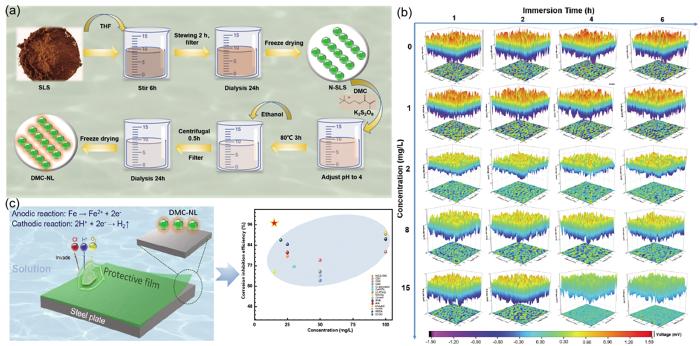
图2
DMC-NL制备流程示意图,不同添加量DMC-NL对碳钢在盐酸溶液中浸泡1、2、4和6 h实时原位SVET图和DMC-NL在HCl溶液中对碳钢缓蚀机理示意图与缓蚀效率对比图[38]
Fig.2
Schematic diagram of DMC-NL preparation process (a), real-time in-situ SVET diagram of carbon steel immersed in hydrochloric acid solution for 1, 2, 4 and 6 h with different dosage of DMC-NL (b) and schematic diagram of corrosion inhibition mechanism of DMC-NL on carbon steel in HCl solution and comparison diagram of corrosion inhibition efficiency (c)[38]
Mouanga等[39]围绕缓蚀剂铈盐对Fe-Al电偶对的抑制作用开展了系统性研究,结果证明,铈盐通过生成Ce(OH)4和CeO2覆盖在Fe-Al电偶对表面,抑制反应进行,可以大大降低腐蚀速率。Montemor等[40]利用SVET和电化学阻抗谱(EIS)技术研究了添加SiO2或CeO2纳米粒子的有机硅烷涂层对镀锌钢的防腐性能。SVET测试揭示了纳米粒子在微观尺度上的防腐机制。研究表明,含SiO2或CeO2纳米粒子的双[三乙氧基甲硅烷基丙基]四硫化硅烷(BTESPT)硅烷膜相比空白膜均能提升整体防腐性能。然而,在划伤区域,SiO2纳米粒子对抑制腐蚀反应效果甚微,而CeO2表现出显著的抑制能力。这主要得益于CeO2在宽pH范围下的稳定性及其螯合能力,有助于稳定钝化膜。
2.2 缓蚀剂吸附行为与成膜过程
木质素是一种典型的具有三维网状结构和丰富官能团的生物大分子物质,Liao等[43]聚焦于木质素磺酸钠(SLS),采用SVET方法探究了其在1 mol·L-1 HCl介质中的缓蚀机理。如图3所示,经长时间浸泡后,空白碳钢遭受严重腐蚀。添加SLS后,表面电位差显著降低。此外,阳极面积减小,表明相应的腐蚀电流密度较低,SLS可以有效地抑制腐蚀。这是由于SLS中含有大量的磺酸基和羟基,因此其表现出优异的水溶性,并且能与金属离子快速形成络合物,在Q235钢表面形成一层薄膜。当缓蚀剂吸附到金属材料表面时,富含磺酸盐的亲水面朝向水溶液,从而迅速形成致密的保护膜,防止腐蚀。此外,缓蚀剂的苯环结构可以与水中Cl-和H+形成络合物,进而进一步提升其缓蚀能力。
图3
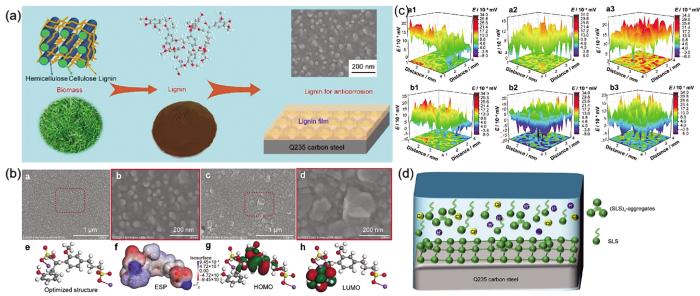
图3
SLS制备流程图,SLS在1 mol·L-1 HCl中分散的SEM图及密度泛函化计算,碳钢在1 mol·L-1 HCl中不同浸泡时间后的电位差分布及SLS对Q235碳钢盐酸溶液中缓蚀机理示意图[43]
Fig.3
SLS preparation flow chart (a), SEM image and density functional calculation of SLS dispersion in 1 mol·L-1 HCl (b), the potential difference distribution of carbon steel after different soaking time in 1 mol·L-1 HCl: A1-A30 mg·L-1 SLS was added for 0.5, 3 and 12 h; b1-b3 20 mg·L-1 SLS 0.5, 3, 12 h (c), schematic diagram of inhibition mechanism of (d) SLS on Q235 carbon steel in hydrochloric acid solution (d)[43]
图4
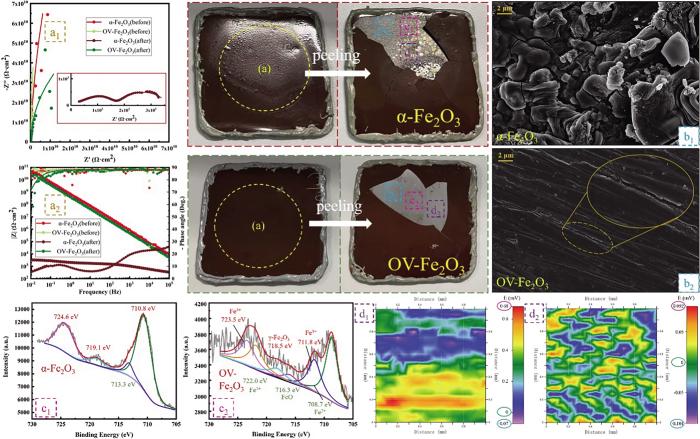
图4
高压氧腐蚀后α-Fe2O3涂层和(2) OV-Fe2O3涂层的外观与基板状态,以及对基板表面的表征结果
Fig.4
Appearance and substrate state of α-Fe2O3 coating and (2) OV-Fe2O3 coating after hyperbaric oxygen corrosion, and characterization results of substrate surface: (a) EIS, (b) SEM, (c) XPS, (d) SVET
Forget等[45]以正戊烷磷酸对Al的表面改性为切入点。采用SVET进行了系统研究,发现未改性的Al表面的腐蚀电流密度较高,且分布不均匀,采用正戊烷磷酸改性工艺改性的Al表面电流密度较低且分布均匀,而采用正戊烷磷酸乙醇改性工艺的Al表面电流密度也较低但是存在一些不均匀分布。说明水溶液中金属表面吸附的正戊烷磷酸分子更多且均匀性更好。
Montemor等[46]通过对比实验探究了硝酸铈/硝酸镧预处理工艺对AZ31镁合金耐蚀性的影响。研究采用XPS、俄歇电子能谱学(AES)和SVET技术,系统分析了不同预处理条件下合金在0.005 mol/L NaCl溶液中的腐蚀行为。数据表明:硝酸铈预处理后,合金表面膜层中检测到稀土阳离子富集;Cl-环境中,预处理可显著抑制AZ31的腐蚀反应,且保护效果与处理时长呈正相关性。该研究为镁合金表面改性工艺优化提供了实验依据。
Jamil等[47]聚焦于钢筋浸在含有4%氨基醇基缓蚀剂中的腐蚀抑制行为。研究表明,缓蚀剂吸附到钢筋表面后,初始会引起表面活性的升高,随后阳极活性完全被抑制。
2.3 缓蚀剂在异种材料防护中的应用监测
在腐蚀体系中,金属表面由于成分、组织的不均匀性以及环境因素的差异,会形成众多微小的腐蚀电池,这些微电池驱动着腐蚀反应的进行。缓蚀剂的作用之一是抑制腐蚀微电池的活性。采用SVET技术可以清晰地观察到缓蚀剂对腐蚀微电池阴阳极反应的影响。通过分析SVET得到的电流分布图像,还可以进一步了解缓蚀剂对腐蚀微电池分布和活性的影响规律,为优化缓蚀剂配方和提高防护效果提供依据。
图5
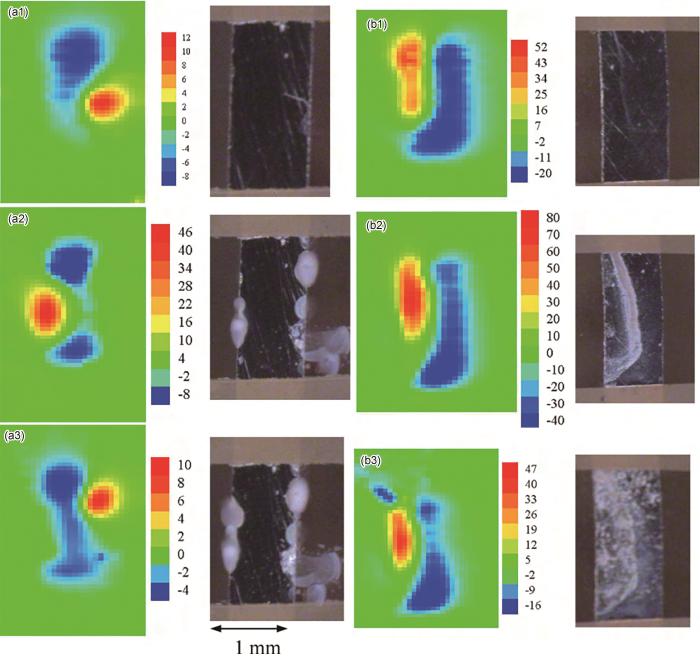
Mouanga等[39]通过SVET研究了铈盐对铁/铝电偶腐蚀的抑制作用,并研究了铈盐浓度和阴离子对抑制效率和保护机制的影响。表明铈盐主要是通过降低阴极活性来抑制铁/铝电偶的腐蚀。
3 SVET在缓蚀剂性能评估中的应用
3.1 缓蚀效率的定量测定
缓蚀效率是衡量缓蚀剂性能的关键指标。SVET通过测量添加缓蚀剂前后金属表面离子电流密度的变化,可以准确地计算缓蚀效率。其计算原理主要是基于法拉第定律,即腐蚀电流与金属腐蚀速率成正比。与传统的失重法、电化学极化曲线法等缓蚀效率测定方法相比,SVET具有测量速度快、无需破坏样品、能够反映金属表面微区腐蚀情况等优点,为缓蚀剂性能的快速准确评估提供了有力手段[49]。
图6
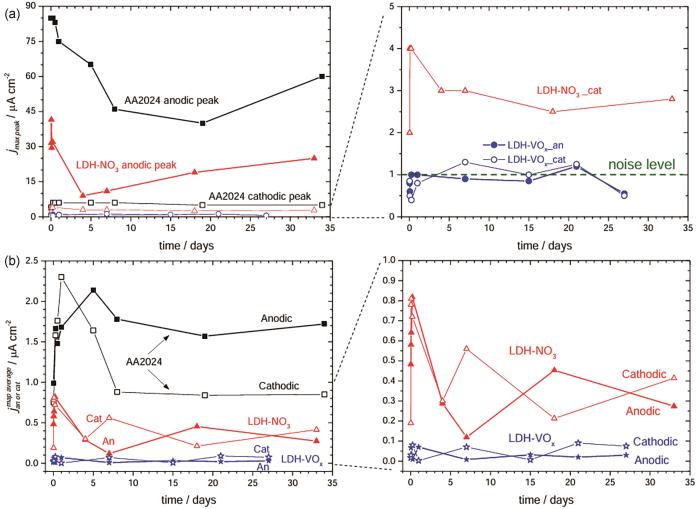
3.2 缓蚀剂长期稳定性评估
缓蚀剂在实际应用中的长期稳定性至关重要。SVET能够在长时间内对金属表面的腐蚀活性进行实时监测,从而评估缓蚀剂的长期缓蚀性能。通过将金属样品浸泡在含有缓蚀剂的腐蚀介质中,利用SVET定期测量金属表面的离子电流密度分布,观察其随时间的变化趋势。如在研究用于钢铁防护的有机缓蚀剂的长期稳定性时,可通过SVET进行长期连续监测钢铁表面的腐蚀电流密度,进而表征缓蚀效果。通过分析不同时间点的电流分布图像,还可以了解缓蚀剂在长期使用过程中对金属表面腐蚀区域的缓蚀情况,以及是否出现局部失效等问题,为缓蚀剂的实际应用提供重要参考[51]。白云龙等[52]采用SVET分析考察硫脲基咪唑啉季铵盐(IM-S1)缓蚀剂对X80管线钢在3种不同pH的模拟油田水溶液中的缓蚀性能。结果表明:在pH7.2的测试条件下,管线钢表面吸附成膜性要优于其他两种测试条件。陈晓华等[53]采用扫描振动电极技术(SVET)原位研究钼酸钠对HRB400钢腐蚀活性的影响,结果表明:不含钼酸钠体系中试样的阴阳极电流密度较高,添加钼酸钠后,试样的电化学活性显著降低。此外,2种溶液体系中试样的阳极活性大于阴极活性,并且随着浸泡时间延长,局部阳极反应逐渐被削弱,发生腐蚀概率减小。
3.3 不同缓蚀剂性能对比
在缓蚀剂的研发和应用过程中,常常需要对多种缓蚀剂的性能进行对比筛选。SVET能够在相同的实验条件下,快速、准确地测量不同缓蚀剂作用下金属表面的腐蚀活性,从而直观地对比它们的缓蚀效果。利用SVET测量添加不同缓蚀剂后金属表面的电流密度分布,可以清晰地比较不同缓蚀剂的性能差异,为选择最合适的缓蚀剂提供科学依据。
图7

Bastos等[55]以商品涂层、Zn粉、纯Zn板为研究对象,以0.05 mol·L-1 NaCl为介质,通过SVET对两种无机缓蚀剂(Ce(NO3)3和La(NO3)3)、两种有机缓蚀剂(苯并三唑和2-巯基苯并噻唑)改性效果进行了评价。研究结果表明,试验所用缓蚀剂均可降低Zn的腐蚀,有机缓蚀剂效果最好。
4 SVET在新型缓蚀剂开发中的应用
4.1 缓蚀剂成分筛选与优化
在新型缓蚀剂的开发过程中,需要从众多的缓蚀剂中筛选出具有良好缓蚀性能的物质,并对其配方进行优化。SVET可以快速评估不同成分对金属腐蚀的抑制效果,为成分筛选提供高效的手段。研究人员通常会合成一系列具有不同结构或官能团的化合物作为潜在的缓蚀剂成分,然后利用SVET分别测量这些化合物在不同浓度下对金属表面离子电流密度的影响,进而获得缓蚀性能优异的缓蚀剂。
李向红团队[56]采用失重法、SVET和表面表征等评估了菜籽粕提取物(RME)对HCl介质中铝腐蚀的抑制性能。RME通过抑制阴极反应显著提高了电化学反应的电荷转移电阻。RME可以自发地吸附在铝表面形成保护膜,这种吸附行为与Langmuir吸附等温线模型一致。此外,这种低自由体积分数和自扩散系数的吸附膜可以强烈延缓HCl介质中铝的腐蚀,最高抑制效率为99.0%。
4.2 缓蚀剂协同作用研究
将多种缓蚀剂成分复配使用,利用它们之间的协同作用可以提高缓蚀效果。SVET能够深入研究缓蚀剂之间的协同作用机制,为优化复配缓蚀剂配方提供理论支持。通过SVET测量不同缓蚀剂单独使用以及复配使用时金属表面的电流密度分布和变化情况,可以分析缓蚀剂之间的相互作用方式和协同效应。
Coelho等[57]针对典型的铝/铜电偶模型,开展了SVET分析研究。在氯化钠溶液中,分别评估了苯并三氮唑(BTA)和氯化铈(CeCl3)单独使用及复配对Al/Cu模型的抑制作用,验证了缓蚀剂的协同作用。通过为其测得的SVET电流密度图,并采用紫外分光光度法和ToF-SIMS等补充技术来研究BTA分子的分解,并确定了BTA基/铈基缓蚀剂膜的化学成分。
4.3 智能缓蚀剂响应特性研究
智能缓蚀剂及涂层因其能够根据环境变化自动调节缓蚀性能而受到广泛关注,它们将在保护层出现缺陷和基体表面暴露时开始起作用,可以有效地抑制腐蚀,并使保护层的受损区域愈合。SVET可以实时监测智能缓蚀剂在不同环境条件下的响应特性,评估其智能调控能力,为智能缓蚀剂的性能优化和实际应用提供了重要数据支持。
图8
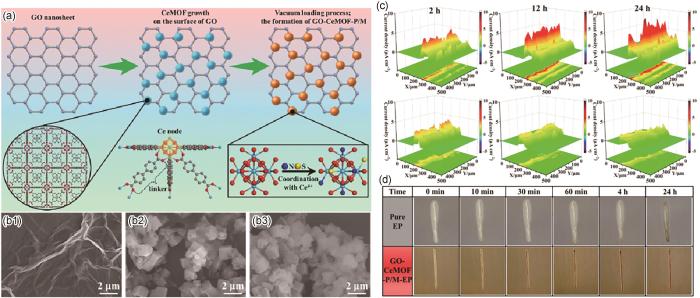
图8
GO-CeMOF-P/M复合材料制备示意图及SEM图像,引入划痕后EP和GO-CeMOF-P/M-EP涂层浸泡24 h的SVET电流密度图及盐雾结果[58]
Fig.8
Schematic diagram (a) and SEM image of Go-Cemof-P/M composite material preparation (b), SVET current density diagram and salt spray results of EP and (c) GO-CeMOF-P/M-EP coatings soaked for 24 h after scratch introduction (d)[58]
图9
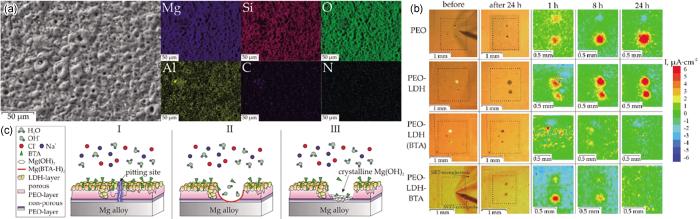
Tian等[60]以8-羟基喹啉为改性填料提高溶胶-凝胶法制得的硅烷基涂层的耐蚀性。采用SVET对涂层缺陷处进行了分析和研究,结果表明8-羟基喹啉可以有效阻止涂层缺陷处的腐蚀,降低腐蚀电流密度。
5 SVET技术未来发展方向
尽管SVET在缓蚀剂应用研究中具有较多优势,但未来仍面临一些挑战:
6 研究成果总结
SVET作为一种先进的微区电化学测量技术,在缓蚀剂研究领域得到了广泛的应用:
(1) 在缓蚀剂作用机制研究方面,借助SVET技术,研究者成功揭示了金属/缓蚀剂界面电荷转移机制,清晰观察到缓蚀剂的吸附行为与成膜过程,为从微观层面理解缓蚀剂的作用原理提供了关键依据。
(2) 在缓蚀剂性能评估方面,利用SVET技术可以定量测定缓蚀效率,可靠评估缓蚀剂的长期稳定性,直观对比不同缓蚀剂的性能差异,为缓蚀剂的筛选和应用提供了科学、高效的手段。
(3) 在新型缓蚀剂开发方面,SVET技术为缓蚀剂成分筛选与优化提供了有力支撑,助力研究者深入探究缓蚀剂协同作用机制,有效评估智能缓蚀剂的响应特性,显著推动了新型、高效缓蚀剂的研发进程。
参考文献
Hydrophobic and anticorrosion properties of thin phosphonate-siloxane films formed on a laser textured zinc surface
[J].
Mechanism of temperature influence on adsorption of Schiff Base
[J].
温度影响席夫碱缓蚀剂吸附的机理研究
[J].
研究了所合成的两种含有苯基基团的席夫碱缓蚀剂 (BB-S缓蚀剂和B-S缓蚀剂) 在不同温度下对N80钢在0.5%盐酸溶液中的缓蚀作用,探讨了温度影响席夫碱缓蚀剂的吸附机理。结果表明,BB-S缓蚀剂和B-S缓蚀剂的缓蚀效率随着温度的升高而降低,且B-S缓蚀剂的缓蚀效率在不同温度下始终大于BB-S缓蚀剂的缓蚀效率。分子动力学和量子化学计算方法表明,两种席夫碱缓蚀剂的缓蚀效率随温度的升高而降低,该现象与席夫碱缓蚀剂中苯环较大的空间位阻、分子热运动、分子吸附构型以及前线轨道能级密切相关。
Triazoles as a class of multifunctional corrosion inhibitors. Review. Part II. 1,2,3-Benzotriazole and its derivatives. Iron and steels
[J].
Preparation of superhydrophobic surface on copper substrate and its corrosion resistance
[J].
铜基超疏水表面的制备及其耐蚀性研究
[J].以十二硫醇作为疏水剂,采用化学刻蚀和高温氧化在铜基体上构造超疏水表面,以提高铜基体的耐蚀性。结果表明,当化学刻蚀8 min、高温氧化6 h、十二硫醇修饰15 min,基体表面形成了具有足够粗糙度并可以捕获大量空气的网状层叠结构,此时基体表面疏水性最好,水的接触角为165.50°。动电位极化曲线表明,超疏水表面的腐蚀速率明显降低,腐蚀电流密度由7.43×10<sup>-5</sup>下降至4.31×10<sup>-6</sup> A·cm<sup>-2</sup>。电化学阻抗谱表明,超疏水表面的电荷转移电阻明显高于铜基体,说明其具耐蚀性相较于铜基体也得到了提高。与当前制备超疏水表面的方法相比,本方法具有廉价、简单、环保的特点。
Improvement of the fatigue resistance and increase its life of specimens of naval brass alloy using laser shock wave processing
[J].
Corrosion behavior of 300M ultra high strength steel in simulated marine environment
[J].
300M超高强度钢在模拟海洋环境中的腐蚀行为研究
[J].
Gravimetrical and surface morphology studies of corrosion inhibition effects of a 4-aminoantipyrine derivative on mild steel in a corrosive solution
[J].
Electrochemical study on newly synthesized chlorocurcumin as an inhibitor for mild steel corrosion in hydrochloric acid
[J].A new curcumin derivative,, (1E,4Z,6E)-5-chloro-1,7-bis(4-hydroxy-3-methoxyphenyl)hepta-1,4,6-trien-3-one (chlorocurcumin), was prepared starting with the natural compound curcumin. The newly synthesized compound was characterized by elemental analysis and spectral studies (IR, ¹H-NMR and C-NMR). The corrosion inhibition of mild steel in 1 M HCl by chlorocurcumin has been studied using potentiodynamic polarization (PDP) measurements and electrochemical impedance spectroscopy (EIS). The inhibition efficiency increases with the concentration of the inhibitor but decreases with increases in temperature. The potentiodynamic polarization reveals that chlorocurcumin is a mixed-type inhibitor. The kinetic parameters for mild steel corrosion were determined and discussed.
Preparation and corrosion inhibition of super hydrophobic adsorption film of lotus leaf extract on mild steel
[J].
Q235钢表面的超疏水吸附层形成与缓蚀研究
[J].用新鲜荷叶作为研究对象,经过简便的乙醇回流萃取取得提取物。室温条件下,荷叶提取物能够在THF/HCl水溶液的混合溶液 (体积比为1/1,1.0 mol/L HCl溶液) 中产生聚集。傅立叶变换红外光谱以及X射线光电子能谱的结果证明了荷叶提取物在Q235钢样品表面发生化学作用,能够形成超疏水的吸附层。电化学结果表明荷叶提取物对碳钢在HCl溶液中具备良好的缓蚀性能,在0.4 g/L浓度下,最大缓蚀效率达到93.14%。
Corrosion inhibition on carbon steel in acidic solution by carbon dots prepared from waste longan shells
[J].
酸性介质中桂圆壳碳点对碳钢的缓蚀性能研究
[J].为开发环境友好、高缓蚀效率的新型缓蚀剂,以桂圆壳生物质为碳源,通过煅烧法和水热法分别合成桂圆壳碳点 (longan shell-CDs,ls-CDs) 和氮掺杂桂圆壳碳点 (N-lsCDs)。在此基础上,本文通过FT-IR、XPS、TEM、电化学方法、荧光光谱分析 (FL) 和静态失重法等手段对其光学性质、结构组成和缓蚀性能进行了测定分析。结果表明:在1 mol·L<sup>-1</sup> HCl体系中,当ls-CDs和N-lsCDs的浓度为100和20 mg·L<sup>-1</sup>时,对Q235钢的缓蚀效率分别达到89.49%和92.41%。尤其是N-lsCDs,具有投加量低、原料废物利用、缓蚀性能优异的特点。极化曲线测试表明N-lsCDs为混合型抑制剂,并且N-lsCDs在碳钢表面的吸附符合Langmuir吸附等温式,同时存在物理吸附与化学吸附。利用生物质为原料制备环保新型缓蚀剂能够变废为宝,具有诱人的潜在应用前景。
Effect of nitrogen doping on corrosion inhibition performance of carbon nanoparticles
[J].
氮掺杂对碳纳米颗粒缓蚀性能的影响
[J].
Electrochemical properties of micro area of 5083 aluminum alloy in 3%NaCl solution
[J].
5083铝合金在3%NaCl溶液中的微区电化学特性
[J].
Localized electrochemical methods applied to cut edge corrosion
[J].
A comparison between conventional macroscopic and novel microscopic scanning electrochemical methods to evaluate galvanic corrosion
[J].
Emulation and study of the corrosion behavior of Al alloy 2024-T3 using a wire beam electrode (WBE) in conjunction with scanning vibrating electrode technique (SVET)
[J].
Use of SVET and SECM to study the galvanic corrosion of an iron-zinc cell
[J].
SVET characterization of localized corrosion of welded X70 pipeline steel in acid solution
[J].
X70钢焊接接头在酸性溶液中的局部腐蚀SVET研究
[J].
Dissolution characteristics of duplex stainless steels in acidic environments
[J].
SVET, AFM and AES study of pitting corrosion initiated on MnS inclusions by microinjection
[J].
Inhibition of Aluminium Alloy AA2024-T3 pitting corrosion by copper complexing compounds
[J].
Location of corrosion on iron and carbon steel surfaces with crevices
[J].
Initiation of stress corrosion cracking of sensitized type 304 stainless steel in dilute thiosulfate solution
[J].
Pitting corrosion by bacteria on carbon steel, determined by the scanning vibrating electrode technique
[J].
Correlation between localized anodic areas and Oceanospirillum biofilms on copper
[J].
Local analysis of oxygen reduction catalysis by scanning vibrating electrode technique: A new approach to the study of biocorrosion
[J].
The use of the scanning vibrating electrode technique for detecting defects in ion vapor-deposited aluminum on steel
[J].Defects in ion vapor-deposited aluminum coatings on steel exposed to a 0.3 M H3BO4 solution adjusted to pH 8 were detected in situ. The nonaggressive borate solution was chosen to prevent any significant damage to the coating during defect location. The defects were located using a scanning vibrating probe electrode which measured the distribution of current density (CD) above the surface of the coated steel. The vibrating electrode technique enabled polarization measurements of specific areas of the surface to be made. The polarization measurements of the defect sites showed that they were not a result of exposed steel but were caused by the presence of inclusions.
Local Probe Techniques for Corrosion Research
[M].
Effects of mechanical forming on the corrosion of electrogalvanised steel
[J].
Determination of current maps by SVET of hot-dip galvanized steel under simultaneous straining
[J].
An apparatus for the examination of localized corrosion behavior
[J].A potential measuring device has been developed which allows the distribution of potential on a specimen surface to be determined and displayed and at the same time the levels of potential to be recorded. This equipment permits the study of corrosion on metallic surfaces under well defined environmental conditions and the direct study of the origin and propagation of pits in metals. The electrochemical data is related to the metallurgical features of the metallic surface.
Applications of the scanning reference electrode technique to localized corrosion
[J].
Electrochemical potential mapping of a rapidly solidified processed light alloy
[J].
Photoelectrochemical investigation of corrosion using scanning electrochemical techniques
[J].
Mechanistic changes in cut-edge corrosion induced by variation of organic coating porosity
[J].
Artifacts induced by large-amplitude probe vibrations in localized corrosion measured by SVET
[J].
Review—On the application of the scanning vibrating electrode technique (SVET) to corrosion research
[J].
SVET method for characterizing anti-corrosion performance of metal-rich coatings
[J].
Modified nano-lignin as a novel biomass-derived corrosion inhibitor for enhanced corrosion resistance of carbon steel
[J].
A localized approach to study the effect of cerium salts as cathodic inhibitor on iron/aluminum galvanic coupling
[J].
Cerium salt activated nanoparticles as fillers for silane films: Evaluation of the corrosion inhibition performance on galvanised steel substrates
[J].
Localized corrosion behavior studies by SVET of 1010 steel in different concentrations of sodium chloride containing [m-2HEA][Ol] ionic liquid as corrosion inhibitor
[J].
Corrosion studies using the scanning vibrating electrode technique (SVET)-A brief review
[J].
Carbon steel anticorrosion performance and mechanism of sodium lignosulfonate
[J].\n Lignin is a typical biological macromolecule with a three‐dimensional network structure and abundant functional groups. It has excellent ionic complexation ability and amphiphilic molecular structure characteristics. In this study, the carbon steel anticorrosion performance of sodium lignosulfonate (SLS) in an acid solution was evaluated using the weight loss method, electrochemical measurements, scanning vibration electrode technique (SVET), and surface characterization methods. SLS exhibited excellent corrosion inhibition efficiency for Q235 carbon steel in 1 mol·L\n ‐1\n HCl, reaching a maximum value of 98%. A low SLS concentration of 20 mg·L\n ‐1\n resulted in the maximum corrosion inhibition efficiency, which remained nearly constant at higher SLS concentrations. The SVET test demonstrated that the formation of an SLS adsorption film can impede corrosion. This study confirms the significance of the application of green biomass resources in the field of metal corrosion protection and green functional materials.\n
Oxygen vacancy modified α-Fe2O3 nanorods provide an environment-friendly and efficient anti-corrosion passive film into polymer coating
[J].
Surface modification of aluminum by n-pentanephosphonic acid: XPS and electrochemical evaluation
[J].
Characterization of rare-earth conversion films formed on the AZ31 magnesium alloy and its relation with corrosion protection
[J].
Electrochemical behaviour of amino alcohol-based inhibitors used to control corrosion of rein forcing steel
[J].
Studying phosphate corrosion inhibition at the cut edge of coil coated galvanized steel using the SVET and EIS
[J].
Cut-edge corrosion behavior assessment of newly developed environmental-friendly coating systems using the Scanning Vibrating Electrode Technique (SVET)
[J].
Corrosion protection of AA2024-T3 by LDH conversion films. Analysis of SVET results
[J].
Insitu SVET studies on the current density distribution on dissolving of Mg, MgZn2, Mg2Si and Al4Cu2Mg8Si7 surfaces in NaCl solutions
[J].This paper aims to acquire the current density distribution on dissolving of Mg, MgZn2 (η -phase), Mg2Si (ß-phase) and Al4Cu2Mg8Si7 (Q-phase) surface in NaCl solutions.
Effect of thiourea imidazoline quaternary ammonium salt corrosion inhibitor on corrosion of X80 pipeline steel
[J].
硫脲基咪唑啉季铵盐缓蚀剂对X80管线钢腐蚀的影响
[J].
Inhibition behavior of low alloy steel by sodium molybdate in simulated concrete pore Solution containing chlorine
[J].
钼酸钠在含氯模拟混凝土孔隙液中对低合金钢的缓蚀行为研究
[J].
Corrosion inhibition by chromate and phosphate extracts for iron substrates studied by EIS and SVET
[J].
A SVET investigation on the modification of zinc dust reactivity
[J].
Agricultural by-product of rapeseed meal extract as a highly efficient inhibitor for aluminum corrosion in HCl media: Experimental and theoretical studies
[J].
A SVET study of the inhibitive effects of benzotriazole and cerium chloride solely and combined on an aluminium/copper galvanic coupling model
[J].
Intelligent marine waterborne epoxy coating based on functionalized multiscale nanocomposite: Mechanical enhancement, self-reporting, and active/passive anti-corrosion
[J].Corrosion activities and related accidents are significant issues for marine facilities, leading to considerable economic losses. Waterborne epoxy (EP) coating has been seen as one of the optimal options for corrosion protection due to its stable properties and eco-friendliness (0 g/L volatile organic compounds). Nevertheless, several intrinsic deficiencies require improvement, such as fragile mechanical properties and defects (macro and micro), resulting in the continuous deterioration of comprehensive coating performances. In this work, a novel nanocomposite coating with mechanical enhancement, intelligent self-reporting, and active protection is fabricated by integrating the functionalized and compatible graphene oxide/cerium based metal-organic framework multiscale structure (GO-CeMOF-P/M). Notably, the homogenous dispersion of GO-CeMOF-P/M and its chemical interaction with the polymer matrix effectively reduces the defects resulting from solution volatilizing and enhances the compactness, which boosts the tensile strength (32.1 MPa/8.5 %) and dry adhesion force (5.8 MPa) of the coating. Additionally, the controllable responsiveness and release of multiscale nanocomposite within external environments endow intelligent active protection and self-reporting characteristics for the GO-CeMOF-P/M-EP coating, making it especially suitable for a variety of practical marine applications. Furthermore, following immersion of 80 d in the aggressive environment, <em>Z<sub>f</sub></em><sub>=0.01 Hz</sub> value of GO-CeMOF-P/M-EP coating is 1.2 × 10<sup>10</sup> Ω cm<sup>2</sup>, which is 164.4 times larger than that of EP coating (7.3 × 10<sup>7</sup> Ω cm<sup>2</sup>), demonstrating remarkably strengthened anti-corrosion ability. Consequently, by offering an intriguing design strategy, the current work anticipates addressing the inherent deficiencies of EP coating and facilitating its practicality and feasibility in real sea environments.
Design of self-healing PEO-based protective layers containing in-situ grown LDH loaded with inhibitor on the MA8 magnesium alloy
[J].
Inhibiting effect of 8-hydroxyquinoline on the corrosion of silane-based sol-gel coatings on AA 2024-T3
[J].
Ion transport and the vibrating probe
[J].The theory of ion transport in the vicinity of a vibrating probe is developed. It is shown that the convection loops produced by the probe will not affect the electrical current density, assuming that the action of the probe does not affect the sources of the current in the biological system. However, the convection loops will significantly alter the ion concentration gradients in the unstirred layer near a tissue or cell surface. The concentration gradients within each convection loop will be reduced, while the concentration gradients between the loops and outside of the loops will be increased relative to the gradients existing without the probe. As a consequence, the electrical potential gradients can be changed relative to the potential gradients existing in the absence of the convection caused by the probe. If the mobility of the ion species carrying the electrical current is greater than the average ion mobility in the medium, then a decrease in ion concentration gradient will be accompanied by an increase in electrical potential gradient, while an increase in concentration gradient will be accompanied by a decrease or even a reversal of electrical potential gradient. Thus, the electrical potential gradient measured by the probe will depend on the concentration gradient in the vicinity of the probe, which will depend in turn on the spatial relation of the convection loops to the probe. An example of the effect of the convection loops on ion concentration and electrical potential is obtained from the theory via a numerical computer calculation. Experimental tests of this theory are discussed.
Local electrochemical impedance measurement: Scanning vibrating electrode technique in ac mode
[J].
Simulation of the role of vibration on Scanning Vibrating Electrode Technique measurements close to a disc in plane
[J].
The influence of vibration and probe movement on SVET measurements
[J].
Corrosion inhibition of aluminum in HCl solution by Flos Sophorae Immaturus extract [J] J
槐米提取物对Al在HCl溶液中的缓蚀作用
[J].利用超声波提取法对槐米 (FSI) 进行提取得到槐米提取物 (FSIE),并采用失重法和电化学法研究了FSIE作为缓蚀剂对Al在1.0 mol/L HCl溶液中的缓蚀作用,同时通过红外光谱 (FTIR) 测定了FSIE及Al表面缓蚀膜层的官能团结构。FSIE对Al在1.0 mol/L HCl溶液中有明显的腐蚀抑制效果,缓蚀性能随着FSIE浓度增大而增强;温度升高,缓蚀性能减弱;当温度为20 ℃,FSIE浓度为500 mg/L时,缓蚀率η<sub>w</sub>达到了83.2%。FSIE在Al表面的吸附符合Langmuir吸附等温式,吸附作用类型为以物理吸附为主的物理和化学相结合的混合吸附。动电位极化曲线表明FSIE为阴极抑制型缓蚀剂,Nyquist图谱的高频区容抗弧随FSIE浓度的增大而明显增大,铝/酸界面的电荷转移电阻增大。从微观表面形貌可看出,在添加FSIE的HCl溶液中,Al表面的腐蚀程度和粗糙度明显减小。
Multi-ion transport and reaction model used to improve the understanding of local current density measurements in presence of concentration gradients around a point current source
[J].
Finite-element method approach to the problem of the IR-potential drop and overpotential measurements by means of a Luggin-Haber capillary
[J].
Ionic current densities in the nearfield of a corroding iron-copper galvanic couple
[J].
Numerical modeling and solution of galvanic corrosion systems: Part I. Governing differential equation and electrodic boundary conditions
[J].This is the first in a pair of papers describing the development of the computational corrosion analysis accomplished at the Naval Underwater Systems Center and the University of Connecticut over the past decade. This paper outlines the mathematical representation of the corrosion problem to be solved in terms of the partial differential equation which describe electric fields in a conductive medium and the boundary conditions which describe the nonlinear electrode kinetics of corroding metals.
Validated numerical modelling of galvanic corrosion for couples: Magnesium alloy (AE44)-mild steel and AE44-aluminium alloy (AA6063) in brine solution
[J].
Research progress of scanning vibrating electrode technique in field of corrosion
[J].
扫描振动电极技术在腐蚀领域的应用进展
[J].概述了扫描振动电极技术的基本原理,并重点对该技术在材料局部腐蚀、缓蚀剂和涂层性能评价等方面的应用进展进行了阐述,最后对其目前应用的局限性进行了总结。
Numerical modeling of micro-galvanic corrosion
[J].


