



核能作为低碳基荷电源的重要组成部分,其可持续发展高度依赖闭式燃料循环体系的完善[1]。但目前我国乏燃料后处理能力有较大的产能缺口[2]。这一矛盾突显了发展乏燃料后处理产业、提升核燃料循环效率的战略意义。在闭式循环体系中,PUREX湿法工艺是乏燃料后处理的主流技术[2,3]。该工艺首端采用沸腾硝酸溶解燃料芯块[2],致使关键设备材料长期暴露于高温(通常60~120 ℃)、高浓度硝酸(沸点浓度可达~6M以上)的极端严苛腐蚀环境[4]。此外,实际后处理过程中(如溶解含锰包壳、引入含锰试剂等)会产生Mn2+。因此,设备材料在硝酸浓度、溶液温度及Mn2+浓度综合作用下的耐蚀性能,直接决定了设备的安全性与服役寿命。
本研究旨在系统揭示硝酸浓度、Mn2+浓度及溶液温度三因素及其交互作用对C25和304L两种不锈钢在模拟乏燃料后处理环境中腐蚀行为的影响。特别聚焦于硝酸浓度与Mn2+浓度交互影响:研究不同浓度Mn2+ (0.1~10 g/L)在低中浓度硝酸(如3 mol/L和6 mol/L)中对材料腐蚀速率和钝化特性的影响;温度与Mn2+浓度交互影响:探讨宽温域(60 ℃至沸点)下Mn2+浓度对不锈钢腐蚀行为的影响;三因素协同作用机制:阐明硝酸浓度、Mn2+浓度及温度三者共同作用下不锈钢的腐蚀形态演变(特别是局部腐蚀敏感性)及表面钝化膜的演变机制。
本研究将综合运用电化学测试(EIS、动电位极化)、不同腐蚀环境下的浸泡实验及表面微观分析(SEM/EDS、XPS)等多种技术手段获取实验数据,结合RSM建模分析,定量解析关键环境因素及其交互作用对两种不锈钢腐蚀速率、钝化行为及局部腐蚀敏感性的作用规律与机制。研究成果将为乏燃料后处理设备的选材优化、工艺参数安全区间确定及腐蚀防护策略制定提供更为精准的理论依据和数据支撑,对保障核设施长期安全运行具有重要的科学意义与工程价值。
1 实验方法
1.1 材料、样品和溶液
表1 C25和304L不锈钢的化学成分 (mass fraction / %)
Table 1
| Samples | Fe | Cr | Ni | Si | Mo | Mn | C | P | S |
|---|---|---|---|---|---|---|---|---|---|
| 304L | Bal. | 18.16 | 8.04 | 0.39 | - | 1.56 | 0.018 | 0.027 | 0.002 |
| C25 | Bal. | 24.80 | 21.54 | < 0.05 | 0.031 | 0.34 | < 0.005 | < 0.005 | < 0.005 |
图1

图1
C25和304L不锈钢的金相组织
Fig.1
Metallographic structure of C25 (a) and 304L (b) stainless steels
用于高温硝酸环境电化学测试的样品为特殊设计的“T”形结构(图2)。暴露于溶液的测试部分尺寸为10 mm × 10 mm × 3 mm,导线连接部分为ϕ4 mm × 10 mm的圆柱体。铜线焊接于圆柱体顶部,并用聚四氟乙烯(PTFE)套管封装,确保与硝酸溶液有效隔离。每个电化学样品的有效暴露面积约为3.3 cm2。测试前,样品测试部分依次经SiC砂纸打磨至800#,再经去离子水和无水乙醇清洗,最后用冷风吹干。
图2

用于浸泡实验、腐蚀形貌观察及表面成分分析的样品尺寸为10 mm × 10 mm × 3 mm。样品一侧打孔,便于浸泡悬挂。样品经SiC砂纸逐级打磨至3000#,并采用金刚石抛光膏进行机械抛光。预磨与抛光后,样品依次经去离子水和无水乙醇清洗,冷风吹干备用。
实验基础溶液为3和6 mol/L硝酸溶液,由去离子水与分析纯65% (质量分数)浓硝酸配制而成。添加的Mn2+源自分析纯Mn(NO3)2(H2O)4试剂。依据后处理厂数据,实验设置Mn2+浓度分别为0.1、1、5和10 g/L。
1.2 电化学测试
电化学测试在含不同浓度Mn2+的3和 6 mol/L 热硝酸溶液中进行。所有测量均在60和80 ℃及沸腾状态下完成。实验使用配备三电极系统的玻璃电解池,并采用Reference 620型电化学工作站进行测试。工作电极为C25和304L两种不锈钢试样,对电极为铂片,参比电极为饱和甘汞电极(SCE)。参比电极通过盐桥与测试溶液连通,盐桥两端填充纳米多孔陶瓷塞,并预先注入硝酸溶液以确保高温稳定性。实验开始时,首先监测开路电位(OCP) 30 min,确认系统达到稳定状态。随后进行电化学阻抗谱(EIS)测试,在OCP基础上叠加10 mV振幅的交流电压信号,频率范围为105~10-1 Hz。之后,以0.5 mV/s的扫描速率进行动电位极化曲线(PD)测量,起始电位低于OCP 500 mV,终止电位略高于过钝化电位(Etr)。Etr定义为阳极电流密度单调增长并超过80~100 μA/cm2时对应的电位[4]。为确保数据可靠性与可重复性,所有电化学测量均重复3次。
1.3 浸泡实验及腐蚀形貌、表面成分分析
在浸泡实验中,为确保结果具有良好的重现性,实验设计采用了3组平行样品进行测试。实验开始前,将抛光后的C25和304L样品依次用去离子水和乙醇冲洗、吹干并称重,记录其初始质量。随后,将样品分别置于含有不同浓度(0.1、1、5和10 g/L) Mn2+的3和6 mol/L沸腾硝酸溶液中,浸泡48 h。实验结束后,样品依次用蒸馏水和无水乙醇冲洗,冷风吹干后立即称重,记录浸泡后质量。基于样品的质量损失(W)、总表面积(S)、密度(D)和时间(T),通过
浸泡实验后的C25和304L不锈钢样品,采用扫描电子显微镜(SEM, INSPECT F50)观察表面腐蚀形貌,并利用X射线光电子能谱仪(XPS, ESCALAB250)分析表面成分。XPS测试使用单色Al Kα X射线源,功率设定为100 W,光电子起飞角为90°,分析区域为直径500 μm的光斑。在通能50 eV、步长0.1 eV的条件下,获取Cr 2p、Fe 2p、Ni 2p、Mn 2p和O 1s的高分辨谱。结合能以284.6 eV的C 1s峰为参考进行校准后,应用XPSPEAK4.1软件对高分辨谱进行拟合,确定钝化膜中元素的化学价态。XPS拟合过程采用高斯-洛伦兹混合函数和Shirley背景扣除法。所有用于拟合的结合能均参考了文献报道值[7,20,21]。
2 实验结果
2.1 电化学测试结果
图3为C25和304L不锈钢在含不同浓度Mn2+、不同温度的3和6 mol/L硝酸溶液中的开路电位(OCP)变化。在3 mol/L硝酸溶液中,随浸泡时间延长,二者的OCP逐渐正移趋稳;然而,随Mn2+浓度增加,两种材料的OCP未呈现一致变化趋势。在6 mol/L硝酸溶液中,二者的OCP随Mn2+浓度及时间的变化均不显著。温度升高时,两种材料的OCP均出现不同程度正移,且在3 mol/L硝酸溶液中的增幅高于6 mol/L硝酸溶液。
图3
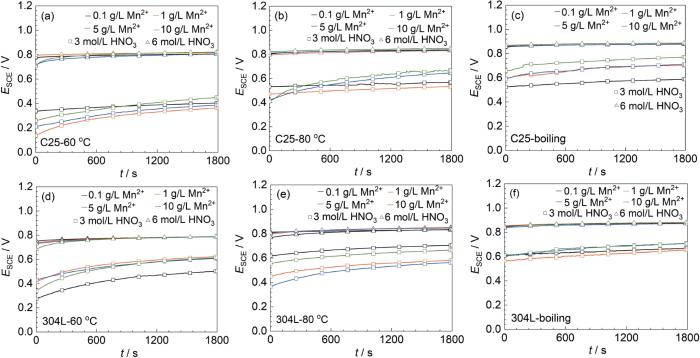
图3
C25和304L不锈钢在含有不同浓度Mn2+、不同温度的3 mol/L和6 mol/L硝酸溶液中的开路电位(OCP)测试结果
Fig.3
OCP measurement results of C25 (a-c) and 304L (d-f) stainless steels in 3 mol/L and 6 mol/L nitric acid solutions at different temperatures and Mn2+ concentrations
图4为C25和304L不锈钢在含不同Mn2+浓度、不同温度的3与6 mol/L硝酸溶液中的动电位极化曲线。对极化曲线进行阴极Tafel斜率拟合的结果列于表2。总体而言,Mn2+浓度对两种不锈钢腐蚀行为的影响缺乏一致规律。在3 mol/L硝酸溶液中,随着Mn2+浓度增加,多数情况下C25和304L不锈钢的自腐蚀电位正移,阴极极化曲线明显上移,表明Mn2+的加入促进了阴极反应过程,而阳极极化曲线变化较小;值得注意的是,304L不锈钢在80 ℃的3 mol/L硝酸溶液中呈现相反趋势。在6 mol/L硝酸溶液中,Mn2+浓度变化对两种不锈钢阴阳极极化曲线的影响均较小。与3 mol/L体系相比,6 mol/L硝酸环境中两种不锈钢的自腐蚀电位显著正移,自腐蚀电流密度明显增大;此外,随温度升高,两种材料的自腐蚀电位均呈小幅正移趋势,同时自腐蚀电流密度也随之增大。
图4
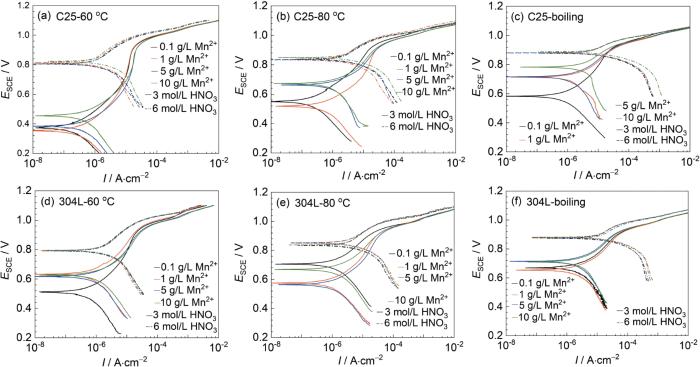
图4
C25和304L不锈钢在含有不同浓度Mn2+、不同温度的3和6 mol/L硝酸溶液中的动电位极化曲线
Fig.4
Potentiodynamic polarization curves of C25 (a-c) and 304L (d-f) stainless steels in 3 mol/L and 6 mol/L nitric acid solutions at different temperatures and Mn2+ concentrations
表2 C25和304L在含不同浓度Mn2+离子、不同温度的3 mol/L及6 mol/L硝酸溶液中的动电位极化曲线及EIS拟合结果
Table 2
| Temperature/ ℃ | Nitric acid concentration / mol·L-1 | Mn2+ ion concentration / g·L-1 | Ecror, SCE / mV | Icorr/ μA·cm-2 | Rs/ Ω·cm2 | CPE/ Ω-1 s-n cm-2 | n | Rf/ Ω·cm2 | χ-2 | Cef / F·cm-2 | |
|---|---|---|---|---|---|---|---|---|---|---|---|
| C25 | 80 | 6 | 0.1 | 838.0 | 11.14 | 0.32 | 9.71 × 10⁻⁵ | 0.93 | 7394 | 7.00 × 10⁻³ | 6.68 × 10⁻⁵ |
| 1 | 835.4 | 9.20 | 0.47 | 8.32 × 10⁻⁵ | 0.93 | 9327 | 8.10 × 10⁻³ | 7.09 × 10⁻⁵ | |||
| 5 | 834.4 | 15.74 | 0.35 | 1.05 × 10⁻⁴ | 0.92 | 7137 | 2.96 × 10⁻³ | 7.39 × 10⁻⁵ | |||
| 10 | 848.9 | 15.13 | 0.35 | 1.19 × 10⁻⁴ | 0.91 | 5972 | 9.60 × 10⁻³ | 8.12 × 10⁻⁵ | |||
| Boiling | 3 | 0.1 | 582.7 | 0.76 | 0.36 | 3.19 × 10⁻⁵ | 0.97 | 42500 | 7.96 × 10⁻³ | 3.21 × 10⁻⁵ | |
| 1 | 713.7 | 1.19 | 0.36 | 5.82 × 10⁻⁵ | 0.96 | 17740 | 3.05 × 10⁻³ | 5.83 × 10⁻⁵ | |||
| 5 | 715.8 | 0.99 | 0.40 | 6.20 × 10⁻⁵ | 0.96 | 18130 | 6.53 × 10⁻³ | 6.23 × 10⁻⁵ | |||
| 10 | 782.7 | 4.92 | 0.42 | 7.68 × 10⁻⁵ | 0.95 | 9208 | 8.09 × 10⁻³ | 7.53 × 10⁻⁵ | |||
| 6 | 0.1 | 879.2 | 58.22 | 0.30 | 1.74 × 10⁻⁴ | 0.90 | 2059 | 9.14 × 10⁻³ | 1.55 × 10⁻⁴ | ||
| 1 | 880.6 | 55.60 | 0.29 | 1.77 × 10⁻⁴ | 0.90 | 1931 | 9.07 × 10⁻³ | 1.56 × 10⁻⁴ | |||
| 5 | 880.3 | 50.47 | 0.30 | 1.75 × 10⁻⁴ | 0.89 | 1915 | 8.72 × 10⁻³ | 1.53 × 10⁻⁴ | |||
| 10 | 887.6 | 84.67 | 0.33 | 2.16 × 10⁻⁴ | 0.89 | 1535 | 7.76 × 10⁻³ | 1.87 × 10⁻⁴ | |||
| 304L | 60 | 3 | 0.1 | 513.0 | 0.53 | 0.44 | 4.21 × 10⁻⁵ | 0.96 | 59540 | 5.56 × 10⁻³ | 4.39 × 10⁻⁵ |
| 1 | 631.8 | 0.86 | 0.74 | 6.00 × 10⁻⁵ | 0.95 | 48660 | 6.39 × 10⁻⁴ | 6.34 × 10⁻⁵ | |||
| 5 | 617.4 | 1.11 | 0.41 | 7.21 × 10⁻⁵ | 0.95 | 36170 | 4.27 × 10⁻³ | 7.57 × 10⁻⁵ | |||
| 10 | 625.8 | 1.14 | 0.41 | 6.97 × 10⁻⁵ | 0.95 | 29510 | 5.82 × 10⁻³ | 7.21 × 10⁻⁵ | |||
| 6 | 0.1 | 791.8 | 3.23 | 0.35 | 6.30 × 10⁻⁵ | 0.95 | 17250 | 7.87 × 10⁻³ | 6.32 × 10⁻⁵ | ||
| 1 | 793.3 | 3.61 | 0.39 | 7.28 × 10⁻⁵ | 0.95 | 15200 | 6.96 × 10⁻³ | 7.32 × 10⁻⁵ | |||
| 5 | 791.1 | 4.54 | 0.44 | 7.09 × 10⁻⁵ | 0.95 | 14070 | 8.00 × 10⁻³ | 7.09 × 10⁻⁵ | |||
| 10 | 794.9 | 3.81 | 0.47 | 7.17 × 10⁻⁵ | 0.94 | 14240 | 7.04 × 10⁻³ | 7.18 × 10⁻⁵ | |||
| 80 | 3 | 0.1 | 705.4 | 1.34 | 0.69 | 7.42 × 10⁻⁵ | 0.94 | 29570 | 1.14 × 10⁻³ | 7.78 × 10⁻⁵ | |
| 1 | 575.4 | 0.98 | 0.41 | 5.86 × 10⁻⁵ | 0.96 | 30190 | 3.61 × 10⁻³ | 6.02 × 10⁻⁵ | |||
| 5 | 563.8 | 1.09 | 0.41 | 6.25 × 10⁻⁵ | 0.96 | 24800 | 4.95 × 10⁻³ | 6.37 × 10⁻⁵ | |||
| 10 | 668.6 | 1.69 | 0.37 | 6.75 × 10⁻⁵ | 0.96 | 20790 | 6.60 × 10⁻³ | 6.86 × 10⁻⁵ | |||
| 6 | 0.1 | 834.8 | 14.18 | 0.33 | 8.69 × 10⁻⁵ | 0.93 | 5485 | 9.15 × 10⁻³ | 8.25 × 10⁻⁵ | ||
| 1 | 852.7 | 14.62 | 0.31 | 1.02 × 10⁻⁴ | 0.92 | 4815 | 7.44 × 10⁻³ | 9.53 × 10⁻⁵ | |||
| 5 | 851.8 | 14.52 | 0.32 | 1.14 × 10⁻⁴ | 0.91 | 5205 | 3.46 × 10⁻³ | 1.08 × 10⁻⁴ | |||
| 10 | 837.9 | 12.96 | 0.34 | 1.03 × 10⁻⁴ | 0.93 | 4669 | 7.99 × 10⁻³ | 9.74 × 10⁻⁵ | |||
| Boiling | 3 | 0.1 | 668.9 | 3.07 | 0.36 | 5.79 × 10⁻⁵ | 0.96 | 11340 | 6.33 × 10⁻³ | 5.69 × 10⁻⁵ | |
| 1 | 653.9 | 2.80 | 0.39 | 5.89 × 10⁻⁵ | 0.96 | 10270 | 6.61 × 10⁻³ | 5.77 × 10⁻⁵ | |||
| 5 | 714.1 | 2.44 | 0.41 | 5.90 × 10⁻⁵ | 0.95 | 12060 | 5.93 × 10⁻³ | 5.80 × 10⁻⁵ | |||
| 10 | 709.8 | 3.33 | 0.39 | 6.06 × 10⁻⁵ | 0.96 | 9674 | 1.56 × 10⁻³ | 5.91 × 10⁻⁵ | |||
| 6 | 0.1 | 876.6 | 78.88 | 0.28 | 1.38 × 10⁻⁴ | 0.92 | 1236 | 9.36 × 10⁻³ | 1.17 × 10⁻⁴ | ||
| 1 | 879.1 | 91.72 | 0.39 | 1.48 × 10⁻⁴ | 0.91 | 1256 | 1.29 × 10⁻³ | 1.25 × 10⁻⁴ | |||
| 5 | 875.4 | 79.29 | 0.76 | 1.67 × 10⁻⁴ | 0.90 | 1177 | 9.89 × 10⁻³ | 1.41 × 10⁻⁴ | |||
| 10 | 881.0 | 91.41 | 0.31 | 1.62 × 10⁻⁴ | 0.91 | 1159 | 7.99 × 10⁻³ | 1.36 × 10⁻⁴ |
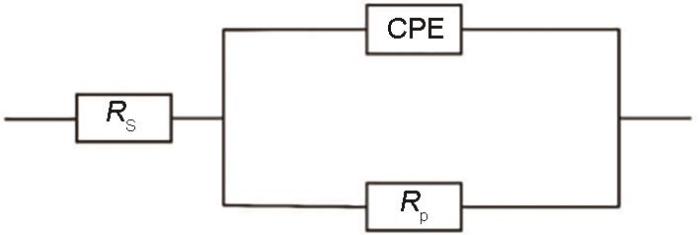
图5为C25和304L不锈钢在含不同浓度Mn2+、不同温度的3和6 mol/L硝酸溶液中的电化学阻抗谱。两种不锈钢的阻抗谱均呈现单一容抗弧特征。通过图6等效电路拟合EIS数据[18],所得电化学参数列于表2。基于表2极化曲线与EIS拟合结果,可深入分析温度、硝酸浓度及Mn2+浓度对两种不锈钢腐蚀行为的影响。温度升高显著增大了腐蚀电流密度(Icorr),同时大幅降低了极化电阻(Rp)。例如,C25不锈钢在沸腾6 mol/L硝酸中的Icorr值,较60 ℃时从3.84 μA/cm2跃升至58.22 μA/cm2,增幅高达15倍;其Rp值则从19600 Ω·cm2急剧下降至2059 Ω·cm2,降幅超过89%,表明温度升高显著加速了腐蚀反应。硝酸浓度从3 mol/L增至6 mol/L也引起腐蚀行为显著变化,例如,60 ℃时,Icorr平均增长达18倍(如C25从0.22增至3.84 μA/cm2);沸腾状态下,Rp下降幅度高达95% (如304L不锈钢从9674降至1159 Ω·cm2),表明两种不锈钢在6 mol/L硝酸中的腐蚀速率显著高于其在3 mol/L硝酸中的腐蚀速率。Mn2+浓度从0.1 g/L升至10 g/L时,多数条件下Icorr变化幅度较小,未呈现显著规律性;而Rp值则表现出更明显的下降趋势,且最高Mn2+浓度下的Rp始终低于最低Mn2+浓度下的Rp,表明Mn2+的存在可能削弱钝化膜稳定性,从而加剧材料的腐蚀倾向。
图5
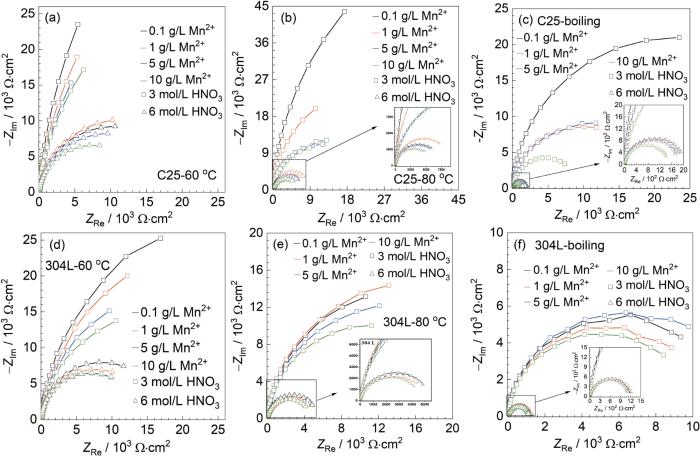
图5
C25和304L不锈钢在含不同浓度Mn2+、不同温度的3 mol/L和6 mol/L硝酸溶液中的电化学阻抗谱
Fig.5
EIS results of C25 (a-c) and 304L (d-f) stainless steels in 3 mol/L and 6 mol/L nitric acid solutions at different temperatures and Mn2+ concentrations
图6
2.2 浸泡实验结果
为直观展示C25和304L不锈钢在含不同浓度Mn2+的高温浓硝酸环境中的腐蚀行为差异,本文在沸腾的6 mol/L硝酸溶液中分别添加不同浓度Mn2+,并对两种材料进行了为期96 h的浸泡实验。图7为两种材料在不同Mn2+浓度条件下浸泡96 h后的腐蚀速率。结果显示,相同条件下304L不锈钢的腐蚀速率显著高于C25不锈钢。两种材料的腐蚀速率均随Mn2+浓度增加呈波动上升趋势:当Mn2+浓度达5 g/L时,C25不锈钢腐蚀速率出现明显增幅;而304L不锈钢则在Mn2+浓度达到最高值(10 g/L)时增幅显著。为深入探究Mn2+对腐蚀形貌的影响,对浸泡后样品进行了SEM观察,并选取0.1和10 g/L Mn2+浓度样品进行XPS表征。
图7

图7
C25和304L不锈钢在含有不同浓度Mn2+的沸腾6 mol/L硝酸溶液中浸泡96 h后的腐蚀速率
Fig.7
Corrosion rates of C25 and 304L stainless steels after immersion in boiling 6 mol/L nitric acid solutions with different concentrations (0.1-10 g/L) of Mn2+ ions for 96 h
图8
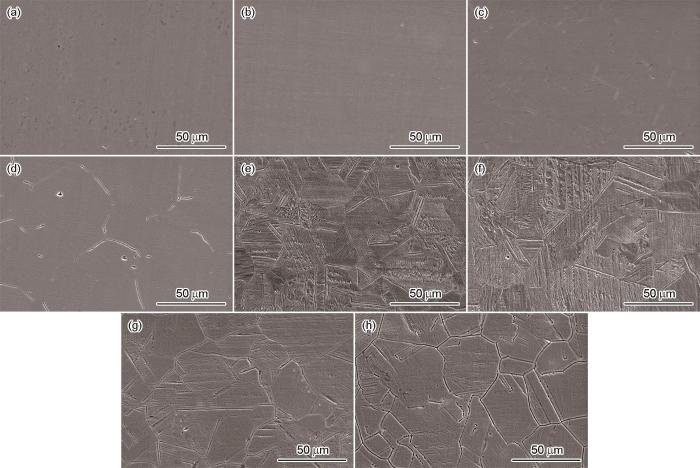
图8
C25和304L不锈钢在含有不同浓度Mn2+的沸腾6 mol/L硝酸溶液中浸泡96 h后的SEM像
Fig.8
Corrosion morphologies of C25 (a-d) and 304L (e-h) stainless steels after 96 h immersion in boiling 6 mol/L nitric acid solutions with 0.1 g/L (a, e), 1 g/L (b, f), 5 g/L (c, g), 10 g/L (d, h) concentrations of Mn2+ ions
2.3 XPS表面分析
图9为C25和304L不锈钢在含不同浓度Mn2+的沸腾6 mol/L硝酸中浸泡96 h后的表面元素XPS深度分布。与低浓度Mn2+环境相比,C25不锈钢表面在高浓度Mn2+条件下O含量微增,Cr含量基本持平,Fe、Ni和Mn含量略有下降,但总体变化有限。然而在高浓度Mn2+条件下,304L材料表面的O含量在整个溅射过程中始终维持高位(≥ 50%),Fe含量则持续处于低位(≤ 10%)。相较于低浓度Mn2+环境,304L不锈钢表面在高浓度条件下表现出更高的O、Cr含量以及更低的Fe、Ni含量。这一结果与文献中关于304L在硝酸介质中发生晶间腐蚀时表面富Cr、贫Fe和Ni的报道一致[7,23],同时也表明304L不锈钢在该环境下的晶间腐蚀行为与传统的贫Cr理论存在差异。
图9
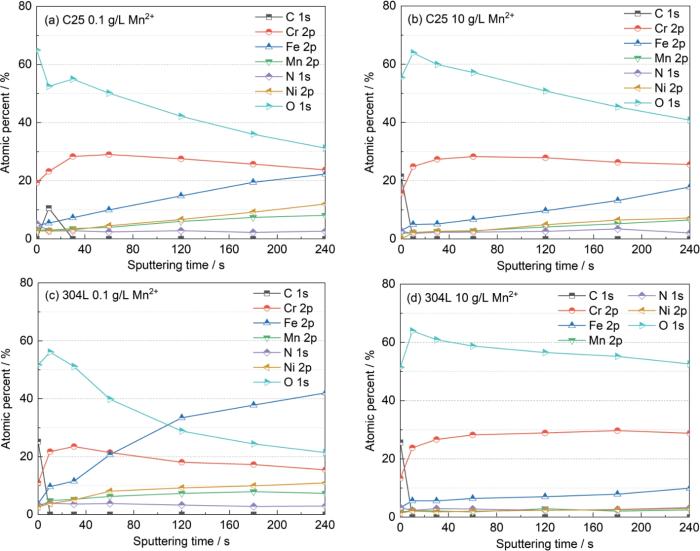
图9
C25和304L不锈钢在含有不同浓度Mn2+的沸腾6 mol/L硝酸中浸泡96 h后表面各元素的XPS深度分布
Fig.9
XPS depth profiles of various elements on the surface of C25 (a, b) and 304L (c, d) stainless steels after 96 h immer-sion in boiling 6 mol/L nitric acid with different concentrations of Mn2+
图10和11分别为C25和304L不锈钢在含不同浓度Mn2+的沸腾6 mol/L硝酸溶液中浸泡96 h后,经0~240 s溅射所得的Fe 2p、Cr 2p、Ni 2p及Mn 2p精细XPS谱。对于C25不锈钢(图10),其表层Fe含量较低,且主要呈氧化态(如FeO和Fe2O3);随溅射深度增加,Fe总量逐渐上升,金属态Fe比例同步提高,至溅射240 s时几乎完全转变为金属态Fe。Cr主要以Cr(OH)3和Cr2O3形式存在,随溅射深度增加,金属Cr比例略有上升,但在最内层(240 s)仍以Cr2O3为主。Ni仅以金属态存在,其含量随溅射深度逐渐增加。Mn在表面层(0 s)几乎未被检出,但随溅射深度增加,其含量逐渐上升且始终以金属态存在,表明该Mn并非源于溶液中Mn2+,而是源自不锈钢材料自身所含的Mn。对于304L不锈钢(图11),各元素化学态及其随溅射深度的变化趋势与C25相似;然而在高浓度Mn2+条件下,相较于低浓度情况,304L表面Fe含量更低且主要呈氧化态(FeO、Fe2O3),Cr含量更高且主要呈Cr2O3形式,金属态Ni和Mn含量则相对较低。
图10
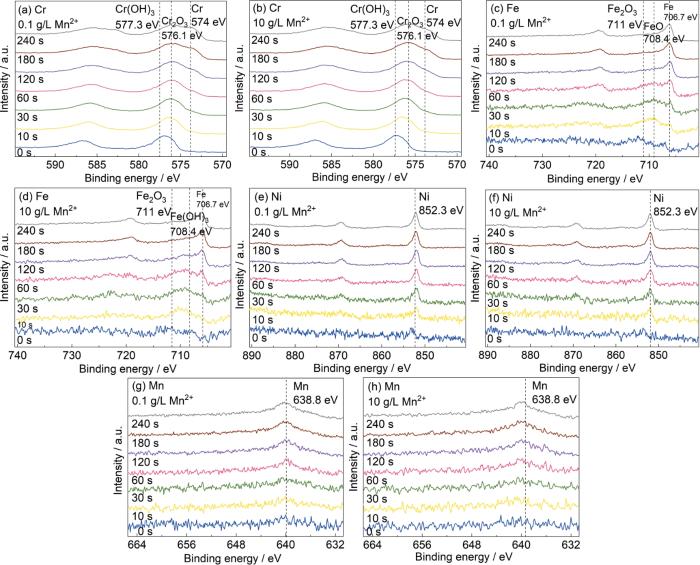
图10
C25在含有不同浓度Mn2+的沸腾6 mol/L硝酸中浸泡96 h后表面溅射不同时间的Cr 2p、Fe 2p、Ni 2p和Mn 2p的精细谱
Fig.10
Detailed spectra of Cr 2p (a, b), Fe 2p (c, d), Ni 2p (e, f), and Mn 2p (g, h) sputtered for different times on the surface of C25 after being immersed in boiling 6 mol/L nitric acid containing different concentrations of Mn2+ for 96 h
图11
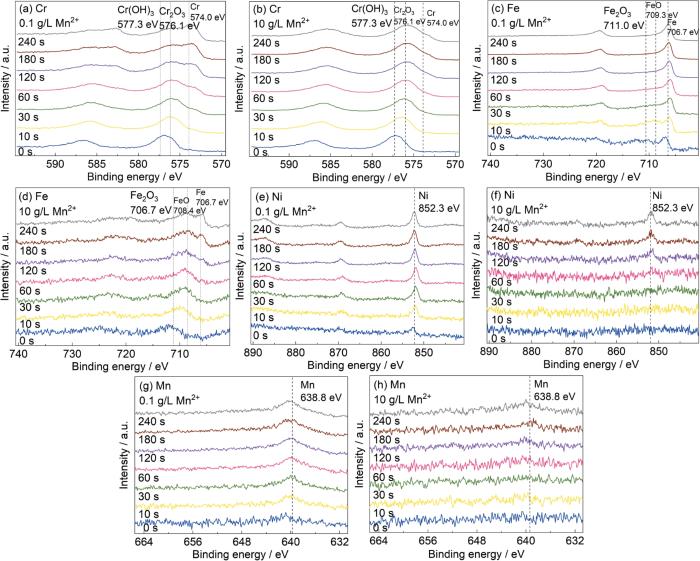
图11
304L在含有不同浓度Mn2+的沸腾6 mol/L硝酸中浸泡96 h后表面溅射不同时间的Cr 2p、Fe 2p、Ni 2p和Mn 2p的精细谱
Fig.11
Detailed spectra of Cr 2p (a, b), Fe 2p (c, d), Ni 2p (e, f) and Mn 2p (g, h) sputtered for different times on the surface of 304L after being immersed in boiling 6 mol/L nitric acid containing different concentrations of Mn2+ ions for 96 h
3 响应曲面法建模分析
前文通过电化学测试系统分析了温度、硝酸浓度及Mn2+浓度对C25与304L不锈钢腐蚀行为的影响,结果表明温度与硝酸浓度的升高会显著加快腐蚀速率并降低材料耐蚀性,而Mn2+浓度的影响规律尚不明确。由于上述分析均在固定两项因素的前提下研究第三项变量的作用,难以直观反映三者协同变化时的综合影响,故本研究将采用响应曲面法(RSM)进一步探究。作为多因素系统建模与优化的常用统计方法,RSM可有效评估各因素对腐蚀速率等响应变量的独立作用及两两交互效应[24~26]。本研究将通过Design-Expert 13软件拟合二次回归等多项式模型,预测不同变量组合下的响应值并揭示非线性关系,同时借助三维响应曲面图直观展示固定某一因素时,其余两因素交互作用对两种材料耐蚀性能的影响趋势,最终明确温度、硝酸浓度及Mn2+浓度对两种不锈钢腐蚀行为的综合影响规律。
3.1 实验设计与模型建立
基于前述电化学实验结果,采用Design-Expert 13软件进行建模分析,选取温度(℃)、硝酸浓度(mol/L)和Mn2+浓度(g/L) 3个变量,并基于Box-Behnken Design (BBD)模型开展数据拟合,以探究各单一因素及其两两交互作用对C25钢与304L不锈钢腐蚀速率与耐蚀性能的影响机制,同时识别影响最为显著的关键因素。实验影响因素及水平设计详见表3。本研究选择由EIS拟合所得的极化电阻Rp (Ω·cm2)而非极化曲线拟合的Icorrr (μA·cm-2)作为主要响应值,原因在于:当Mn2+浓度从0.1 g/L升至10 g/L时,多数实验条件下Icorr波动微弱且未呈现显著单调变化趋势;相比之下,Rp值则表现出更为明显的下降趋势,尤其在最高Mn2+浓度条件下,其Rp值始终低于最低浓度条件下的数值。
表3 实验影响因素及水平设计
Table 3
| Factor | Low level (-1) | Hight level(1) |
|---|---|---|
| A: temperature (℃) | 60 | Boiling |
| B: nitric acid concentration (mol/L) | 3 | 6 |
| C: Mn2+ ion concentration (g/L) | 0.1 | 10 |
表4 C25不锈钢BBD模型的优化水平和Rp值
Table 4
| Number | Temperature / ℃ | Nitric acid concentration / mol·L-1 | Mn2+ ion concentration / g·L-1 | Rp / Ω·cm-2 |
|---|---|---|---|---|
| 1 | 60 | 3 | 0.1 | 137300 |
| 2 | 60 | 3 | 1 | 94290 |
| 3 | 60 | 3 | 5 | 69840 |
| 4 | 60 | 3 | 10 | 60360 |
| 5 | 60 | 6 | 0.1 | 19600 |
| 6 | 60 | 6 | 1 | 21320 |
| 7 | 60 | 6 | 5 | 17520 |
| 8 | 60 | 6 | 10 | 14400 |
| 9 | 80 | 3 | 0.1 | 141000 |
| 10 | 80 | 3 | 1 | 52650 |
| 11 | 80 | 3 | 5 | 22960 |
| 12 | 80 | 3 | 10 | 23110 |
| 13 | 80 | 6 | 0.1 | 7394 |
| 14 | 80 | 6 | 1 | 9327 |
| 15 | 80 | 6 | 5 | 7137 |
| 16 | 80 | 6 | 10 | 5972 |
| 17 | 110 | 3 | 0.1 | 42500 |
| 18 | 110 | 3 | 1 | 17740 |
| 19 | 110 | 3 | 5 | 18130 |
| 20 | 110 | 3 | 10 | 9208 |
| 21 | 110 | 6 | 0.1 | 2059 |
| 22 | 110 | 6 | 1 | 1931 |
| 23 | 110 | 6 | 5 | 1915 |
| 24 | 110 | 6 | 10 | 1535 |
表5 304L不锈钢BBD模型的优化水平和Rp值
Table 5
| Number | Temperature / ℃ | Nitric acid concentration / mol·L-1 | Mn2+ ion concentration / g·L-1 | Rp / Ω·cm-2 |
|---|---|---|---|---|
| 1 | 60 | 3 | 0.1 | 59540 |
| 2 | 60 | 3 | 1 | 48660 |
| 3 | 60 | 3 | 5 | 36170 |
| 4 | 60 | 3 | 10 | 29510 |
| 5 | 60 | 6 | 0.1 | 17250 |
| 6 | 60 | 6 | 1 | 15200 |
| 7 | 60 | 6 | 5 | 14070 |
| 8 | 60 | 6 | 10 | 14240 |
| 9 | 80 | 3 | 0.1 | 29570 |
| 10 | 80 | 3 | 1 | 30190 |
| 11 | 80 | 3 | 5 | 24800 |
| 12 | 80 | 3 | 10 | 20790 |
| 13 | 80 | 6 | 0.1 | 5485 |
| 14 | 80 | 6 | 1 | 4815 |
| 15 | 80 | 6 | 5 | 5205 |
| 16 | 80 | 6 | 10 | 4669 |
| 17 | 110 | 3 | 0.1 | 11340 |
| 18 | 110 | 3 | 1 | 10270 |
| 19 | 110 | 3 | 5 | 12060 |
| 20 | 110 | 3 | 10 | 9674 |
| 21 | 110 | 6 | 0.1 | 1236 |
| 22 | 110 | 6 | 1 | 1256 |
| 23 | 110 | 6 | 5 | 1177 |
| 24 | 110 | 6 | 10 | 1159 |
3.2 模型拟合与统计学显著性分析
基于BBD模型拟合结果,获得Rp值与温度(A),硝酸浓度(B)和Mn2+浓度(C)关系如下:
(1) 对于C25:Rp = 28775.96-19664.74A-20349.98B-15091.14C + 13087.47AB + 6377.47AC + 14014.63BC
(2) 对于304L:Rp = 15950.99-11038.77A-9276.26B-3531.45C + 4678.36AB + 3838.69AC + 3230.73BC
表6 C25和304L两种不锈钢的回归系数
Table 6
| Steel | R2 | Adjusted R2 | Predicted R2 | Adeq precision |
|---|---|---|---|---|
| C25 | 0.8227 | 0.7602 | 0.6841 | 11.5855 |
| 304L | 0.9492 | 0.9313 | 0.8798 | 23.7552 |
表7和8分别展示了C25和304L不锈钢BBD模型的方差分析结果。输入变量对Rp响应模型的影响包括线性项A、B、C,以及交互作用项AB、AC、BC,表明这些项是Rp的主要影响因素。对于C25和304L两种不锈钢,所建立的响应曲面模型均高度显著(P < 0.0001),能真实反映各因素与极化电阻(Rp)的关系[27,28]。从各项的P值来看,A和B的P值均小于0.01,表明三者均为Rp的极显著影响因素,其影响强度主次顺序为A≈ B ≫ C,表明环境酸度与温度是控制腐蚀行为的最主导因素,而Mn2+是显著的次要促进因素。此外,两者在交互作用上呈现差异:C25不锈钢的交互项AB和BC的P值小于0.05,表明温度与硝酸浓度、硝酸浓度与Mn2+浓度之间存在显著的交互效应;而交互项AC的P值大于0.05,表明温度与Mn2+浓度之间的交互作用不显著。而304L不锈钢的所有两两交互作用(AB、AC、BC)均显著,说明其腐蚀行为受到更为复杂的多因素协同机制调控。
表7 C25不锈钢BBD模型回归方差分析
Table 7
| Source | F-value | P-value |
|---|---|---|
| Model | 13.15 | < 0.0001 |
| A | 15.01 | 0.0012 |
| B | 23.64 | 0.0001 |
| C | 8.67 | 0.0091 |
| AB | 7.1 | 0.0163 |
| AC | 1.05 | 0.3191 |
| BC | 7.53 | 0.0138 |
表8 304L不锈钢BBD模型回归方差分析
Table 8
| Source | F-value | P-value |
|---|---|---|
| Model | 52.97 | < 0.0001 |
| A | 118.78 | < 0.0001 |
| B | 123.36 | < 0.0001 |
| C | 9.18 | 0.0076 |
| AB | 21.65 | 0.0002 |
| AC | 7.37 | 0.0147 |
| BC | 7.73 | 0.0128 |
图12展示了C25和304L两种不锈钢材料的响应值预测值与实测值之间的差异。实测数据点基本分布在预测直线附近,表明预测模型具有较高的准确性,也验证了该实验方法的可行性。
图12
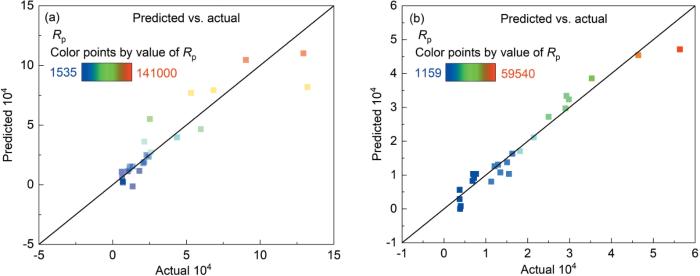
图12
C25和304L不锈钢模型对响应值的预测值和真实值的关系
Fig.12
Relationship between the predicted and actual values of the response for the C25 (a) and 304L (b) stainless steel models
3.3 响应曲面分析:主效应与交互效应
图13直观呈现了单个输入变量对两种材料Rp值的影响程度。曲线越陡峭,表明该因素对响应值的影响越敏感。
图13

图13
C25和304L不锈钢的Rp值的摄动图
Fig.13
Perturbation diagrams of Rp values for C25 (a) and 304L (b) stainless steels
从图13a可以看出,C25不锈钢的三条曲线斜率均为负,说明温度、硝酸浓、Mn2+的升高均会导致Rp下降,即加剧腐蚀。其中,曲线B与曲线A的斜率较陡,说明这两个因素是影响C25不锈钢Rp值的主要因素;曲线C则相对平缓,表明其影响较弱,且三者的影响力差异不大。
图14和15是温度、硝酸浓度和Mn2+浓度两两交互作用对C25和304L不锈钢Rp影响的三维响应曲面图及其等高线投影图。整体而言,所有响应曲面均呈现明显的下降趋势,表啥明任意两个因素的升高均会导致Rp值降低,即材料耐腐蚀性能下降。通过对比等高线图的形状与疏密可见,对于C25不锈钢(图14),硝酸浓度与温度交互的等高线最为密集且呈近正圆形(见图14b),表明随着温度和硝酸浓度的升高Rp显著下降,说明高温与高酸度协同加剧腐蚀。而温度与Mn2+浓度交互的等高线则相对稀疏且呈近椭圆形(见图14d),表明在固定硝酸浓度时,温度升高显著降低Rp,而Mn2+浓度增加的影响相对较弱,验证了方差分析中AC项不显著的结论,说明两者交互作用较弱。同样地,在固定温度时(见图14f),硝酸浓度升高对Rp的降低作用大于Mn2+浓度的影响。
图14

图14
温度、Mn2+浓度和硝酸浓度两两交互作用对C25不锈钢Rp的影响图及其对应的响应值的等高线图
Fig.14
The interaction effects of temperature, Mn2+ ion concentration, and nitric acid concentration on the Rp of C25 stainless steel (a1-c1) and the corresponding contour plots of response values (a2-c2)
图15
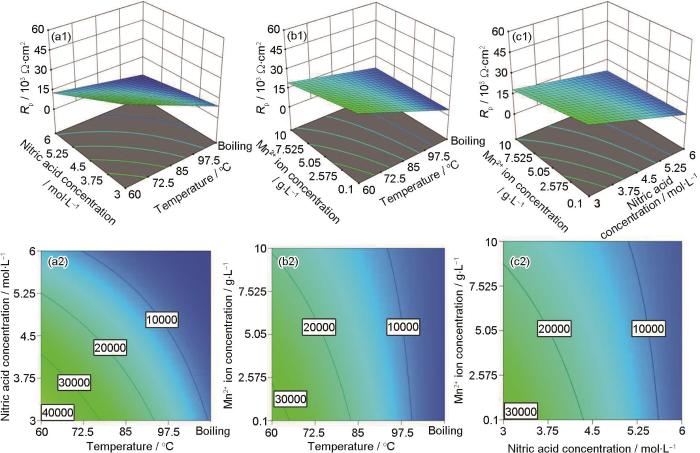
图15
温度、Mn2+浓度和硝酸浓度两两交互作用对304L不锈钢Rp的影响图及其对应的响应值的等高线图
Fig.15
The interaction effects of temperature, Mn2+ ion concentration and nitric acid concentration on the Rp of 304L stainless steel (a1-c1) and the corresponding contour plots of response values (a2-c2)
4 讨论
结果表明,温度与硝酸浓度是影响不锈钢腐蚀行为的最主导因素,两者升高均显著促进阴极反应,加速材料腐蚀。尤其在沸腾状态下,6 mol/L硝酸环境中的腐蚀速率较3 mol/L硝酸高出数十倍,充分体现了高温高酸环境的极端腐蚀性。Mn2+虽非主导因素,但其存在仍在一定程度上削弱钝化膜的稳定性,该效应在中等酸度(3 mol/L)和高温条件下尤为明显。XPS分析表明,高Mn2+环境中304L不锈钢表面Fe含量降低、Cr含量升高,暗示Mn2+可能通过竞争吸附或表面复合物形成影响钝化膜的组成与稳定性。
材料性能对比显示,C25不锈钢因更高的Cr、Ni含量和更低的C、P、S杂质,始终表现出更优的耐蚀性能,其Icorr平均仅为304L不锈钢的60%。在极端工况(沸腾状态、6 mol/L硝酸、10 g/L Mn2+)下,C25的极化电阻(Rₚ = 1535 Ω·cm2)显著高于304L不锈钢(1159 Ω·cm2),进一步凸显其在高腐蚀风险环境下的应用优势。
从多因素协同机制来看,温度与酸度的耦合作用导致腐蚀行为出现阶跃式增强,例如沸腾状态下6 mol/L硝酸中的Icorr比3 mol/L环境高约50倍。Mn2+则在中低酸度条件下表现出对腐蚀的放大效应。三因素共同作用时(沸腾+ 6 mol/L HNO3 + 10 g/L Mn2+),Rₚ急剧下降至1600 Ω·cm2以下,标志着最为严苛的腐蚀窗口。综上所述,各因素对腐蚀敏感性的影响程度依次为:温度>硝酸浓度≫ Mn2+浓度。C25不锈钢在高温且硝酸浓度≥ 6 mol/L的环境中表现出更显著的耐蚀优势。
5 结论
本研究通过电化学测试、浸泡实验、表面分析与RSM建模,系统揭示了温度、硝酸浓度和Mn2+浓度对C25和304L不锈钢在高温硝酸环境中腐蚀行为的综合影响。结果表明:
(1) 温度与硝酸浓度是影响C25和304L不锈钢腐蚀行为的最主要因素,二者的升高通过显著强化阴极反应,共同导致了材料腐蚀速率的数量级式增长。特别值得注意的是,在溶液达到沸腾状态且硝酸浓度升至6 mol/L时,腐蚀行为会发生阶跃式恶化。Mn2+虽为次要因素,但在中低酸度(如3 mol/L)与高温条件下仍具显著促进腐蚀的作用。
(2) C25不锈钢在所有实验条件下均表现出优于304L的耐蚀性,定量数据表明,C25的腐蚀电流密度(Icorr)平均仅为304L的60%。尤其在高温、高酸、高Mn2+的极端环境中,例如6 mol/L HNO3、10 g/L Mn2+这一极端腐蚀窗口中,C25的极化电阻(Rp = 1535 Ω·cm2)显著高于304L (1159 Ω·cm2),这充分论证了C25更具应用潜力。
(3) Mn2+通过影响钝化膜组成,降低其稳定性而促进腐蚀,尤其在304L中更为明显。高Mn2+环境中304L表面Fe含量降低、Cr氧化物富集,这一现象暗示,Mn2+可能通过与Fe、Cr等元素的竞争性吸附,或形成含Mn的表面复合物,改变了钝化膜的自然生长过程。这种非典型的成分变化,虽然看似Cr含量增加,但可能破坏了钝化膜的均匀性与黏附性,反而加剧了材料的局部腐蚀敏感性。
(4) 所建立的RSM模型能够精准量化温度、硝酸浓度与Mn2+浓度三因素对极化电阻(Rp)的协同影响,并实现可靠的预测,它能够为工业系统识别并界定出特定的“高腐蚀风险窗口”(例如,Rp急剧下降至1600 Ω·cm2以下的工况组合)。这为工程设计与运营维护提供了前瞻性的理论支持与量化依据,指导人们主动规避高风险参数区,优化材料选型与工艺控制,从而实现设备的长期安全稳定运行。
参考文献
Status and development of technology on reprocessing spent nuclear fuel in China
[J].
我国核燃料后处理技术现状和发展
[J].
Status of global spent fuel reprocessing
[J].
全球乏燃料后处理现状与分析
[J].
Comparative study on wet and dry storage technology of spent fuel in nuclear power plant and relevant suggestions
[J].
核电厂乏燃料湿法与干法贮存技术对比研究及相关对策建议
[J].
Direct dissolution of used nuclear fuel in PUREX solvent: Review and flowsheet development
[J].
Correlation between composition of passive layer and corrosion behavior of high Si-containing austenitic stainless steels in nitric acid
[J].
Corrosion mechanisms of austenitic stainless steels in nitric media used in reprocessing plants
[J].
Kinetics of the oxidation of stainless steel in hot and concentrated nitric acid in the passive and transpassive domains
[J].
Towards a reliable determination of the intergranular corrosion rate of austenitic stainless steel in oxidizing media
[J].
Optimization of grain boundary character distribution for intergranular corrosion resistant 304 stainless steel by twin-induced grain boundary engineering
[J].
Proton irradiation assisted localized corrosion and stress corrosion cracking in 304 nuclear grade stainless steel in simulated primary PWR water
[J].
Localized deformation and corrosion in irradiated 304 nuclear grade stainless steel in simulated primary water were investigated. The investigation was conducted by comparing the deformation structure, the oxide scale formed at the deformation structure, and their correlation with cracking. The results revealed that increasing the irradiation dose promoted localized corrosion at the slip step and grain boundary, which was primarily attributed to the strain concentration induced by enhanced localized deformation and depletion of Cr at grain boundary. Further, a synergic effect of the enhanced localized deformation and localized corrosion at the slip step and grain boundary caused a higher cracking susceptibility of the irradiated steel.
Optimization of growth and electrocatalytic oxygen evolution of nickel-iron dihydroxide by response surface method
[J].
镍铁双氢氧化物的响应曲面法优化生长和电催化析氧性能研究
[J].
Corrosion behavior of carbon steel in simulated flue gas condensate using response surface methodology method
[J].
响应曲面法研究碳钢在模拟烟气冷凝液中的腐蚀行为
[J].
Performance assessment of corroding RC beams using response surface methodology
[J].
基于响应面法的结构优化设计研究
[D].
Optimization of microwave-assisted extraction of flavones from celery using response surface analysis
[J].
响应面法优化芹菜总黄酮的微波提取工艺研究
[J].
Screening, optimization and evaluation of indigenous microorganism activation system in Zhan 3 block, Shengli Oilfield
[J].
胜利油田沾3区块内源微生物激活剂的筛选、优化及效果评价
[J].
Optimization of microwave-assisted extraction of total flavones from peanut hull by response surface analysis
[J].
用响应面法优化微波提取花生壳总黄酮工艺
[J].
Effect of oxidizing ions on the corrosion behavior of SiN stainless steel in high-temperature nitric acid solution
[J].
Influence of temperature on the electrochemical and passivation behavior of 2507 super duplex stainless steel in simulated desulfurized flue gas condensates
[J].
Synergistic effects of fluoride and chloride on general corrosion behavior of AISI 316 stainless steel and pure titanium in H2SO4 solutions
[J].
The effect of severe plastic deformation on the corrosion resistance of AISI type 304L stainless steel
[J].
Optimization of enzymolysis-ultrasonic assisted extraction of polysaccharides from Momordica charabtia L. by response surface methodology
[J].
Optimization and evaluation of a thermoresponsive ophthalmic in situ gel containing curcumin-loaded albumin nanoparticles
[J].This study aimed to optimize and evaluate a thermoresponsive ophthalmic in situ gel containing curcumin-loaded albumin nanoparticles (Cur-BSA-NPs-Gel). Albumin nanoparticles were prepared via a desolvation method, and the gels were prepared via a cold method. The central composite design and response surface method was used to evaluate the effects of varying Pluronic (R) F127 and Pluronic (R) F68 concentrations on the sol-gel transition temperature, which is an indicator of optimum formulations. The optimized formulation was a free-flowing liquid below 30.9 degrees C that transformed into a semi-solid gel above 34.2 degrees C after dilution with simulated tear fluid. Results of the in vitro release and erosion behavior study indicated that Cur-BSA-NPs-Gel achieved superior sustained-release effects and that incorporation of albumin nanoparticles exerted minimal effects on the gel structure. In addition, in vivo-ophthalmic experiments employing Cur-BSA-NPs-Gel were subsequently performed in rabbits. In vivo eye irritation results showed that Cur-BSA-NPs-Gel might be considered safe for ophthalmic drug delivery. The in vivo study also revealed that the formulation could significantly increase curcumin bioavailability in the aqueous humor. In conclusion, the optimized in situ gel-formulation developed in this work has significant potential for ocular application.
Numerical simulation of erosion wear in slurry pipeline based on DDPM-RSM
[J].
基于DDPM-RSM的浆体管道冲蚀磨损数值模拟研究
[J].为揭示浆体输送过程中铁精矿对管道的冲蚀磨损机理,提出了一种基于稠密离散相模型(DDPM)与响应曲面法(RSM)的浆体管道冲蚀磨损特性分析的方法,模拟浆体输送过程中铁精矿对管道造成冲蚀磨损行为,并分析单因素和多因素耦合对管道冲蚀磨损的影响。首先,结合铁精矿输送实际工况,建立计算流体力学模型;其次利用公开数据集验证E/CRC冲蚀模型的准确性,表明该模型可用于计算矿浆管道的冲蚀磨损;最后,探究入口流速、颗粒粒径、颗粒质量流率及矿浆流动方向对管道冲蚀磨损的影响,设计RSM试验分析不同因素影响重要程度。结果表明:冲蚀速率随入口流速增加而增大,在1.5~2.0 m/s范围内管道的冲蚀磨损最小;随着粒径增大,冲蚀速率呈现先减小后增大的趋势,粒径大小为100 μm时,能有效降低管道冲蚀磨损;随着颗粒质量流率增加,最大冲蚀速率先增大,后减小,最后趋于稳定,存在临界质量流率,结合管道运输的经济性,颗粒质量流率应大于2.5 kg/s;3种流场因素对管道冲蚀磨损影响程度为入口流速>颗粒质量流率>颗粒粒径;多因素耦合下,入口流速与颗粒粒径对管道冲蚀磨损影响最大。可为管道冲蚀防护提供理论依据。


