



聚合物对金属有一定的缓蚀作用,可通过物理(静电)吸附或化学吸附作用在金属表面形成保护膜后干扰金属/溶液界面的电荷转移过程(如抑制金属阳极溶解或阴极氧还原),或同时降低两者的反应速率、形成腐蚀产物膜等后置过程干预,从而实现对金属的保护[9~13]。此外,在油气田开发过程中,技术人员往往使用超声波管道防垢技术解决金属管道内壁结垢问题,且超声波能改善聚合物在油藏中的分布均匀性,提高原油采收率[14,15]。在超声处理的过程中,超声波通过破坏液体中水分子结构来提高水的溶解性,超声空化产生的机械效应可破坏污垢沉积环境。现有研究表明,超声波对聚合物流变特性也有显著影响,能降低熔体粘度并改善制品力学性能。超声波的加入对聚合物的挤出过程产生了较大的影响,可降低挤出时的口膜压力,提高挤出质量,从而降低聚合物的粘度并影响其力学性能和结晶形态。
超声技术在金属腐蚀与防护领域的研究已取得较大进展,但超声参数(频率、功率)、腐蚀介质(Cl-浓度、pH值)和材料类型(不锈钢、铝合金等)之间的交互影响机制尚未完全阐明,不同金属材料对特定超声频率(20~100 kHz)的响应差异显著,且在不同介质浓度下超声功率阈值对腐蚀行为的影响规律尚未明确。研究表明,超声波频率与功率对金属腐蚀行为影响显著,但作用效果因材料类型而异[16]。在低频超声范围(20~40 kHz),方玉荣和付朝阳[17]的研究表明,28 kHz超声可有效抑制304不锈钢在酸性FeCl3溶液中的点蚀,显著提高钝化膜稳定性;而Kwok等[18,19]研究表明,20 kHz超声会加速低碳钢和灰铸铁在盐水环境中的腐蚀,这在龙正和刘秀梅[20]对Q235钢的研究中得到进一步验证,他们研究表明随着超声频率升高,钢片表面蚀坑加深、空蚀加剧。当频率升高至高频范围(> 100 kHz)时,Lavigne等[21]的研究显示,500 kHz超声会导致不锈钢钝化膜结构无序化,从而降低其耐蚀性。在功率影响方面,研究结果同样呈现差异性:Whillock和Harvey[22]指出超声强度的增加会加剧304L不锈钢在含Cl-介质中的腐蚀程度,而方玉荣和付朝阳[17]的研究则表明适度的功率条件(如480 W)可以通过促进
综上所述,现有研究多局限于单因素分析,超声波与聚合物协同作用对金属腐蚀行为的影响机制尚不明确,特别是多参数耦合条件下的腐蚀动力学过程与界面反应机理亟待深入探究。因此,本研究揭示超声空化效应在聚合物/金属界面的化学-机械耦合作用机制,阐明多因素耦合条件下钝化膜动态形成与破坏机制,为超声辅助聚合物缓蚀技术的工程应用提供理论支撑和实践指导。
1 实验方法
实验选用20#钢(G5-1526标准)作为基体材料,其化学成分(质量分数,%)为:C 0.18、Mn 0.39、P 0.014、S 0.005、Si 0.18、Cr 0.01、Ni 0.01、Cu 0.01,Fe余量(> 99%)。腐蚀挂片试样尺寸为50 mm × 25 mm × 2 mm,电化学测试样品经机械切割获得1 cm2有效工作面,试样背面焊接Cu导线,非工作面采用环氧树脂密封固化。在实验开始前,需要对测试电极和腐蚀挂片进行预处理:依次使用600#~1500#砂纸逐级打磨以抛光金属表面,然后用丙酮脱脂、无水乙醇,最后通过N2干燥后放入干燥器中静置备用。
以3.5 g/L的NaCl溶液配制质量浓度为1000 mg/L的聚丙烯酰胺溶液作为实验溶液。使用超声细胞破碎器(LC-JY92-IIN型)对溶液进行超声处理,超声频率为20 kHz,时间为1 min,功率分别为0%P、25%P、50%P、75%P、100%P (P = 2500 W)。实验在35 ℃条件下进行。
使用25 ℃的标准粘度液对粘度仪(Brookfield)进行校准,并确认转子型号与待测溶液粘度范围匹配;将待测溶液放置油田微生物培养箱(SY-300L-Ⅱ)中恒温至(25 ± 0.1) ℃的测试温度后,超声前组样品直接进行取样测试,超声后各组样品则需在超声处理结束后5 min内完成测试。
采用CS350H型电化学工作站进行电化学测试。实验采用标准三电极体系,其中工作电极(WE)为碳钢电极,参比电极(RE)为饱和甘汞电极,对电极(CE)为Pt电极。
动电位极化曲线测试,扫描速率为0.5 mV/s,扫描电位范围为开路电位(OCP) ±500 mV。电化学阻抗谱(EIS)测试,频率范围为105~10-2 Hz,正弦扰动幅度为10 mV。
取出浸泡5 d的样品,使用无水乙醇浸泡,氮气干燥,使用扫描电子显微镜(SEM, COXEMEM-30AX+)表征金属表面形貌特征及腐蚀程度,用X射线粉末衍射仪(XRD, PANalytical X'Pert Powder)表征金属腐蚀产物组分,以确定腐蚀产物的化学组成。随后使用酸去膜液清洗金属表面的腐蚀产物,无水乙醇清洗,氮气干燥,观察去除腐蚀产物后的表面SEM形貌。
2 结果与讨论
2.1 粘度分析
不同功率下超声1 min后溶液的粘度如表1所示。结果表明,超声作用显著降低了溶液的粘度,随着超声功率的增加,溶液的粘度呈现先降低后增加的趋势。这可归因于超声作用形成的空化汽泡在溃灭时产生的高温、高压、冲击波和微射流使聚合物流体分子剧烈运动,并协同机械效应和热效应使聚丙烯酰胺分子链断裂[29],形成少量的丙烯酰胺单体,从而使聚合物降解,达到降粘的效果。功率为100%P时,溶液粘度出现小幅回升,可归因于极高功率下探头端面附近瞬间产生大量密集的气泡云,形成了强烈的“声屏障”效应,导致声能向溶液深部的传输受阻,整体有效空化强度反而减弱,使大分子主链的断裂降解受到限制。且残余的剪切力促使部分分子链从卷曲状态向舒展状态转变,舒展及部分交联的分子链在溶液中占据更大的流体力学体积,分子间摩擦阻力增大,宏观上表现为粘度的回升。
表1 超声作用1 min后的极化曲线拟合参数
Table 1
| Experimental conditions | Ecorr / V | Icorr / A·cm-2 | bc / mV·dec-1 | ba / mV·dec-1 | Corrosion rate / mm·a-1 |
|---|---|---|---|---|---|
| Control group | -0.756 | 1.156 × 10⁻⁵ | -325.82 | 141.97 | 0.136 |
| 25%P | -0.710 | 4.927 × 10⁻⁶ | -343.04 | 184.31 | 0.058 |
| 50%P | -0.622 | 6.765 × 10⁻⁶ | -391.23 | 178.47 | 0.079 |
| 75%P | -0.813 | 9.985 × 10⁻⁶ | -254.16 | 277.29 | 0.117 |
| 100%P | -0.631 | 9.138 × 10⁻⁶ | -305.22 | 278.81 | 0.107 |
不同超声功率作用下溶液的粘度如下:超声功率为0时,粘度为118.1 mPa·s;25%P时为23.4 mPa·s;50%P时为10.3 mPa·s;75%P时为6.0 mPa·s;100%P时为10.1 mPa·s。
2.2 电化学测试结果分析
2.2.1 极化曲线分析
在电化学分析中,通过极化曲线分析腐蚀电位(Ecorr)和腐蚀电流密度(Icorr),显示出金属腐蚀速率的动态趋势。Ecorr的变化可初步反映金属热力学稳定性趋势(正移通常预示腐蚀倾向降低),而Icorr的数值直接关联到腐蚀发生的速率。进一步地,阴极和阳极Tafel斜率(bc和ba)反映金属的耐腐蚀性能,并识别出控制腐蚀过程的主要电极反应。
图1为不同超声功率作用下的金属的动电位极化曲线,其中绿色曲线的体系为NaCl溶液作为本实验的空白组,蓝色曲线为经超声功率25%P的聚合物组的极化曲线,红色曲线为经超声功率50%P的聚合物组的极化曲线,紫色曲线经超声功率75%P的聚合物组的极化曲线,橙色曲线经超声功率100%P的聚合物组的极化曲线。由图1可知,相同电位下超声处理后金属阳极电流密度均小于空白体系,表明超声作用抑制了金属的阳极溶解,功率为75%P时其抑制阳极反应程度相较于与其他功率相比较弱。相同电位下,100%P功率下作用下金属的阴极电流密度处于最大值,表明此功率下超声促进了金属的阴极反应。会清除电极表面的氧化物、污染物或钝化层,暴露出更多活性位点。这使得阴极反应速率在一定程度上加快,更多的腐蚀介质能够参与反应,削弱了聚合物对阴极反应的抑制作用,导致腐蚀电流密度增大。
图1
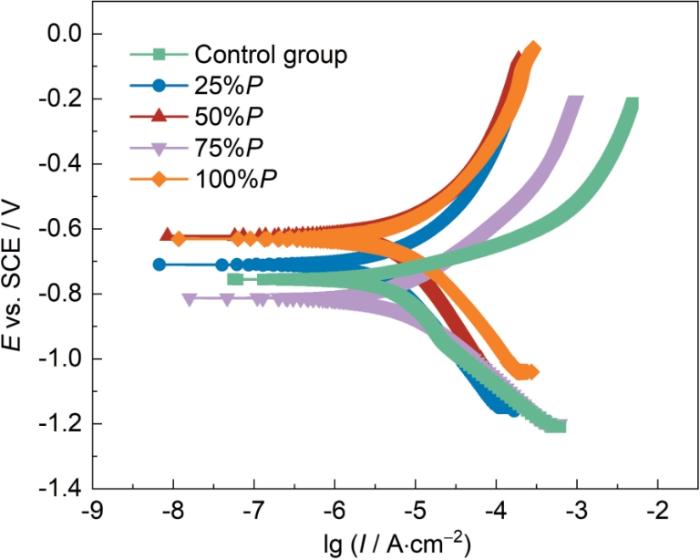
图1
金属在不同超声功率作用下浸泡5 d后的动电位极化曲线
Fig.1
Potentiodynamic polarization curves of metals after 5 d of immersion in a system with different ultrasonic powers
2.2.2 电化学参数分析
电化学腐蚀动力学参数,即Ecorr、ba、bc以及Icorr,通过Tafel直线的外推获得,计算出的各组抑制金属腐蚀速率,如表1所示。
超声处理抑制了金属在NaCl溶液中的电化学腐蚀行为,空白组的Ecorr为-0.756 V,Icorr为1.156 × 10⁻⁶ A·cm-2,而施加超声后Ecorr正移(绝对值减小),Icorr降低,表明超声抑制了腐蚀过程。其中25%P超声功率时抑制效果最佳,腐蚀电流降至4.927 × 10⁻⁶ A·cm-2 (腐蚀速率为0.058 mm/a),随着超声功率增大,抑制效果呈现先减小后增加的趋势。在25%P~75%P范围内,腐蚀速率先升至0.079 mm/a (50%P),随后在75%P功率时达到实验组的最大腐蚀速率(0.117 mm/a);而在75%P~100%P范围内,腐蚀速率略有回落至0.107 mm/a。ba无明显变化趋势,而bc从325.82 mV·dec-1 (空白组)变化至305.22 mV·dec-1(100%P),表明超声处理后的聚合物主要通过抑制阴极反应来减缓腐蚀,属于混合型抑制剂(兼具阳极和阴极抑制效应)。上述极化参数的变化规律表明,超声功率在25%P时抑制效果最佳。
2.2.3 EIS分析
图2
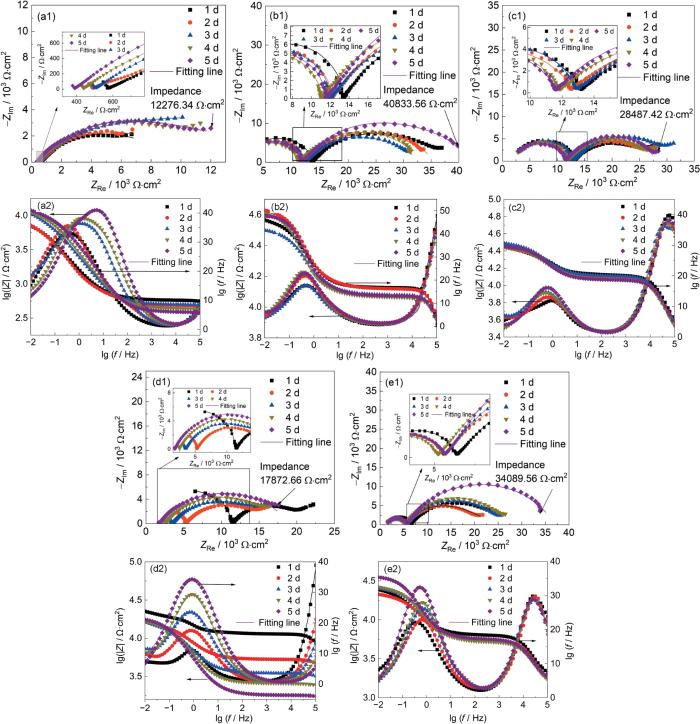
图2
腐蚀120 h后不同电解液环境下的EIS谱图
Fig.2
Nyquist plots (a1-e1) and Bode plots (a2-e2) after 120 h of corrosion comparing the control group (a) with environments subjected to ultrasonic power levels of 25%P (b), 50%P (c), 75%P (d) and 100%P (e)
图3
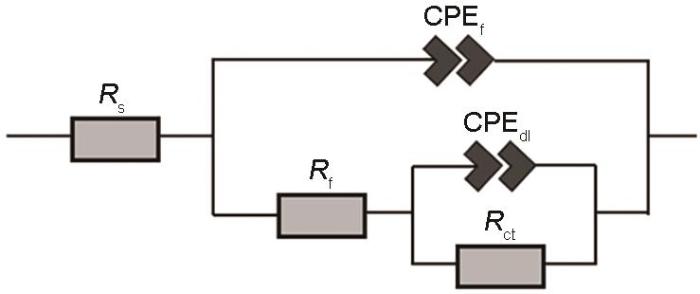
图2a所示,空白体系下,浸泡前2 d容抗弧的直径并未明显变化,表明浸泡2 d内金属的腐蚀速率并未发生明显变化,随着浸泡时间的进一步增加容抗弧的直径逐渐增大,腐蚀速率逐渐减小,这可归因于金属表面生成的腐蚀产物以及聚合物吸附。在浸泡5 d后的Bode相图上能看到两个弛豫时间。这可能表明这些样品上的金属腐蚀过程主要受多个电化学过程的控制,表明系统在该频率下可能表现出接近纯电阻性的行为,在该频率范围内,电化学系统中的电容效应相对较弱,电阻效应占主导地位。由图2b可知,在超声功率为25%P时,容抗弧的半径随着时间的增加呈现先减小后增加的趋势,金属的腐蚀速率呈现先增加后减小的趋势。由图2c可知,在超声功率为50%P时,容抗弧的半径随着时间的增加呈现先增加后减小的趋势,金属的腐蚀速率呈现先减小后增加的趋势。由图2d可知,在超声功率为75%P时,容抗弧的半径随着时间的增加呈现前期快速减小随后趋于平稳的趋势,金属的腐蚀速率在前期增加后期并未发生明显现象。由图2e可知,在超声功率为100%P时,容抗弧的半径随着时间的增加呈现先减小后增加的趋势,金属的腐蚀速率呈现先增加后减小的趋势。
图3为EIS的等效电路图。结合等效模拟电路模型对EIS实验数据进行拟合。在中频区出现的容抗弧,其直径直接关联电荷转移电阻(Rct),该值越大表明缓蚀效果越强。低频区(< 1 Hz)的响应则主要与反应粒子的扩散过程有关。25%P组的电荷转移电阻显著高于空白组,验证超声-聚合物协同缓蚀效应。
由图4可知,浸泡5 d内,无超声空白组体系下金属的极化电阻均小于超声作用体系下金属的极化电阻,这表明空白体系下金属腐蚀最为严重,超声的作用抑制了金属在聚丙烯酰胺溶液中的腐蚀。超声功率为25%P时,浸泡5 d内金属的极化电阻均处于最大值,表明此时金属的腐蚀速率最小:当超声功率进一步增大时,极化电阻整体呈先减小后增加的变化,金属的腐蚀速率表现为先升后降,这表明随着超声功率的增加,其对金属腐蚀的抑制作用呈现出先减弱后增强的态势。
图4
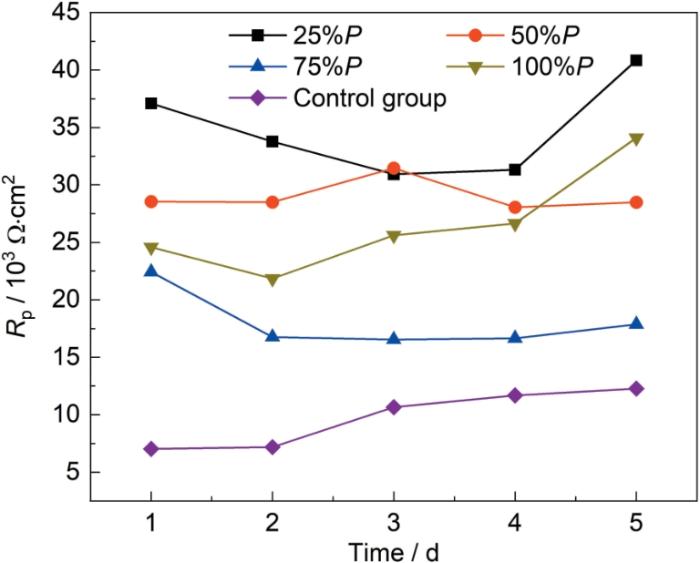
图4
不同超声功率下不同时间节点的极化电阻
Fig.4
Polarization resistance at different time nodes under different polarization resistance at different time nodes under different ultrasonic power
2.3 XRD分析
取实验试样的腐蚀产物进行XRD检测分析,图5为腐蚀产物XRD测试结果。通过对腐蚀产物的XRD分析,并结合相关化学反应式(1)~(6)可以深入理解不同电解液环境下20#钢的腐蚀机理。
图5
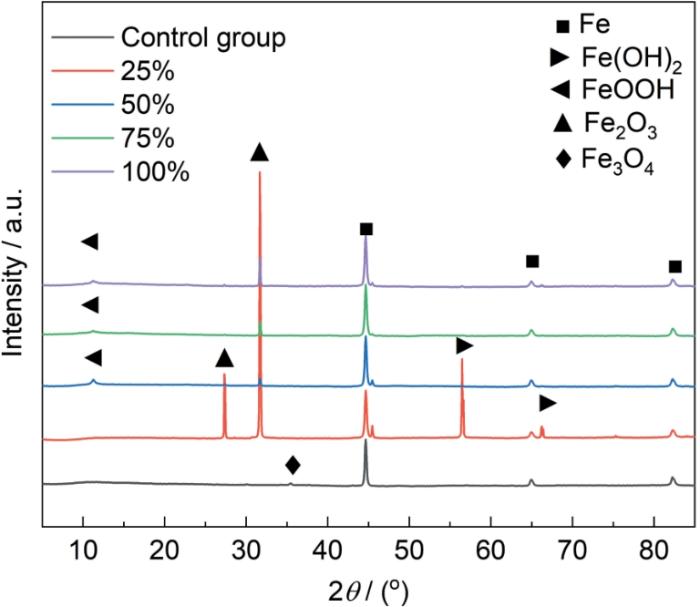
图5
不同体系样品浸泡5 d后的XRD图谱
Fig.5
XRD patterns of samples from different systems after 5 d of immersion
2.4 腐蚀形貌
图6为不同体系下的金属试样微观腐蚀产物形貌。由图6a可见,空白组样品表面生成了较少的颗粒状腐蚀产物,其对金属保护性弱,主要成分为导电的FeOOH和Fe3O4。清洗后的金属表面有明显点蚀坑和局部深度腐蚀区域。这些腐蚀产物与Fe基体形成了一种常见的局部腐蚀形式-电偶腐蚀,形成微小的电池效应,导致电位差的出现,并加速了金属的腐蚀过程。SEM分析表明,1 min处理的样品表面腐蚀产物虽呈大颗粒分布,但无宏观裂纹,如图6a和b,清洗后的整体呈现均匀的轻微腐蚀形貌,表面仅见浅表腐蚀痕迹,粗糙度较低且金属表面点蚀坑较少。由图6b可见,25%P超声功率组的样品,表面腐蚀产物呈均匀大颗粒分布且无宏观裂纹,形成复合屏障从而抑制局部剥落,降低金属的腐蚀速率。腐蚀产物主要含Fe2O3、FeOOH,而导电性较强的Fe3O4含量较低。低导电性产物在偶对界面形成高阻屏障,可减少电偶腐蚀效应[37],与电化学分析中25%P组的|Z|值明显高于含Fe3O4为主的75%P组的结论一致,符合绝缘性产物阻碍电荷转移的特性。由图6c可见,表面出现浅而小的腐蚀坑,但腐蚀产物分布较25%P组更密集,仍保持较好的覆盖率和保护效果,其腐蚀程度介于25%P与75%P之间。由图6d可见,75%P超声功率组的样品表面呈现明显的腐蚀形貌,存在较大量深而密集的腐蚀坑,表明该处理条件下金属遭受了较严重腐蚀。与低功率组相比,该组样品表面未能形成有效的保护性腐蚀产物层,表面零星分散着不均匀且大块的腐蚀产物,可能会导致氧气在金属表面分布不均匀。这种产物组成促进了电偶腐蚀效应,导致金属基体持续溶解,这与该组电化学阻抗值(|Z|最小)和最高腐蚀速率的测试结果完全一致。此外,超声空化效应可能破坏了聚合物分子的保护作用,使其无法有效填充颗粒间隙形成复合屏障,最终导致该组样品的防腐蚀性能最差。由图6e可见,腐蚀产物稀疏但腐蚀坑大而浅,超高功率超声的机械作用可能部分去除疏松腐蚀产物,使表面暴露出新鲜金属基体,反而减少了局部电偶腐蚀的持续发展,其破坏程度低于75%P组。
图6
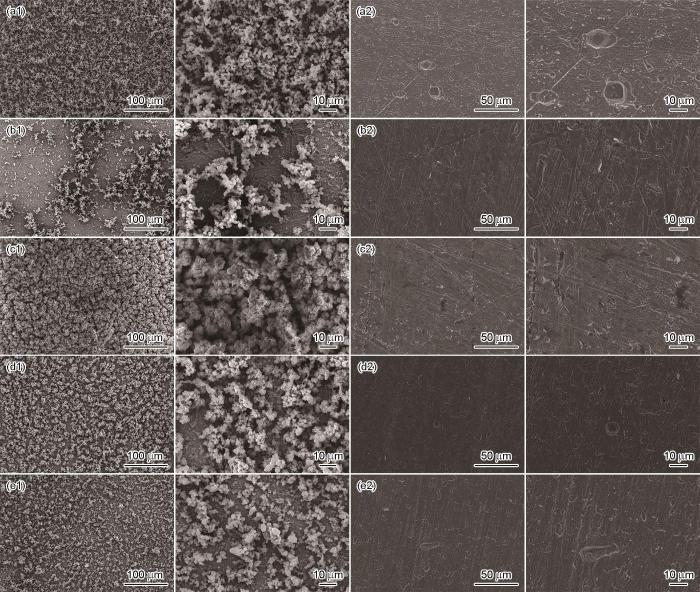
图6
金属试样微观腐蚀形貌
Fig. 6
Microcorrosion morphology of the control group (a) and the electrolyte environments at ultrasonic powers of 25 %P (b), 50 %P (c), 75 %P (d) and 100 %P (e) after 120 h of corrosion (a1-e1) and the same samples after cleaning (a2-e2)
3 机理分析
针对现有研究对聚合物与超声波技术的协同效应在金属管道腐蚀中的作用及机理缺乏深入探讨,本实验研究了在超声作用下,聚合物溶液中金属腐蚀行为的变化。通过电化学测试和表面分析技术,揭示了超声波通过降低溶液中的溶解氧含量、抑制金属的吸氧腐蚀过程、促进聚合物分子链的断裂和降解、降低溶液粘度,从而减缓腐蚀速率的新机制。具体分析如下:
对于聚合物体系中的金属,超声的作用抑制了金属腐蚀,电化学测试以及电镜的表征均证明了这一结果。当超声功率为25%P时,超声作用有效驱散了溶液中的溶解氧(O2),降低了金属界面的氧气浓度,使得金属表面生成的Fe(OH)2无法与足够的溶解氧发生进一步氧化反应(图5),从而抑制阴极的氧去极化腐蚀过程。同时,在此功率下的温和剪切力促进了聚丙烯酰胺分子中羧基(—COOH)和氨基(—NH2)等极性基团与金属表面Fe原子通过配位键形成稳固的化学吸附。密度泛函理论计算表明,Fe—O(羧酸盐)键能约为218 kJ/mol,Fe—N (氨基配合物)键能约为156 kJ/mol[40,41]。这种强相互作用显著提升了缓蚀剂分子在界面上的吸附稳定性,与本研究观察到的持久缓蚀效果具有一致性。这种定向且均匀的吸附促使聚合物分子在碳钢表面形成一层完整、致密的保护膜,有效阻隔了腐蚀介质与金属基体的接触,进一步抑制了金属的阴阳极反应。
羧基吸附:
氨基吸附:
随着超声功率进一步的增加(达到75%P时),水分子会发生超声分解:
超声使空化气泡破裂产生的自由基(如
(形成吸附态的中间产物);随后,该中间产物Fe(OH)ads与另一个水分子或OH-反应,生成可溶性的水解产物,再生出OH-和一个电子:Fe(OH)ads + OH-→ Fe(OH)2 + e-;生成的Fe(OH)2从电极表面溶解进入溶液,并进一步被氧化成Fe(III)的锈蚀产物(如FeOOH, Fe2O3·nH2O等):Fe(OH)
超声功率为100%P时,金属表面破坏扩散边界层,加速溶解氧向阴极表面的扩散,降低浓差极化(图3),促进氧还原,然而,在极高功率输入下,声源附近形成密集的空化气泡云,引发显著的“声屏障效应”,阻碍了声能的有效传递。这导致溶液内的实际有效空化强度下降,自由基的生成速率受到抑制,从而减弱了由羟基自由基诱导的Fe的阳极溶解过程。此外,高功率下的强微射流及振动作用,不仅改善了传质,还促进了部分降解后的PAM低分子量片段在碳钢表面通过氢键或静电作用进行高密度重排与紧密吸附,形成了更为致密、稳定的吸附层(图7),显著提升了界面屏障效应。因此,在阳极溶解受抑和致密膜阻挡的双重机制下,该体系对金属腐蚀的抑制性能再次增强。
图7
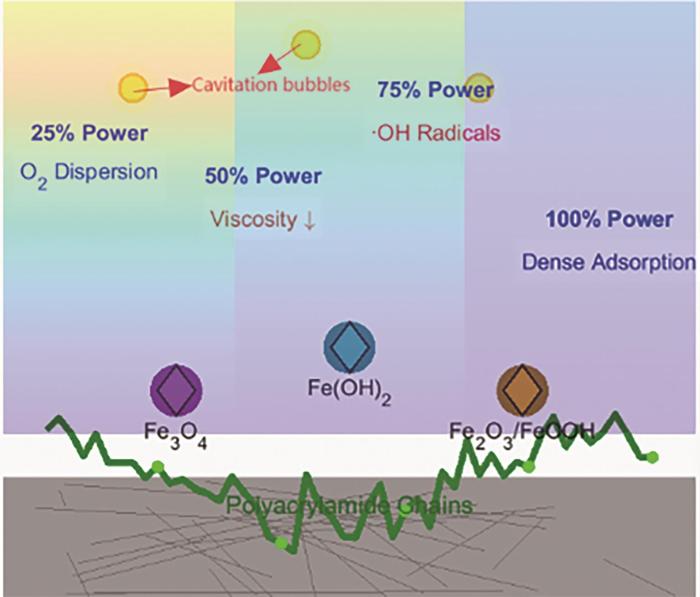
图7
超声波辅助聚合物缓蚀-多尺度作用机制示意图
Fig.7
Schematic diagram of the multi-scale mechanism of ultrasonic-assisted polymer corrosion inhibition
4 结论
(1) 超声功率对缓蚀效果具有非线性调控作用:实验结果表明,25%超声功率时金属极化电阻在浸泡5 d内始终处于最大值,表明腐蚀速率最小(0.0578 mm/a)、防腐蚀效果最佳;随超声功率增加,腐蚀速率先增大后减小;75%P时腐蚀速率达到最大值(0.117 mm/a),效果最差。
(2) 超声-聚合物协同缓蚀机制:超声通过多路径协同抑制金属腐蚀:降低聚合物溶液粘度,增强缓蚀剂分子扩散与金属表面吸附效率;通过机械-化学耦合作用抑制阴极氧还原反应动力学,同时调控阳极金属溶解反应;促进生成致密非导电性腐蚀产物层(如Fe2O3、FeOOH),有效阻断电偶腐蚀形成。
参考文献
Review on oil displacement technologies of enhanced oil recovery: State-of-the-art and outlook
[J].
A review of enhanced oil recovery technologies
[J].
三次采油技术综述
[J].
Research on corrosion and protection of oil pipelines in EOR blocks
[J].
三次采油区块输油管道的腐蚀及防护研究
[J].
Current situation and trend of chemical flooding technology for tertiary oil recovery
[J].
三次采油化学驱油技术现状与趋势
[J].
Progress of main enhanced oil recovery technologies for oilfields in China (Ⅰ)
[J].
国内油田三次采油提高采收率主体技术进展(上)
[J].
Progress of main enhanced oil recovery technologies for oilfields in China (Ⅱ)
[J].
国内油田三次采油提高采收率主体技术进展(下)
[J].
Corrosion mechanism of typical shale gas gathering and transportation pipelines in southwest China
[J].
Corrosion mechanism and anticorrosion technology of oil and gas gathering and transportation pipeline
[J].
Comprehensive investigation of modified polyethyleneimine as an efficient polymeric corrosion inhibitor in neutral medium: Synthesis, experimental and theoretical assessments
[J].
Polymeric corrosion inhibitors for the oil and gas industry: Design principles and mechanism
[J].
Effects of polymer corrosion inhibitor on widening etch tunnels of aluminum foil for capacitor
[J].
The dynamic variation characteristics of polymer flooding in class III reservoirs of Daqing oilfield
[J].
大庆油田三类油层聚合物驱开采动态变化特征
[J].
Experimental study on the enhanced oil recovery mechanism of an ordinary heavy oil field by polymer flooding
[J].
It is widely known that in the water flooding development process of ordinary heavy oil, the fingering phenomenon is obvious, there are a lot of unswept areas, and absolutely, the recovery is really very low. In addition, for some shallow and thin ordinary heavy oil reservoirs limited by the geological conditions of the reservoir, the thermal recovery technology also has serious heat loss and high development cost. Therefore, there is an urgent need to transform the development and further improve the enhanced oil recovery (EOR). In this paper, the mechanism of EOR by polymer flooding was investigated for high-porosity and high-permeability terrestrial ordinary heavy oil reservoirs. Through laboratory experiments, we analyzed the characteristics of oil-water relative permeability curves, mobility control ability, and microscopic seepage characteristics during polymer flooding of ordinary heavy oil reservoirs. On this basis, the effect of the mobility ratio on seepage characteristics and the mechanism of EOR enhancement were clarified. The results show that the polymer can effectively improve the mobility control effect of the displacing fluid. As the polymer solution and ordinary heavy oil have the characteristics of high viscosity and low mobility, there is a minimum mobility ratio in the process of polymer flooding. Namely, the characteristics of dual low mobility exist in the process of polymer flooding for the ordinary heavy oil. It effectively enhances the profile control and plugging ability of the polymer, thus expanding the sweep volume of larger pores and improving the displacement efficiency of smaller pores. Based on the two factors mentioned above, it is found that the dual low mobility characteristics can improve the recovery of ordinary heavy oil by polymer flooding. Therefore, it is proposed that an enhanced profile control and plugging effect due to the dual low mobility characteristics is an important EOR mechanism for ordinary heavy oil development by polymer flooding.© 2023 The Authors. Published by American Chemical Society.
Influence of the polymer degradation on enhanced oil recovery processes
[J].
Experimental study on enhanced oil recovery of adaptive system after polymer flooding
[J].After polymer flooding in Daqing Oilfield, the heterogeneity of the reservoir is enhanced, leading to the development of the dominant percolation channels, a significant issue with inefficient circulation, a substantial amount of displacement agents, and elevated cost. In order to further improve oil recovery, an adaptive oil displacement system (ASP-PPG) was proposed by combining preformed particle gel (PPG) with an alkali-surfactant-polymer system (ASP). This comprehensive study aims to assess the effectiveness of the adaptive oil displacement system (ASP-PPG) in improving the recovery efficiency of heterogeneous reservoirs after polymer flooding. The evaluation encompasses various critical aspects, including static performance tests, flow experiments, microscopic experiments, profile control experiments, and flooding experiments conducted on a four-layer heterogeneous physical model. The experimental results show that the adaptive system has robust stability, enhanced mobility, effective plugging capability, and profile improvement capability. Notably, the system demonstrates the remarkable ability to successfully pass through the core and effectively block the large pores, resulting in an 18.4% recovery incremental after polymer flooding. This improvement is reflected in the reduced oil saturation values in the ultra-high permeability, high permeability, medium, and low permeability layers, which are 5.09%, 7.01%, 13.81%, and 15.45%, respectively. The adaptive system effectively recovered the remaining oil in the low and medium permeability layers, providing a promising approach for improving the recovery factors under challenging reservoir conditions.
Electrochemical corrosion of stainless steel under ultrasound
[D].
不锈钢超声电化学腐蚀机理研究
[D].
Corrosion and corrosion inhibition of 304 stainless steel in acidic FeCl3 solution with applied inhibitor K2Cr2O7 and ultrasonic vibration
[J].
酸性FeCl3溶液中304不锈钢的超声腐蚀和缓蚀行为
[J].
Laser-fabricated Fe-Ni-Co-Cr-B austenitic alloy on steels. Part I. Microstructures and cavitation erosion behaviour
[J].
Laser-fabricated Fe-Ni-Co-Cr-B austenitic alloy on steels. Part II. Corrosion behaviour and corrosion-erosion synergism
[J].
Effects of ultrasonic cavitation on surface erosion of Q235 steel specimens
[J].
超声空化对Q235钢表面腐蚀行为的影响
[J].
Water irradiation by high-frequency ultrasonic wave: Effects on properties of passive film formed on stainless steel
[J].In this paper an aqueous solution was irradiated with a 1.63MHz ultrasonic wave. It is shown that if stainless steel can passivate under dynamic polarization in this medium, under static polarization, the latter does not show any repassivation behaviour with time. This is attributed to a diminution of the diffusion layer thickness that is developed at the electrode/electrolyte interface, which is associated with a production of H(2) species by sonolysis and which maintains reductive conditions at the interface. The oxide film formed under ultrasonic irradiation for 1h at a passive potential of+0.2V(SCE) shows an early stage of passivation and an increased disordered state, which implies a considerable decrease in the corrosion resistance behaviour of the sample. The polarization resistance of the stainless steel R(p) is divided by a value of 4.5 under ultrasonic conditions.Copyright © 2011 Elsevier B.V. All rights reserved.
Ultrasonically enhanced corrosion of 304L stainless steel I: The effect of temperature and hydrostatic pressure
[J].A systematic study of the effect exerted by various parameters on the corrosion of 304L stainless steel in an ultrasonic field has been carried out. Ultrasound increased the corrosion rate under all the investigated conditions. In this paper, attention is focused on the effect of temperature and hydrostatic pressure. At ambient pressure, increase in temperature, T, was found to increase the ultrasonically enhanced corrosion rate up to a maximum of 40 degrees C; at 50 degrees C a marked decrease in the effect of ultrasound was observed. At constant temperature, increase in hydrostatic pressure caused a strong increase in corrosion rate to values in excess of 2500 mm yr(-1) at 4 bar.
Effect of ultrasonic peening on corrosion resistance of AZ91D magnesium alloy
[J].
超声冲击对AZ91D镁合金耐腐蚀性的影响
[J].
Corrosion inhibition performance of rapeseed meal refluxed and ultrasonic extracts on cold rolled steel in hydrochloric acid medium: Combining experimental with theoretical insights
[J].
Mechanochemical backbone editing for controlled degradation of vinyl polymers
[J].
Manipulation of bubble collapse patterns near the wall of an adherent gas layer
[J].
Experimental and mechanism study: Partially hydrolyzed polyacrylamide gel degradation and deplugging via ultrasonic waves and chemical agents
[J].Partially hydrolyzed Polyacrylamide (PHPAM) crosslinked by Cr is frequently applied to plug thief zone for the better water management in matured oil reservoir. However, PHPAM gel may certainly cause inevitable formation damage nearby the wellbore. Although various kinds of chemical agents, such as hydrogen peroxide (HO), sodium hypochlorite (NaOCl), and chlorine dioxide (ClO) were employed to mitigate the nearby wellbore damage. But, huge financial investment, poor degelation efficiency, environmentally insecure, corrosion problem, and long time span requirement persuade researchers to look for other effective technique. In this connection, ultrasonic waves is characterized by reliable, environment friendly, and cost effective technology. Current work involves comparative study of PHPAM gel degradation by the individual means of chemical agent and ultrasonic waves. Subsequently, the best-performed ultrasonic parameters and well-performed chemical agent were used independently and then simultaneously to deplug (PHPAM gel) the core sample. Results showed that 20 KHz frequency (1000 W) effectively reduced gel viscosity from original (2495 mPa.s) to 1.37 mPa.s after 10 min irradiation. This degradation is attributed to cavitation, heat energy, and hydroxyl radical (HO∙). However, after 2 min further exposure, the viscosity grew back to 3.29 mPa.s (18 KHz), 1.42 mPa.s (20 KHz), and 3.74 mPa.s (25 KHz). This adverse behavior is owing to hydroxyl radical (HO∙) annihilation. In chemical treatment, HO among other chemicals efficiently degelled the PHPAM gel's original viscosity to 2.64 mPa.s after 24 h reaction. Similarly, NaOCl and ClO brought down original viscosity to 6.5 mPa.s and 159 mPa.s respectively. SEM of the samples before and after treatment was performed for the better understanding of PHPAM gel morphology. Considering dynamic experiment, maximum 23.5% and 19.80% damaged permeability recovery (30 × 10 μm gas permeability) were obtained by applying ultrasonic waves (20 KHz, 1000 W, and 100 min irradiation) and chemical agent (HO) respectively. Permeability recovery was further increased to 40.90% by the simultaneous application of ultrasonic waves and chemical agent.Copyright © 2019 Elsevier B.V. All rights reserved.
Mechanism on improvement of fatigue performance of pre-corroded 7A52-CZ aluminum alloy by ultrasonic deep rolling treatment
[J].
超声深滚处理改善预腐蚀7A52-CZ铝合金疲劳性能机理
[J].
The effects of SiO2 nanoparticles on the thermal stability and rheological behavior of hydrolyzed polyacrylamide based polymeric solutions
[J].
N-octadecyl lactose-amide modified microemulsions as targeting delivery carrier for α-linolenic acid: In vitro evaluation and interaction mechanism
[J].
Review of mechanistic analysis by electrochemical impedance spectroscopy
[J].
A simple analysis of impedance spectroscopy: Review
[J].
Research on the corrosion characteristics of X70 steel with coating damage under mixed alternating current (AC) and direct current (DC) interference
[J].
交直流混合干扰下涂层破损X70钢腐蚀特性研究
[J].
Mechanistic study of the effect of ultrasonic synergistic polymers on metal corrosion
[J].
超声波协同聚合物对金属腐蚀影响的机理研究
[J].
Galvanic corrosion behavior of coupling pairs of Ti80 alloy with various marine metallic materials
[J].
Ti80合金与船用金属的电偶腐蚀行为研究
[J].通过开路电位、动电位极化曲线和电化学阻抗谱等电化学测试以及微观形貌分析,探究了Ti80合金与4种常见船用金属材料(921A钢、B10铜合金、6061铝合金和40Cr合金钢)在NaCl溶液中的电偶腐蚀行为。此外,通过失重实验量化了与Ti80偶接对于4种金属材料腐蚀速率的影响。结果表明:4种金属与Ti80偶接均会形成不同程度的电偶腐蚀效应。电偶腐蚀并未改变阳极金属的腐蚀机理,但两种金属之间存在的自腐蚀电位差导致电偶体系产生电子转移势能,引发阳极金属加速溶解。相较金属材料的自腐蚀,与Ti80偶接后4种金属材料腐蚀速率增长幅度大小排序为:6061 > 40Cr > 921A > B10,电偶效应并不与电位差呈正相关。
Comparison of corrosion resistance of Zr-based amorphous alloys and traditional alloys in seawater
[J].
锆基非晶合金与传统合金在海水中的耐腐蚀性能对比研究
[J].采用X射线衍射仪(XRD)和差示量热扫描分析仪(DSC)对锆基非晶合金进行结构和热力学性能表征;采用动电位极化曲线及电化学阻抗谱研究锆基非晶合金和传统金属合金(304不锈钢、6082铝合金)在3.5%NaCl溶液和模拟海水溶液中的电化学行为;采用扫描电镜(SEM)观察腐蚀后试样的表面形貌,并利用能谱仪(EDS)分析非晶合金腐蚀后表面元素的变化。结果表明:4种金属合金在腐蚀溶液中均发生点蚀现象,非晶合金表现出更加优异的耐腐蚀性能。相较于在3.5%NaCl溶液中的极化曲线,非晶合金和传统合金在模拟海水溶液中的极化曲线均发生负移,归因于海水中溶有大量的氯化物和硫酸盐。相较于传统合金,非晶合金表面形成的钝化膜表现的更加稳定。
Mechanism of galvanic corrosion of coupled 2024 Al-alloy and 316L stainless steel beneath a thin electrolyte film studied by real-time monitoring technologies
[J].
实时监测技术研究薄液膜下电偶腐蚀的机理
[J].采用大气腐蚀检测技术 (ACM)、零电阻电流技术 (ZRA) 以及电化学阻抗谱技术 (EIS) 对2024铝合金与316L不锈钢在薄液膜下的电偶腐蚀行为进行了实时监测。结果表明,电偶腐蚀的过程可分为诱导期、加速期和减速期3个阶段。随着两电极之间距离的减小,电偶腐蚀会快速诱发,且腐蚀速率迅速增加,但电偶腐蚀的加速期变短。
Density functional theory study on the geometric and electronic structures of Fe2O2 and the reaction of Fe2 + O2
[J].
Density functional theory calculation of electronic structure of Fe-N-C, Fe-O-C, Fe-P-C, Fe-S-C single-atom catalysts systems
[J].


