



在众多ILs体系中,咪唑基双子型离子液体[10]因其特有分子结构,成为酸性介质缓蚀剂优选,核心优势包括:1) 咪唑环中N=C-N活性位点[12]可通过N原子孤对电子及芳环π电子与金属d轨道形成多重配位键,实现以化学吸附为主导的强界面结合;2) 双子型结构通过柔性烷基链(如C10间隔基)调节分子空间构象,使双咪唑环对金属/溶液界面形成平行吸附,进而构建致密保护层;3) 阴离子(如Br-)可通过静电吸引优先粘附于金属表面缺陷位点,协同抑制局部腐蚀。电化学研究显示,这类ILs通常呈混合型[13]缓蚀特性,例如Zafari等[14]开发的苯并咪唑基ILs在碳钢上缓蚀效率较高,其机制涉及π-d轨道共轭效应与羟基配位键的协同作用。当前研究存在以下局限:1) 针对高Cl-浓度酸性环境(如1 mol/L HCl)中N80钢(低碳微合金钢)缓蚀体系的研究不足,现有结论多基于常规碳钢或稀酸条件;2) 缺乏对缓蚀剂浓度梯度效应的系统研究,传统研究常忽视“缓蚀效率-浓度”协同优化分析,导致工业应用中难以平衡防护性能与经济效益。
为解决上述问题,本研究设计合成了以1,10-二溴癸烷为间隔基的双子型咪唑基离子液体[C2(Bim)10]Br2。首先,通过Fourier变换红外光谱(FT-IR)、¹H核磁共振(NMR)及热重分析(TGA)对其进行系统表征,确认热稳定性与分子构型;接着,采用失重实验与电化学测试,评估[C2(Bim)10]Br2在1 mol/L HCl溶液中对N80钢的缓蚀性能;同时,借助扫描电子显微镜(SEM)和X射线光电子能谱(XPS),详细分析N80钢表面形貌与化学成分,以深入理解其缓蚀机理。本研究重点在于对比不同浓度下的缓蚀效率,探讨浓度梯度效应与缓蚀效率的关系,建立“缓蚀效率-浓度”优化模型,为高Cl-浓度酸性环境中新型缓蚀剂作用机制提供理论支持,同时指导工业应用中在真实环境下平衡防护性能与经济效益。
1 实验方法
1.1 实验步骤
以1-丙基-2-甲基咪唑和1,10-二溴癸烷为原料,合成双子型咪唑基离子液体缓蚀剂。其制备采用高温反应结合后续纯化工艺[15,16]。具体合成过程如图1所示:向100 mL圆底烧瓶中加入2 mmol 1-丙基-2-甲基咪唑,搅拌条件下缓慢滴加1 mmol 1,10-二溴癸烷;将混合物加热至90 ℃并恒温反应48 h,确保反应充分进行;反应结束后,静置混合物并自然冷却至室温,促使沉淀物析出固化;对所得固体用乙酸乙酯多次洗涤,去除未反应原料及副产物以提高纯度;最后将洗涤后的固体置于真空干燥箱中干燥24 h,得到目标化合物1,2-双(N-丙基咪唑)奎烷溴盐([C2(Bim)10]Br2),产率为77.55%。
图1

1.2 缓蚀性能评价
失重法为评估缓蚀剂性能的常用方法,通过材料在腐蚀环境中的质量变化计算腐蚀速率及缓蚀效率。本文采用该方法测试双子型咪唑基离子液体在1 mol/L HCl溶液中对N80钢的缓蚀性能。实验所用N80钢试片尺寸为50 mm × 10 mm × 2 mm。实验前,所有试片依次经丙酮、无水乙醇超声清洗以去除表面油脂,自然干燥后,用电子天平精确称重并记录编号及质量。随后,将试片分别浸入未加缓蚀剂及添加不同浓度缓蚀剂的1 mol/L HCl溶液中,于25 ℃下浸泡24 h。每组实验悬挂3个试片,质量变化取平均值以减少误差。实验结束后,取出试片并置于酸洗液中超声清洗,用少量脱脂棉擦除表面腐蚀产物,再依次经去离子水、无水乙醇清洗,干燥后重新用电子天平称重。N80钢的腐蚀速率(CR)通过
式中,CR为腐蚀速率,mm·a-1;m为腐蚀前N80钢试片的质量,g;mt为腐蚀后N80钢试片的质量,g;S为试片的总表面积,cm2;t为实验时间,h;ρ为N80钢的密度,g·cm-3。
缓蚀效率(η)根据
式中,CR和CR(inh)分别为无缓蚀剂和添加缓蚀剂条件下N80钢的腐蚀速率,mm·a-1。
采用配备三电极体系的CHI760电化学工作站进行电化学测试,工作电极为表面积为1.0 cm2的N80钢试片,参比电极为饱和甘汞电极(SCE),对电极为铂电极。测试溶液为未添加和添加不同浓度缓蚀剂的1 mol/L HCl溶液。开始测试前,将电极浸泡在测试溶液中30 min,待开路电位(OCP)平衡稳定。测试频率范围为105~10-2 Hz,交流激励信号幅值为5 mV (vs. OCP)。测试结束后,使用Zview软件对测得的电化学阻抗谱图进行拟合,可以分别得出溶液电阻Rs、电荷转移电阻Rct、双电层恒定相位元件CPEdl等参数。根据拟合出的Rct值,通过
式中,Rct和Rct, 0分别为未添加缓蚀剂和添加缓蚀剂后的电荷转移电阻,Ω·cm2。
动电位极化曲线测试的扫描范围为OCP ± 500 mV,扫描速率为0.3 mV·s-1。腐蚀电位(Ecorr)和腐蚀电流密度(Icorr)通过对极化曲线进行Tafel 拟合得到。根据
式中,I
采用SEM (Nova NanoSEM 450)观察失重实验后N80钢试片表面微观腐蚀形貌。测试样品包括未添加缓蚀剂的试片及经不同浓度缓蚀剂处理的腐蚀试片,通过对比不同条件下的腐蚀形貌评估缓蚀剂对N80钢的保护效果。由于SEM对表面粗糙度的量化能力有限,本研究另采用Dimension Icon原子力显微镜(AFM)观察N80试片三维形貌,包括未添加缓蚀剂的试片和经最佳浓度缓蚀剂处理的腐蚀试片,扫描面积为5.0 μm × 5.0 μm。所得三维图像通过NanoScope Analysis软件分析表面粗糙度,以判断腐蚀程度。此外,采用Nexsa XPS确定材料表面元素组成及化学价态,分析金属表面缓蚀剂吸附膜成分。测试结束后,使用Avantage软件分析XPS结果,并对高分辨率光谱进行分峰拟合,明确峰值对应的特征元素及价态,深入探讨缓蚀剂分子在N80钢表面的吸附情况。最后,利用JC2000D接触角测量仪测定并评价未添加缓蚀剂的试片与经缓蚀剂处理的腐蚀试片的表面接触角,进一步验证缓蚀剂的缓蚀效果。
1.3 分子模拟研究
采用Materials Studio软件进行多尺度模拟研究。首先,基于Dmol3模块计算缓蚀剂分子的电子结构,选用GGA-PBE泛函、All Electron核处理方法和DNP 4.4基组,SCF收敛容差设为1.0 × 10⁻⁶,获取HOMO/LUMO能级及轨道分布。随后,利用Forcite模块模拟缓蚀剂在Fe(110)表面的吸附行为:构建6层Fe原子基底,表面添加2000个水分子和24个Cl-(对应24个H3O+维持电中性),设置8 nm真空层;采用COMPASS力场描述相互作用,静电和van der Waals作用分别通过Ewald与Atom-based (截断半径1.25 nm)求和方法处理。体系经Smart算法优化后,在NVT系综(NHL控温,298 K)下进行2 ns分子动力学模拟,步长1.0 fs,每5 ps采样一帧,分析吸附构型、浓度分布及相互作用能。
2 结果与讨论
2.1 结构表征
使用Nicolet IS50 Fourier变换红外光谱仪对提纯产物进行红外光谱测试,结果如图2a所示。波数2930和2860 cm-1处的特征吸收峰,对应长烷基链中亚甲基(-CH2-)的不对称伸缩振动与对称伸缩振动,源于1,10-二溴癸烷中-(CH2)10-链段;1621和1600 cm-1处吸收峰分别归属于咪唑环骨架中C=N键伸缩振动及共轭C=C键振动,揭示产物含咪唑环芳香共轭体系;1306与1261 cm-1处吸收峰对应咪唑环中C—N单键伸缩振动及烷基链与咪唑环连接处C—N+伸缩振动。上述特征吸收峰证实双子型离子液体[C2(Bim)10]Br2已成功合成。
图2

图2
[C2(Bim)10]Br2的红外光谱图、核磁氢谱图及热重曲线
Fig.2
Infrared spectrum (a), proton NMR spectrum (b) and thermogravimetric curve (c) of [C2(Bim)10]Br2
为进一步验证缓蚀剂合成成功,使用AV 400 MHz核磁共振仪对[C2(Bim)10]Br2进行氢谱分析,表征结果如图2b所示,图中各出峰位置已标注对应结构。
使用TG209F3热重分析仪评估[C2(Bim)10]Br2的热稳定性。图2c结果显示,25~300 ℃温度区间内,化合物的质量损失不到10%,表明该离子液体缓蚀剂具有优异的热稳定性。然而,当温度升至300 ℃时,出现了显著的热分解现象,失重率迅速达到100%。值得注意的是,与单咪唑型离子液体相比,该化合物的热分解温度显著提高。
2.2 缓蚀性能表征
2.2.1 静态失重结果
通过静态失重法系统表征新型离子液体缓蚀剂[C2(Bim)10]Br2在1 mol/L HCl溶液中对N80钢的腐蚀抑制行为,结果如图3所示。空白腐蚀介质中N80钢的腐蚀速率达58.2 mm/a;添加50 mg/L [C2(Bim)10]Br2后,腐蚀速率显著降至16.7 mm/a;随缓蚀剂浓度升至200 mg/L,腐蚀速率迅速降至5.9 mm/a,对应缓蚀效率达89.9%,这归因于[C2(Bim)10]Br2分子中咪唑环平面与金属表面的强配位吸附,及疏水性烷基链形成的物理屏障效应的共同作用。值得注意的是,缓蚀剂浓度进一步增加时,缓蚀效率未相应提升反而略微下降,原因是随缓蚀剂增多,试片表面缓蚀剂分子间相互作用增强,解吸附速率增大。
图3

图3
N80钢在含不同浓度[C2(Bim)10]Br2的1 mol/L HCl溶液中浸泡24 h后的缓蚀效率和腐蚀速率曲线
Fig.3
Corrosion inhibition efficiency and corrosion rate curves of N80 steel after immersion in 1 mol/L HCl solution containing different concentrations of [C2(Bim)10]Br2 for 24 h
2.2.2 电化学测试
图4展示了N80钢在含不同浓度缓蚀剂的1 mol/L HCl溶液中的Nyquist图、Bode图及极化曲线。由图4a可知,添加缓蚀剂后,电容弧形状与未添加缓蚀剂的样品一致,表明缓蚀剂未改变腐蚀机理。随缓蚀剂浓度从50 mg/L增至200 mg/L,电容弧直径逐渐增大,说明钢表面缓蚀剂膜更致密,缓蚀效率升至89.03%,该性能与Ashmawy等[21]制备的新型双子型离子液体缓蚀剂(N1,N1,N3,N3-四甲基-N1,N3-双(4-硝基苄基)丙烷1,3-二胺氯化物)相当,后者在相同的条件下的缓蚀性能达90.60%。但浓度增至250 mg/L时,电容弧直径略微减小,因缓蚀剂浓度较高时分子间相互作用增强,部分分子从金属表面解吸附,导致吸附膜致密度在一定程度上降低,缓蚀性能略微下降[22,23]。[C2(Bim)10]Br2的腐蚀抑制效果也体现在图4b中。添加缓蚀剂后,低频区阻抗幅值显著增大,相位角最大值增大且向左移动,表明缓蚀剂分子吸附于钢表面,阻碍腐蚀过程中的电荷转移。此外,未添加缓蚀剂时,相位角曲线呈单一时间常数特征,说明腐蚀过程主要由金属/电解液界面的电荷转移主导控制;添加缓蚀剂后仍保持单峰特征,表明缓蚀剂吸附未显著改变界面过程的电化学响应模式。
图4

图4
N80钢在含不同浓度[C2(Bim)10]Br2的1 mol/L HCl溶液中的Nyquist图、Bode图和极化曲线
Fig.4
Nyquist (a), Bode (b) plots and polarization curves (c) of N80 steel in 1 mol/L HCl solution containing different concentrations of [C2(Bim)10]Br2
为了进一步了解添加[C2(Bim)10]Br2后钢表面的电化学特性,对电化学阻抗图进行了定量研究,利用图4a插图中的等效电路提取了相关参数,见表1,卡方为10-2数量级,表明所用的等效电路图拟合出的理论数据与实验数据相吻合[24,25]。其中,Rs代表溶液电阻,Rct为电荷转移电阻,CPEdl为恒相位元件,本质上是非理想电容。与理想电容(Cdl)相比,CPEdl通过引入分散效应指数n (0 < n ≤ 1)修正了传统模型的局限性。由表可知,Rs约为1.3 Ω·cm2,Rct随着浓度的增加逐渐增大,直到浓度饱和时略有降低;n值约为0.85,CPEdl则随着浓度增加逐渐减小,直到浓度饱和时略微增大。这与缓蚀效率随浓度变化的情况及静态失重实验结果一致。图4c显示了在添加不同浓度缓蚀剂后得到的动电位极化曲线。通过Tafel外推法,得出了阳极Tafel斜率(βa)、阴极Tafel斜率(βc)、Ecorr和Icorr,如表2所示。对比结果显示,在未添加缓蚀剂时,Icorr为478.60 μA/cm2,相对较大;而随着缓蚀剂的添加,Icorr逐渐减小。
表1 N80钢在含不同浓度[C2(Bim)10]Br2的1 mol/L HCl solution中的电化学阻抗参数
Table 1
| Concentration / mg·L-1 | Rs / Ω·cm2 | Rct / Ω·cm2 | Y0 / 10-6 S·s n ·cm-2 | n | CPEdl / μF·cm-2 | η / % | χ2 / 10-2 |
|---|---|---|---|---|---|---|---|
| 0 | 1.32 | 80.21 | 134.02 | 0.85 | 60.60 | - | 2.32 |
| 50 | 1.39 | 274.63 | 107.62 | 0.83 | 53.24 | 70.79 | 1.59 |
| 100 | 1.29 | 411.52 | 100.18 | 0.84 | 54.92 | 80.51 | 1.34 |
| 150 | 1.25 | 456.89 | 99.45 | 0.84 | 56.23 | 82.45 | 2.64 |
| 200 | 1.20 | 730.94 | 64.80 | 0.85 | 37.96 | 89.03 | 1.82 |
| 250 | 1.28 | 675.37 | 77.85 | 0.85 | 49.64 | 88.13 | 3.51 |
表2 N80钢在含不同浓度[C2(Bim)10]Br2的1 mol/L HCl溶液中的动电位极化参数
Table 2
| Concentration / mg·L-1 | Ecorr vs. SCE / V | βa / V·dec-1 | -βc / V·dec-1 | Icorr / μA·cm-2 | η / % |
|---|---|---|---|---|---|
| 0 | -0.45 | 0.09 | 0.14 | 478.60 | - |
| 50 | -0.42 | 0.08 | 0.13 | 45.71 | 90.45 |
| 100 | -0.42 | 0.08 | 0.10 | 34.67 | 92.76 |
| 150 | -0.41 | 0.07 | 0.10 | 28.18 | 94.11 |
| 200 | -0.46 | 0.13 | 0.11 | 32.36 | 93.24 |
| 250 | -0.43 | 0.10 | 0.11 | 31.62 | 93.39 |
此外,Ecorr的最大变化小于±85 mV,表明缓蚀剂能够有效抑制阳极的金属溶解及阴极的析氢反应,具备混合型缓蚀剂的特性。
2.2.3 表面形貌分析
图5
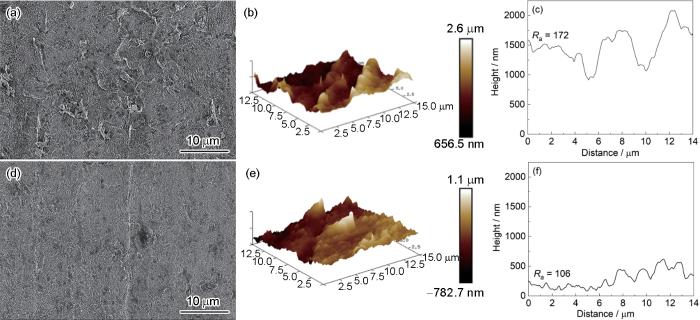
图5
N80钢在不含和含200 mg/L [C2(Bim)10]Br2的1 mol/L HCl溶液中浸泡24 h后的SEM、AFM图及粗糙度曲线图
Fig.5
SEM images, AFM and roughness curve of N80 steel after soaking in 1 mol/L HCl solution without (a-c) and 200 mg/L (d-f) [C2(Bim)10]Br2 for 24 h
2.2.4 表面结构分析
除了对试片表面的形貌进行分析外,还利用XPS和接触角分析仪测试了浸泡24 h后试片表面的元素组成分布及接触角大小,结果如图6所示。XPS测试表明,浸泡后试片表面由Fe、O、N、C等元素组成,其中Fe 2p轨道可分峰为Fe2+、Fe3+、Fe0及卫星峰;N 1s在400.5 eV处出现特征峰,归属于Fe—N键,这源于[C2(Bim)10]Br2中N原子孤对电子与Fe的3d空轨道形成配位作用。
图6

图6
N80钢在含200 mg/L的[C2(Bim)10]Br2的1 mol/L HCl溶液中浸泡24 h后的XPS谱图和含不同浓度[C2(Bim)10]Br2的1 mol/L HCl溶液中浸泡24 h后的接触角图
Fig.6
XPS spectra (a-c) of N80 steel immersed in 1 mol/L HCl solution containing 200 mg/L [C2(Bim)10]Br2 for 24 h and contact angle diagrams (d) after immersion in 1 mol/L HCl solution containing different concentration of [C2(Bim)10]Br2 for 24 h
2.3 分子模拟分析
通过量化和分子动力学(MD)模拟揭示了缓蚀剂分子在Fe表面的吸附机制,如图7所示。量化计算显示,该缓蚀剂具有较高的HOMO能级(-11.544 eV)和较低的LUMO能级(-6.589 eV),4.955 eV的窄能隙表明其良好的反应活性,有利于通过电子转移与Fe表面形成稳定吸附。MD模拟结果表明,缓蚀剂分子优先吸附在Fe表面1.79 nm处,形成强吸附峰,同时竞争性取代了水分子在1.43和1.75 nm处形成的较弱水化层。形貌分析证实缓蚀剂以平行构型吸附在Fe表面,最大化接触面积。相互作用能分析显示,缓蚀剂与Fe表面的结合能(-98.41 kJ/mol)以力(-91.50 kJ/mol)为主导,静电作用(-6.95 kJ/mol)为辅,表明van der Waals (VDW)吸附是主要作用机制。均方位移(MSD)曲线进一步显示分子在平行表面方向(X/Y)运动受限,而在垂直方向(Z)位移较大,证实了缓蚀剂在Fe表面形成稳定的二维保护层。这些结果共同表明,该缓蚀剂通过物理吸附主导、电子协同增强的复合机制,在Fe表面形成致密吸附层,有效阻隔腐蚀介质的渗透,展现出良好的缓蚀性能。
图7
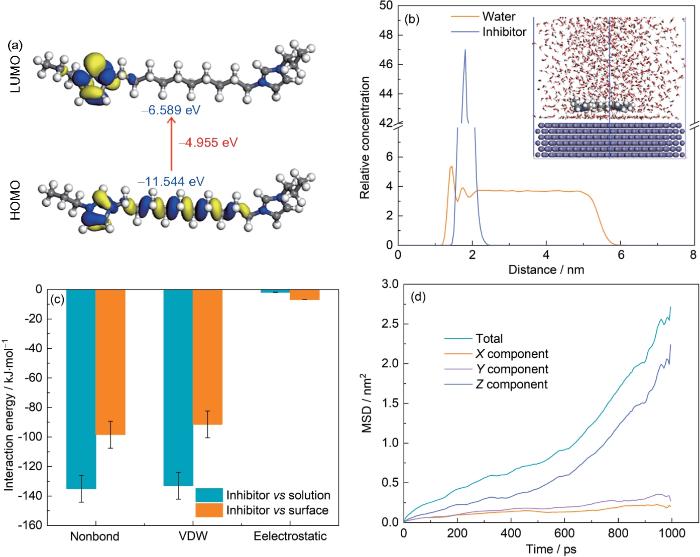
图7
缓蚀剂轨道能级、Fe表面缓蚀剂和水的浓度分布、缓蚀剂与Fe表面及与溶液的相互作用能以及缓蚀剂在金属表面不同方向的均方位移曲线
Fig.7
Orbital energy levels of the corrosion inhibitor (a), the concentration distribution of the corrosion inhibitor and water on the iron surface (b), the interaction energy between the corrosion inhibitor and the iron surface as well as with the solution (c), and the average azimuth movement curves of the corrosion inhibitor in different directions on the metal surface (d)
3 结论
(1) 利用1,10-二溴癸烷和1-丙基-2-甲基咪唑进行取代反应,制备了[C2(Bim)10]Br2双子型离子液体缓蚀剂,其在1 mol/L HCl溶液中对N80钢的缓蚀效率可达90%,缓蚀效果良好。
(2) 电化学阻抗谱表明,随着[C2(Bim)10]Br2浓度的增加(0~200 mg/L),电容弧直径增大,在低频区,阻抗幅值明显增大,只存在一个时间常数,相位角的最大值增大且向左移动。极化曲线表明,随着缓蚀剂的添加,Icorr逐渐减小。此外,Ecorr的最大变化小于±85 mV,缓蚀剂能够有效抑制阳极的金属溶解及阴极的析氢反应,具备混合型缓蚀剂的特性。当浓度大于200 mg/L,其缓蚀效率不再增加,这是因为缓蚀剂分子在钢表面已形成致密的保护膜,导致其达到吸附平衡。
(3) 失重后的表面形貌和结构分析表明,添加缓蚀剂的N80钢表面较为光滑,腐蚀产物较少,粗糙度较小且水滴接触角较大,并且其表面可以检测到Fe—N特征键,这证实了[C2(Bim)10]Br2通过N杂环与Fe原子的3d轨道形成化学吸附。
(4) 该缓蚀剂通过窄能隙(4.955 eV)促进电子转移,优先平行吸附于Fe表面(1.79 nm),依靠van der Waals力形成稳定保护层,有效阻隔腐蚀介质,展现出优异的缓蚀性能。
参考文献
Progress in public inquiry concerning corrosion in Chinese industrial and natural environments
[J].
中国工业与自然环境腐蚀调查的进展
[J].
Long-term prediction of metal corrosion losses in atmosphere using a power-linear function
[J].
Research progress of organic corrosion inhibitors in metal corrosion protection
[J].
Metal materials are vulnerable to corrosion in the process of production and service, which often leads to serious disasters, including the decline of the performance of metal components and the shortened service life, and even causes catastrophic accidents and ecological damage. Adding a certain amount of corrosion inhibitors (CIs) to the corrosive medium is a simple, efficient, and economical anti-corrosion method to slow down and restrain the corrosion of metal materials. Organic corrosion inhibitors (OCIs) are considered to have good application prospects and are widely used for surface anti-corrosion of metal materials, as they generally have advantages such as good metal adsorption, low oxidation resistance, good thermal and chemical stability, and green environmental protection. This paper systematically summarized some major OCIs, including alkyl chains, imidazoles, and pyridines, and their structural characteristics, as well as the action mechanism of OCIs. Moreover, this paper discusses some natural compounds used as environmentally friendly CIs and provides a prospect for the development trend of OCIs.
Advances in corrosion and protection of materials
[J].From an engineering standpoint, the corrosion of metallic materials is a challenging phenomenon, responsible for huge costs and serious failures [...]
Recent developments in sustainable corrosion inhibitors: Design, performance and industrial scale applications
[J].
Ionic liquids as green and sustainable steel corrosion inhibitors: Recent developments
[J].
Recent developments in sustainable corrosion inhibition using ionic liquids: A review
[J].
Inhibition of acid corrosion of carbon steel using four imidazolium tetrafluoroborates ionic liquids
[J].
Lignin-derivative ionic liquids as corrosion inhibitors
[J].Corrosion is a significant problem that negatively affects a wide range of structures and buildings, resulting in their premature failure, which causes safety hazards and significant economic loss. For this reason, various approaches have been developed to prevent or minimize the effects of corrosion, including corrosion inhibitors. Recently, biobased inhibitors have gained a certain interest thanks to their unique properties, eco-friendliness, and availability. Among all the green precursors, lignin is of particular interest, being a natural polymer that can be obtained from different sources including agricultural residues. Corrosion inhibitors based on ionic liquids (ILs) also present interesting advantages, such as low volatility and high tunability. If combined, it may be possible to obtain new lignin-based ILs that present interesting corrosion inhibitor properties. In this work, the inhibition properties of new biobased lignin ILs and the influence of anions and cations on the corrosion of mild steel in an aqueous solution of 0.01 M NaCl were investigated by Potentiostatic Electrochemical Impedance Spectroscopy (PEIS) and Cyclic Potentiodynamic Polarization (CPP). Moreover, the surface was characterized using SEM, EDS, and optical profilometry. The IL choline syringate showed promising performance, reducing the corrosion current after 24 h immersion in 0.01 M sodium chloride, from 1.66 µA/cm2 for the control to 0.066 µA/cm2 with 10 mM of the IL present. In addition to its performance as a corrosion inhibitor, both components of this IL also meet or exceed the current additional desired properties of such compounds, being readily available, and well tolerated in organisms and the environment.
Layer structure of quaternary-ammonium-salt-type amphiphilic gemini and trimeric ionic liquids
[J].
Three new gemini ionic liquids: Synthesis, characterizations and anticorrosion applications
[J].
Morphological performances and corrosion inhibition mechanism of new amphiphilic tetra-cationic imidazolium ionic liquids for carbon steel in 1M HCl medium
[J].
Imidazolium based ionic liquid as an efficient and green corrosion constraint for mild steel at acidic pH levels
[J].Anticorrosion impact of a green ionic liquid 3-(4-fluorobenzyl)-1-methyl-1H-imidazol-3-ium bromide [FBMIm) Br has been studied for mild steel in 0.5 M H2SO4 solution using computational and electrochemical methods. The structure of the obtained (FBMIm]Br was confirmed by using H-1 NMR, C-13 NMR, and FTIR spectroscopy, which also confirm the absence of any major impurity. The adsorption of this ionic liquid on the mild steel surface nicely follows Langmuir adsorption isotherm. The corrosion data extracted from Tafel plots and electrochemical impedance spectroscopy (EIS) indicate quite high inhibition effectiveness at acidic pH levels providing 98.90% and 99.48% efficiency using polarization and EIS methods respectively with 0.01 M IL at 298 K. Polarization curves also suggest that the molecule shows mixed mode of inhibition. Scanning electron microscopy (SEM) and atomic force microscopy (AFM) observations of mild steel surface confirmed the existence of protective inhibitor film on metal surface in the presence of this ionic liquid. The computational descriptors given by density functional theory (DFT) and advanced molecular dynamics (MD) simulation of the present molecule have also supported the experimental findings within the satisfactory limits and strengthened the overall study. (C) 2019 Elsevier B.V.
A novel green corrosion inhibitor based on task-specific benzimidazolium ionic liquid for carbon steel in HCl
[J].
Eco-friendly benzimidazolium based ionic liquid as a corrosion inhibitor for aluminum alloy composite in acidic media
[J].
Evaluation of ionic liquids based imidazolium salts as an environmentally friendly corrosion inhibitors for carbon steel in HCl solutions
[J].The features of this work on corrosion inhibition have been investigated based on the ecological awareness and according to the strict environmental legislations. This was done by studying how different imidazolium derivatives ionic liquids containing different alkyl chains R8, R10 and R12 affected the corrosion reaction of carbon steel specimen immersed in 1 M hydrochloric acid at various temperatures. Weight loss, potentiodynamic polarization and electrochemical impedance spectroscopy were utilized to examine the corrosion inhibition behavior on carbon steel. In addition, FT-IR spectroscopy was used to analyze the coated film that has been formed on the metal surface. The prepared ionic liquids showed effective inhibition efficiency, where the corrosion rate after the using of 100 ppm of R8-IL, R10-IL and R12-IL was decreased from 5.95 (µg cm−2 min−1) to 0.66, 0.56, and 0.44 (µg cm−2 min−1), respectively at 20 °C. In the polarization curves, the corrosion current, Icorr, decreases by ILs addition and suggest that ILs act as mixed type inhibitors. From EIS findings, the increase in Rct and decrease in Cdl values proves the adherence of inhibitor molecules on carbon steel surface. The temperature effect was also studied on the film formed, where increasing the temperature from 20 to 50 °C, the corrosion rate increased and the inhibitors efficacy decreased. The increasing in the length of the attached alkyl chain, the efficacies of the prepared inhibitors increases. Various thermodynamic parameters such as the reaction activation free energy (ΔG*), the entropy of activation (ΔS*), and the enthalpy of activation (ΔH*), as well as the adsorption isotherm were investigated in order to interpret the mechanism and obtain the most accurate perception.
Microbiologically influenced corrosion of X52 pipeline steel in thin layers of solution containing sulfate-reducing bacteria trapped under disbonded coating
[J].
Synergism of imidazoline and sodium dodecylbenzenesulphonate inhibitors on corrosion inhibition of X52 carbon steel in CO2-saturated chloride solutions
[J].
Chitosan Schiff base: An environmentally benign biological macromolecule as a new corrosion inhibitor for oil & gas industries
[J].An eco-friendly Schiff base, namely Salicylaldeyde-Chitosan Schiff Base (SCSB), was synthesized by the reaction of chitosan and salicylaldehyde. In 3.5% NaCl saturated with carbon dioxide at 65 °C corrosion inhibition effect was analyzed using weight loss, electrochemical impedance spectroscopy (EIS) and potentiodynamic polarization (PDP) methods. The PDP results revealed that SCSB acts as a mixed type inhibitor and reduces the corrosion process effectively at 150 mg L concentration with an inhibition efficiency of 95.2% and corrosion rate of 0.444 mm/y. EIS measurements suggest that the corrosion inhibition process is kinetically controlled. Langmuir adsorption model is the best fit among the other tested isotherms. The surface analysis was carried out using scanning electron microscopy (SEM), atomic force microscopy (AFM), scanning Kelvin probe (SKP), and X-ray photoelectron spectroscopy (XPS) to corroborate the formation of inhibitor film on the metal surface. Computational studies showed the effective adsorption of the protonated form of inhibitor.Copyright © 2019 Elsevier B.V. All rights reserved.
Molecular assembly between weak crosslinking cyclodextrin polymer and trans-cinnamaldehyde for corrosion inhibition towards mild steel in 3.5%NaCl solution: Experimental and theoretical studies
[J].
Eco-friendly gemini ionic liquid as a corrosion inhibitor for carbon steel in petroleum pipelines
[J].
Na-CDs as an eco-friendly and efficient corrosion inhibitor for Q235 in 1 M HCl
[J].
In-situ growth hierarchical and superhydrophobic flower-like Cu3(PO4)2·2H2O nanosheets based on copper mesh for efficient oil-water separation
[J].
Corrosion inhibition of peanut shell extract on cold rolled steel in hydrochloric acid solution
[J].
花生壳提取物对冷轧钢在盐酸溶液中的缓蚀作用及机理
[J].
Corrosion inhibition performance of nitrobarbituric acid on Mg-alloys AZ31B and AZ91D in 3.5% NaCl solution
[J].
3.5%NaCl溶液中硝基巴比妥酸对AZ31B与AZ91D镁合金腐蚀的缓蚀作用及机理研究
[J].为了探究一种缓蚀剂对于不同型号的镁合金的缓蚀效果是否存在差异,本文采用静态失重法、析氢和电化学测试、SEM-EDS、XRD和XPS等手段对镁合金表面形成的腐蚀产物形貌、成分和元素组成进行分析,探究硝基巴比妥酸(NBA)对AZ31B和AZ91D镁合金的缓蚀作用机理。结果表明:NBA能明显抑制AZ31B镁合金在3.5% (质量分数) NaCl溶液中的腐蚀速率,而对于AZ91D镁合金则表现为促进腐蚀。NBA为酸性物质,加入3.5%NaCl溶液后,降低了溶液的pH值,初始由于AZ31B镁合金基体的溶解,基体表面产生大量Mg<sup>2+</sup>,与阴极反应产生的OH<sup>-</sup>发生反应,在合金表面沉积一层致密的Mg(OH)<sub>2</sub>保护膜,从而抑制腐蚀;而对于AZ91D镁合金,由于不能在表面快速形成致密的Mg(OH)<sub>2</sub>保护膜,从而腐蚀加速。
Adsorption and inhibition action of dodecyl dimethyl benzyl ammonium chloride on cold-rolled steel in trichloroacetic acid
[J].
三氯乙酸中十二烷基二甲基苄基氯化铵在冷轧钢表面的吸附及缓蚀作用
[J].
In-depth experimental assessment of two new aminocoumarin derivatives as corrosion inhibitors for carbon steel in HCl media combined with AFM, SEM/EDX, contact angle, and DFT/MDs simulations
[J].


