



一般从植物中提取出的缓蚀剂和抑菌剂具有环境友好特性,常用的提取方法有索氏提取法、加热回流法和超声辅助提取法等[4]。针对CO2腐蚀,研究表明金玉桃叶[5]、白果[6]、毛竹叶[7]、陈皮[8]、咖啡渣[9]等植物具有良好的缓蚀效果,缓蚀率可达84.8%~94.4%。此外,印楝[10]、大蒜油[11]等植物对SRB腐蚀表现出较好的抑菌性能。为解决SRB腐蚀和酸性环境(如HCl)腐蚀共存的防护需求,也有研究人员开展植物的适应性筛选,研究表明柿子皮[12]、银杏叶[13]等对SRB抑制效果显著,但在HCl环境下缓蚀性能不佳。目前油气田现场出现的CO2腐蚀与SRB腐蚀共存的问题亟待解决,但在CO2环境下具有优异缓蚀性能且能够抑制SRB活性的植物提取物药剂研究相对较少,因此亟需基于现场实际需求进行植物优选。
1 实验方法
试样采用20#钢,其化学成分(质量分数,%)为C 0.22、Si 0.24、Mn 0.56、P 0.02、S 0.007、Ni 0.012、Cr 0.02、Cu 0.017,余为Fe。腐蚀失重试样尺寸为:50 mm × 10 mm × 3 mm。电化学测试中预处理后工作电极的工作面积为100 mm2,其他部分用环氧树脂封装。采出水来自西南某气田现场,pH为6.13,离子(mg/L)组成为:K+ 184.8、Na+ 10620.6、Ca2+ 350.2、Mg2+ 31.4、Ba2+ 253、Sr2+ 118.3、Fe2+ + Fe3+ 15.8、Cl- 15679.9、SO
实验中使用的旱莲草源于安徽亳州地区。经过清洗后,以60 ℃的温度烘干并研磨粉碎。根据单因素变量法确定提取工艺参数,称取20 g加入200 mL的90%乙醇溶液中浸泡36 h,超声处理3次,每次持续30 min。利用循环水真空泵进行减压过滤,使用旋转蒸发仪连续蒸馏,将萃取液定容至50 mL,得到提取物。使用Fourier红外光谱分析仪(WQF520)进行官能团检测,推测提取物中的缓蚀有效成分。
实验温度为25、35和45 ℃,在电化学工作站(PARSTAT4000)上进行电化学实验,采用三电极体系,测试温度为35 ℃,腐蚀介质为采出水,工作电极采用20#钢,参比电极采用饱和甘汞电极,辅助电极采用面积为100 mm2的铂电极。在对极化曲线进行测试时,扫描电位的范围:相对开路电位为±200 mV,动电位扫描速度为0.1667 mV/s。测试电化学阻抗谱时,扫描频率范围设置为105~10-2 Hz,交流激励幅值设置为10 mV。缓蚀率计算公式如下:
式中,η1和η2均为缓蚀率,%;I
经过电化学测试选出缓蚀效果最好的温度,失重实验温度为35 ℃,腐蚀介质为采出水,用水磨砂纸(400#~1200#)逐级打磨试样表面直至光滑,干燥后称重,将试样浸没于腐蚀介质中72 h,用酸洗去除腐蚀产物并干燥处理后再次称重并在同一条件下进行3次测试计算平均腐蚀速率,公式如下:
式中,v为腐蚀速率,mm/a;M和M1为实验前后的试样质量,g;S为试样的总面积,cm2;t为实验时间,h;D为材料的密度,kg/m3;研究的金属材料密度取7850 kg/m3。
将经过处理的20#钢分别置于空白组和对照组,浸泡一定时间后,使用扫描电子显微镜(ZEISS EVO MA15)观察20#钢表面的腐蚀形貌。
通过Material Studio的Dmol3模型进行量子化学计算,根据量子化学中的密度泛函理论,首先优化旱莲草中缓蚀有效分子结构模型得到其最优分子构型及电荷密度分布,然后计算最高占据轨道能(EHOMO)、最低非占据轨道能(ELUMO)、能隙(ΔE)、电负性(χ)、总硬度(η)、总软度(σ)、转移电子分数(ΔN)等量子化学参数,分析提取物的吸附性能。
2 结果与讨论
2.1 缓蚀性能评价
2.1.1 电化学阻抗谱
基于成本可行性及现场试剂的要求,选择1%~5% (体积分数)的提取物浓度进行测试。图1展示了20#钢在不同温度(25、35和45 ℃)下,不同浓度旱莲草提取物(1%~5%)在腐蚀介质中得到的Nyquist图。在未添加旱莲草提取物时,Nyquist图包含高频区的容抗弧与低频区的感抗弧。添加旱莲草提取物后,Nyquist图包含高频区的容抗弧和低频区的一条倾斜直线。高频区容抗弧半径的大小与电荷转移电阻有关[18],高频区容抗弧曲率半径随提取物浓度增大而增大,当提取物浓度达到5%时,高频区容抗弧的曲率半径最大。低频区出现了Warburg阻抗,Warburg阻抗主要受到电极表面或其附近浓差效应的影响[19]。
图1

图1
不同温度、不同浓度旱莲草提取物在腐蚀溶液中的Nyquist图
Fig.1
Nyquist plots of eclipta prostrata extract in corrosive solution under 25 ℃ (a), 35 ℃ (b) and 45 ℃ (c)
图2

图2
腐蚀溶液中不含和含旱莲草提取物的等效电路
Fig.2
Equivalent circuit of the corrosive solution without (a) and with (b) eclipta prostrata extract
表1 不同温度、不同浓度旱莲草提取物在腐蚀溶液中的电化学阻抗谱拟合结果
Table 1
| T/ ℃ | Volumefraction / % | Rs/ Ω·cm2 | Cdl/ μF·cm-2 | Rct/ Ω·cm2 | RL/ Ω·cm2 | Cf/ μF·cm-2 | Rf/ Ω·cm2 | W/ Ω·cm2·s1/2 | χ2 | η2/ % |
|---|---|---|---|---|---|---|---|---|---|---|
| 25 | 0 | 1.48 | 224.59 | 91.67 | 169.15 | 159.62 | - | - | 6.39 × 10⁻³ | - |
| 1 | 1.11 | 175.11 | 180.75 | - | 128.16 | 288.4 | 0.0299 | 7.32 × 10⁻³ | 49.28 | |
| 2 | 1.85 | 153.49 | 229.13 | - | 92.61 | 341.1 | 0.0134 | 5.66 × 10⁻³ | 59.99 | |
| 3 | 0.72 | 120.07 | 371.8 | - | 85.73 | 391.9 | 0.0107 | 5.39 × 10⁻³ | 75.34 | |
| 4 | 1.36 | 111.37 | 405.21 | - | 65.41 | 440.6 | 0.0099 | 4.58 × 10⁻³ | 77.38 | |
| 5 | 1.45 | 90.56 | 589.65 | - | 54.24 | 474.3 | 0.0097 | 8.74 × 10⁻³ | 84.45 | |
| 35 | 0 | 1.07 | 255.12 | 56.09 | 127.63 | 188.96 | - | - | 4.94 × 10⁻³ | - |
| 1 | 1.57 | 188.36 | 339.56 | - | 135.87 | 273.48 | 0.0087 | 4.14 × 10⁻³ | 83.48 | |
| 2 | 1.77 | 156.23 | 473.88 | - | 99.91 | 334.56 | 0.0071 | 1.47 × 10⁻³ | 88.16 | |
| 3 | 1.61 | 141.99 | 581.42 | - | 75.72 | 498.71 | 0.0064 | 9.33 × 10⁻³ | 90.35 | |
| 4 | 1.39 | 120.47 | 622.26 | - | 63.55 | 510.05 | 0.0062 | 7.85 × 10⁻³ | 90.99 | |
| 5 | 1.54 | 100.23 | 673.13 | - | 45.03 | 569.27 | 0.0059 | 2.02 × 10⁻³ | 91.67 | |
| 45 | 0 | 1.6 | 271.53 | 43.75 | 100.99 | 219.1 | - | - | 7.69 × 10⁻³ | - |
| 1 | 0.72 | 209.45 | 255.1 | - | 159.98 | 299.96 | 0.0102 | 6.28 × 10⁻³ | 82.85 | |
| 2 | 1.49 | 168.12 | 305.77 | - | 144.26 | 302.18 | 0.0097 | 2.91 × 10⁻³ | 85.69 | |
| 3 | 1.25 | 150.86 | 356.16 | - | 108.01 | 373.26 | 0.0092 | 6.74 × 10⁻³ | 87.72 | |
| 4 | 2.18 | 126.85 | 379.25 | - | 91.37 | 456.12 | 0.0088 | 5.19 × 10⁻³ | 88.46 | |
| 5 | 1.88 | 120.86 | 422.75 | - | 73.93 | 510.46 | 0.0074 | 4.86 × 10⁻³ | 89.65 |
表1结果可知,当温度一定时,随提取物浓度增大,缓蚀效率增大。提取物浓度增大,更多的分子吸附在钢片的活性位点上,逐渐形成致密保护膜,阻隔腐蚀介质与钢片表面接触。提取物浓度达到一定值后,吸附达到饱和状态,故缓蚀率趋于平稳。当浓度不变时,缓蚀率随着升温先增大后减小。温度上升至35 ℃时,溶液中分子运动加剧,提取物分子更迅速地附着在金属表面保护金属基体。温度继续升高到45 ℃时,由于溶液中分子运动过快,破坏了20#钢表面的脱附和吸附平衡,部分提取物分子发生脱附。因此温度35 ℃,提取物浓度5%时,缓蚀率最高达到91.67%。
2.1.2 极化曲线
图3展示了20#钢在不同温度(25、35和45 ℃)下,不同浓度旱莲草提取物(1%~5%)在腐蚀介质中进行腐蚀实验得到的极化曲线。与空白组极化曲线相比,加入旱莲草提取物后,腐蚀电位呈现出正向偏移,极化曲线中的阴极和阳极部分均向低电流方向移动,阳极的降低趋势更明显,表明腐蚀反应的阴极和阳极部分均得到了有效抑制,提取物对阳极反应的抑制作用比阴极更强烈。此外,随着提取物浓度逐渐增大,缓蚀效果也更加显著。
图3

图3
不同温度、不同浓度旱莲草提取物在腐蚀溶液中的极化曲线
Fig.3
Polarization curves of 20# carbon steelin corrosive solution containing eclipta prostrata extract under 25 ℃ (a), 35 ℃ (b) and 45 ℃ (c)
极化曲线参数如表2所示,随着旱莲草提取物浓度增加,自腐蚀电流密度Icorr降低,缓蚀率增大。提取物浓度增加,提取物分子吸附在电极表面形成致密的保护膜,减缓了腐蚀反应的进程。在35 ℃、旱莲草提取物浓度为5%时,自腐蚀电流密度最小为10.15 μA/cm2,此时缓蚀率达到最高94.31%。极化曲线结果与EIS结果一致。
表2 不同温度、不同浓度旱莲草提取物在腐蚀溶液中的极化曲线参数
Table 2
| T/ ℃ | Volume fraction / % | Ecorr/ mV | Icorr/ μA·cm-2 | βa/ mV·dec-1 | βc/ mV·dec-1 | ƒa | ƒc | ƒa/ ƒc | η1/ % |
|---|---|---|---|---|---|---|---|---|---|
| 25 | 0 | -671.04 | 118.64 | 37.88 | 97.78 | - | - | - | - |
| 1 | -663.62 | 24.67 | 65.94 | 108.43 | 0.1768 | 0.2119 | 0.8345 | 79.21 | |
| 2 | -649.07 | 21.88 | 161.41 | 115.17 | 0.1515 | 0.2100 | 0.7212 | 81.56 | |
| 3 | -653.9 | 19.93 | 228.73 | 121.93 | 0.1623 | 0.2013 | 0.8061 | 83.2 | |
| 4 | -658.03 | 16.76 | 237.17 | 126.72 | 0.1275 | 0.1492 | 0.8543 | 85.87 | |
| 5 | -661.48 | 15.29 | 240.58 | 132.85 | 0.1214 | 0.1357 | 0.8943 | 87.11 | |
| 35 | 0 | -685.15 | 191.48 | 48.17 | 102.66 | - | - | - | - |
| 1 | -619.71 | 31.26 | 171.98 | 113.18 | 0.1078 | 0.2813 | 0.3834 | 83.67 | |
| 2 | -607.6 | 25.13 | 184.58 | 128.77 | 0.0860 | 0.2391 | 0.3597 | 86.88 | |
| 3 | -647.14 | 22.91 | 192.57 | 138.46 | 0.0970 | 0.1555 | 0.6238 | 88.04 | |
| 4 | -630.99 | 16.57 | 208.46 | 122.44 | 0.0622 | 0.1254 | 0.4955 | 91.35 | |
| 5 | -613.36 | 10.89 | 227.633 | 137.94 | 0.0394 | 0.0910 | 0.4335 | 94.31 | |
| 45 | 0 | -684.97 | 229.46 | 42.78 | 81.932 | - | - | - | - |
| 1 | -663.11 | 41.84 | 72.56 | 102.7 | 0.1344 | 0.2247 | 0.5980 | 81.77 | |
| 2 | -616.7 | 33.57 | 137.97 | 113.36 | 0.0923 | 0.2764 | 0.3339 | 85.37 | |
| 3 | -644.41 | 28.63 | 168.35 | 130.82 | 0.1001 | 0.1736 | 0.5764 | 87.52 | |
| 4 | -622.16 | 26.95 | 183.44 | 176.96 | 0.0844 | 0.1696 | 0.4979 | 88.26 | |
| 5 | -625.69 | 21.61 | 209.81 | 161.58 | 0.0708 | 0.1355 | 0.5223 | 90.58 |
加入提取物后,实验组与空白组的腐蚀电位的变化量ΔEcorr < 85 mV,可认为该提取物为混合抑制型缓蚀剂。经计算,提取物在不同条件下ƒa和ƒc均小于1,表明在该环境下,提取物对阳极和阴极均有抑制作用;随着旱莲草提取浓度增大,ƒa和ƒc都减小,说明随着提取物浓度增大,对腐蚀反应阻滞作用变大。另外,ƒa/ƒ c 小于1,ƒa小于ƒc,表明提取物对阳极的抑制效果更为显著。因此旱莲草提取物是以抑制阳极为主的混合型缓蚀剂。
2.1.3 失重实验
图4展示了失重实验中计算得到均匀腐蚀速率及平均缓蚀率。旱莲草提取物浓度增加,缓蚀效果增强。体积浓度从1%提高到5%时,平均腐蚀速率由0.2086 mm/a下降到0.0475 mm/a,缓蚀率从53.79%提高到89.47%,表明旱莲草提取物浓度增加,提取物分子覆盖在金属表面的腐蚀活性位点增多,有效抑制了20#钢表面的腐蚀,与上述电化学实验结果一致,结果相对偏差为2.39%~5.13%。
图4

图4
静态失重实验均匀腐蚀速率及平均缓蚀率
Fig.4
Uniform corrosion rate and average inhibition efficiency from static weight loss experiments
2.1.4 腐蚀形貌分析
图5

图5
腐蚀溶液中不含和含旱莲草提取物的腐蚀形貌
Fig.5
Corrosion morphology of 20# carbon steel in corrosive solution with and without eclipta prostrata extract: (a) without additive, (b) addition of extract 5%
2.2 缓蚀机理分析
2.2.1 吸附模型
为探究旱莲草提取物在20#钢表面的吸附模型,将实验数据代入以下公式进行拟合得到35 ℃下莲草提取物在20#钢表面的吸附过程所属等温线:
式中,θ为表面覆盖度;K为吸附平衡常数,L/g;Cinh为缓蚀剂的浓度,g/L;a为吸附粒子间相互作用参数;n为常数。
图6

图6
35 ℃下旱莲草提取物在20#钢表面的吸附等温线
Fig.6
Adsorption isotherm of eclipta prostrata extract on 20# steel surface at 35 ℃: (a) Langmuir adsorption isotherm fitting, (b) Temkin adsorption isotherm fitting, (c) Freundlich adsorption isotherm fitting, (d) Frumkin adsorption isotherm fitting
图7

图7
不同温度下的Langmuir吸附模型
Fig.7
Langmuir adsorption isotherm fitting under 25 ℃ (a), 35 ℃ (b) and 45 ℃ (c)
2.2.2 提取物官能团表征
图8
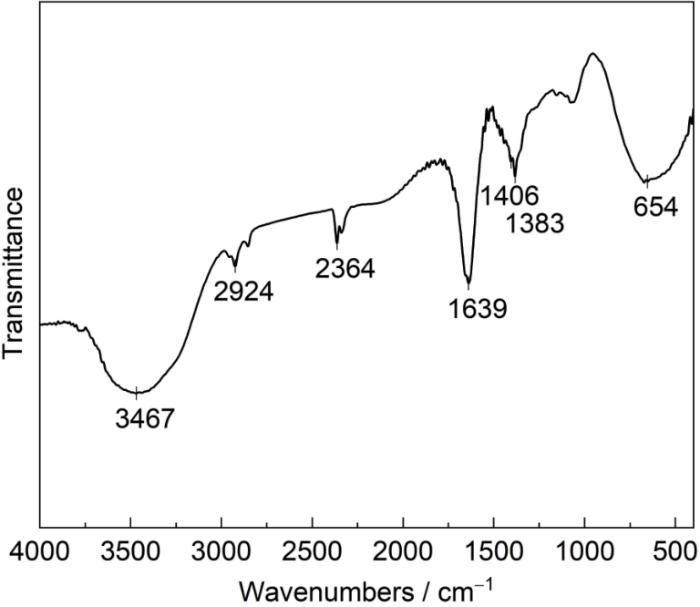
图9

图9
旱莲草提取物XPS谱图
Fig.9
XPS spectrum of eclipta prostrata extract: (a) C 1s, (b) N 1s, (c) O 1s
2.2.3 量子化学计算
分别从黄酮类化合物、三萜类化合物和甾体类化合物中选择槲皮素、旱莲苷A和豆甾醇用于量子化学计算,最优模型以及电荷密度分布见表3、3类化合物HOMO轨道主要分布在O—H、C=C、C—O、C=O以及苯环附近,LUMO轨道主要分布在C=C、C—C、C—O、C=O以及苯环附近。槲皮素的HOMO和LUMO主要集中分布于其共轭芳香环及相邻羟基官能团区域,这种集中的电子云分布使其能通过多位点吸附在碳钢表面形成致密吸附层,从而覆盖较大的保护面积。旱莲苷A的HOMO与LUMO轨道空间分布较为分散且重叠度较低,该分子的大扭曲构象促成了这种电子结构特征,使得其在Fe表面的吸附构型呈现出更强的取向依赖性,使富电子区(如HOMO主导区)优先锚定阳极位点,缺电子区(如LUMO主导区)覆盖阴极位点,对提升吸附稳定性及缓蚀效率起到协同促进作用。
表3 3种化合物FMO电荷密度分布
Table 3
| Molecule | Optimized molecular geometry | HOMO | LUMO |
|---|---|---|---|
| Quercetin | |||
| Ecliptasaponin A | |||
| Stigmasterol |
根据表4,在3种化合物中,槲皮素展现出最优异的量子化学参数特征:其最高占据分子轨道能级(EHOMO)最大,表明该分子具有最强的电子供体能力;而最低未占分子轨道能级(ELUMO)最小,显示出对自由电子的高效捕获特性。能隙值(ΔE)最低值表明其具有最高的化学反应活性,其与Fe原子间的电荷转移驱动力显著增强。此外,槲皮素的总硬度(η3)最低且总软度(σ)最高,表明其电子转移过程所受阻力最小化;其电子转移分数(ΔN)最大进一步验证该分子具有最强的电子供给倾向性。综上所述,槲皮素比其他两种化合物更具有吸附优势。
表4 3种化合物的量子化学参数
Table 4
| Molecule | EHOMO / eV | ELUMO / eV | ΔE / eV | χ / eV | η3 / eV | σ / eV -1 | ΔN |
|---|---|---|---|---|---|---|---|
| Quercetin | -4.89 | -2.23 | 2.67 | 3.57 | 1.33 | 0.75 | 1.29 |
| Ecliptasaponin A | -5.34 | -0.97 | 4.38 | 3.16 | 2.19 | 0.46 | 0.88 |
| Stigmasterol | -5.06 | 0.14 | 5.20 | 2.46 | 2.60 | 0.38 | 0.87 |
2.3 抑菌性能评价
2.3.1 抑菌效果评价
将细菌瓶按序排列,每排8个,设置稀释梯度为10,平行管数为3,培养时间为7 d进行计数,根据细菌瓶计数结果,采出水中SRB含量为1 × 10⁵个/mL。将不同浓度的旱莲草提取物加入采出水中,温度35 ℃,药菌接触时间为24 h。抑菌评价结果如表5所示,当浓度为5%时,抑菌效果不理想,因此在成本可控的条件下继续加大浓度,随着旱莲草提取物浓度的增加,抑菌性能越好。
表5 旱莲草提取物抑菌评价效果
Table 5
| Volume fraction / % | Test vial results | Viable cell count/ CFU·L-1 |
|---|---|---|
3 | +++++-+- +++++--- +++++--- | 40000 |
5 | +++++--- +++++--- +++++--- | 25000 |
7 | ++++++-- ++++-+-- ++++-+-- | 16000 |
9 | ++++---- +++++--- +++++--- | 9500 |
11 | +++-+--- +++++--- +++----- | 1150 |
2.3.2 腐蚀形貌分析
35 ℃下,20#钢分别在空白组和添加体积浓度11%的提取物的腐蚀介质(SRB含量105个/mL)中浸泡7 d并进行细胞固定后,通过扫描电镜对20#钢表面生物膜进行表征。如图10a所示,空白组的金属基体表面覆盖着相对致密的沉积物,符合SRB生物膜特征。腐蚀介质中的SRB吸附到金属表面并进行生命活动,并且分泌胞外聚合物(EPS)附着在金属表面,形成一层含有SRB的薄膜[22]。试样表面生物膜的形成和结构变化导致电化学性质不均匀,产生局部腐蚀的条件[22],试样表面出现局部凹陷。添加提取物后,观测结果如图10b所示,金属基体表面平整,表面未观察到明显的SRB生物膜,表面有划痕,但无明显的腐蚀现象,金属基体得到了有效保护。
图10

图10
不含和含旱莲草提取物的SRB腐蚀形貌
Fig.10
Surface morphology of SRB in corrosive solution with and without eclipta prostrata extract: (a) without additive, (b) addition of extract at 11% (volume fraction)
2.4 抑菌机理分析
3 结论
(1) 旱莲草提取物能有效抑制CO2腐蚀和SRB腐蚀。35 ℃下,5%旱莲草提取物缓蚀率达94.31%,其含有黄酮、三萜及甾体类有效缓蚀成分。提取物能抑制SRB生物膜形成并且随着体积比增加抑菌效果越好。
(2) 旱莲草提取物在20#钢表面属于Langmuir吸附,其有效成分中旱莲苷A提升吸附稳定性,槲皮素增大保护面积。旱莲草提取物中的多酚类化合物可以抑制SRB活性。
参考文献
Corrosion characteristics and protection measures in shale gas field
[J].
页岩气田腐蚀特征及防腐措施
[J].
Corrosion inhibition of Erigeron canadensis L. extract for steel in HCl solution
[J].
小蓬草提取物对钢在HCl介质中的缓蚀作用
[J].
以外来入侵杂草小蓬草(Erigeron canadensis L.)为原料通过超声波辅助提取制备小蓬草提取物(ECE)。利用失重法、电化学法、金属表面测试表征首次研究了以ECE作为缓蚀剂对钢在1.0 mol/L HCl介质中的缓蚀性能及作用机理。结果表明:ECE对钢在1.0 mol/L HCl介质中具有良好的缓蚀性能,缓蚀率随ECE浓度的增加而增大。40℃下,300 mg/L的ECE的缓蚀率最佳,达到93.7%。ECE在钢表面的吸附符合Langmuir吸附等温模型。20~50℃下,标准吸附Gibbs自由能范围为-28.37~-27.60 kJ/mol,吸附作用类型为物理吸附与化学吸附相结合的混合吸附。动电位极化曲线表明ECE为通过“几何覆盖效应”作用的混合抑制型缓蚀剂;Nyquist图谱呈单一容抗弧,钢/酸界面的电荷转移电阻随ECE浓度升高而增大,同时,双电层电容下降。金相显微镜、原子力显微镜(AFM)、接触角、FTIR和UV-Vis等测试表明ECE吸附在钢表面形成缓蚀膜层后使钢在HCl介质中的腐蚀明显减缓,并增强了钢表面的疏水能力。
Mechanism of eco-friendly and biomimetic biocides against microbiologically influenced corrosion under biofilms
[D].
环保仿生型抗菌剂对生物膜下微生物腐蚀作用机制
[D].
Research progress of plant corrosion inhibitors in CO2 environment
[J].
CO2环境中植物缓蚀剂研究进展
[J].
Corrosion inhibition of mild steel by Calotropis procera leaves extract in a CO2 saturated sodium chloride solution
[J].
Gingko biloba fruit extract as an eco-friendly corrosion inhibitor for J55 steel in CO2 saturated 3.5%NaCl solution
[J].
Hairy bamboo leaf extract as an eco-friendly corrosion inhibitor for L245N steel in CO2-saturated oilfield produced water
[J].
Inhibition effect of tangerine peel extract on J55 steel in CO2-saturated 3.5wt.%NaCl solution
[J].
Performance of an amide-based inhibitor derived from coffee bagasse oil as corrosion inhibitor for X70 steel in CO2-saturated brine
[J].The performance of a fatty acid amide inhibitor synthesized from the coffee bagasse oil has been evaluated by electrochemical techniques such as potentiodynamic polarization curves, open circuit potential measurements, linear polarization resistance, and electrochemical impedance spectroscopy. Inhibitor concentrations included 0, 5, 10, 25, 50, and 100 ppm. Inhibitor efficiency was evaluated on an X70 steel in a CO2-saturated brine at 60 degrees C. All the different techniques have indicated a decrease in the cathodic current density and inhibitor efficiency values as high as 96%. The inhibitor was chemically adsorbed on to the steel according to the analysis of the inhibitor adsorption process. [GRAPHICS].
Neem extract as an inhibitor for biocorrosion influenced by sulfate reducing bacteria: A preliminary investigation
[J].
Microbiologically-influenced corrosion of 1020 carbon steel in artificial seawater using garlic oil as natural biocide
[J].
Research of the corrosion inhibition and inhibition to oilfield bacteria by persimmon husk extraction
[J].
柿子皮提取物缓蚀及抑制油田微生物作用研究
[J].
Investigation of ginkgo biloba leave extracts as corrosion and oil field microorganism inhibitors
[J].Ginkgo biloba (Ginkgoaceae), originating from China, now distributes all over the world. Wide application of Ginkgo biloba extracts is determined by the main active substances, flavonoids and terpenoids, which indicates its extracts suitable to be used as an effective corrosion inhibitor. The extracts of Ginkgo biloba leave have been investigated on the corrosion inhibition of Q235A steel with weight loss and potentiodynamic polarisation techniques. The inhibition efficiency of the extracts varies with extract concentration. The extracts inhibit corrosion mainly by adsorption mechanism. Potentiodynamic polarisation studies show that extracts are mixed type inhibitors. The antibacterial activity of the extracts against oil field microorganism (SRB, IB and TGB) was also investigated.
Chemcial constituents of Eclipta prostrata
[J].
中药墨旱莲化学成分研究
[J].
Corrosion inhibition performance and mechanism of orange peel extract in H3PO4 solution
[J].
橙子皮提取物在H3PO4溶液中的缓蚀性能及缓蚀机理研究
[J].
Preparation of poly-containing wastewater fungicides in oil field and study on its sterilization mechanism
[D].
油田含聚污水杀菌剂的制备及杀菌机理研究
[D].
Adsorption and inhibition action of dodecyl dimethyl benzyl ammonium chloride on cold-rolled Steel in trichloroacetic acid
[J].
三氯乙酸中十二烷基二甲基苄基氯化铵在冷轧钢表面的吸附及缓蚀作用
[J].
Datura stramonium plant seed extracts as a new green corrosion inhibitor for mild steel in 1 M HCl solution: Experimental and surface characterization studies
[J].
Experimental and surface morphological study of corrosion inhibition of N80 carbon steel in HCl stimulated acidizing solution using gum exudate from Terminalia mentaly
[J].
Study on effective corrosion inhibition and adsorption mechanism of three plant extracts
[D].
三种植物提取物的高效缓蚀性能及吸附机理研究
[D].
Microbial corrosion of X60 pipeline steel in groundwater containing sulfate-reducing bacteria/iron-oxidizing bacteria mixed colonies
[J].


