



为了在低成本、高效率、易操作、环保性佳的前提下减缓低碳钢在酸性环境中的腐蚀,工业上广泛采用添加有机缓蚀剂的方法。这类缓蚀剂通常含有大量杂原子(如N、S和O)[7],通过静电作用和共价键形成吸附膜[8,9]。在恶劣条件下,有机缓蚀剂依旧能表现出优异的缓蚀效果,但潜在的毒性可能对环境保护和人体健康造成危害[10,11]。近年来,越来越多的研究者认识到这一问题,着手开发环保型缓蚀剂。其中,植物提取物就是一种具有良好可再生性、可降解性、高效性和易制备特点的环保型缓蚀剂[5,12,13]。此外,大多数植物提取物含有富含N、S和O等元素的多酚、萜类、黄酮和生物碱,具有与合成类的有机缓蚀剂类似的保护低碳钢免受酸性腐蚀的能力[14,15]。
1 实验方法
首先,对金银花进行提取。将33 g干燥的金银花粉末加入400 mL无水乙醇中,在333 K条件下回流2 h。随后对浸出液进行过滤,并用50 mL无水乙醇洗涤残渣3次。收集滤液后,通过旋转蒸发去除溶剂,最后将样品在323 K温度下的真空干燥箱中干燥24 h,得到棕色粘稠的HSE液体(4.1 g)。
实验选取低碳钢的化学成分(质量分数,%)为:0.19 C、0.46 Mn、0.22 Si、0.021 P、0.04 Cr、0.02 Cu、0.01 Ni、0.007 S,余量为Fe。失重测试使用的试样尺寸为50 mm × 13 mm × 2 mm,试样悬挂于腐蚀介质中。电化学测试的工作电极为低碳钢电极,通过Cu线焊接后用环氧树脂密封,有效暴露面积为0.26 cm2。形貌分析所用的试样尺寸为ϕ10 mm × 2 mm。
用滴管将一滴HSE液体滴在载玻片上。待HSE液体流动成一层均匀的薄膜后,将带有HSE液体薄膜的载玻片放入红外光谱(FT-IR,VERTEX 70)仪中进行测试,采用透射模式对HSE液体薄膜进行扫描,以获得HSE的官能团成分。
将试样在1 mol/L HCl溶液中浸泡3 h (303 K)后,通过失重法计算低碳钢样品的腐蚀速率(v)。每个条件下均测试3个平行试样。取出试样后,用蒸馏水和无水乙醇分别清洗,在氮气保护下干燥。试样的质量使用精度为0.1 mg的分析天平进行测量。缓蚀效率(η)根据
其中,vi和v0分别为添加和不添加缓蚀剂时的腐蚀速率。
将试样在1 mol/L HCl溶液中浸泡3 h后,分别使用蒸馏水和无水乙醇清洗试样并进行干燥,然后将样品保存于干燥器中。采用环境扫描电子显微镜(ESEM,Quanta 200,FEI)对试样的表面形貌进行扫描和观察。
2 结果与讨论
2.1 FT-IR测试
在缓蚀剂领域,多种植物提取物表现出显著的作用。鱼腥草叶、芦荟叶、紫茎泽兰叶、罂粟叶、丝瓜叶等叶片类提取物,木瓜、菠萝等果实提取物,大蒜、姜、橘皮、石榴皮等根茎果皮类提取物,以及芥末籽、桂圆籽、葵花籽等种子提取物,还有玫瑰、百合、洋甘菊等花卉提取物。
这些植物提取物之所以能发挥作用,源于其含有的丰富化学物质,包括糖苷类、生物碱、黄酮、甾醇、皂甙、鞣质、氨基酸、三萜等。这些物质具备羟基(—OH)、氨基 (—NH2)、酰胺(—CONH2)、羧酸(—COOH)、酯(—COO)等极性官能团,可通过吸附作用在金属表面形成保护膜,从而阻断金属与腐蚀性环境的直接接触,实现缓蚀的效果[25]。
图1

2.2 失重测试
失重法是一种随时间持续累积而成的腐蚀测试方法,更接近现场的实际情况。图2是低碳钢在303 K下、含有不同质量浓度HSE的1 mol/L HCl溶液中的腐蚀速率。可以看出,低碳钢在未添加HSE的1 mol/L的HCl中腐蚀严重,腐蚀速率为18.5 mm/a。添加HSE后,腐蚀速率显著降低,其中加入300 mg/L HSE的缓蚀效率达到最高,为89%(腐蚀速率为2.1 mm/a)。在同等实验条件下,仇莉等[33]制备的花生壳提取物(PSE)对冷轧钢表现出的缓蚀效果为88% (200 mg/L)。与之相比,虽然HSE的用量有所增多,但缓蚀效果得到了一定的提升。因此,HSE与PSE对低碳钢表现出同等的缓蚀能力,对1 mol/L HCl中的低碳钢腐蚀具有良好抑制作用。
图2
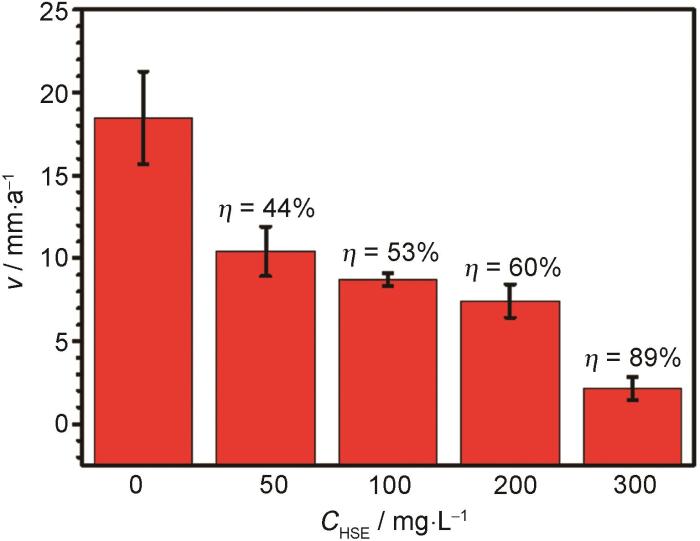
图2
低碳钢在303 K下、不同HSE质量浓度(0,50,100,200,300 mg/L)的1 mol/L HCl溶液中浸泡3 h后的腐蚀速率
Fig.2
Corrosion rate based on mass loss of mild steel after 3 h immersion in 1 mol/L HCl solution at various HSE content (0, 50, 100, 200, 300 mg/L) and 303 K
2.3 电化学阻抗谱测试
图3
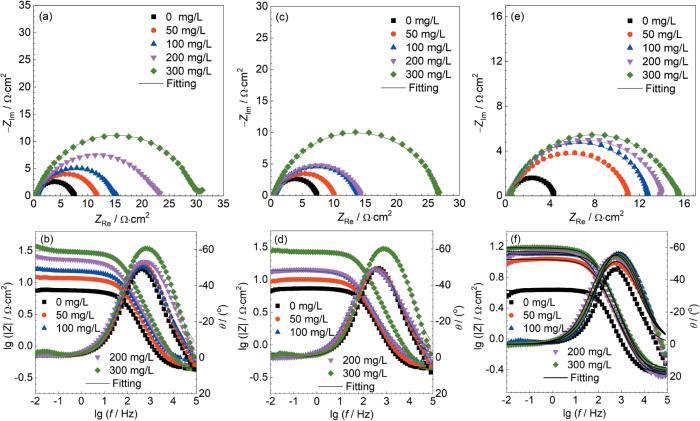
图3
低碳钢在不同HSE质量浓度(0, 50, 100, 200, 300 mg/L)和不同温度(303, 313, 323 K)下的1 mol/L HCl溶液中浸泡1 h后的Nyquist和Bode图
Fig.3
Nyquist plots and Bode plots of mild steel at the end of 1 h exposure in 1 mol/L HCl solution at various HSE concentrations (0, 50, 100, 200, 300 mg/L) and temperatures of 303 K (a, b), 313 K (c, d) and 323 K (e, f)
图4

图4
用于拟合EIS谱的等效电路图
Fig.4
Equivalent circuit model for fitting EIS data in Fig.3
表1 图3中电化学阻抗谱的拟合参数
Table 1
| T / K | CHSE / mg·L-1 | Rs / Ω·cm2 | Qdl / 10-4 Ω-1·s n ·cm-2 | n | Rct / Ω·cm2 | ηi / % |
|---|---|---|---|---|---|---|
| 303 | 0 | 0.44 | 8.64 | 0.82 | 6.98 | - |
| 50 | 0.48 | 6.98 | 0.80 | 11.8 | 41 | |
| 100 | 0.57 | 7.18 | 0.78 | 14.8 | 53 | |
| 200 | 0.44 | 6.76 | 0.75 | 23.0 | 70 | |
| 300 | 0.43 | 2.75 | 0.82 | 30.1 | 77 | |
| 313 | 0 | 0.44 | 7.76 | 0.83 | 6.81 | - |
| 50 | 0.46 | 9.88 | 0.78 | 9.68 | 30 | |
| 100 | 0.52 | 11.60 | 0.76 | 13.5 | 50 | |
| 200 | 0.48 | 12.10 | 0.74 | 14.1 | 52 | |
| 300 | 0.44 | 2.55 | 0.82 | 26.6 | 74 | |
| 323 | 0 | 0.37 | 7.43 | 0.86 | 3.89 | - |
| 50 | 0.37 | 9.00 | 0.77 | 10.8 | 64 | |
| 100 | 0.36 | 4.10 | 0.83 | 12.4 | 69 | |
| 200 | 0.33 | 7.70 | 0.79 | 13.8 | 72 | |
| 300 | 0.41 | 5.05 | 0.80 | 15.0 | 74 |
图5

图5
303 K下低碳钢在0和50 mg/L HSE的1 mol/L HCl溶液中浸泡1 h后的EPZC和EOCP
Fig.5
Plots of EPZC and EOCP measured after 1 h exposure with 0 (a) and 50 mg/L (b) HSE in 1 mol/L HCl solution at 303 K
图6
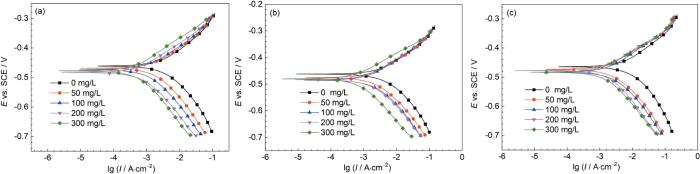
图6
低碳钢在含不同质量浓度(0,50,100,200,300 mg/L)HSE以及不同温度(303,313,323 K)下的1 mol/L的HCl溶液中浸泡1.5 h后的动电位极化曲线
Fig.6
Potentiodynamic polarization of mild steel at the end of 1.5 h exposure in 1 mol/L HCl solution at various HSE concentrations (0, 50, 100, 200, 300 mg/L) at 303 K (a), 313 K (b) and 323 K (c)
通过Cview软件对动电位极化数据进行了拟合处理,获得的阳极和阴极Tafel斜率(βa和βc)、腐蚀电位(Ecorr)和腐蚀电流密度(Icorr)等参数列于表2,可知Icorr随HSE质量浓度的增加而显著降低,303 K下缓蚀效率(ηi)在300 mg/L时可达90%。与此同时,无论是否添加HSE,Icorr均随温度升高而显著增加,表明在温度较高的条件下低碳钢腐蚀更为严重。
表2 图6中动电位极化曲线拟合参数
Table 2
| T / K | CHSE / mg·L-1 | βa / V·dec-1 | βc / V·dec-1 | Ecorr, SCE / V | Icorr / mA·cm-2 | ηi / % |
|---|---|---|---|---|---|---|
| 303 | 0 | 0.105 | -0.129 | -0.462 | 3.44 | - |
| 50 | 0.089 | -0.131 | -0.469 | 1.75 | 49 | |
| 100 | 0.084 | -0.128 | -0.474 | 1.13 | 67 | |
| 200 | 0.081 | -0.114 | -0.484 | 0.59 | 83 | |
| 300 | 0.084 | -0.123 | -0.478 | 0.31 | 91 | |
| 313 | 0 | 0.102 | -0.127 | -0.462 | 3.75 | - |
| 50 | 0.090 | -0.124 | -0.476 | 2.06 | 45 | |
| 100 | 0.097 | -0.124 | -0.485 | 1.73 | 54 | |
| 200 | 0.089 | -0.120 | -0.483 | 1.43 | 62 | |
| 300 | 0.075 | -0.119 | -0.480 | 0.85 | 77 | |
| 323 | 0 | 0.108 | -0.137 | -0.464 | 7.90 | - |
| 50 | 0.078 | -0.109 | -0.473 | 2.08 | 74 | |
| 100 | 0.086 | -0.118 | -0.482 | 1.85 | 77 | |
| 200 | 0.076 | -0.125 | -0.478 | 1.41 | 82 | |
| 300 | 0.075 | -0.122 | -0.483 | 1.04 | 87 |
2.4 SEM形貌
图7

图7
330 K温度下低碳钢在不同质量浓度HSE的1 mol/L HCl溶液中腐蚀3 h后的SEM形貌
Fig.7
SEM images of mild steel after 3 h exposure in 1 mol/L HCl solution containing different content of HSE at 303 K: (a) 0 mg/L, (b) 100 mg/L, (c) 200 mg/L, (d) 300 mg/L
2.5 吸附类型计算
根据Icorr得出缓蚀率ηi (表2),遵循Langemuir吸附模型计算出Langemuir吸附中KadsCSPT的值。公式如下:
其中,θ是金银花提取物在低碳钢表面的覆盖率,由ηe/100得出。Kads是吸附平衡常数,CH是金银花提取物的质量浓度。其中Kads和Gibbs自由能变化之间的关系如下[38]:
其中,R为气体常数 (8.314J/(mol·K)),T为绝对温度(303,313和323 K),C
图8
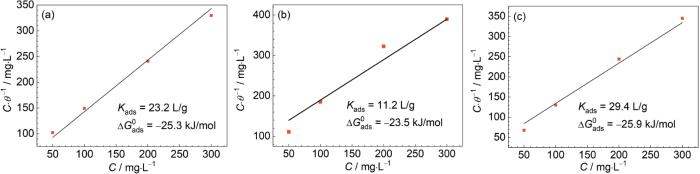
图8
不同温度下的HSE在低碳钢表面的Langemuir吸附等温线
Fig.8
Langmuir adsorption isotherm fitting of HSE on the surface of mild steel at 303 (a), 313 (b) and 323 K (c)
表3 由图8得到的HSE在低碳钢表面的标准热力学和吸附平衡参数
Table 3
| T / K | C·θ-1 / mg·L-1 | Kads / L·g-1 | ΔG |
|---|---|---|---|
| 303 | 43.0 | 2.33 × 10² | -25.3 |
| 313 | 89.6 | 1.16 × 10² | -23.5 |
| 323 | 34.0 | 2.94 × 10² | -25.9 |
3 结论
(1) 电化学结果表明,温度的升高会加剧低碳钢在1 mol/L HCl中的腐蚀速率,但HSE在较高的温度条件下仍表现出了良好的缓蚀效果。失重法测得300 mg/L的HSE对浸泡在1 mol/L HCl中的低碳钢缓蚀效率达到了89%,与电化学测试的结果趋势一致。
(2) 吸附模型的计算结果表明,由于低碳钢表面附带正电荷,HSE通过静电吸附和电荷转移作用,在低碳钢表面同时进行着物理吸附和化学吸附,从而获得了较高的缓蚀效果。综上所述,这种高效的环保型提取物,为开发环境友好型缓蚀剂提供了新思路。
参考文献
Aerobic corrosion process of Q235 steel in NaHCO3 solutions
[J].
Q235钢在不同浓度碳酸氢钠溶液中的有氧腐蚀行为
[J].
Initial corrosion behavior of several pure irons and steels in 3.5%NaCl solution
[J].
6种典型商用纯铁和钢材在3.5%NaCl溶液中的初期腐蚀行为
[J].
2-Amino-4-(4-methoxyphenyl)-thiazole as a novel corrosion inhibitor for mild steel in acidic medium
[J].
The inhibition of carbon steel corrosion in hydrochloric and sulfuric acid media using some benzimidazole derivatives
[J].
Eco-friendly corrosion inhibitors based on Cashew nut shell liquid (CNSL) for acidizing fluids
[J].
Benzimidazole derivatives as novel inhibitors for the corrosion of mild steel in acidic solution: Experimental and theoretical studies
[J].
The performance and mechanism of bifunctional biocide sodium pyrithione against sulfate reducing bacteria in X80 carbon steel corrosion
[J].
Effect of benzyl substitution at different sites on the inhibition performance of pyrimidine derivatives for mild steel in highly acidic solution
[J].
Investigation of inhibition effect of rhodanine-N-acetic acid on mild steel corrosion in HCl solution
[J].
Cephradine as corrosion inhibitor for copper in 0.9%NaCl solution
[J].
Investigation of adsorption and corrosion inhibition of mild steel in hydrochloric acid solution by 5-(4-Dimethylaminobenzylidene) rhodanine
[J].
Corrosion mitigation of mild steel in acidic medium using Lagerstroemia speciosa leaf extract: A combined experimental and theoretical approach
[J].
Detailed macro-/micro-scale exploration of the excellent active corrosion inhibition of a novel environmentally friendly green inhibitor for carbon steel in acidic environments
[J].
Evaluation of Ficus tikoua leaves extract as an eco-friendly corrosion inhibitor for carbon steel in HCl media
[J].
A detailed atomic level computational and electrochemical exploration of the Juglans regia green fruit shell extract as a sustainable and highly efficient green corrosion inhibitor for mild steel in 3.5 wt%NaCl solution
[J].
Spectrum-effect relationship study between HPLC fingerprints and antioxidant of honeysuckle extract
[J].
Study on the anaphylactoid of three phenolic acids in Honeysuckle
[J].
Medicinal plants with potential antipyretic activity: A review
[J].
A comparative study of Lonicera japonica with related species: Morphological characteristics, ITS sequences and active compounds
[J].
Structure and hemolytic activity relationships of triterpenoid saponins and sapogenins
[J]. J.
Development of a colloidal gold-based lateral flow dipstick immunoassay for rapid detection of chlorogenic acid and luteoloside in Flos Lonicerae Japonicae
[J].
Corrosion inhibition performance of imidazoline derivatives and thiourea on X65 steel under inert deposits scale in an artificial CO2 saturated oilfield produced water
[J].
咪唑啉衍生物与硫脲对X65钢在惰性沉积物垢下腐蚀的缓蚀机理研究
[J].
Study of the corrosion behavior of Aspergillus niger on 7075-T6 aluminum alloy in a high salinity environment
[J].
Corrosion behavior of Aspergillus niger on 7075 aluminum alloy and the inhibition effect of zinc pyrithione biocide
[J].
Research progress and prospects of the inhibition of plant corrosion inhibitors to steel
[J].
植物缓蚀剂对钢的缓蚀作用研究进展与展望
[J].
Photoacoustic spectroscopic studies of polycyclic aromatic hydrocarbons: Naphthalene molecule
[J].
Syntheses and anti-depressant activity of 5-amino-1, 3, 4-thiadiazole-2-thiol imines and thiobenzyl derivatives
[J].
Synthesis of sulfonated Poly(arylene ether)s in a one-pot polymerization process and their nafion-blend membranes for proton exchange membrane fuel cell applications
[J].
Synthesis of graphene/epoxy resin composite via 1,8-diaminooctane by ultrasonication approach for corrosion protection
[J].
1,1,3,3-Tetramethylguanidine immobilized on graphene oxide: A highly active and selective heterogeneous catalyst for Aldol reaction
[J].
High Performance Poly(ether-amide)s Derived from 1,1-Bis[4-(4-carboxy methylene phenoxy)-3-methyl phenyl] cyclopentane and aromatic diamines
[J].
Shedding light on sporopollenin chemistry, with reference to UV reconstructions
[J].
Corrosion inhibition of peanut shell extract on cold rolled steel in hydrochloric acid solution
[J].
花生壳提取物对冷轧钢在盐酸溶液中的缓蚀作用及机理
[J].
Investigation of adsorption and inhibition effects of some novel anil compounds towards mild steel in H2SO4 solution: Electrochemical and theoretical quantum studies
[J].
An electrochemical and theoretical evaluation of 4,6-diamino-2-pyrimidinethiol as a corrosion inhibitor for mild steel in HCl solutions
[J].
The capability of ultrafiltrated alkaline and organosolv oil palm (Elaeis guineensis) fronds lignin as green corrosion inhibitor for mild steel in 0.5M HCl solution
[J].
Corrosion inhibition effect of spiropyrimidinethiones on mild steel in 15%HCl solution: Insight from electrochemical and quantum studies
[J].
Study on corrosion inhibition behavior of photinia leaf extracts for Q235 steel in HCl medium
[J].
石楠叶提取物在盐酸中对Q235钢的缓蚀行为研究
[J].


