



缝隙腐蚀作为局部腐蚀的典型形态之一,多出现于金属材料与其他金属或非金属材料相互接触形成的狭窄间隙区域,其本质上是一种电化学反应过程。在有氧环境下,当缝隙内的氧气被还原反应消耗时,缝内金属离子水解导致缝隙外腐蚀性阴离子向缝隙内转移,从而引发缝内局部腐蚀。影响缝隙腐蚀的因素包括缝隙几何形状、介质中氧含量和Cl-浓度、介质的温度、pH值、流速以及金属表面状态等[7]。其中缝隙开口宽度对缝隙内外的介质化学环境和电化学差异有着决定性的影响。Engelhardt等[8]推导了缝隙临界深度(钝化膜活化-钝化失效转变区)与缝隙宽度、电解质电导率以及金属电位之间的函数关系,缝隙临界深度与缝隙宽度和电解质电导率成正比。Hu等[9]通过电化学噪声技术研究了不锈钢在NaCl溶液中的缝隙腐蚀行为,研究表明缝隙开口宽度尺寸越小,缝隙腐蚀的诱导期越短,缝隙开口宽度尺寸是缝隙腐蚀诱发和演变的关键因素。Chen等[10]研究了缝隙开口宽度和缝隙深度对304不锈钢在高温高压纯水中的缝隙腐蚀的影响,研究表明缝隙开口宽度对缝隙内溶解氧浓度有显著影响,导致缝隙内电流(I)和电阻(R)的乘积(IR)降变化,从而影响缝隙内氧化物的生长及演变。Chang等[11]研究了缝隙深宽比对316L不锈钢缝腐蚀萌生阶段的影响,认为IR降包括化学电位降和物理电位降,且两者比率与缝隙几何尺寸有关,尤其是缝隙深宽比。缝隙宽度对IR降影响较大,宽度越大,IR降越小,发生缝隙腐蚀的可能性越小。当缝隙深宽比大于250时,316L不锈钢极易发生缝隙腐蚀的萌生。许志昱等[12]研究了2205双相不锈钢在NaCl溶液中的缝隙腐蚀行为,当缝隙开口宽度较小时,缝隙腐蚀孕育阶段Cl-与H⁺的富集速率显著提高,其中H⁺浓度可提升两个数量级;进入缝隙腐蚀发展阶段后,OH-浓度呈现出明显的上升趋势;同时,缝内电位降越小,阳极溶解速率则越高。Hu等[13]开展了在CO2饱和的NaCl-HAc溶液中缝隙尺寸对N80碳钢缝隙腐蚀行为的影响,结果表明N80碳钢对缝隙腐蚀有较高敏感性,当缝隙开口宽度为100~500 μm时,缝隙腐蚀可即刻发生,无需经历诱导期。
目前关于缝隙腐蚀的研究环境大多集中于有氧环境,关于高温高压环境下CO2饱和盐溶液中金属缝隙腐蚀行为研究较少,特别是关于超级13Cr不锈钢缝隙腐蚀行为的研究更是鲜有报道。文献[14]证实,油管钢在60 ℃具有较高的腐蚀速率。本文采用浸泡及电化学实验,研究了超级13Cr不锈钢在60 ℃,饱和CO2油田采出液中不同缝隙开口宽度下的缝隙腐蚀行为,研究结果旨在对油井管服役寿命提供有益参考。
1 实验方法
1.1 实验材料
实验材料为超级13Cr不锈钢,化学成分为(质量分数,%):C 0.027,Si 0.23,Mn 0.41,P 0.022,S 0.008,Cr 13.3,Mo 0.95,Ni 2.6,Fe余量。线切割浸泡实验样品尺寸为ϕ20 mm × 10 mm和ϕ14 mm × 6 mm;电化学试样尺寸为10 mm × 10 mm × 2 mm。电化学试样背面点焊引出Cu导线,非工作表面用环氧树脂封装并留出有效面积1 cm2的工作面。将SiC水砂纸将浸泡试样和电化学试样逐级打磨到2000#,用丙酮和无水乙醇清洗后吹干待用。
实验溶液为我国西部某油气田采出液模拟溶液,其组成成分(g/L)为:NaHCO3 0.26,MgCl2·6H2O 3.836,CaCl2 23.06,MgSO4 0.5375,KCl 12.495,NaCl 174.73。实验前通入CO2气体12 h,使溶液达到饱和CO2状态,测得溶液pH值为4.4。
1.2 浸泡实验
浸泡实验用缝隙腐蚀样品装配图如图1所示。该缝隙样品中,下部试样缝隙内阳极面积与缝隙外阴极面积比约为1∶9,满足发生缝隙腐蚀的小阳极大阴极要求。上下试样通过标准M6的Al2O3陶瓷螺栓同轴连接,下部试样固定,上部试样可沿螺栓自由旋转,通过调节上部试样的旋转角度控制旋进距离,进而调整缝隙宽度。所采用的陶瓷螺栓螺距为1 mm,将上下部分连接后,通过旋转上部试样至45°、90° 及180°角度,对应形成的缝隙宽度分别为0.125、0.25和0.5 mm。为确保缝隙宽度稳定,上部试样角度调整完成后,通过将螺帽安装在其背面陶瓷螺栓上进行固定。
图1
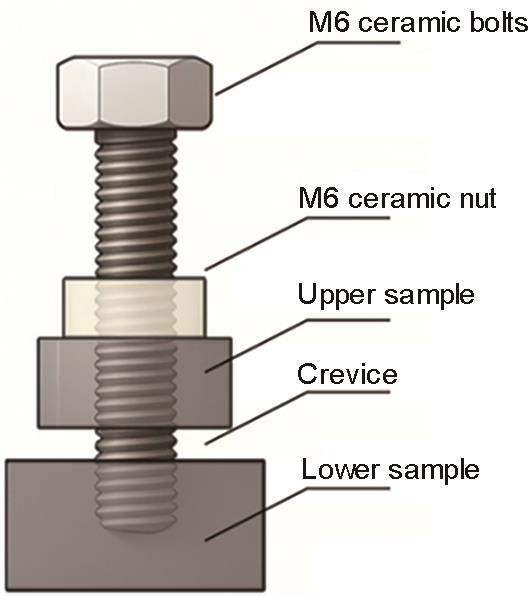
图1
浸泡实验缝隙试样装配图
Fig.1
Schematic diagram of the crevice corrosion specimen for the immersion experiment
浸泡实验在高温高压釜中进行,每组实验放置两个平行试样。将反应釜温度升高至60 ℃时,向釜内充入CO2直至压力达到1.5 MPa,实验时间为240 h。浸泡实验结束后,取出下部试样,按照GB/T 16545-2015规定清除试样表面腐蚀产物。用扫描电镜(SEM,SU8010)观察去除腐蚀产物前后试样表面微观结构。采用能量散射谱(EDS,Q500MW)分析了腐蚀产物中的成分。采用X射线光电子能谱(XPS,ThermoFisher K-Alpha)对腐蚀产物成分进行分析,用XPS Peak 4.1软件对数据进行拟合处理。
1.3 电化学实验
电化学实验缝隙试样装配图如图2所示。用聚四氟垫片调整缝隙宽度分别至0.125、0.25和0.5 mm。实验在电化学高温高压反应釜中进行,实验温度为60 ℃,高压釜内通入CO2使釜内压力至1.5 MPa。电化学实验在Zahner电化学工作站上完成。采用三电极体系,工作电极为超级13Cr不锈钢试样,辅助电极为Pt电极,参比电极为Ag/AgCl电极。在浸泡时间进行到24、120和240 h时进行电化学阻抗谱(EIS)测试,测试频率为105~10-2 Hz,正弦激励信号为10 mV。浸泡时间为240 h时进行动电位极化曲线测试,动电位极化曲线电位扫描范围为-1.0~0.8 V,扫描速率为0.667 mV/min。本文所有电极电位均相对于Ag/AgCl电极。
图2
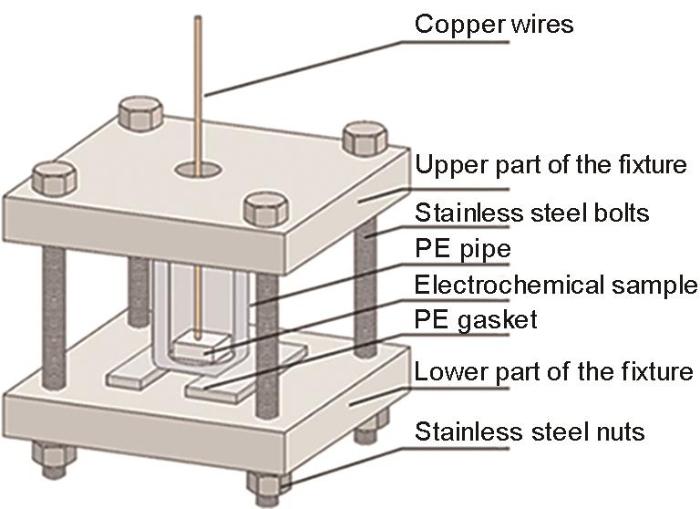
图2
电化学实验缝隙试样装配图
Fig.2
Schematic diagram of the crevice corrosion specimen for electrochemical experiment
2 实验结果
2.1 腐蚀形貌及腐蚀产物EDS分析
图3为60 ℃、CO2压力为1.5 MPa下,不同缝隙开口宽度的超级13Cr不锈钢浸泡240 h后下部试样的宏观腐蚀形貌。可以看出,当缝隙开口宽度为0.125 mm时,试样外边缘发生了腐蚀,当缝隙宽度增大为0.25 mm时,试样外边缘表面光滑,内边缘出现腐蚀产物,当缝隙宽度进一步增大为0.5 mm,试样表面颜色趋于相同。
图3
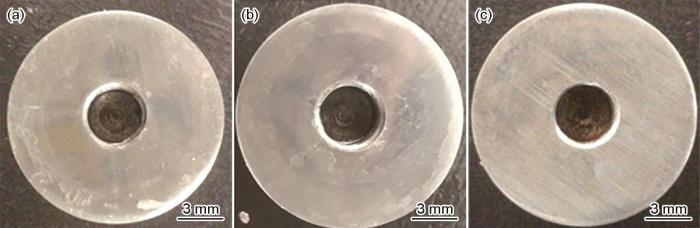
图3
不同缝隙开口宽度超级13Cr不锈钢浸泡240 h后宏观腐蚀形貌
Fig.3
Macroscopic corrosion morphologies of super 13Cr stainless steel with crevice widths of 0.125 (a), 0.25 (b) and 0.5 mm (c) after immersion for 240 h
图4
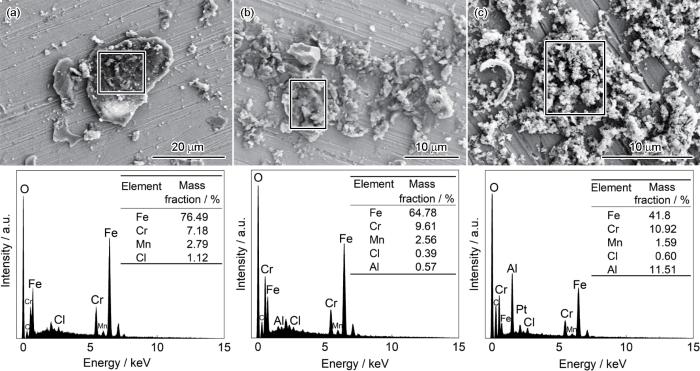
图4
不同缝隙宽度超级13Cr不锈钢浸泡240 h后腐蚀产物SEM及EDS结果
Fig.4
SEM and EDS results of corrosion products of super 13Cr stainless steel with crevice widths of 0.125 mm (a), 0.25 mm (b) and 0.5 mm (c) after immersion for 240 h
图5为去除腐蚀产物后的浸泡试样缝隙内外的SEM形貌。缝隙宽度为0.125 mm时,缝隙内只有少许经过机械加工的痕迹(图5a1),没有明显的腐蚀痕迹,缝隙外有较小的点蚀痕迹(图5a2)。缝隙宽度为0.25 mm时,缝隙内的金属表面出现轻微的腐蚀(图5b1),而缝隙外有较大的点蚀坑(图5b2)。缝隙宽度为0.5 mm时,在缝隙内出现较大的点蚀坑(图5c1),点蚀坑中有夹杂物,对夹杂物进行EDS分析,结果见图6。EDS结果显示夹杂物的主要成分为Al的氧化物。缝隙宽度为0.5 mm时缝隙外腐蚀形貌见图5c2,试样表面变得粗糙,有点蚀发生。由此可见,随缝隙宽度增加,缝隙内腐蚀程度增加。但缝隙外也发生了局部腐蚀。
图5

图5
不同缝隙宽度超级13Cr不锈钢去除腐蚀产物后缝内和缝外SEM形貌
Fig.5
SEM results of super 13Cr stainless steel after removal of corrosion products inside (a1-c1) and outside (a2-c2) the crevices with widths of 0.125 mm (a1, a2), 0.25 mm (b1, b2) and 0.5 mm (c1, c2)
图6
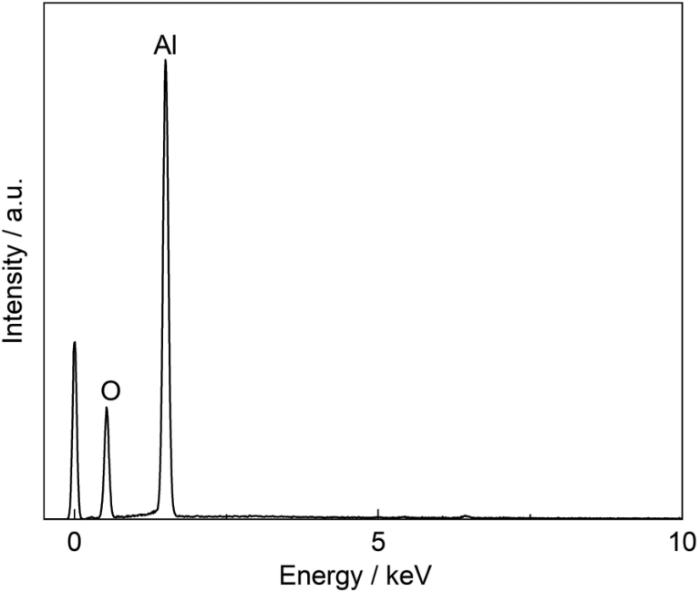
图6
缝隙宽度0.5 mm时缝隙内夹杂物EDS结果
Fig.6
EDS results of inclusions in the crevice with the width of 0.5 mm
2.2 XPS分析
图7
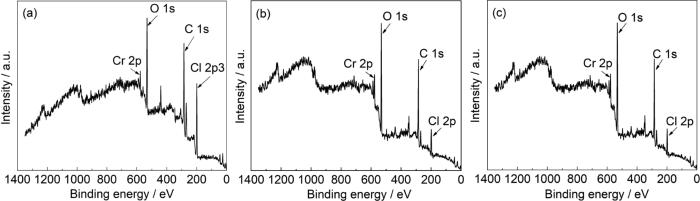
图7
不同缝隙宽度超级13Cr不锈钢在浸泡240 h后XPS全谱
Fig.7
XPS spectra of super 13Cr stainless steel with crevice widths of 0.125 mm (a), 0.25 mm (b) and 0.5 mm (c) after immersion for 240 h
图8
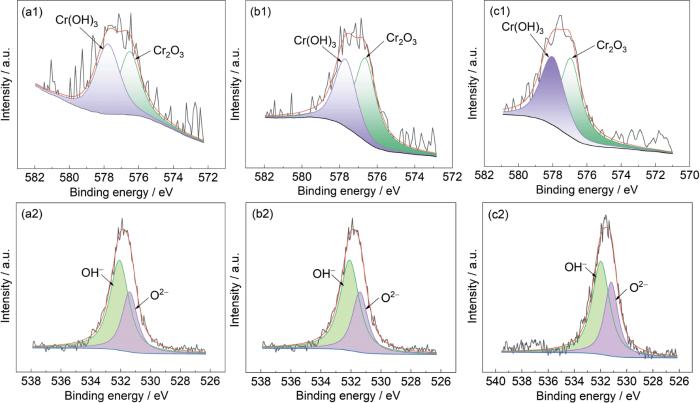
图8
不同缝隙宽度超级13Cr不锈钢浸泡240 h后Cr 2p和O 1s XPS结果
Fig.8
XPS results of Cr 2p and O 1s of super 13Cr stainless steel after immersion for 240 h with crevice widths of 0.125 mm (a), 0.25 mm (b) and 0.5 mm (c)
对Cr 2p和O 1s XPS结果中不同成分及对应结合能与峰面积结果见表1。可以看出,当缝隙宽度为0.125 mm时,Cr(OH)3的峰面积大于Cr2O3峰面积,表明此时缝隙内表面膜主要以Cr(OH)3为主。随缝隙宽度增大至0.25 mm以上,Cr(OH)3峰面积小于峰Cr2O3面积,表明此时缝隙内金属表面膜主要以Cr2O3为主。
表1 不同缝隙宽度下腐蚀产物中Cr元素组成对应结合能及峰面积
Table 1
| Crevice width/ mm | Corrosion products | Binding energy / eV | Peak area of CPS / eV |
|---|---|---|---|
| 0.125 | Cr2O3 | 576.53 | 220.44 |
| Cr(OH)3 | 577.79 | 254.09 | |
| 0.25 | Cr2O3 | 576.62 | 424.52 |
| Cr(OH)3 | 577.67 | 286.35 | |
| 0.5 | Cr2O3 | 576.94 | 493.52 |
| Cr(OH)3 | 577.30 | 407.82 |
2.3 电化学测试
2.3.1 开路电位
图9
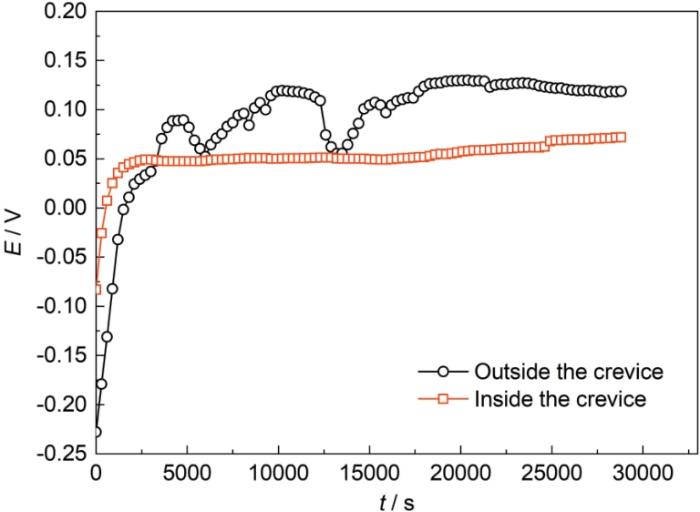
图9
缝隙内外超级13Cr不锈钢的开路电位
Fig.9
OCP of super 13Cr stainless steel inside and outside the crevice
2.3.2 动电位极化曲线
图10
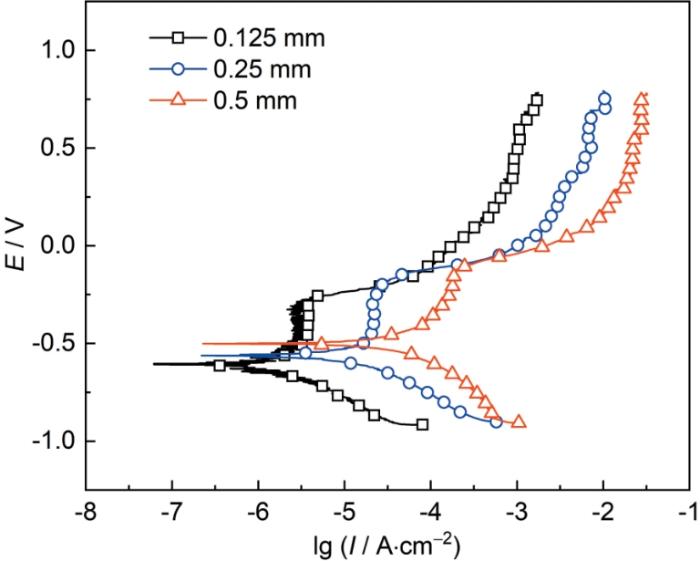
图10
不同缝隙宽度超级13Cr不锈钢浸泡240 h后极化曲线结果
Fig.10
Polarization curves of super 13Cr stainless steel with different crevice widths after immersion for 240 h
表2 不同缝隙宽度下超级13Cr不锈钢极化曲线拟合结果
Table 2
| Crevice width / mm | Ecorr / V | Ipass / μA·cm-2 | Passivation range / mV | Etp / V |
|---|---|---|---|---|
| 0.125 | -0.605 | 3.98 | 197 | -0.283 |
| 0.25 | -0.562 | 21.50 | 170 | -0.243 |
| 0.5 | -0.501 | 147.91 | 96 | -0.137 |
2.3.3 EIS
图11为不同缝隙宽度的超级13Cr不锈钢在饱和CO2油田采出液中浸泡不同时间的EIS结果。当缝隙宽度为0.125 mm时,不同浸泡时间的Nyqusit图中容抗弧尾部均出现Warburg扩散特征(图11a1),表明反应由电化学和扩散过程共同控制。随着浸泡时间的增加,容抗弧半径略有增大。Bode图中(图11a2),随浸泡时间增加相位角的峰值和阻抗模值略有增大。当缝隙宽度为0.25 mm时,容抗弧低频区Warburg阻抗更加明显(图11b1),浸泡时间的延长对容抗弧半径大小没有显著的影响。从Bode图可知(图11b2),阻抗模值几乎不随时间变化。当缝隙宽度为0.5 mm时,由Nyquist图可知(图11c1),容抗弧半径在第5 d时最大值,第10 d时最小。Bode图中呈现明显的2个时间常数特征(图11c2)。
图11
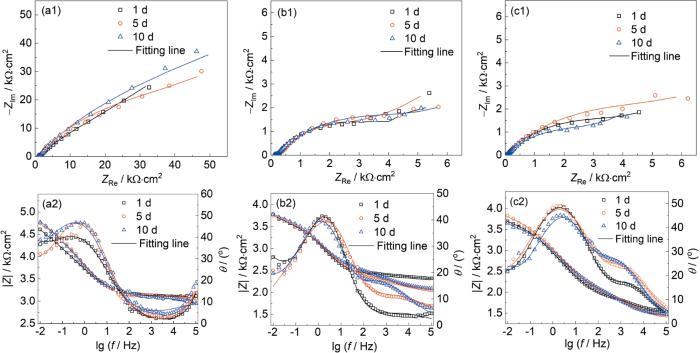
图11
超级13Cr不锈钢在不同缝隙宽度下EIS结果
Fig.11
EIS of super 13Cr stainless steel with different crevice widths: (a) 0.125 mm, (b) 0.25 mm, (c) 0.5 mm
将不同缝隙宽度的240 h时的EIS结果进行对比,结果见图12。可以看出,当缝隙宽度从0.125 mm增加至0.25 mm时,容抗弧半径显著减小,缝隙宽度继续增加至0.5 mm时,容抗弧半径变化不大。这表明,当缝隙宽度为0.25 mm时,超级13Cr耐缝隙腐蚀性能显著降低。Bode图中,当缝隙宽度增大时,相位角峰值呈现向高频区移动的趋势,这表明缝隙宽度的增加会加速电化学反应中的阳极过程,进而导致腐蚀程度加剧。阻抗值随着缝隙宽度增加呈现减小趋势,意味着腐蚀产物膜的保护性能逐渐减弱。
图12
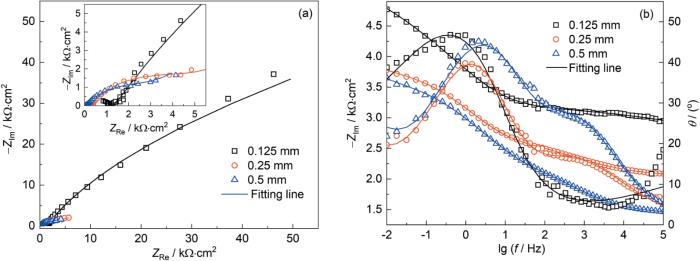
图12
不同缝隙宽度超级13Cr不锈钢浸泡240 h后EIS结果
Fig.12
Nyquist plots (a) and Bode plots (b) of super 13Cr stainless steel with different crevice widths after 240 h immersion
采用图13所示的等效电路对EIS结果进行拟合,拟合结果见表3,其中,Rs为溶液电阻,Rf为膜电阻,Rct为电荷转移电阻;Qf为腐蚀产物膜的常相位角元件,Qdl为双电层电容;W是平面电极的半无限扩散阻抗。拟合得到的不同缝隙宽度下的Rct结果见图14。由表3和图14可知,缝隙宽度为0.125和0.25 mm时,Rct值随浸泡时间增加而增加。缝隙宽度为0.5 mm时,Rct在第5 d时达到最大,然后减小。缝隙宽度为0.125 mm时Rct远大于其余两种缝隙宽度的Rct,这说明缝隙宽度为0.125 mm缝内电化学反应难度最大,腐蚀相对轻微。此外,这与浸泡结果一致。缝隙宽度为0.125 mm时的Rs也远大于其余两种缝隙宽度的Rs,表明此时缝内溶液电阻最大,缝外电流难以到达缝隙内部。
图13
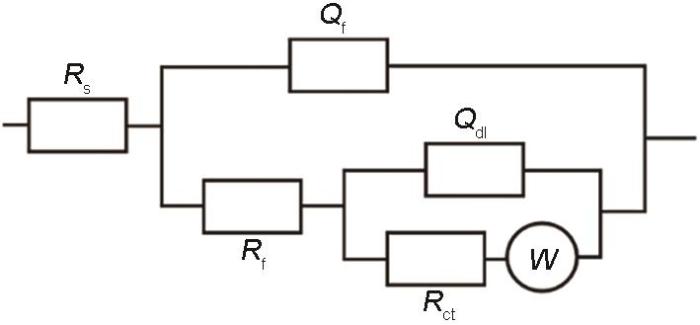
表3 不同缝隙宽度超级13Cr不锈钢EIS拟合结果
Table 3
| Crevice width / mm | Time / h | Rs / Ω·cm2 | Qf / F·cm-2 | Rf / Ω·cm2 | Qdl / F·cm-2 | Rct / Ω·cm2 | W / 10-3 Ω·cm-2 |
|---|---|---|---|---|---|---|---|
| 0.125 | 24 | 456.0 | 1.1 × 10⁻⁷ | 1290 | 7.4 × 10⁻⁵ | 4.6 × 10⁴ | 7.5 |
| 120 | 557.0 | 1.3 × 10⁻⁶ | 1280 | 4.9 × 10⁻⁵ | 5.5 × 10⁴ | 7.1 | |
| 240 | 690.0 | 7.1 × 10⁻⁶ | 1370 | 2.3 × 10⁻⁵ | 7.1 × 10⁴ | 8.3 | |
| 0.25 | 24 | 107.3 | 1.6 × 10⁻⁵ | 133 | 1.2 × 10⁻⁴ | 3.8 × 10³ | 1.2 |
| 120 | 105.8 | 1.4 × 10⁻⁴ | 155 | 1.5 × 10⁻⁵ | 4.2 × 10³ | 1.4 | |
| 240 | 109.3 | 1.2 × 10⁻⁴ | 192 | 1.2 × 10⁻⁴ | 5.6 × 10³ | 2.1 | |
| 0.5 | 24 | 32.5 | 1.0 × 10⁻⁴ | 160 | 2.2 × 10⁻⁴ | 4.5 × 10³ | 2.3 |
| 120 | 24.9 | 1.3 × 10⁻⁴ | 221 | 1.5 × 10⁻⁴ | 6.6 × 10³ | 1.8 | |
| 240 | 27.3 | 1.4 × 10⁻⁴ | 125 | 1.5 × 10⁻⁴ | 3.3 × 10³ | 1.9 |
图14
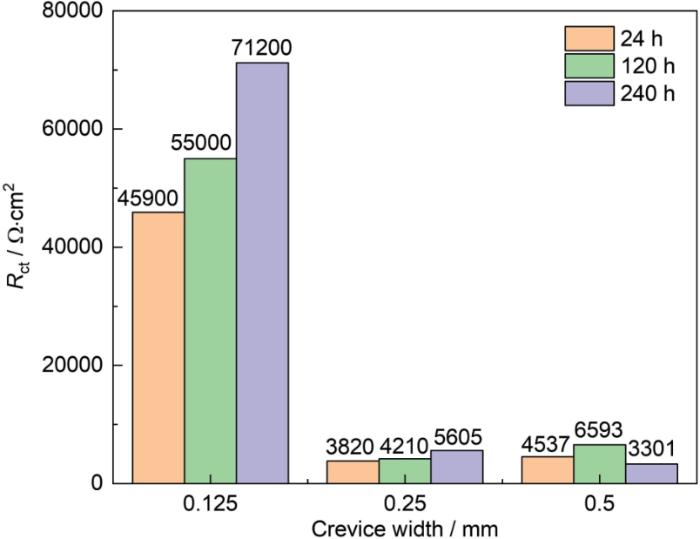
图14
不同缝隙宽度超级13Cr不锈钢不同浸泡时间下Rct值
Fig.14
Rct values of super 13Cr stainless steel with different crevice widths after different immersion duration
3 分析与讨论
超级13Cr不锈钢在饱和CO2采出液中的缝隙腐蚀过程本质上属于电化学腐蚀过程。CO2易溶于水,溶于水时形成H2CO3,H2CO3两步电离,生成CO
在腐蚀初始阶段,缝隙内外金属和溶液状态一致,缝隙内外的阳极反应速率与阴极反应速率相等。缝内外超级13Cr不锈钢发生以下阳极溶解反应[17]:
其对应的阴极反应为电离产物H2CO3、H+和HCO
随着腐蚀进入到发展阶段,由于缝隙结构对传质效应的限制,缝隙内外局部化学和电化学环境产生差异。当缝隙宽度为0.125 mm时,SEM结果显示此时缝内金属不发生腐蚀。这是由于较窄的缝隙开口使缝内外物质交换困难,缝内阴极去极化剂H2CO3、H+和HCO
当缝隙宽度进一步增加为0.5 mm时,缝隙内外物质交换更加容易,缝内外化学环境差距减小,尽管SEM结果表明缝口有更多的疏松的腐蚀产物形成,却难以阻挡缝外更多的H2CO3、H+、HCO
此外,本实验中各缝隙宽度下缝外金属表面均发生了点蚀。缝外本体溶液pH值较低(为pH 4.4),Cl-浓度较高(3.5 mol/L),随着缝内H+的被阴极反应消耗,缝外H+向缝内迁移的倾向增加,并导致Cl-向缝口迁移,导致缝口外产生H+和Cl-浓集,促进金属钝化膜溶解,诱发了缝外的点蚀。Li等[18]的研究表明缝外金属腐蚀比缝内更严重,并将此归因于缝隙内阴极反应的物质耗竭,而缝外还原物质在本体溶液中很快得到补充。由此可见,超级13Cr不锈钢在饱和CO2油田采出液中的缝隙腐蚀行为主要由CO2水解产物的阴极过程主导,并随缝隙开口宽度增加而加剧。
4 结论
(1) 在60 ℃、1.5 MPa的饱和CO2油田采出液中,随缝隙开口宽度增加,超级13Cr不锈钢缝隙腐蚀敏感性逐渐增加。当缝隙宽度为0.125 mm时,缝隙内金属不发生腐蚀;当缝隙宽度为0.25 mm时,缝隙内出现点蚀坑,缝内腐蚀速率增大;当缝隙宽度为0.5 mm时,缝隙内的点蚀坑增大,点蚀萌生于夹杂物。
(2) 随缝隙宽度增加,超级13Cr不锈钢钝化膜逐渐发生活化溶解,钝化膜中Cr2O3逐渐向Cr(OH)3转变。
(3) 不同缝隙宽度下腐蚀产物均堆积在缝口,腐蚀产物对物质交换阻碍作用较小,缝口均外发生了点蚀。
(4) 超级13Cr不锈钢在饱和CO2油田采出液中的缝隙腐蚀行为主要由CO2水解产物的阴极过程主导。当缝隙宽度不足以使缝内物质交换时,缝内阴极还原物不能得到补充,阴极反应受到抑制,缝内金属仍保持钝化状态,不发生腐蚀;当缝隙宽度增加至缝内外物质可以交换时,缝内钝化膜在H+作用下发生阳极溶解,诱发点蚀发生。
参考文献
Evaluation on crevice corrosion of joint composed of oil tubing and collar
[J].
油管与接箍接头的缝隙腐蚀评价
[J].
Overview and future research prospect of tubing string corrosion of high pressure and high temperature gas well
[J].
高温高压气井管柱腐蚀现状及未来研究展望
[J].
Finite element simulation of pitting corrosion of super 13Cr stainless steel in high-temperature and high-pressured CO2 containing artificial formation waters
[J].
高温高压CO2环境中超级13Cr不锈钢点蚀有限元模拟
[J].
Failure causes and countermeasures of downhole pipe string in a gas field
[J].
某气田井下管柱的失效原因分析及对策
[J].
Impact of reversed austenite on the pitting corrosion behavior of super 13Cr martensitic stainless steel
[J].
Research on corrosion mechanism of HP-13Cr stainless steel for nature gas well in the extremely aggressive environment
[D].
极端环境下天然气井用HP-13Cr不锈钢腐蚀机理的研究
[D].
Study on crevice corrosion of super 13Cr in simulated oil and gas field environment
[D].
模拟油气田环境中超级13Cr缝隙腐蚀研究
[D].
Possible distribution of potential and corrosion current density inside corroding crevices
[J].
The crevice corrosion behaviour of stainless steel in sodium chloride solution
[J].
Effects of crevice geometry on corrosion behavior of 304 stainless steel during crevice corrosion in high temperature pure water
[J].
Initiation modeling of crevice corrosion in 316L stainless steels
[J].
Effect of crevice geometry on chemical environment of crevice solution and corrosion behavior of 2205 duplex stainless steel
[J].
缝隙几何尺寸对闭塞区化学环境及腐蚀行为的影响
[J].
Effect of crevice size on crevice corrosion of N80 carbon steel in CO2-saturated NaCl-HAc solution
[J].
Corrosion inhibitors and its application in CO2 corrosion
[J].
CO2腐蚀及其缓蚀剂应用研究进展
[J].
Research progress on corrosion behavior of metallic materials in acetic acid environment
[J].
醋酸环境下金属材料腐蚀行为的研究进展
[J].
Effects of temperature on the corrosion behaviour of X70 steel in CO2-containing formation water
[J].
Effect of extremely aggressive environment on the nature of corrosion scales of HP-13Cr stainless steel
[J].
Crevice corrosion of N80 carbon steel in CO2-saturated environment containing acetic acid
[J].
Potential and current distributions of one-dimensional galvanic corrosion systems
[J].
Effect of chromium on the pitting resistance of oil tube steel in a carbon dioxide corrosion system
[J].
The effect of temperature and ionic strength on iron carbonate (FeCO3) solubility limit
[J].


