Chemical signaling in biofilm-mediated biofouling
1
2024
... 海洋生物污损和腐蚀问题给全球经济造成了重大损失.其中,海洋生物污损每年给全球带来约1.5万亿美元的经济损失[1~6].生物污损不仅造成巨大的能源浪费,还导致一系列连锁问题,如降低设备运行效率、增加维护成本、破坏海洋生态平衡、诱发局部安全隐患等[7~12].另一方面,全球每年因海洋腐蚀造成的直接经济损失超过3000亿美元.海水中的盐分、酸碱物质及溶解氧等腐蚀介质会加速船舶、海洋平台及其他海洋工程设施的结构劣化,严重影响其服役性能和使用安全[13~18].因此,开发高效的防护涂层技术以应对海洋生物污损和腐蚀问题,减少其对环境、经济和社会的不利影响,已成为当前国际社会共同关注的重要研究课题[19~26]. ...
Antibacterial-renew dual-function anti-biofouling strategy: Self-assembled Schiff-base metal complex coatings built from natural products
2023
Effectiveness and mechanisms of recoverable magnetic nanoparticles on mitigating golden mussel biofouling
2021
Layer-by-layer-assembled antifouling films with surface microtopography inspired by Laminaria japonica
2020
Quaternary ammonium salts-based materials: A review on environmental toxicity, anti-fouling mechanisms and applications in marine and water treatment industries
The development of the anti-biofouling coating agent using metal nanoparticles and analysis by Raman spectroscopy and FIB system
1
2017
... 海洋生物污损和腐蚀问题给全球经济造成了重大损失.其中,海洋生物污损每年给全球带来约1.5万亿美元的经济损失[1~6].生物污损不仅造成巨大的能源浪费,还导致一系列连锁问题,如降低设备运行效率、增加维护成本、破坏海洋生态平衡、诱发局部安全隐患等[7~12].另一方面,全球每年因海洋腐蚀造成的直接经济损失超过3000亿美元.海水中的盐分、酸碱物质及溶解氧等腐蚀介质会加速船舶、海洋平台及其他海洋工程设施的结构劣化,严重影响其服役性能和使用安全[13~18].因此,开发高效的防护涂层技术以应对海洋生物污损和腐蚀问题,减少其对环境、经济和社会的不利影响,已成为当前国际社会共同关注的重要研究课题[19~26]. ...
Environmentally friendly antifouling coatings based on biodegradable polymer and natural antifoulant
1
2017
... 海洋生物污损和腐蚀问题给全球经济造成了重大损失.其中,海洋生物污损每年给全球带来约1.5万亿美元的经济损失[1~6].生物污损不仅造成巨大的能源浪费,还导致一系列连锁问题,如降低设备运行效率、增加维护成本、破坏海洋生态平衡、诱发局部安全隐患等[7~12].另一方面,全球每年因海洋腐蚀造成的直接经济损失超过3000亿美元.海水中的盐分、酸碱物质及溶解氧等腐蚀介质会加速船舶、海洋平台及其他海洋工程设施的结构劣化,严重影响其服役性能和使用安全[13~18].因此,开发高效的防护涂层技术以应对海洋生物污损和腐蚀问题,减少其对环境、经济和社会的不利影响,已成为当前国际社会共同关注的重要研究课题[19~26]. ...
Biofouling reduction in recirculating cooling systems through biofiltration of process water
2003
Fouling organism attachment behavior and corrosion mechanism of titanium alloy in the sea
2024
TC4钛合金实海污损生物附着行为与腐蚀机理研究
2024
Assessment of the effectiveness of antifouling solutions for recreational boats in the context of marine bioinvasions
2024
Prioritizing management of high-risk routes and ports by vessel type to improve marine biosecurity efforts
2023
Biomimetic one step fabrication of manganese stearate superhydrophobic surface as an efficient barrier against marine corrosion and Chlorella vulgaris-induced biofouling
1
2016
... 海洋生物污损和腐蚀问题给全球经济造成了重大损失.其中,海洋生物污损每年给全球带来约1.5万亿美元的经济损失[1~6].生物污损不仅造成巨大的能源浪费,还导致一系列连锁问题,如降低设备运行效率、增加维护成本、破坏海洋生态平衡、诱发局部安全隐患等[7~12].另一方面,全球每年因海洋腐蚀造成的直接经济损失超过3000亿美元.海水中的盐分、酸碱物质及溶解氧等腐蚀介质会加速船舶、海洋平台及其他海洋工程设施的结构劣化,严重影响其服役性能和使用安全[13~18].因此,开发高效的防护涂层技术以应对海洋生物污损和腐蚀问题,减少其对环境、经济和社会的不利影响,已成为当前国际社会共同关注的重要研究课题[19~26]. ...
Chemical composition optimization and sea water corrosion resistance of a ductile cast iron
1
2014
... 海洋生物污损和腐蚀问题给全球经济造成了重大损失.其中,海洋生物污损每年给全球带来约1.5万亿美元的经济损失[1~6].生物污损不仅造成巨大的能源浪费,还导致一系列连锁问题,如降低设备运行效率、增加维护成本、破坏海洋生态平衡、诱发局部安全隐患等[7~12].另一方面,全球每年因海洋腐蚀造成的直接经济损失超过3000亿美元.海水中的盐分、酸碱物质及溶解氧等腐蚀介质会加速船舶、海洋平台及其他海洋工程设施的结构劣化,严重影响其服役性能和使用安全[13~18].因此,开发高效的防护涂层技术以应对海洋生物污损和腐蚀问题,减少其对环境、经济和社会的不利影响,已成为当前国际社会共同关注的重要研究课题[19~26]. ...
耐海水腐蚀球墨铸铁成分优化设计及其抗蚀性能
1
2014
... 海洋生物污损和腐蚀问题给全球经济造成了重大损失.其中,海洋生物污损每年给全球带来约1.5万亿美元的经济损失[1~6].生物污损不仅造成巨大的能源浪费,还导致一系列连锁问题,如降低设备运行效率、增加维护成本、破坏海洋生态平衡、诱发局部安全隐患等[7~12].另一方面,全球每年因海洋腐蚀造成的直接经济损失超过3000亿美元.海水中的盐分、酸碱物质及溶解氧等腐蚀介质会加速船舶、海洋平台及其他海洋工程设施的结构劣化,严重影响其服役性能和使用安全[13~18].因此,开发高效的防护涂层技术以应对海洋生物污损和腐蚀问题,减少其对环境、经济和社会的不利影响,已成为当前国际社会共同关注的重要研究课题[19~26]. ...
Effect of pseudomonas on electrochemical corrosion behavior of S45C steel in seawater and a culture medium
2013
海水及培养基中假单胞菌对45钢电化学腐蚀行为的影响
2013
2D nanomaterials reinforced organic coatings for marine corrosion protection: State of the art, challenges, and future prospectives
2024
Superhydrophobic anti-corrosion coating: Advancing research from laboratory to real marine corrosion environment
2025
Living marine bacterium Tenacibaculum mesophilum D-6 inhibits crevice corrosion of X70 carbon steel
2023
Marine biofilms with significant corrosion inhibition performance by secreting extracellular polymeric substances
1
2021
... 海洋生物污损和腐蚀问题给全球经济造成了重大损失.其中,海洋生物污损每年给全球带来约1.5万亿美元的经济损失[1~6].生物污损不仅造成巨大的能源浪费,还导致一系列连锁问题,如降低设备运行效率、增加维护成本、破坏海洋生态平衡、诱发局部安全隐患等[7~12].另一方面,全球每年因海洋腐蚀造成的直接经济损失超过3000亿美元.海水中的盐分、酸碱物质及溶解氧等腐蚀介质会加速船舶、海洋平台及其他海洋工程设施的结构劣化,严重影响其服役性能和使用安全[13~18].因此,开发高效的防护涂层技术以应对海洋生物污损和腐蚀问题,减少其对环境、经济和社会的不利影响,已成为当前国际社会共同关注的重要研究课题[19~26]. ...
Transparent coating based on multienzyme-mimicking Janus nanozyme for synergetic biofouling control in seawater
1
2024
... 海洋生物污损和腐蚀问题给全球经济造成了重大损失.其中,海洋生物污损每年给全球带来约1.5万亿美元的经济损失[1~6].生物污损不仅造成巨大的能源浪费,还导致一系列连锁问题,如降低设备运行效率、增加维护成本、破坏海洋生态平衡、诱发局部安全隐患等[7~12].另一方面,全球每年因海洋腐蚀造成的直接经济损失超过3000亿美元.海水中的盐分、酸碱物质及溶解氧等腐蚀介质会加速船舶、海洋平台及其他海洋工程设施的结构劣化,严重影响其服役性能和使用安全[13~18].因此,开发高效的防护涂层技术以应对海洋生物污损和腐蚀问题,减少其对环境、经济和社会的不利影响,已成为当前国际社会共同关注的重要研究课题[19~26]. ...
Robust chiral metal-organic framework coatings for self-activating and sustainable biofouling mitigation
2024
Coatings defects of metallurgical equipment and its prevention measures
2017
Transparent antibiofouling coating to improve the efficiency of Nannochloropsis gaditana and Chlorella sorokiniana culture photobioreactors at the pilot-plant scale
2024
Nacre-inspired metal-organic framework coatings reinforced by multiscale hierarchical cross-linking for integrated antifouling and anti-microbial corrosion
2023
Insights into the hydrophobic coating with integrated high-efficiency anti-corrosion, anti-biofouling and self-healing properties based on anti-bacterial nano LDH materials
2024
Complementary effects of nanosilver and superhydrophobic coatings on the prevention of marine bacterial adhesion
2012
Supramolecular-assisted nanocomposite coatings with sustainable and robust resistance to microbially mediated biofouling and corrosion
1
2025
... 海洋生物污损和腐蚀问题给全球经济造成了重大损失.其中,海洋生物污损每年给全球带来约1.5万亿美元的经济损失[1~6].生物污损不仅造成巨大的能源浪费,还导致一系列连锁问题,如降低设备运行效率、增加维护成本、破坏海洋生态平衡、诱发局部安全隐患等[7~12].另一方面,全球每年因海洋腐蚀造成的直接经济损失超过3000亿美元.海水中的盐分、酸碱物质及溶解氧等腐蚀介质会加速船舶、海洋平台及其他海洋工程设施的结构劣化,严重影响其服役性能和使用安全[13~18].因此,开发高效的防护涂层技术以应对海洋生物污损和腐蚀问题,减少其对环境、经济和社会的不利影响,已成为当前国际社会共同关注的重要研究课题[19~26]. ...
An investigation on the corrosion behavior of the epoxy coating embedded with mesoporous silica nanocontainer loaded by sulfamethazine inhibitor
1
2019
... 经典的聚合物涂层(如环氧树脂、聚苯胺、聚氨酯、硅树脂及丙烯酸锌树脂等)因其各自优异的功能特性,在海洋防护领域得到广泛应用[27~37].然而,在潮湿且富营养化的海洋环境中,微生物、细菌和藻类等生物污损物易在上述涂层表面富集,并加速其脱落与失效[38~46].针对上述问题,传统解决方案采用多层涂层体系(底漆、连接漆和面漆的组合)以实现对外部有害物质的高效防护.然而,该类涂层不同层数之间存在显著的界面兼容性问题.在海水反复地冲刷作用下,涂层极易出现分层和剥离现象,严重影响其功能性发挥和长效服役.此外,在防污漆的择取方面,早期的有机锡防污漆和现行的Cu基防污漆虽可有效缓解污损生物的附着,却均含有毒性.这会对海洋生态环境平衡的维系产生较为不利的影响.为有效规避传统多层涂层体系存在的诸多问题[47~55],近年来,研究重点转向于开发单层的海洋防护涂层.通过在聚合物基体中掺入防污剂、防腐剂、及相关功能组分,实现防污防腐一体化的海洋防护涂层的高效制备[56~63].Zhang等[64]采用硅烷改性Cu2O纳米颗粒增强环氧树脂涂层,通过Cu+缓释杀菌和硅烷疏水性实现涂层长效的防污防腐功效.Liu等[65]以低表面能环状硅氧烷单体(TOCS)和商用双酚A环氧树脂(BE-188)为原料制备出高性能的复合涂层(SAT).TOCS的引入显著提升了涂层的防污性、附着力及力学性能,BE-188则具备本征的防腐效果.以上涂层均展现出良好的环境适应性和广阔的应用空间. ...
Using high-temperature mechanochemistry treatment to modify iron oxide and improve the corrosion performance of epoxy coating-I. High-temperature ball milling treatment
2015
Corrosion resistance of graphene-reinforced waterborne epoxy coatings
2016
Fabrication of polyaniline/waste sugarcane bagasse composite fillers for excellent anti-corrosion protective coatings
2024
Covalently functionalized ethylene diamine modified graphene oxide poly-paraphenylene diamine dispersed polyurethane anticorrosive nanocomposite coatings
2021
A novel epoxy resin composite coating containing polyaniline modified GO with triple anti-corrosion effects of barrier, passivation and corrosion inhibition
2024
Polymers and their composites for corrosion inhibition application: Development, advancement, and future scope-A critical review
2024
A stable anticorrosion coating with multifunctional linkage against seawater corrosion
2023
A mechanically robust superhydrophobic corrosion resistant coating with self-healing capability
2024
Modification of nano-hybrid silicon acrylic resin with anticorrosion and hydrophobic properties
2020
Research on waterborne acrylic anticorrosive coatings
1
2024
... 经典的聚合物涂层(如环氧树脂、聚苯胺、聚氨酯、硅树脂及丙烯酸锌树脂等)因其各自优异的功能特性,在海洋防护领域得到广泛应用[27~37].然而,在潮湿且富营养化的海洋环境中,微生物、细菌和藻类等生物污损物易在上述涂层表面富集,并加速其脱落与失效[38~46].针对上述问题,传统解决方案采用多层涂层体系(底漆、连接漆和面漆的组合)以实现对外部有害物质的高效防护.然而,该类涂层不同层数之间存在显著的界面兼容性问题.在海水反复地冲刷作用下,涂层极易出现分层和剥离现象,严重影响其功能性发挥和长效服役.此外,在防污漆的择取方面,早期的有机锡防污漆和现行的Cu基防污漆虽可有效缓解污损生物的附着,却均含有毒性.这会对海洋生态环境平衡的维系产生较为不利的影响.为有效规避传统多层涂层体系存在的诸多问题[47~55],近年来,研究重点转向于开发单层的海洋防护涂层.通过在聚合物基体中掺入防污剂、防腐剂、及相关功能组分,实现防污防腐一体化的海洋防护涂层的高效制备[56~63].Zhang等[64]采用硅烷改性Cu2O纳米颗粒增强环氧树脂涂层,通过Cu+缓释杀菌和硅烷疏水性实现涂层长效的防污防腐功效.Liu等[65]以低表面能环状硅氧烷单体(TOCS)和商用双酚A环氧树脂(BE-188)为原料制备出高性能的复合涂层(SAT).TOCS的引入显著提升了涂层的防污性、附着力及力学性能,BE-188则具备本征的防腐效果.以上涂层均展现出良好的环境适应性和广阔的应用空间. ...
水性丙烯酸防腐涂料的研究
1
2024
... 经典的聚合物涂层(如环氧树脂、聚苯胺、聚氨酯、硅树脂及丙烯酸锌树脂等)因其各自优异的功能特性,在海洋防护领域得到广泛应用[27~37].然而,在潮湿且富营养化的海洋环境中,微生物、细菌和藻类等生物污损物易在上述涂层表面富集,并加速其脱落与失效[38~46].针对上述问题,传统解决方案采用多层涂层体系(底漆、连接漆和面漆的组合)以实现对外部有害物质的高效防护.然而,该类涂层不同层数之间存在显著的界面兼容性问题.在海水反复地冲刷作用下,涂层极易出现分层和剥离现象,严重影响其功能性发挥和长效服役.此外,在防污漆的择取方面,早期的有机锡防污漆和现行的Cu基防污漆虽可有效缓解污损生物的附着,却均含有毒性.这会对海洋生态环境平衡的维系产生较为不利的影响.为有效规避传统多层涂层体系存在的诸多问题[47~55],近年来,研究重点转向于开发单层的海洋防护涂层.通过在聚合物基体中掺入防污剂、防腐剂、及相关功能组分,实现防污防腐一体化的海洋防护涂层的高效制备[56~63].Zhang等[64]采用硅烷改性Cu2O纳米颗粒增强环氧树脂涂层,通过Cu+缓释杀菌和硅烷疏水性实现涂层长效的防污防腐功效.Liu等[65]以低表面能环状硅氧烷单体(TOCS)和商用双酚A环氧树脂(BE-188)为原料制备出高性能的复合涂层(SAT).TOCS的引入显著提升了涂层的防污性、附着力及力学性能,BE-188则具备本征的防腐效果.以上涂层均展现出良好的环境适应性和广阔的应用空间. ...
Development and progress in polymer materials for anti-corrosion and anti-fouling applications: A review
1
2024
... 经典的聚合物涂层(如环氧树脂、聚苯胺、聚氨酯、硅树脂及丙烯酸锌树脂等)因其各自优异的功能特性,在海洋防护领域得到广泛应用[27~37].然而,在潮湿且富营养化的海洋环境中,微生物、细菌和藻类等生物污损物易在上述涂层表面富集,并加速其脱落与失效[38~46].针对上述问题,传统解决方案采用多层涂层体系(底漆、连接漆和面漆的组合)以实现对外部有害物质的高效防护.然而,该类涂层不同层数之间存在显著的界面兼容性问题.在海水反复地冲刷作用下,涂层极易出现分层和剥离现象,严重影响其功能性发挥和长效服役.此外,在防污漆的择取方面,早期的有机锡防污漆和现行的Cu基防污漆虽可有效缓解污损生物的附着,却均含有毒性.这会对海洋生态环境平衡的维系产生较为不利的影响.为有效规避传统多层涂层体系存在的诸多问题[47~55],近年来,研究重点转向于开发单层的海洋防护涂层.通过在聚合物基体中掺入防污剂、防腐剂、及相关功能组分,实现防污防腐一体化的海洋防护涂层的高效制备[56~63].Zhang等[64]采用硅烷改性Cu2O纳米颗粒增强环氧树脂涂层,通过Cu+缓释杀菌和硅烷疏水性实现涂层长效的防污防腐功效.Liu等[65]以低表面能环状硅氧烷单体(TOCS)和商用双酚A环氧树脂(BE-188)为原料制备出高性能的复合涂层(SAT).TOCS的引入显著提升了涂层的防污性、附着力及力学性能,BE-188则具备本征的防腐效果.以上涂层均展现出良好的环境适应性和广阔的应用空间. ...
Enzymatic waterborne polyurethane towards a robust and environmentally friendly anti-biofouling coating
2016
Coacervate dense phase displaces surface-established Pseudomonas aeruginosa biofilms
2024
Microalgal extract as bio-coating to enhance biofilm growth of marine microalgae on microporous membranes
2023
Bioinspired sulfobetaine borneol fluorinated amphiphilic polymers for marine antifouling and fouling release applications
2024
Algal extracellular organic matter pre-treatment enhances microalgal biofilm adhesion onto microporous substrate
2022
The fouling process of typical marine organisms and the influence of coating surface characteristics on their attachment behaviors
2024
典型海洋生物污损过程及涂层表面特性对其附着行为的影响
2024
Testing for biofilm release as a function of simulated ship speed using a calibrated water jet device
2024
Research progress of antibacterial coating for medical catheter
1
2024
... 经典的聚合物涂层(如环氧树脂、聚苯胺、聚氨酯、硅树脂及丙烯酸锌树脂等)因其各自优异的功能特性,在海洋防护领域得到广泛应用[27~37].然而,在潮湿且富营养化的海洋环境中,微生物、细菌和藻类等生物污损物易在上述涂层表面富集,并加速其脱落与失效[38~46].针对上述问题,传统解决方案采用多层涂层体系(底漆、连接漆和面漆的组合)以实现对外部有害物质的高效防护.然而,该类涂层不同层数之间存在显著的界面兼容性问题.在海水反复地冲刷作用下,涂层极易出现分层和剥离现象,严重影响其功能性发挥和长效服役.此外,在防污漆的择取方面,早期的有机锡防污漆和现行的Cu基防污漆虽可有效缓解污损生物的附着,却均含有毒性.这会对海洋生态环境平衡的维系产生较为不利的影响.为有效规避传统多层涂层体系存在的诸多问题[47~55],近年来,研究重点转向于开发单层的海洋防护涂层.通过在聚合物基体中掺入防污剂、防腐剂、及相关功能组分,实现防污防腐一体化的海洋防护涂层的高效制备[56~63].Zhang等[64]采用硅烷改性Cu2O纳米颗粒增强环氧树脂涂层,通过Cu+缓释杀菌和硅烷疏水性实现涂层长效的防污防腐功效.Liu等[65]以低表面能环状硅氧烷单体(TOCS)和商用双酚A环氧树脂(BE-188)为原料制备出高性能的复合涂层(SAT).TOCS的引入显著提升了涂层的防污性、附着力及力学性能,BE-188则具备本征的防腐效果.以上涂层均展现出良好的环境适应性和广阔的应用空间. ...
医用导管抗菌涂层的研究进展
1
2024
... 经典的聚合物涂层(如环氧树脂、聚苯胺、聚氨酯、硅树脂及丙烯酸锌树脂等)因其各自优异的功能特性,在海洋防护领域得到广泛应用[27~37].然而,在潮湿且富营养化的海洋环境中,微生物、细菌和藻类等生物污损物易在上述涂层表面富集,并加速其脱落与失效[38~46].针对上述问题,传统解决方案采用多层涂层体系(底漆、连接漆和面漆的组合)以实现对外部有害物质的高效防护.然而,该类涂层不同层数之间存在显著的界面兼容性问题.在海水反复地冲刷作用下,涂层极易出现分层和剥离现象,严重影响其功能性发挥和长效服役.此外,在防污漆的择取方面,早期的有机锡防污漆和现行的Cu基防污漆虽可有效缓解污损生物的附着,却均含有毒性.这会对海洋生态环境平衡的维系产生较为不利的影响.为有效规避传统多层涂层体系存在的诸多问题[47~55],近年来,研究重点转向于开发单层的海洋防护涂层.通过在聚合物基体中掺入防污剂、防腐剂、及相关功能组分,实现防污防腐一体化的海洋防护涂层的高效制备[56~63].Zhang等[64]采用硅烷改性Cu2O纳米颗粒增强环氧树脂涂层,通过Cu+缓释杀菌和硅烷疏水性实现涂层长效的防污防腐功效.Liu等[65]以低表面能环状硅氧烷单体(TOCS)和商用双酚A环氧树脂(BE-188)为原料制备出高性能的复合涂层(SAT).TOCS的引入显著提升了涂层的防污性、附着力及力学性能,BE-188则具备本征的防腐效果.以上涂层均展现出良好的环境适应性和广阔的应用空间. ...
Green synthesis of silk fibroin-silver nanoparticle composites with effective antibacterial and biofilm-disrupting properties
1
2013
... 经典的聚合物涂层(如环氧树脂、聚苯胺、聚氨酯、硅树脂及丙烯酸锌树脂等)因其各自优异的功能特性,在海洋防护领域得到广泛应用[27~37].然而,在潮湿且富营养化的海洋环境中,微生物、细菌和藻类等生物污损物易在上述涂层表面富集,并加速其脱落与失效[38~46].针对上述问题,传统解决方案采用多层涂层体系(底漆、连接漆和面漆的组合)以实现对外部有害物质的高效防护.然而,该类涂层不同层数之间存在显著的界面兼容性问题.在海水反复地冲刷作用下,涂层极易出现分层和剥离现象,严重影响其功能性发挥和长效服役.此外,在防污漆的择取方面,早期的有机锡防污漆和现行的Cu基防污漆虽可有效缓解污损生物的附着,却均含有毒性.这会对海洋生态环境平衡的维系产生较为不利的影响.为有效规避传统多层涂层体系存在的诸多问题[47~55],近年来,研究重点转向于开发单层的海洋防护涂层.通过在聚合物基体中掺入防污剂、防腐剂、及相关功能组分,实现防污防腐一体化的海洋防护涂层的高效制备[56~63].Zhang等[64]采用硅烷改性Cu2O纳米颗粒增强环氧树脂涂层,通过Cu+缓释杀菌和硅烷疏水性实现涂层长效的防污防腐功效.Liu等[65]以低表面能环状硅氧烷单体(TOCS)和商用双酚A环氧树脂(BE-188)为原料制备出高性能的复合涂层(SAT).TOCS的引入显著提升了涂层的防污性、附着力及力学性能,BE-188则具备本征的防腐效果.以上涂层均展现出良好的环境适应性和广阔的应用空间. ...
Ag nanoparticles on mXene nanosheets for combined ionic and photothermal therapy of bacterial infections
2024
Cold sprayed Ta-Ag composites: Mechanistic insight into enhanced corrosion resistance and antibacterial ability
2024
Synthesis of flower-like sulfadiazine copper/polyvinyl pyrrolidone composite and its antimicrobial activities
2015
Preparation and properties of polyvinylpyrrolidone-cuprous oxide microcapsule antifouling coating
2020
Construction of a novel environmentally-friendly long-term antifouling coating with a double-layer structure regulated by phenylmethyl silicone oil and verification of the static antifouling performance of the coating
2025
Changing cinnamaldehyde skeleton achieves antibacterial nanoswitch
2024
Synthesis, morphology and antibacterial properties of bactericidal nano-hybrid fluorosilicone resin
2022
Preparation and characterization of low surface energy waterborne acrylic anticorrosion and antibacterial coatings applied in maritime protection
1
2025
... 经典的聚合物涂层(如环氧树脂、聚苯胺、聚氨酯、硅树脂及丙烯酸锌树脂等)因其各自优异的功能特性,在海洋防护领域得到广泛应用[27~37].然而,在潮湿且富营养化的海洋环境中,微生物、细菌和藻类等生物污损物易在上述涂层表面富集,并加速其脱落与失效[38~46].针对上述问题,传统解决方案采用多层涂层体系(底漆、连接漆和面漆的组合)以实现对外部有害物质的高效防护.然而,该类涂层不同层数之间存在显著的界面兼容性问题.在海水反复地冲刷作用下,涂层极易出现分层和剥离现象,严重影响其功能性发挥和长效服役.此外,在防污漆的择取方面,早期的有机锡防污漆和现行的Cu基防污漆虽可有效缓解污损生物的附着,却均含有毒性.这会对海洋生态环境平衡的维系产生较为不利的影响.为有效规避传统多层涂层体系存在的诸多问题[47~55],近年来,研究重点转向于开发单层的海洋防护涂层.通过在聚合物基体中掺入防污剂、防腐剂、及相关功能组分,实现防污防腐一体化的海洋防护涂层的高效制备[56~63].Zhang等[64]采用硅烷改性Cu2O纳米颗粒增强环氧树脂涂层,通过Cu+缓释杀菌和硅烷疏水性实现涂层长效的防污防腐功效.Liu等[65]以低表面能环状硅氧烷单体(TOCS)和商用双酚A环氧树脂(BE-188)为原料制备出高性能的复合涂层(SAT).TOCS的引入显著提升了涂层的防污性、附着力及力学性能,BE-188则具备本征的防腐效果.以上涂层均展现出良好的环境适应性和广阔的应用空间. ...
Preparation of pH-responsive polymer antibacterial coating and its performance
1
2021
... 经典的聚合物涂层(如环氧树脂、聚苯胺、聚氨酯、硅树脂及丙烯酸锌树脂等)因其各自优异的功能特性,在海洋防护领域得到广泛应用[27~37].然而,在潮湿且富营养化的海洋环境中,微生物、细菌和藻类等生物污损物易在上述涂层表面富集,并加速其脱落与失效[38~46].针对上述问题,传统解决方案采用多层涂层体系(底漆、连接漆和面漆的组合)以实现对外部有害物质的高效防护.然而,该类涂层不同层数之间存在显著的界面兼容性问题.在海水反复地冲刷作用下,涂层极易出现分层和剥离现象,严重影响其功能性发挥和长效服役.此外,在防污漆的择取方面,早期的有机锡防污漆和现行的Cu基防污漆虽可有效缓解污损生物的附着,却均含有毒性.这会对海洋生态环境平衡的维系产生较为不利的影响.为有效规避传统多层涂层体系存在的诸多问题[47~55],近年来,研究重点转向于开发单层的海洋防护涂层.通过在聚合物基体中掺入防污剂、防腐剂、及相关功能组分,实现防污防腐一体化的海洋防护涂层的高效制备[56~63].Zhang等[64]采用硅烷改性Cu2O纳米颗粒增强环氧树脂涂层,通过Cu+缓释杀菌和硅烷疏水性实现涂层长效的防污防腐功效.Liu等[65]以低表面能环状硅氧烷单体(TOCS)和商用双酚A环氧树脂(BE-188)为原料制备出高性能的复合涂层(SAT).TOCS的引入显著提升了涂层的防污性、附着力及力学性能,BE-188则具备本征的防腐效果.以上涂层均展现出良好的环境适应性和广阔的应用空间. ...
pH响应性聚合物抗菌涂层的制备及性能研究
1
2021
... 经典的聚合物涂层(如环氧树脂、聚苯胺、聚氨酯、硅树脂及丙烯酸锌树脂等)因其各自优异的功能特性,在海洋防护领域得到广泛应用[27~37].然而,在潮湿且富营养化的海洋环境中,微生物、细菌和藻类等生物污损物易在上述涂层表面富集,并加速其脱落与失效[38~46].针对上述问题,传统解决方案采用多层涂层体系(底漆、连接漆和面漆的组合)以实现对外部有害物质的高效防护.然而,该类涂层不同层数之间存在显著的界面兼容性问题.在海水反复地冲刷作用下,涂层极易出现分层和剥离现象,严重影响其功能性发挥和长效服役.此外,在防污漆的择取方面,早期的有机锡防污漆和现行的Cu基防污漆虽可有效缓解污损生物的附着,却均含有毒性.这会对海洋生态环境平衡的维系产生较为不利的影响.为有效规避传统多层涂层体系存在的诸多问题[47~55],近年来,研究重点转向于开发单层的海洋防护涂层.通过在聚合物基体中掺入防污剂、防腐剂、及相关功能组分,实现防污防腐一体化的海洋防护涂层的高效制备[56~63].Zhang等[64]采用硅烷改性Cu2O纳米颗粒增强环氧树脂涂层,通过Cu+缓释杀菌和硅烷疏水性实现涂层长效的防污防腐功效.Liu等[65]以低表面能环状硅氧烷单体(TOCS)和商用双酚A环氧树脂(BE-188)为原料制备出高性能的复合涂层(SAT).TOCS的引入显著提升了涂层的防污性、附着力及力学性能,BE-188则具备本征的防腐效果.以上涂层均展现出良好的环境适应性和广阔的应用空间. ...
Waterborne coatings based on acrylic latex containing nanostructured ZnO as an active additive
2020
Preparation and properties of antibacterial amphiphobic Ag/PFOA composite coating on 316L stainless steel surface
2024
316L不锈钢表面抗菌双疏Ag/PFOA复合涂层的制备及其性能
2024
The role of Zinc Molybdate in the anticorrosion and antibacterial characteristics of sustainable polyurethane coating derived from epoxidized soybean oil
2024
Surface modification of 316L stainless steel with multifunctional locust gum/polyethylene glycol-silver nanoparticles using different coating methods
2023
Anticorrosion coated stainless steel as durable support for C-N-TiO2 photo catalyst layer
2020
ZIF-8 based bifunctional coatings with anticorrosive and antibacterial properties: A new design strategy for more efficiency
2024
Overview of silica-polymer nanostructures for waterborne high-performance coatings
1
2021
... 经典的聚合物涂层(如环氧树脂、聚苯胺、聚氨酯、硅树脂及丙烯酸锌树脂等)因其各自优异的功能特性,在海洋防护领域得到广泛应用[27~37].然而,在潮湿且富营养化的海洋环境中,微生物、细菌和藻类等生物污损物易在上述涂层表面富集,并加速其脱落与失效[38~46].针对上述问题,传统解决方案采用多层涂层体系(底漆、连接漆和面漆的组合)以实现对外部有害物质的高效防护.然而,该类涂层不同层数之间存在显著的界面兼容性问题.在海水反复地冲刷作用下,涂层极易出现分层和剥离现象,严重影响其功能性发挥和长效服役.此外,在防污漆的择取方面,早期的有机锡防污漆和现行的Cu基防污漆虽可有效缓解污损生物的附着,却均含有毒性.这会对海洋生态环境平衡的维系产生较为不利的影响.为有效规避传统多层涂层体系存在的诸多问题[47~55],近年来,研究重点转向于开发单层的海洋防护涂层.通过在聚合物基体中掺入防污剂、防腐剂、及相关功能组分,实现防污防腐一体化的海洋防护涂层的高效制备[56~63].Zhang等[64]采用硅烷改性Cu2O纳米颗粒增强环氧树脂涂层,通过Cu+缓释杀菌和硅烷疏水性实现涂层长效的防污防腐功效.Liu等[65]以低表面能环状硅氧烷单体(TOCS)和商用双酚A环氧树脂(BE-188)为原料制备出高性能的复合涂层(SAT).TOCS的引入显著提升了涂层的防污性、附着力及力学性能,BE-188则具备本征的防腐效果.以上涂层均展现出良好的环境适应性和广阔的应用空间. ...
Fluorine-free, robust and self-healing superhydrophobic surfaces with anticorrosion and antibacterial performances
1
2024
... 经典的聚合物涂层(如环氧树脂、聚苯胺、聚氨酯、硅树脂及丙烯酸锌树脂等)因其各自优异的功能特性,在海洋防护领域得到广泛应用[27~37].然而,在潮湿且富营养化的海洋环境中,微生物、细菌和藻类等生物污损物易在上述涂层表面富集,并加速其脱落与失效[38~46].针对上述问题,传统解决方案采用多层涂层体系(底漆、连接漆和面漆的组合)以实现对外部有害物质的高效防护.然而,该类涂层不同层数之间存在显著的界面兼容性问题.在海水反复地冲刷作用下,涂层极易出现分层和剥离现象,严重影响其功能性发挥和长效服役.此外,在防污漆的择取方面,早期的有机锡防污漆和现行的Cu基防污漆虽可有效缓解污损生物的附着,却均含有毒性.这会对海洋生态环境平衡的维系产生较为不利的影响.为有效规避传统多层涂层体系存在的诸多问题[47~55],近年来,研究重点转向于开发单层的海洋防护涂层.通过在聚合物基体中掺入防污剂、防腐剂、及相关功能组分,实现防污防腐一体化的海洋防护涂层的高效制备[56~63].Zhang等[64]采用硅烷改性Cu2O纳米颗粒增强环氧树脂涂层,通过Cu+缓释杀菌和硅烷疏水性实现涂层长效的防污防腐功效.Liu等[65]以低表面能环状硅氧烷单体(TOCS)和商用双酚A环氧树脂(BE-188)为原料制备出高性能的复合涂层(SAT).TOCS的引入显著提升了涂层的防污性、附着力及力学性能,BE-188则具备本征的防腐效果.以上涂层均展现出良好的环境适应性和广阔的应用空间. ...
Boosting anti-corrosion and anti-fouling properties of photocured epoxy films with multi-epoxy siloxane monomer
1
2025
... 经典的聚合物涂层(如环氧树脂、聚苯胺、聚氨酯、硅树脂及丙烯酸锌树脂等)因其各自优异的功能特性,在海洋防护领域得到广泛应用[27~37].然而,在潮湿且富营养化的海洋环境中,微生物、细菌和藻类等生物污损物易在上述涂层表面富集,并加速其脱落与失效[38~46].针对上述问题,传统解决方案采用多层涂层体系(底漆、连接漆和面漆的组合)以实现对外部有害物质的高效防护.然而,该类涂层不同层数之间存在显著的界面兼容性问题.在海水反复地冲刷作用下,涂层极易出现分层和剥离现象,严重影响其功能性发挥和长效服役.此外,在防污漆的择取方面,早期的有机锡防污漆和现行的Cu基防污漆虽可有效缓解污损生物的附着,却均含有毒性.这会对海洋生态环境平衡的维系产生较为不利的影响.为有效规避传统多层涂层体系存在的诸多问题[47~55],近年来,研究重点转向于开发单层的海洋防护涂层.通过在聚合物基体中掺入防污剂、防腐剂、及相关功能组分,实现防污防腐一体化的海洋防护涂层的高效制备[56~63].Zhang等[64]采用硅烷改性Cu2O纳米颗粒增强环氧树脂涂层,通过Cu+缓释杀菌和硅烷疏水性实现涂层长效的防污防腐功效.Liu等[65]以低表面能环状硅氧烷单体(TOCS)和商用双酚A环氧树脂(BE-188)为原料制备出高性能的复合涂层(SAT).TOCS的引入显著提升了涂层的防污性、附着力及力学性能,BE-188则具备本征的防腐效果.以上涂层均展现出良好的环境适应性和广阔的应用空间. ...
Ag2O-containing biocidal interpolyelectrolyte complexes on glass surfaces—Adhesive properties of the coatings
1
2023
... 尽管上述海洋防污防腐涂层在减少海洋污损、提高设备性能和延长使用寿命等方面具有显著优势,但其负面的生态环境影响、昂贵的生产成本、复杂的制备工艺等缺点依然需要在研究和实际应用中加以克服[66~70].在未来的研究中,应着重于开发低毒、环境友好、耐用且成本可接受的防污防腐涂层,以应对现有技术中的挑战[71~73].值得关注地是,有效屏蔽有害物质在涂层表层的黏附及渗透对确保优异海洋防护效果起到关键作用.基于表面浸润性调控工艺制备的超浸润涂层不仅可有效抑制细菌、藻类等污损生物在基材表面的附着,同时可有效隔挡腐蚀介质的界面渗透,具备绿色、无毒、环保、长效的防污防腐效果[74~76].为便于读者深入理解该类涂层的相关特性,本文首先介绍润湿性方面的相关基本理论,其次对现行超浸润防护涂层进行逐次介绍.通过对其各自的优缺点及功能性进行概述,对该类涂层未来潜在的发展趋势做出合理预测. ...
Bioinspired photoelectronic synergy coating with antifogging and antibacterial properties
2024
The fabrication of mechanobactericidal coating and its application in mechanical sterilization
2023
Role of citric acid coating in enhancing applicability of CoFe2O4 nanoparticles in antibacterial and hyperthermia
2024
Construction of decorative, antibacterial, anti-aging and fire-retardant integrative coatings for wood substrates with super protective performances
1
2024
... 尽管上述海洋防污防腐涂层在减少海洋污损、提高设备性能和延长使用寿命等方面具有显著优势,但其负面的生态环境影响、昂贵的生产成本、复杂的制备工艺等缺点依然需要在研究和实际应用中加以克服[66~70].在未来的研究中,应着重于开发低毒、环境友好、耐用且成本可接受的防污防腐涂层,以应对现有技术中的挑战[71~73].值得关注地是,有效屏蔽有害物质在涂层表层的黏附及渗透对确保优异海洋防护效果起到关键作用.基于表面浸润性调控工艺制备的超浸润涂层不仅可有效抑制细菌、藻类等污损生物在基材表面的附着,同时可有效隔挡腐蚀介质的界面渗透,具备绿色、无毒、环保、长效的防污防腐效果[74~76].为便于读者深入理解该类涂层的相关特性,本文首先介绍润湿性方面的相关基本理论,其次对现行超浸润防护涂层进行逐次介绍.通过对其各自的优缺点及功能性进行概述,对该类涂层未来潜在的发展趋势做出合理预测. ...
Fouling-release performance of silicone oil-modified siloxane-polyurethane coatings
1
2016
... 尽管上述海洋防污防腐涂层在减少海洋污损、提高设备性能和延长使用寿命等方面具有显著优势,但其负面的生态环境影响、昂贵的生产成本、复杂的制备工艺等缺点依然需要在研究和实际应用中加以克服[66~70].在未来的研究中,应着重于开发低毒、环境友好、耐用且成本可接受的防污防腐涂层,以应对现有技术中的挑战[71~73].值得关注地是,有效屏蔽有害物质在涂层表层的黏附及渗透对确保优异海洋防护效果起到关键作用.基于表面浸润性调控工艺制备的超浸润涂层不仅可有效抑制细菌、藻类等污损生物在基材表面的附着,同时可有效隔挡腐蚀介质的界面渗透,具备绿色、无毒、环保、长效的防污防腐效果[74~76].为便于读者深入理解该类涂层的相关特性,本文首先介绍润湿性方面的相关基本理论,其次对现行超浸润防护涂层进行逐次介绍.通过对其各自的优缺点及功能性进行概述,对该类涂层未来潜在的发展趋势做出合理预测. ...
A small-scale waterjet test method for screening novel foul-release coatings
2015
Protein antifouling and fouling-release in perfluoropolyether surfaces
1
2014
... 尽管上述海洋防污防腐涂层在减少海洋污损、提高设备性能和延长使用寿命等方面具有显著优势,但其负面的生态环境影响、昂贵的生产成本、复杂的制备工艺等缺点依然需要在研究和实际应用中加以克服[66~70].在未来的研究中,应着重于开发低毒、环境友好、耐用且成本可接受的防污防腐涂层,以应对现有技术中的挑战[71~73].值得关注地是,有效屏蔽有害物质在涂层表层的黏附及渗透对确保优异海洋防护效果起到关键作用.基于表面浸润性调控工艺制备的超浸润涂层不仅可有效抑制细菌、藻类等污损生物在基材表面的附着,同时可有效隔挡腐蚀介质的界面渗透,具备绿色、无毒、环保、长效的防污防腐效果[74~76].为便于读者深入理解该类涂层的相关特性,本文首先介绍润湿性方面的相关基本理论,其次对现行超浸润防护涂层进行逐次介绍.通过对其各自的优缺点及功能性进行概述,对该类涂层未来潜在的发展趋势做出合理预测. ...
Hydrophilic silicone coatings as fouling release: Simple synthesis, comparison to commercial, marine coatings and application on fresh water-cooled heat exchangers
1
2020
... 尽管上述海洋防污防腐涂层在减少海洋污损、提高设备性能和延长使用寿命等方面具有显著优势,但其负面的生态环境影响、昂贵的生产成本、复杂的制备工艺等缺点依然需要在研究和实际应用中加以克服[66~70].在未来的研究中,应着重于开发低毒、环境友好、耐用且成本可接受的防污防腐涂层,以应对现有技术中的挑战[71~73].值得关注地是,有效屏蔽有害物质在涂层表层的黏附及渗透对确保优异海洋防护效果起到关键作用.基于表面浸润性调控工艺制备的超浸润涂层不仅可有效抑制细菌、藻类等污损生物在基材表面的附着,同时可有效隔挡腐蚀介质的界面渗透,具备绿色、无毒、环保、长效的防污防腐效果[74~76].为便于读者深入理解该类涂层的相关特性,本文首先介绍润湿性方面的相关基本理论,其次对现行超浸润防护涂层进行逐次介绍.通过对其各自的优缺点及功能性进行概述,对该类涂层未来潜在的发展趋势做出合理预测. ...
Ecofriendly antifouling marine coatings
2015
Bioinspired self-stratification fouling release silicone coating with strong adhesion to substrate
1
2022
... 尽管上述海洋防污防腐涂层在减少海洋污损、提高设备性能和延长使用寿命等方面具有显著优势,但其负面的生态环境影响、昂贵的生产成本、复杂的制备工艺等缺点依然需要在研究和实际应用中加以克服[66~70].在未来的研究中,应着重于开发低毒、环境友好、耐用且成本可接受的防污防腐涂层,以应对现有技术中的挑战[71~73].值得关注地是,有效屏蔽有害物质在涂层表层的黏附及渗透对确保优异海洋防护效果起到关键作用.基于表面浸润性调控工艺制备的超浸润涂层不仅可有效抑制细菌、藻类等污损生物在基材表面的附着,同时可有效隔挡腐蚀介质的界面渗透,具备绿色、无毒、环保、长效的防污防腐效果[74~76].为便于读者深入理解该类涂层的相关特性,本文首先介绍润湿性方面的相关基本理论,其次对现行超浸润防护涂层进行逐次介绍.通过对其各自的优缺点及功能性进行概述,对该类涂层未来潜在的发展趋势做出合理预测. ...
Fouling release coating consisting of hyperbranched poly (ε-caprolactone)/siloxane elastomer
1
2020
... 表面润湿性作为海洋防护涂层功能实现的关键调控因素,其合理设计可显著提升涂层的防水、防冰、防油、防污及防腐等综合性能[77].要深入理解涂层防护机理,必须系统掌握润湿性基础理论体系.经典Young's方程(式1)从热力学平衡角度建立了理想光滑表面上液滴形态与界面张力的定量关系. ...
Silicone-modified polyurea-interpenetrating polymer network fouling release coatings with excellent wear resistance property tailored to regulations
1
2024
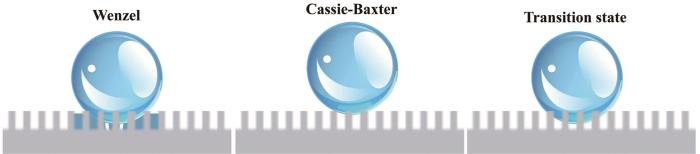
... 式中,γsv、γsl、γlv分别为固/气界面张力、固/液界面张力及液/气界面张力.θ0为液滴在光滑固体表面上的接触角,可作为表面浸润性的核心评价指标.根据Wang等[78]研究,通常以65°作为亲疏水特性的分界阈值.然而,实际应用中需进一步考察表面粗糙度对表面润湿性的作用规律,以更为准确地反映液体在固体表面真实的润湿特性.从润湿机理角度分析,液滴在粗糙结构表面的润湿行为主要存在3种状态:Wenzel状态(完全润湿)、Cassie-Baxter状态(复合接触)和过渡状态(部分润湿),其示意图见图1.其中,Wenzel方程(式2)如下: ...
Antifouling and removal efficiency of foul-release polydimethylsiloxane-based coatings: Lab-scale and seawater immersion fouling test and hydrodynamic shearing test
1
2021
... 其中,θe代表液滴的表观接触角;fs为固/液实际接触面积比;θ0为Young's接触角.该模型考虑了固-液-气三相复合接触模式.在超疏水表面设计中,固/气复合界面的形成至关重要.当表面微纳结构中截留的空气层占比足够大(通常fₛ < 5%)时,即可实现超疏水状态.通过微纳结构几何参数(如柱状阵列的间距/直径比、分级粗糙度等)的精准设计,可实现对fₛ值的定量调控,从而定向优化表面润湿性能.特别说明的一点是,Cassie-Baxter态与Wenzel态之间的过渡态稳定性受表面微纳结构尺寸特征和外界环境因素共同影响[79].研究表明,通过精确调控表面化学组成、微纳结构粗糙度等参数,可有效降低过渡态的发生概率,进而保证固体表面超疏水性能的长效维系[80]. ...
Progress in research of fouling-release antifouling coatings
1
2023
... 其中,θe代表液滴的表观接触角;fs为固/液实际接触面积比;θ0为Young's接触角.该模型考虑了固-液-气三相复合接触模式.在超疏水表面设计中,固/气复合界面的形成至关重要.当表面微纳结构中截留的空气层占比足够大(通常fₛ < 5%)时,即可实现超疏水状态.通过微纳结构几何参数(如柱状阵列的间距/直径比、分级粗糙度等)的精准设计,可实现对fₛ值的定量调控,从而定向优化表面润湿性能.特别说明的一点是,Cassie-Baxter态与Wenzel态之间的过渡态稳定性受表面微纳结构尺寸特征和外界环境因素共同影响[79].研究表明,通过精确调控表面化学组成、微纳结构粗糙度等参数,可有效降低过渡态的发生概率,进而保证固体表面超疏水性能的长效维系[80]. ...
污损释放型防污涂料研究进展
1
2023
... 其中,θe代表液滴的表观接触角;fs为固/液实际接触面积比;θ0为Young's接触角.该模型考虑了固-液-气三相复合接触模式.在超疏水表面设计中,固/气复合界面的形成至关重要.当表面微纳结构中截留的空气层占比足够大(通常fₛ < 5%)时,即可实现超疏水状态.通过微纳结构几何参数(如柱状阵列的间距/直径比、分级粗糙度等)的精准设计,可实现对fₛ值的定量调控,从而定向优化表面润湿性能.特别说明的一点是,Cassie-Baxter态与Wenzel态之间的过渡态稳定性受表面微纳结构尺寸特征和外界环境因素共同影响[79].研究表明,通过精确调控表面化学组成、微纳结构粗糙度等参数,可有效降低过渡态的发生概率,进而保证固体表面超疏水性能的长效维系[80]. ...
Stearic acid modified zinc nano-coatings with superhydrophobicity and enhanced antifouling performance
1
2018
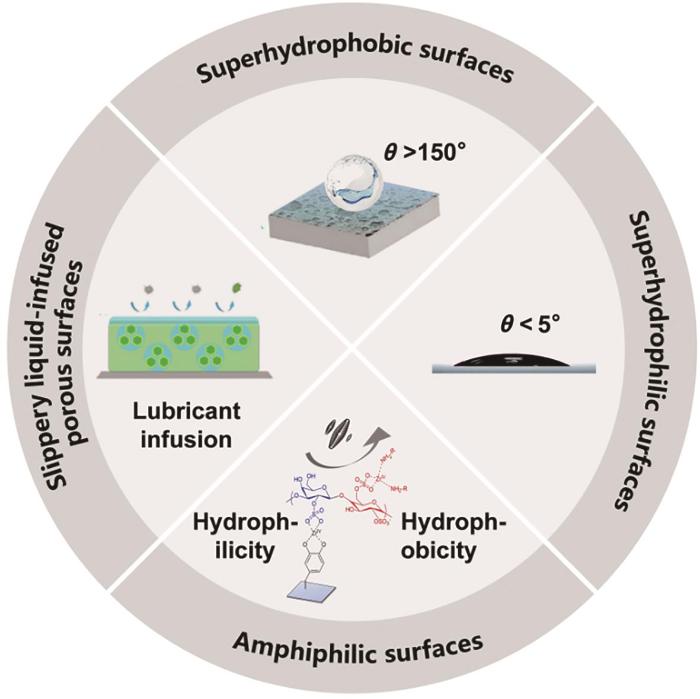
... 超疏水涂层作为一类典型的超浸润体系,通过微纳米级粗糙结构与低表面能化学组分的协同作用,实现θ超过150°、α小于10°的超疏水特性.该类涂层基于自身优异的自清洁特性,可显著抑制水、电解质、腐蚀介质及海洋微生物在固体表面的附着,在海洋防污防腐领域展现出显著优势[81,82].其设计准则源自于自然界中荷叶效应.荷叶表面通过微纳米结构与蜡质层的协同作用形成稳定的空气层,展现出卓越的超疏水特性和自清洁效应,这一现象为后续大量人工超疏水表面的设计提供了重要启示[83~85]. ...
Self-healing superhydrophobic fluoropolymer brushes as highly protein-repellent coatings
1
2016
... 超疏水涂层作为一类典型的超浸润体系,通过微纳米级粗糙结构与低表面能化学组分的协同作用,实现θ超过150°、α小于10°的超疏水特性.该类涂层基于自身优异的自清洁特性,可显著抑制水、电解质、腐蚀介质及海洋微生物在固体表面的附着,在海洋防污防腐领域展现出显著优势[81,82].其设计准则源自于自然界中荷叶效应.荷叶表面通过微纳米结构与蜡质层的协同作用形成稳定的空气层,展现出卓越的超疏水特性和自清洁效应,这一现象为后续大量人工超疏水表面的设计提供了重要启示[83~85]. ...
Progress in biomimetic leverages for marine antifouling using nanocomposite coatings
1
2020
... 超疏水涂层作为一类典型的超浸润体系,通过微纳米级粗糙结构与低表面能化学组分的协同作用,实现θ超过150°、α小于10°的超疏水特性.该类涂层基于自身优异的自清洁特性,可显著抑制水、电解质、腐蚀介质及海洋微生物在固体表面的附着,在海洋防污防腐领域展现出显著优势[81,82].其设计准则源自于自然界中荷叶效应.荷叶表面通过微纳米结构与蜡质层的协同作用形成稳定的空气层,展现出卓越的超疏水特性和自清洁效应,这一现象为后续大量人工超疏水表面的设计提供了重要启示[83~85]. ...
Hierarchical biocide-free silicone/graphene-silicon carbide nanocomposite coatings for marine antifouling and superhydrophobicity of ship hulls
2024
Superhydrophobic coating of silicone/β-MnO2 nanorod composite for marine antifouling
1
2019
... 超疏水涂层作为一类典型的超浸润体系,通过微纳米级粗糙结构与低表面能化学组分的协同作用,实现θ超过150°、α小于10°的超疏水特性.该类涂层基于自身优异的自清洁特性,可显著抑制水、电解质、腐蚀介质及海洋微生物在固体表面的附着,在海洋防污防腐领域展现出显著优势[81,82].其设计准则源自于自然界中荷叶效应.荷叶表面通过微纳米结构与蜡质层的协同作用形成稳定的空气层,展现出卓越的超疏水特性和自清洁效应,这一现象为后续大量人工超疏水表面的设计提供了重要启示[83~85]. ...
Study of the classical Cassie theory and Wenzel theory used in nanoscale
1
2021
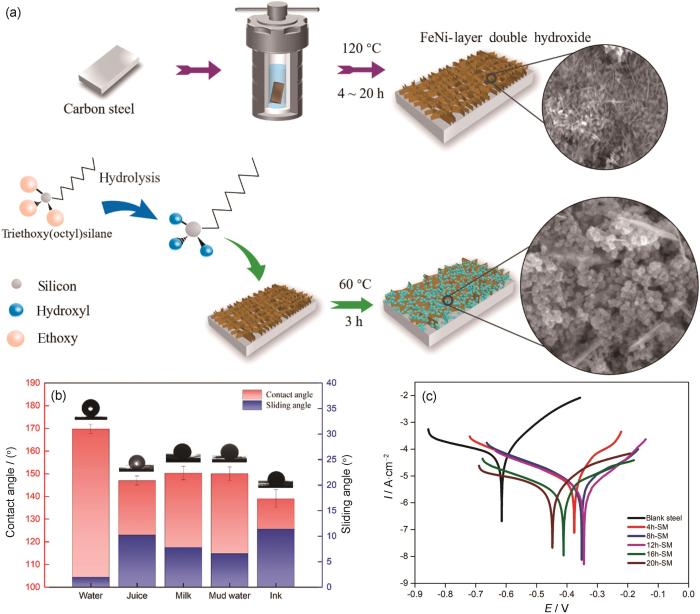
... 目前,超疏水涂层的制备工艺主要包括自上而下(物理加工)和自下而上(化学合成)两类技术路线.其中,自下而上的化学方法因操作简便、成本低廉且易于规模化而备受关注.常见的化学合成工艺包含化学气相沉积、水热合成法、溶胶凝胶法及自组装法等工艺[86~91].Xiang等[92]基于层状双氢氧化物(LDH)开发了一种新型超疏水涂层体系.该团队通过水热合成法在不同金属基底(黄铜、Mg合金、钢铁等)上原位生长具有特定金属组成的LDH粗糙结构,随后利用三乙氧基(辛基)硅烷(TTOS)进行表面修饰(图3a).其中,铁镍基样品经12 h反应后表现出优异的超疏水性能,θ高达169° (图3b),电化学测试显示其腐蚀抑制效率达到96.3% (图3c).这种“自下而上”的制备策略不仅避免了传统刻蚀工艺的材料损耗问题,更实现了对不同金属基底的普适性修饰.与此同时,其他研究团队也在探索多元化的超疏水表面构建方法.Latthe等[93]采用溶胶-凝胶技术,将聚甲基丙烯酸甲酯(PMMA)引入硅酸盐网络,制备出兼具超疏水性(θ = 159°)、良好透光性和优异机械性能的复合涂层.Zhang等[94]则开发出基于胶体纳米颗粒自组装的功能化超疏水薄膜,其独特的分级结构不仅赋予涂层增强的机械韧性,还能通过结构色变化直观反映涂层的损耗状态,为涂层服役性能的实时监测提供了新思路.这些方法均展现出良好的基底兼容性和工艺简便性,为超疏水涂层的实际应用奠定了基础. ...
Surface measurement of binderless bio-composite particleboard through contact angle and fractal surfaces
2019
Evaluation of macroscale wetting equations on a microrough surface
2015
Effect of nanostructured roughness on evaporating thin films in microchannels for Wenzel and Cassie-Baxter states
2013
Effects of geometrical characteristics of surface roughness on droplet wetting
2007
Achieving hierarchical structure with superhydrophobicity and enhanced anti-corrosion via electrochemical etching and chemical vapor deposition
1
2023
... 目前,超疏水涂层的制备工艺主要包括自上而下(物理加工)和自下而上(化学合成)两类技术路线.其中,自下而上的化学方法因操作简便、成本低廉且易于规模化而备受关注.常见的化学合成工艺包含化学气相沉积、水热合成法、溶胶凝胶法及自组装法等工艺[86~91].Xiang等[92]基于层状双氢氧化物(LDH)开发了一种新型超疏水涂层体系.该团队通过水热合成法在不同金属基底(黄铜、Mg合金、钢铁等)上原位生长具有特定金属组成的LDH粗糙结构,随后利用三乙氧基(辛基)硅烷(TTOS)进行表面修饰(图3a).其中,铁镍基样品经12 h反应后表现出优异的超疏水性能,θ高达169° (图3b),电化学测试显示其腐蚀抑制效率达到96.3% (图3c).这种“自下而上”的制备策略不仅避免了传统刻蚀工艺的材料损耗问题,更实现了对不同金属基底的普适性修饰.与此同时,其他研究团队也在探索多元化的超疏水表面构建方法.Latthe等[93]采用溶胶-凝胶技术,将聚甲基丙烯酸甲酯(PMMA)引入硅酸盐网络,制备出兼具超疏水性(θ = 159°)、良好透光性和优异机械性能的复合涂层.Zhang等[94]则开发出基于胶体纳米颗粒自组装的功能化超疏水薄膜,其独特的分级结构不仅赋予涂层增强的机械韧性,还能通过结构色变化直观反映涂层的损耗状态,为涂层服役性能的实时监测提供了新思路.这些方法均展现出良好的基底兼容性和工艺简便性,为超疏水涂层的实际应用奠定了基础. ...
Superhydrophobic LDH/TTOS composite surface based on microstructure for the anti-corrosion, anti-fouling and oil-water separation application
3
2021
... 目前,超疏水涂层的制备工艺主要包括自上而下(物理加工)和自下而上(化学合成)两类技术路线.其中,自下而上的化学方法因操作简便、成本低廉且易于规模化而备受关注.常见的化学合成工艺包含化学气相沉积、水热合成法、溶胶凝胶法及自组装法等工艺[86~91].Xiang等[92]基于层状双氢氧化物(LDH)开发了一种新型超疏水涂层体系.该团队通过水热合成法在不同金属基底(黄铜、Mg合金、钢铁等)上原位生长具有特定金属组成的LDH粗糙结构,随后利用三乙氧基(辛基)硅烷(TTOS)进行表面修饰(图3a).其中,铁镍基样品经12 h反应后表现出优异的超疏水性能,θ高达169° (图3b),电化学测试显示其腐蚀抑制效率达到96.3% (图3c).这种“自下而上”的制备策略不仅避免了传统刻蚀工艺的材料损耗问题,更实现了对不同金属基底的普适性修饰.与此同时,其他研究团队也在探索多元化的超疏水表面构建方法.Latthe等[93]采用溶胶-凝胶技术,将聚甲基丙烯酸甲酯(PMMA)引入硅酸盐网络,制备出兼具超疏水性(θ = 159°)、良好透光性和优异机械性能的复合涂层.Zhang等[94]则开发出基于胶体纳米颗粒自组装的功能化超疏水薄膜,其独特的分级结构不仅赋予涂层增强的机械韧性,还能通过结构色变化直观反映涂层的损耗状态,为涂层服役性能的实时监测提供了新思路.这些方法均展现出良好的基底兼容性和工艺简便性,为超疏水涂层的实际应用奠定了基础. ...
... [
92]
Schematic of the layered double hydroxide (LDH) superhydrophobic coating grafted with triethoxy(octyl)silane (TTOS) (a), contact angles and sliding angles of five different liquids (water, orange juice, milk, soda water, and ink) on iron-nickel LDH superhydrophobic coating (b), polarization electrochemical curves of iron-nickel LDH superhydrophobic coatings under different reaction times (c)<sup>[<xref ref-type="bibr" rid="R92">92</xref>]</sup>Fig.3![]()
尽管通过合理的表面微纳结构设计和低表面能材料的选择能够有效赋予涂层超疏水特性和防腐性能,但该类涂层的实际应用仍面临重大挑战.在实际海水环境中,水压、机械摩擦、污损生物及腐蚀介质等外部因素的反复干扰作用会加速超疏水涂层表面空气膜的破坏进程,导致涂层表面由Cassie-Baxter态过渡至Wenzel态,致使防污和防腐功能失效.这一缺陷严重制约了超疏水涂层在海洋环境中的推广应用.针对这一关键问题,研究者们通过对涂层进行多级结构优化,表面自修复及功能性复合,开发出多种解决方案.其中,基于仿生思想,Zhang等[95]采用光蚀刻、酸蚀刻、阳极氧化和氟烷基硅烷改性处理等工艺,通过构建分级微结构制备一种的新型超疏水涂层体系.其中,次级竹笋状微结构提供显著的防水性能,所制表面的θ为173°,α仅为1.5°,在空气和强酸碱性环境中均表现出良好的化学稳定性.微米级截头圆锥柱则有效延缓微纳结构的损坏进程,充分确保涂层的稳定性及长效防污功效.在经历循环摩擦实验后,表面依然具备良好的防水性能.Tian等[96]则开发了一种环境友好的超疏水Zn-Fe合金涂层.通过电镀工艺构建了仿Echinopsis植物的分级微纳结构,结合四十烷酸修饰,实现了优异的超疏水性能(θ = 166°,α = 4°).分级微纳结构的引入显著提升了涂层的力学强度和耐蚀性能.该涂层的电荷转移阻抗(Rct)较裸钢提升了3个数量级(从11.5 Ω·cm2增至1384.0 Ω·cm2),展现出卓越的防腐性能.其制备过程中采用的绿色非氰化碱性甘油体系显著提高了技术的实用性和环保性. ...
... [
92]
Fig.3![]()
尽管通过合理的表面微纳结构设计和低表面能材料的选择能够有效赋予涂层超疏水特性和防腐性能,但该类涂层的实际应用仍面临重大挑战.在实际海水环境中,水压、机械摩擦、污损生物及腐蚀介质等外部因素的反复干扰作用会加速超疏水涂层表面空气膜的破坏进程,导致涂层表面由Cassie-Baxter态过渡至Wenzel态,致使防污和防腐功能失效.这一缺陷严重制约了超疏水涂层在海洋环境中的推广应用.针对这一关键问题,研究者们通过对涂层进行多级结构优化,表面自修复及功能性复合,开发出多种解决方案.其中,基于仿生思想,Zhang等[95]采用光蚀刻、酸蚀刻、阳极氧化和氟烷基硅烷改性处理等工艺,通过构建分级微结构制备一种的新型超疏水涂层体系.其中,次级竹笋状微结构提供显著的防水性能,所制表面的θ为173°,α仅为1.5°,在空气和强酸碱性环境中均表现出良好的化学稳定性.微米级截头圆锥柱则有效延缓微纳结构的损坏进程,充分确保涂层的稳定性及长效防污功效.在经历循环摩擦实验后,表面依然具备良好的防水性能.Tian等[96]则开发了一种环境友好的超疏水Zn-Fe合金涂层.通过电镀工艺构建了仿Echinopsis植物的分级微纳结构,结合四十烷酸修饰,实现了优异的超疏水性能(θ = 166°,α = 4°).分级微纳结构的引入显著提升了涂层的力学强度和耐蚀性能.该涂层的电荷转移阻抗(Rct)较裸钢提升了3个数量级(从11.5 Ω·cm2增至1384.0 Ω·cm2),展现出卓越的防腐性能.其制备过程中采用的绿色非氰化碱性甘油体系显著提高了技术的实用性和环保性. ...
Development of sol-gel processed semi-transparent and self-cleaning superhydrophobic coatings
1
2014
... 目前,超疏水涂层的制备工艺主要包括自上而下(物理加工)和自下而上(化学合成)两类技术路线.其中,自下而上的化学方法因操作简便、成本低廉且易于规模化而备受关注.常见的化学合成工艺包含化学气相沉积、水热合成法、溶胶凝胶法及自组装法等工艺[86~91].Xiang等[92]基于层状双氢氧化物(LDH)开发了一种新型超疏水涂层体系.该团队通过水热合成法在不同金属基底(黄铜、Mg合金、钢铁等)上原位生长具有特定金属组成的LDH粗糙结构,随后利用三乙氧基(辛基)硅烷(TTOS)进行表面修饰(图3a).其中,铁镍基样品经12 h反应后表现出优异的超疏水性能,θ高达169° (图3b),电化学测试显示其腐蚀抑制效率达到96.3% (图3c).这种“自下而上”的制备策略不仅避免了传统刻蚀工艺的材料损耗问题,更实现了对不同金属基底的普适性修饰.与此同时,其他研究团队也在探索多元化的超疏水表面构建方法.Latthe等[93]采用溶胶-凝胶技术,将聚甲基丙烯酸甲酯(PMMA)引入硅酸盐网络,制备出兼具超疏水性(θ = 159°)、良好透光性和优异机械性能的复合涂层.Zhang等[94]则开发出基于胶体纳米颗粒自组装的功能化超疏水薄膜,其独特的分级结构不仅赋予涂层增强的机械韧性,还能通过结构色变化直观反映涂层的损耗状态,为涂层服役性能的实时监测提供了新思路.这些方法均展现出良好的基底兼容性和工艺简便性,为超疏水涂层的实际应用奠定了基础. ...
Bioinspired superhydrophobic surface by hierarchically colloidal assembling of microparticles and colloidal nanoparticles
1
2020
... 目前,超疏水涂层的制备工艺主要包括自上而下(物理加工)和自下而上(化学合成)两类技术路线.其中,自下而上的化学方法因操作简便、成本低廉且易于规模化而备受关注.常见的化学合成工艺包含化学气相沉积、水热合成法、溶胶凝胶法及自组装法等工艺[86~91].Xiang等[92]基于层状双氢氧化物(LDH)开发了一种新型超疏水涂层体系.该团队通过水热合成法在不同金属基底(黄铜、Mg合金、钢铁等)上原位生长具有特定金属组成的LDH粗糙结构,随后利用三乙氧基(辛基)硅烷(TTOS)进行表面修饰(图3a).其中,铁镍基样品经12 h反应后表现出优异的超疏水性能,θ高达169° (图3b),电化学测试显示其腐蚀抑制效率达到96.3% (图3c).这种“自下而上”的制备策略不仅避免了传统刻蚀工艺的材料损耗问题,更实现了对不同金属基底的普适性修饰.与此同时,其他研究团队也在探索多元化的超疏水表面构建方法.Latthe等[93]采用溶胶-凝胶技术,将聚甲基丙烯酸甲酯(PMMA)引入硅酸盐网络,制备出兼具超疏水性(θ = 159°)、良好透光性和优异机械性能的复合涂层.Zhang等[94]则开发出基于胶体纳米颗粒自组装的功能化超疏水薄膜,其独特的分级结构不仅赋予涂层增强的机械韧性,还能通过结构色变化直观反映涂层的损耗状态,为涂层服役性能的实时监测提供了新思路.这些方法均展现出良好的基底兼容性和工艺简便性,为超疏水涂层的实际应用奠定了基础. ...
Durable superhydrophobic surface with hierarchical microstructures for efficient water collection
1
2021
... 尽管通过合理的表面微纳结构设计和低表面能材料的选择能够有效赋予涂层超疏水特性和防腐性能,但该类涂层的实际应用仍面临重大挑战.在实际海水环境中,水压、机械摩擦、污损生物及腐蚀介质等外部因素的反复干扰作用会加速超疏水涂层表面空气膜的破坏进程,导致涂层表面由Cassie-Baxter态过渡至Wenzel态,致使防污和防腐功能失效.这一缺陷严重制约了超疏水涂层在海洋环境中的推广应用.针对这一关键问题,研究者们通过对涂层进行多级结构优化,表面自修复及功能性复合,开发出多种解决方案.其中,基于仿生思想,Zhang等[95]采用光蚀刻、酸蚀刻、阳极氧化和氟烷基硅烷改性处理等工艺,通过构建分级微结构制备一种的新型超疏水涂层体系.其中,次级竹笋状微结构提供显著的防水性能,所制表面的θ为173°,α仅为1.5°,在空气和强酸碱性环境中均表现出良好的化学稳定性.微米级截头圆锥柱则有效延缓微纳结构的损坏进程,充分确保涂层的稳定性及长效防污功效.在经历循环摩擦实验后,表面依然具备良好的防水性能.Tian等[96]则开发了一种环境友好的超疏水Zn-Fe合金涂层.通过电镀工艺构建了仿Echinopsis植物的分级微纳结构,结合四十烷酸修饰,实现了优异的超疏水性能(θ = 166°,α = 4°).分级微纳结构的引入显著提升了涂层的力学强度和耐蚀性能.该涂层的电荷转移阻抗(Rct)较裸钢提升了3个数量级(从11.5 Ω·cm2增至1384.0 Ω·cm2),展现出卓越的防腐性能.其制备过程中采用的绿色非氰化碱性甘油体系显著提高了技术的实用性和环保性. ...
High corrosion protection performance of a novel nonfluorinated biomimetic superhydrophobic Zn-Fe coating with Echinopsis multiplex-like structure
1
2019
... 尽管通过合理的表面微纳结构设计和低表面能材料的选择能够有效赋予涂层超疏水特性和防腐性能,但该类涂层的实际应用仍面临重大挑战.在实际海水环境中,水压、机械摩擦、污损生物及腐蚀介质等外部因素的反复干扰作用会加速超疏水涂层表面空气膜的破坏进程,导致涂层表面由Cassie-Baxter态过渡至Wenzel态,致使防污和防腐功能失效.这一缺陷严重制约了超疏水涂层在海洋环境中的推广应用.针对这一关键问题,研究者们通过对涂层进行多级结构优化,表面自修复及功能性复合,开发出多种解决方案.其中,基于仿生思想,Zhang等[95]采用光蚀刻、酸蚀刻、阳极氧化和氟烷基硅烷改性处理等工艺,通过构建分级微结构制备一种的新型超疏水涂层体系.其中,次级竹笋状微结构提供显著的防水性能,所制表面的θ为173°,α仅为1.5°,在空气和强酸碱性环境中均表现出良好的化学稳定性.微米级截头圆锥柱则有效延缓微纳结构的损坏进程,充分确保涂层的稳定性及长效防污功效.在经历循环摩擦实验后,表面依然具备良好的防水性能.Tian等[96]则开发了一种环境友好的超疏水Zn-Fe合金涂层.通过电镀工艺构建了仿Echinopsis植物的分级微纳结构,结合四十烷酸修饰,实现了优异的超疏水性能(θ = 166°,α = 4°).分级微纳结构的引入显著提升了涂层的力学强度和耐蚀性能.该涂层的电荷转移阻抗(Rct)较裸钢提升了3个数量级(从11.5 Ω·cm2增至1384.0 Ω·cm2),展现出卓越的防腐性能.其制备过程中采用的绿色非氰化碱性甘油体系显著提高了技术的实用性和环保性. ...
UV-NIR Dual-responsive nanocomposite coatings with healable, superhydrophobic, and contaminant-resistant properties
1
2020
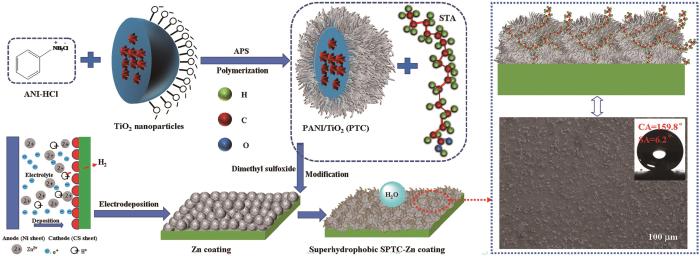
... 近年来,自修复超疏水材料获得科研工作者们越来越多的青睐.该类涂层通过将微胶囊、液体纤维及自相似结构等低表面能修复剂储存至其内部,在外部刺激的条件下及时释放并迁移至破损部位进行愈合,具有优异的高效性、环保性及耐久性.Li等[97]将紫外响应微胶囊与近红外响应碳纳米颗粒、疏水SiO2纳米颗粒以及水性有机硅乳液复合,开发出具有快速大面积修复功能的超疏水涂层体系.其中,紫外响应微胶囊通过带负电的TiO2纳米颗粒与带正电微胶囊表面的静电吸附作用简易制备,内部封装氟硅烷(FAS-13)修复剂可在紫外光照条件下释放迁移涂层表面,实现涂层超疏水特性的长效维持.该自修复超疏水涂层不仅具备优异的耐油污性,还具备良好的耐腐蚀和耐磨性能.Li等[98]通过Cl催化反应制备出十六烷基聚硅氧烷改性修饰的SiO2(SiO2@HD-POS)均相悬浮液.通过喷涂工艺得到绿色无氟、机械坚固、且具备自愈合性能的超疏水涂层.由于涂层的高耐久性,具有独特的分级宏观/纳米结构,以及固体润滑SiO2@HD-POS纳米粒子从涂层上脱落,涂层具备优异的力学稳定性.由于HD-POS可高效迁移至受损表面,涂层还显示出快速稳定的自愈能力.由于对主要瓶颈问题的不断解决,自愈合超疏水涂层可用于各种领域.此外,Hu等[99]则拓展了超疏水涂层的功能性.他们开发的聚苯胺/TiO2-硬脂酸复合涂层(SPTC)兼具超疏水性(θ = 159.8°,α = 6.2°)、光催化灭菌性和导电性(图4).当空气膜在实际环境中被破坏时,复合涂料中TiO2纳米颗粒显著的光催化杀菌功效有效抑制了生物被膜的形成,进而弥补了气垫破坏后涂层的防污功能性缺失.这种独特的协同效应不仅使其在海洋防护领域中具备良好的应用性,还使其在电子传感领域展现出巨大应用潜力. ...
Totally waterborne, nonfluorinated, mechanically robust, and self-healing superhydrophobic coatings for actual anti-icing
1
2018
... 近年来,自修复超疏水材料获得科研工作者们越来越多的青睐.该类涂层通过将微胶囊、液体纤维及自相似结构等低表面能修复剂储存至其内部,在外部刺激的条件下及时释放并迁移至破损部位进行愈合,具有优异的高效性、环保性及耐久性.Li等[97]将紫外响应微胶囊与近红外响应碳纳米颗粒、疏水SiO2纳米颗粒以及水性有机硅乳液复合,开发出具有快速大面积修复功能的超疏水涂层体系.其中,紫外响应微胶囊通过带负电的TiO2纳米颗粒与带正电微胶囊表面的静电吸附作用简易制备,内部封装氟硅烷(FAS-13)修复剂可在紫外光照条件下释放迁移涂层表面,实现涂层超疏水特性的长效维持.该自修复超疏水涂层不仅具备优异的耐油污性,还具备良好的耐腐蚀和耐磨性能.Li等[98]通过Cl催化反应制备出十六烷基聚硅氧烷改性修饰的SiO2(SiO2@HD-POS)均相悬浮液.通过喷涂工艺得到绿色无氟、机械坚固、且具备自愈合性能的超疏水涂层.由于涂层的高耐久性,具有独特的分级宏观/纳米结构,以及固体润滑SiO2@HD-POS纳米粒子从涂层上脱落,涂层具备优异的力学稳定性.由于HD-POS可高效迁移至受损表面,涂层还显示出快速稳定的自愈能力.由于对主要瓶颈问题的不断解决,自愈合超疏水涂层可用于各种领域.此外,Hu等[99]则拓展了超疏水涂层的功能性.他们开发的聚苯胺/TiO2-硬脂酸复合涂层(SPTC)兼具超疏水性(θ = 159.8°,α = 6.2°)、光催化灭菌性和导电性(图4).当空气膜在实际环境中被破坏时,复合涂料中TiO2纳米颗粒显著的光催化杀菌功效有效抑制了生物被膜的形成,进而弥补了气垫破坏后涂层的防污功能性缺失.这种独特的协同效应不仅使其在海洋防护领域中具备良好的应用性,还使其在电子传感领域展现出巨大应用潜力. ...
Superhydrophobic polyaniline/TiO2 composite coating with enhanced anticorrosion function
3
2022
... 近年来,自修复超疏水材料获得科研工作者们越来越多的青睐.该类涂层通过将微胶囊、液体纤维及自相似结构等低表面能修复剂储存至其内部,在外部刺激的条件下及时释放并迁移至破损部位进行愈合,具有优异的高效性、环保性及耐久性.Li等[97]将紫外响应微胶囊与近红外响应碳纳米颗粒、疏水SiO2纳米颗粒以及水性有机硅乳液复合,开发出具有快速大面积修复功能的超疏水涂层体系.其中,紫外响应微胶囊通过带负电的TiO2纳米颗粒与带正电微胶囊表面的静电吸附作用简易制备,内部封装氟硅烷(FAS-13)修复剂可在紫外光照条件下释放迁移涂层表面,实现涂层超疏水特性的长效维持.该自修复超疏水涂层不仅具备优异的耐油污性,还具备良好的耐腐蚀和耐磨性能.Li等[98]通过Cl催化反应制备出十六烷基聚硅氧烷改性修饰的SiO2(SiO2@HD-POS)均相悬浮液.通过喷涂工艺得到绿色无氟、机械坚固、且具备自愈合性能的超疏水涂层.由于涂层的高耐久性,具有独特的分级宏观/纳米结构,以及固体润滑SiO2@HD-POS纳米粒子从涂层上脱落,涂层具备优异的力学稳定性.由于HD-POS可高效迁移至受损表面,涂层还显示出快速稳定的自愈能力.由于对主要瓶颈问题的不断解决,自愈合超疏水涂层可用于各种领域.此外,Hu等[99]则拓展了超疏水涂层的功能性.他们开发的聚苯胺/TiO2-硬脂酸复合涂层(SPTC)兼具超疏水性(θ = 159.8°,α = 6.2°)、光催化灭菌性和导电性(图4).当空气膜在实际环境中被破坏时,复合涂料中TiO2纳米颗粒显著的光催化杀菌功效有效抑制了生物被膜的形成,进而弥补了气垫破坏后涂层的防污功能性缺失.这种独特的协同效应不仅使其在海洋防护领域中具备良好的应用性,还使其在电子传感领域展现出巨大应用潜力. ...
... [
99]
Schematic of the manufacturing process of SPTC coating (left) and the water contact angle and sliding angle (right)<sup>[<xref ref-type="bibr" rid="R99">99</xref>]</sup>Fig.4![]()
聚焦于多级结构优化、表面自修复、多功能集成设计等新兴技术和研究热点,未来研究应着重开发具有长效智能防污功效的新型超疏水涂层体系,以应对复杂的海洋环境挑战. ...
... [
99]
Fig.4![]()
聚焦于多级结构优化、表面自修复、多功能集成设计等新兴技术和研究热点,未来研究应着重开发具有长效智能防污功效的新型超疏水涂层体系,以应对复杂的海洋环境挑战. ...
Fabrication of stable liquid-like wetting buckled surfaces as bioinspired antibiofouling coatings by using silicon-containing block copolymers
1
2024
... 超亲水涂层(θ < 10°)因其较高的表面能特性,能够实现液滴在材料表面的快速铺展与完全浸润.目前主要通过两种策略构建超亲水涂层:一是通过化学修饰在材料表面引入羟基、羧基等亲水基团;二是在材料表面构筑纳米级粗糙结构以增强毛细作用.其中,基于表面水合层屏蔽机制的水凝胶、两性离子聚合物刷和聚乙二醇(PEG)薄膜等超亲水体系,因其能有效阻隔生物小分子、病毒和细菌等污染物的附着[100~102],已在生物医学领域获得广泛应用,并展现出在海洋防污领域的应用潜力[103~105]. ...
Amphiphilic marine antifouling coatings based on zwitterion-modified silicone polymers
2025
Polymer brush coatings for combating marine biofouling
1
2014
... 超亲水涂层(θ < 10°)因其较高的表面能特性,能够实现液滴在材料表面的快速铺展与完全浸润.目前主要通过两种策略构建超亲水涂层:一是通过化学修饰在材料表面引入羟基、羧基等亲水基团;二是在材料表面构筑纳米级粗糙结构以增强毛细作用.其中,基于表面水合层屏蔽机制的水凝胶、两性离子聚合物刷和聚乙二醇(PEG)薄膜等超亲水体系,因其能有效阻隔生物小分子、病毒和细菌等污染物的附着[100~102],已在生物医学领域获得广泛应用,并展现出在海洋防污领域的应用潜力[103~105]. ...
Zwitterionic hydrogel coated superhydrophilic hierarchical antifouling floater enables unimpeded interfacial steam generation and multi-contamination resistance in complex conditions
1
2021
... 超亲水涂层(θ < 10°)因其较高的表面能特性,能够实现液滴在材料表面的快速铺展与完全浸润.目前主要通过两种策略构建超亲水涂层:一是通过化学修饰在材料表面引入羟基、羧基等亲水基团;二是在材料表面构筑纳米级粗糙结构以增强毛细作用.其中,基于表面水合层屏蔽机制的水凝胶、两性离子聚合物刷和聚乙二醇(PEG)薄膜等超亲水体系,因其能有效阻隔生物小分子、病毒和细菌等污染物的附着[100~102],已在生物医学领域获得广泛应用,并展现出在海洋防污领域的应用潜力[103~105]. ...
Reverse actuation of polyelectrolyte effect for in vivo antifouling
2021
Surface hydration and antifouling activity of zwitterionic polymers
1
2022
... 超亲水涂层(θ < 10°)因其较高的表面能特性,能够实现液滴在材料表面的快速铺展与完全浸润.目前主要通过两种策略构建超亲水涂层:一是通过化学修饰在材料表面引入羟基、羧基等亲水基团;二是在材料表面构筑纳米级粗糙结构以增强毛细作用.其中,基于表面水合层屏蔽机制的水凝胶、两性离子聚合物刷和聚乙二醇(PEG)薄膜等超亲水体系,因其能有效阻隔生物小分子、病毒和细菌等污染物的附着[100~102],已在生物医学领域获得广泛应用,并展现出在海洋防污领域的应用潜力[103~105]. ...
Improved antifouling ability for double-network hydrogel coatings with excellent elastic and toughness under marine tidal environment
3
2023
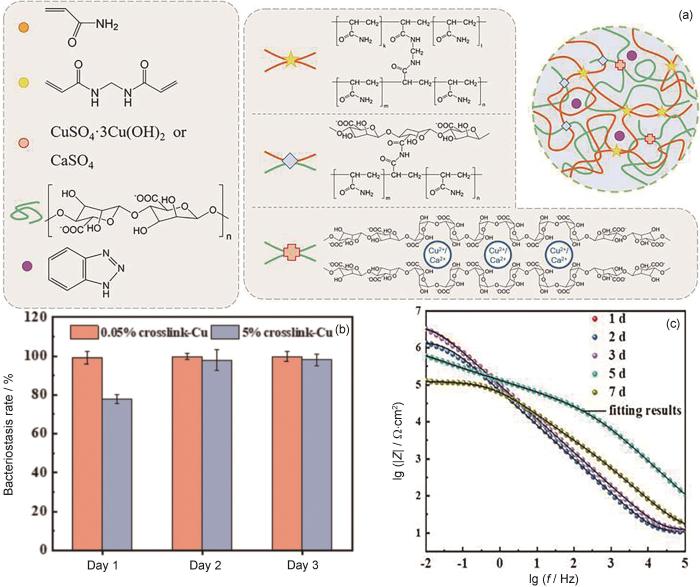
... Li等[106]开发了一种具有优异力学性能和防污效果的双网络水凝胶涂层系统.该体系以化学交联的聚丙烯酰胺构成第一网络,物理交联的铜藻酸盐作为第二网络,后者同时作为应变缓冲单元.引入的Cu2+不仅显著提升了涂层的力学性能(优于传统Ca2+体系),还增强了其防污功能.同时,防腐抑制剂苯并噻唑(BTA)通过与铜基材的配位作用,有效提高了涂层在金属基材(如Cu、Al、Fe等)上的附着力(图5a).这种致密的复合膜结构具有出色的机械韧性,使其在潮汐区环境下展现出持久的防污防腐性能(图5b和c).然而,该技术对非金属基材(如塑料、木材、玻璃等)的适用性仍有待深入研究.受贻贝粘附蛋白启发,聚多巴胺(PDA)因其儿茶酚-OH基团的强配位能力和紧密排列特性,被广泛用作增强界面结合的中间层.Feng等[107]基于这一原理设计了一种具有Janus结构的自清洁水凝胶湿粘合剂.该体系通过聚乙烯醇/甘油单宁酸(PVA/Gly-TA/Cu2+)水凝胶中的Cu2+与聚(多巴胺甲基丙烯酰胺-丙烯酸甲氧基乙酯共聚物)P(DMA-co-MEA)中儿茶酚-OH基团的协同配位作用,实现了4.4 MPa的拉伸强度和14 kPa的粘附强度,所制涂层在多种基材表面均实现较好黏附.得益于水合层的屏蔽效应,涂层表现出148°的水下油接触角和极低的藻类附着密度,同时保持优异的光学稳定性,在海洋工程领域具有广阔应用前景.Wei等[108]采用原位接枝技术构建了多功能复合涂层.首先通过3-氨丙基三乙氧基硅烷(APTES)单分子层增强PDA的防腐性能,随后接枝具有抗菌功能的两性硫磺基聚合物(PSB).基于共价接枝的强键合作用(优于离子配位),该涂层展现出增强的附着力、广谱抗菌性和优异的低频阻抗特性(|Z| f = 0.01 Hz).所用原位接枝策略有效避免了多层涂层的界面兼容性问题,为开发高性能防污防腐涂层提供了新思路. ...
... [
106]
Constituents of physical-chemical double network crosslinking hydrogel incorporating Cu<sup>2+</sup> as the antifouling agent and BTA as the corrosion inhibition agent (a), antifouling testing results (b) and electrochemical corrosion data (Bode curves) (c) of the developed hydrophilic surfaces<sup>[<xref ref-type="bibr" rid="R106">106</xref>]</sup>Fig.5![]()
基于网络互穿、离子配位、共价接枝等过程,上述开发的超亲水涂层有效提升了涂层的力学性能、粘合强度及防污防腐功效,具有良好的应用前景.然而,超亲水涂层的吸水溶胀行为破坏了其结构完整性,阻碍了其在实际水下的长效服役.如何降低该类涂层的吸水率以保证其在水下的长期稳定性,是其实用化的关键瓶颈问题.Xie等[109]在甲基丙烯酰胺水凝胶的沉淀聚合过程中引入石墨烯纳米片层,基于石墨烯纳米片层与聚合物网络的协同作用机制,成功开发出具有优异抗冲击性能和抗溶胀性能的复合水凝胶涂层体系.其中,石墨烯的二维纳米结构在水凝胶网络中形成三维穿插网络,其巨大的比表面积和疏水特性有效阻隔了水分子的渗透扩散路径.此外,石墨烯片层与甲基丙烯酰胺分子链间的π-π堆叠作用和氢键交联,构建了具有能量耗散功能的双重网络结构,充分保证纳米复合涂层的力学强度和长效性.Dou等[110]利用Fe3+与壳聚糖(CS)、聚(N-丙烯酰基-2-甘氨酸)(PACG)的配位作用在分子层面构建了三维交联防护体系.通过精细调控配位键密度和网络拓扑结构,水凝胶在长期浸水环境下展现出非凡的尺寸稳定性:在生理盐水中浸泡180 d后体积溶胀率低于15%,且压缩模量保持率超过85%,突破了传统水凝胶材料在湿润环境中力学性能急剧衰减的技术瓶颈.值得一提的是,该体系通过pH响应性金属配位键的可逆断裂与重组,实现了溶胀行为的动态智能调控,使水凝胶能在5%~2000%的宽幅溶胀范围内进行精确可编程调节. ...
... [
106]
Fig.5![]()
基于网络互穿、离子配位、共价接枝等过程,上述开发的超亲水涂层有效提升了涂层的力学性能、粘合强度及防污防腐功效,具有良好的应用前景.然而,超亲水涂层的吸水溶胀行为破坏了其结构完整性,阻碍了其在实际水下的长效服役.如何降低该类涂层的吸水率以保证其在水下的长期稳定性,是其实用化的关键瓶颈问题.Xie等[109]在甲基丙烯酰胺水凝胶的沉淀聚合过程中引入石墨烯纳米片层,基于石墨烯纳米片层与聚合物网络的协同作用机制,成功开发出具有优异抗冲击性能和抗溶胀性能的复合水凝胶涂层体系.其中,石墨烯的二维纳米结构在水凝胶网络中形成三维穿插网络,其巨大的比表面积和疏水特性有效阻隔了水分子的渗透扩散路径.此外,石墨烯片层与甲基丙烯酰胺分子链间的π-π堆叠作用和氢键交联,构建了具有能量耗散功能的双重网络结构,充分保证纳米复合涂层的力学强度和长效性.Dou等[110]利用Fe3+与壳聚糖(CS)、聚(N-丙烯酰基-2-甘氨酸)(PACG)的配位作用在分子层面构建了三维交联防护体系.通过精细调控配位键密度和网络拓扑结构,水凝胶在长期浸水环境下展现出非凡的尺寸稳定性:在生理盐水中浸泡180 d后体积溶胀率低于15%,且压缩模量保持率超过85%,突破了传统水凝胶材料在湿润环境中力学性能急剧衰减的技术瓶颈.值得一提的是,该体系通过pH响应性金属配位键的可逆断裂与重组,实现了溶胀行为的动态智能调控,使水凝胶能在5%~2000%的宽幅溶胀范围内进行精确可编程调节. ...
Transparent Janus hydrogel wet adhesive for underwater self-cleaning
1
2021
... Li等[106]开发了一种具有优异力学性能和防污效果的双网络水凝胶涂层系统.该体系以化学交联的聚丙烯酰胺构成第一网络,物理交联的铜藻酸盐作为第二网络,后者同时作为应变缓冲单元.引入的Cu2+不仅显著提升了涂层的力学性能(优于传统Ca2+体系),还增强了其防污功能.同时,防腐抑制剂苯并噻唑(BTA)通过与铜基材的配位作用,有效提高了涂层在金属基材(如Cu、Al、Fe等)上的附着力(图5a).这种致密的复合膜结构具有出色的机械韧性,使其在潮汐区环境下展现出持久的防污防腐性能(图5b和c).然而,该技术对非金属基材(如塑料、木材、玻璃等)的适用性仍有待深入研究.受贻贝粘附蛋白启发,聚多巴胺(PDA)因其儿茶酚-OH基团的强配位能力和紧密排列特性,被广泛用作增强界面结合的中间层.Feng等[107]基于这一原理设计了一种具有Janus结构的自清洁水凝胶湿粘合剂.该体系通过聚乙烯醇/甘油单宁酸(PVA/Gly-TA/Cu2+)水凝胶中的Cu2+与聚(多巴胺甲基丙烯酰胺-丙烯酸甲氧基乙酯共聚物)P(DMA-co-MEA)中儿茶酚-OH基团的协同配位作用,实现了4.4 MPa的拉伸强度和14 kPa的粘附强度,所制涂层在多种基材表面均实现较好黏附.得益于水合层的屏蔽效应,涂层表现出148°的水下油接触角和极低的藻类附着密度,同时保持优异的光学稳定性,在海洋工程领域具有广阔应用前景.Wei等[108]采用原位接枝技术构建了多功能复合涂层.首先通过3-氨丙基三乙氧基硅烷(APTES)单分子层增强PDA的防腐性能,随后接枝具有抗菌功能的两性硫磺基聚合物(PSB).基于共价接枝的强键合作用(优于离子配位),该涂层展现出增强的附着力、广谱抗菌性和优异的低频阻抗特性(|Z| f = 0.01 Hz).所用原位接枝策略有效避免了多层涂层的界面兼容性问题,为开发高性能防污防腐涂层提供了新思路. ...
Sulfobetaine zwitterionic/quaternary ammonium cationic copolymers as high-efficiency antifouling and bactericidal coatings for polyurethane substrates
1
2024
... Li等[106]开发了一种具有优异力学性能和防污效果的双网络水凝胶涂层系统.该体系以化学交联的聚丙烯酰胺构成第一网络,物理交联的铜藻酸盐作为第二网络,后者同时作为应变缓冲单元.引入的Cu2+不仅显著提升了涂层的力学性能(优于传统Ca2+体系),还增强了其防污功能.同时,防腐抑制剂苯并噻唑(BTA)通过与铜基材的配位作用,有效提高了涂层在金属基材(如Cu、Al、Fe等)上的附着力(图5a).这种致密的复合膜结构具有出色的机械韧性,使其在潮汐区环境下展现出持久的防污防腐性能(图5b和c).然而,该技术对非金属基材(如塑料、木材、玻璃等)的适用性仍有待深入研究.受贻贝粘附蛋白启发,聚多巴胺(PDA)因其儿茶酚-OH基团的强配位能力和紧密排列特性,被广泛用作增强界面结合的中间层.Feng等[107]基于这一原理设计了一种具有Janus结构的自清洁水凝胶湿粘合剂.该体系通过聚乙烯醇/甘油单宁酸(PVA/Gly-TA/Cu2+)水凝胶中的Cu2+与聚(多巴胺甲基丙烯酰胺-丙烯酸甲氧基乙酯共聚物)P(DMA-co-MEA)中儿茶酚-OH基团的协同配位作用,实现了4.4 MPa的拉伸强度和14 kPa的粘附强度,所制涂层在多种基材表面均实现较好黏附.得益于水合层的屏蔽效应,涂层表现出148°的水下油接触角和极低的藻类附着密度,同时保持优异的光学稳定性,在海洋工程领域具有广阔应用前景.Wei等[108]采用原位接枝技术构建了多功能复合涂层.首先通过3-氨丙基三乙氧基硅烷(APTES)单分子层增强PDA的防腐性能,随后接枝具有抗菌功能的两性硫磺基聚合物(PSB).基于共价接枝的强键合作用(优于离子配位),该涂层展现出增强的附着力、广谱抗菌性和优异的低频阻抗特性(|Z| f = 0.01 Hz).所用原位接枝策略有效避免了多层涂层的界面兼容性问题,为开发高性能防污防腐涂层提供了新思路. ...
Anti-impact electromagnetic shielding hydrogel with solvent-driven tunability
1
2025
... 基于网络互穿、离子配位、共价接枝等过程,上述开发的超亲水涂层有效提升了涂层的力学性能、粘合强度及防污防腐功效,具有良好的应用前景.然而,超亲水涂层的吸水溶胀行为破坏了其结构完整性,阻碍了其在实际水下的长效服役.如何降低该类涂层的吸水率以保证其在水下的长期稳定性,是其实用化的关键瓶颈问题.Xie等[109]在甲基丙烯酰胺水凝胶的沉淀聚合过程中引入石墨烯纳米片层,基于石墨烯纳米片层与聚合物网络的协同作用机制,成功开发出具有优异抗冲击性能和抗溶胀性能的复合水凝胶涂层体系.其中,石墨烯的二维纳米结构在水凝胶网络中形成三维穿插网络,其巨大的比表面积和疏水特性有效阻隔了水分子的渗透扩散路径.此外,石墨烯片层与甲基丙烯酰胺分子链间的π-π堆叠作用和氢键交联,构建了具有能量耗散功能的双重网络结构,充分保证纳米复合涂层的力学强度和长效性.Dou等[110]利用Fe3+与壳聚糖(CS)、聚(N-丙烯酰基-2-甘氨酸)(PACG)的配位作用在分子层面构建了三维交联防护体系.通过精细调控配位键密度和网络拓扑结构,水凝胶在长期浸水环境下展现出非凡的尺寸稳定性:在生理盐水中浸泡180 d后体积溶胀率低于15%,且压缩模量保持率超过85%,突破了传统水凝胶材料在湿润环境中力学性能急剧衰减的技术瓶颈.值得一提的是,该体系通过pH响应性金属配位键的可逆断裂与重组,实现了溶胀行为的动态智能调控,使水凝胶能在5%~2000%的宽幅溶胀范围内进行精确可编程调节. ...
One-step soaking strategy toward anti-swelling hydrogels with a stiff “armor”
1
2023
... 基于网络互穿、离子配位、共价接枝等过程,上述开发的超亲水涂层有效提升了涂层的力学性能、粘合强度及防污防腐功效,具有良好的应用前景.然而,超亲水涂层的吸水溶胀行为破坏了其结构完整性,阻碍了其在实际水下的长效服役.如何降低该类涂层的吸水率以保证其在水下的长期稳定性,是其实用化的关键瓶颈问题.Xie等[109]在甲基丙烯酰胺水凝胶的沉淀聚合过程中引入石墨烯纳米片层,基于石墨烯纳米片层与聚合物网络的协同作用机制,成功开发出具有优异抗冲击性能和抗溶胀性能的复合水凝胶涂层体系.其中,石墨烯的二维纳米结构在水凝胶网络中形成三维穿插网络,其巨大的比表面积和疏水特性有效阻隔了水分子的渗透扩散路径.此外,石墨烯片层与甲基丙烯酰胺分子链间的π-π堆叠作用和氢键交联,构建了具有能量耗散功能的双重网络结构,充分保证纳米复合涂层的力学强度和长效性.Dou等[110]利用Fe3+与壳聚糖(CS)、聚(N-丙烯酰基-2-甘氨酸)(PACG)的配位作用在分子层面构建了三维交联防护体系.通过精细调控配位键密度和网络拓扑结构,水凝胶在长期浸水环境下展现出非凡的尺寸稳定性:在生理盐水中浸泡180 d后体积溶胀率低于15%,且压缩模量保持率超过85%,突破了传统水凝胶材料在湿润环境中力学性能急剧衰减的技术瓶颈.值得一提的是,该体系通过pH响应性金属配位键的可逆断裂与重组,实现了溶胀行为的动态智能调控,使水凝胶能在5%~2000%的宽幅溶胀范围内进行精确可编程调节. ...
Synthesis and characterization of degradable hyperbranched poly (2-ethyl-2-oxazoline)
1
2019
... 超亲水涂层通过氢键作用形成的水合层能有效阻隔污染物和生物体的附着,展现出优异的抗生物污染性能.然而,这类涂层普遍存在机械强度不足和环境稳定性差等问题,导致其耐久性和防护性能难以满足实际应用需求,制约了其在海洋环境中的大规模应用[111,112].相比之下,超疏水涂层凭借其低表面能特性和空气层的物理屏障作用,不仅能有效去除表面污垢,还能通过合理的成分选择和结构设计显著提升机械强度,实现长效防污.但值得注意的是,现有研究对超疏水涂层在抵抗生物粘液附着和生物膜形成方面的性能关注不足[113,114].基于此,开发新型两亲性涂层系统,通过巧妙结合亲水性和疏水性组分的协同效应,有望突破单一润湿性涂层的性能局限,实现性能更优异的选择性长期防护效果.这种复合策略既能保留水合层的抗污染优势,又可发挥对水介质的隔绝屏障,为海洋防护涂层的设计提供了新思路. ...
Improvement of permeability and antifouling performance of PVDF membranes via dopamine-assisted deposition of zwitterionic copolymer
1
2023
... 超亲水涂层通过氢键作用形成的水合层能有效阻隔污染物和生物体的附着,展现出优异的抗生物污染性能.然而,这类涂层普遍存在机械强度不足和环境稳定性差等问题,导致其耐久性和防护性能难以满足实际应用需求,制约了其在海洋环境中的大规模应用[111,112].相比之下,超疏水涂层凭借其低表面能特性和空气层的物理屏障作用,不仅能有效去除表面污垢,还能通过合理的成分选择和结构设计显著提升机械强度,实现长效防污.但值得注意的是,现有研究对超疏水涂层在抵抗生物粘液附着和生物膜形成方面的性能关注不足[113,114].基于此,开发新型两亲性涂层系统,通过巧妙结合亲水性和疏水性组分的协同效应,有望突破单一润湿性涂层的性能局限,实现性能更优异的选择性长期防护效果.这种复合策略既能保留水合层的抗污染优势,又可发挥对水介质的隔绝屏障,为海洋防护涂层的设计提供了新思路. ...
Novel antifouling polymer with self-cleaning efficiency as surface coating for protein analysis by electrophoresis
1
2021
... 超亲水涂层通过氢键作用形成的水合层能有效阻隔污染物和生物体的附着,展现出优异的抗生物污染性能.然而,这类涂层普遍存在机械强度不足和环境稳定性差等问题,导致其耐久性和防护性能难以满足实际应用需求,制约了其在海洋环境中的大规模应用[111,112].相比之下,超疏水涂层凭借其低表面能特性和空气层的物理屏障作用,不仅能有效去除表面污垢,还能通过合理的成分选择和结构设计显著提升机械强度,实现长效防污.但值得注意的是,现有研究对超疏水涂层在抵抗生物粘液附着和生物膜形成方面的性能关注不足[113,114].基于此,开发新型两亲性涂层系统,通过巧妙结合亲水性和疏水性组分的协同效应,有望突破单一润湿性涂层的性能局限,实现性能更优异的选择性长期防护效果.这种复合策略既能保留水合层的抗污染优势,又可发挥对水介质的隔绝屏障,为海洋防护涂层的设计提供了新思路. ...
Copolymerization of zwitterionic carboxybetaine and various hydrophobic groups to optimize antifouling and biocompatible properties
1
2021
... 超亲水涂层通过氢键作用形成的水合层能有效阻隔污染物和生物体的附着,展现出优异的抗生物污染性能.然而,这类涂层普遍存在机械强度不足和环境稳定性差等问题,导致其耐久性和防护性能难以满足实际应用需求,制约了其在海洋环境中的大规模应用[111,112].相比之下,超疏水涂层凭借其低表面能特性和空气层的物理屏障作用,不仅能有效去除表面污垢,还能通过合理的成分选择和结构设计显著提升机械强度,实现长效防污.但值得注意的是,现有研究对超疏水涂层在抵抗生物粘液附着和生物膜形成方面的性能关注不足[113,114].基于此,开发新型两亲性涂层系统,通过巧妙结合亲水性和疏水性组分的协同效应,有望突破单一润湿性涂层的性能局限,实现性能更优异的选择性长期防护效果.这种复合策略既能保留水合层的抗污染优势,又可发挥对水介质的隔绝屏障,为海洋防护涂层的设计提供了新思路. ...
Fabrication of bio-based amphiphilic hydrogel coating with excellent antifouling and mechanical properties
3
2021
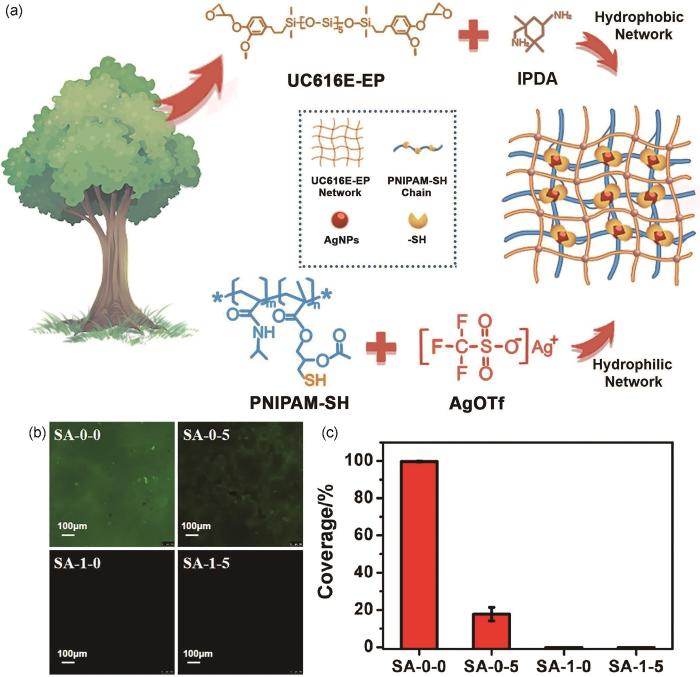
... 近年来,两亲性海洋防护涂层的研发取得了重要突破.Lu等[115]通过原位构建疏水-亲水交错聚合物网络,成功制备了生物基两亲性水凝胶涂层(图6a).该体系以含硅环氧树脂为疏水基质,赋予涂层优异的机械性能(5B级附着力)和防腐性能,同时通过交联引入水凝胶链段与Ag纳米颗粒(Ag NPs)实现卓越的防污效果(图6b和c).实验证实该涂层对蛋白质、细菌和藻类均表现出显著抑制效果,并在东海实地测试中展现出优异的长期稳定性.Zhao等[116]开发出基于PEG/薄荷脑改性的聚二甲基硅氧烷(PDMS)两亲性涂层,XPS和接触角测试表明其表面组分可自发调控以适应海洋环境.得益于薄荷脑的双环单萜结构和两亲性链段的协同效应,该涂层实现了对大肠杆菌(抑制率86.72%)和绿藻(抑制率87.76%)的高效防护,同时保持了环境友好特性.嵌段共聚物方面,Leonardi等[117]通过在聚苯乙烯嵌段聚二甲基硅氧烷(PS-b-PDMS)链段上接枝2,2,6,6-四甲基脂质-1-氧基(TEMPO)和PEG,首次证实了两亲性表面对宏观生物污损(如藤壶)的抑制效果.这一突破为开发抗宏观生物附着涂层提供了新思路.Chen等[118]采用溶胶-凝胶法将超支化多硅氧烷(HPSi)与硅烷封端两亲性长链(S-FP)复合,所制备的涂层兼具快速固化(HPSi缩短干燥时间)、优异力学性能和长效防护特性. ...
... [
115]
Schematic illustration of the preparation process for amphiphilic hydrogel coating (a), Fluorescent images of BSA on the coating observed using confocal microscopy (b) and coverage analysis (c)<sup>[<xref ref-type="bibr" rid="R115">115</xref>]</sup>Fig.6![]()
特别注意的是,两亲性涂层材料因其独特的分子结构设计而展现出特殊的抗溶胀性能.这类材料通过亲水链段和疏水链段的微观相分离,能够在一定程度上阻隔水分子的渗透扩散.然而,与超疏水涂层相比,两亲性涂层在阻水效率和长期稳定性方面仍存在明显不足:一方面,亲水链段的存在使得涂层对水分子仍保持一定的亲和性;另一方面,在水下环境中,涂层的力学性能往往难以长期维持.这些局限性严重制约了两亲性涂层的实际应用效果.为突破这一技术瓶颈,研究人员从分子设计和结构调控两个维度开展了工作.其中,Zhao等[119]开发了一种基于聚柠檬酸-聚乙二醇-多巴胺(PCA-PEG-DA)共聚物和氨基封端Pluronic F127 (APF)胶束的复合水凝胶体系.该材料通过邻苯二酚-氨基共价交联网络构建刚性骨架,同时利用疏水性APF胶束形成分子级阻水屏障,实现了溶胀率较传统水凝胶降低60%以上的突破性进展.实验数据表明,该材料在长期浸水条件下仍能保持90%以上的机械性能,展现出卓越的环境稳定性.在结构创新方面,Lan等[120]通过仿生设计理念开发了具有分形微通道的自泵送有机水凝胶.研究人员采用乳液界面聚合技术,精确调控有机凝胶前体液滴的动态行为,在亲水性基质中构建了三维连通的疏水微通道网络.这种独特结构不仅将液体引流效率提升至传统水凝胶的30倍,更重要的是通过建立物理阻隔机制,将材料吸水率控制在极低水平.该设计巧妙地平衡了材料的亲水性和疏水性,既保证了良好的生物相容性,又显著提升了水下稳定性. ...
... [
115]
Fig.6![]()
特别注意的是,两亲性涂层材料因其独特的分子结构设计而展现出特殊的抗溶胀性能.这类材料通过亲水链段和疏水链段的微观相分离,能够在一定程度上阻隔水分子的渗透扩散.然而,与超疏水涂层相比,两亲性涂层在阻水效率和长期稳定性方面仍存在明显不足:一方面,亲水链段的存在使得涂层对水分子仍保持一定的亲和性;另一方面,在水下环境中,涂层的力学性能往往难以长期维持.这些局限性严重制约了两亲性涂层的实际应用效果.为突破这一技术瓶颈,研究人员从分子设计和结构调控两个维度开展了工作.其中,Zhao等[119]开发了一种基于聚柠檬酸-聚乙二醇-多巴胺(PCA-PEG-DA)共聚物和氨基封端Pluronic F127 (APF)胶束的复合水凝胶体系.该材料通过邻苯二酚-氨基共价交联网络构建刚性骨架,同时利用疏水性APF胶束形成分子级阻水屏障,实现了溶胀率较传统水凝胶降低60%以上的突破性进展.实验数据表明,该材料在长期浸水条件下仍能保持90%以上的机械性能,展现出卓越的环境稳定性.在结构创新方面,Lan等[120]通过仿生设计理念开发了具有分形微通道的自泵送有机水凝胶.研究人员采用乳液界面聚合技术,精确调控有机凝胶前体液滴的动态行为,在亲水性基质中构建了三维连通的疏水微通道网络.这种独特结构不仅将液体引流效率提升至传统水凝胶的30倍,更重要的是通过建立物理阻隔机制,将材料吸水率控制在极低水平.该设计巧妙地平衡了材料的亲水性和疏水性,既保证了良好的生物相容性,又显著提升了水下稳定性. ...
Dynamic migration mechanism of borneol synergistic polyethylene glycol for the construction of silicon-acrylate antifouling coating
1
2024
... 近年来,两亲性海洋防护涂层的研发取得了重要突破.Lu等[115]通过原位构建疏水-亲水交错聚合物网络,成功制备了生物基两亲性水凝胶涂层(图6a).该体系以含硅环氧树脂为疏水基质,赋予涂层优异的机械性能(5B级附着力)和防腐性能,同时通过交联引入水凝胶链段与Ag纳米颗粒(Ag NPs)实现卓越的防污效果(图6b和c).实验证实该涂层对蛋白质、细菌和藻类均表现出显著抑制效果,并在东海实地测试中展现出优异的长期稳定性.Zhao等[116]开发出基于PEG/薄荷脑改性的聚二甲基硅氧烷(PDMS)两亲性涂层,XPS和接触角测试表明其表面组分可自发调控以适应海洋环境.得益于薄荷脑的双环单萜结构和两亲性链段的协同效应,该涂层实现了对大肠杆菌(抑制率86.72%)和绿藻(抑制率87.76%)的高效防护,同时保持了环境友好特性.嵌段共聚物方面,Leonardi等[117]通过在聚苯乙烯嵌段聚二甲基硅氧烷(PS-b-PDMS)链段上接枝2,2,6,6-四甲基脂质-1-氧基(TEMPO)和PEG,首次证实了两亲性表面对宏观生物污损(如藤壶)的抑制效果.这一突破为开发抗宏观生物附着涂层提供了新思路.Chen等[118]采用溶胶-凝胶法将超支化多硅氧烷(HPSi)与硅烷封端两亲性长链(S-FP)复合,所制备的涂层兼具快速固化(HPSi缩短干燥时间)、优异力学性能和长效防护特性. ...
Amphiphilic nitroxide-bearing siloxane-based block copolymer coatings for enhanced marine fouling release
1
2021
... 近年来,两亲性海洋防护涂层的研发取得了重要突破.Lu等[115]通过原位构建疏水-亲水交错聚合物网络,成功制备了生物基两亲性水凝胶涂层(图6a).该体系以含硅环氧树脂为疏水基质,赋予涂层优异的机械性能(5B级附着力)和防腐性能,同时通过交联引入水凝胶链段与Ag纳米颗粒(Ag NPs)实现卓越的防污效果(图6b和c).实验证实该涂层对蛋白质、细菌和藻类均表现出显著抑制效果,并在东海实地测试中展现出优异的长期稳定性.Zhao等[116]开发出基于PEG/薄荷脑改性的聚二甲基硅氧烷(PDMS)两亲性涂层,XPS和接触角测试表明其表面组分可自发调控以适应海洋环境.得益于薄荷脑的双环单萜结构和两亲性链段的协同效应,该涂层实现了对大肠杆菌(抑制率86.72%)和绿藻(抑制率87.76%)的高效防护,同时保持了环境友好特性.嵌段共聚物方面,Leonardi等[117]通过在聚苯乙烯嵌段聚二甲基硅氧烷(PS-b-PDMS)链段上接枝2,2,6,6-四甲基脂质-1-氧基(TEMPO)和PEG,首次证实了两亲性表面对宏观生物污损(如藤壶)的抑制效果.这一突破为开发抗宏观生物附着涂层提供了新思路.Chen等[118]采用溶胶-凝胶法将超支化多硅氧烷(HPSi)与硅烷封端两亲性长链(S-FP)复合,所制备的涂层兼具快速固化(HPSi缩短干燥时间)、优异力学性能和长效防护特性. ...
Rapid curing and self-stratifying lacquer coating with antifouling and anticorrosive properties
1
2021
... 近年来,两亲性海洋防护涂层的研发取得了重要突破.Lu等[115]通过原位构建疏水-亲水交错聚合物网络,成功制备了生物基两亲性水凝胶涂层(图6a).该体系以含硅环氧树脂为疏水基质,赋予涂层优异的机械性能(5B级附着力)和防腐性能,同时通过交联引入水凝胶链段与Ag纳米颗粒(Ag NPs)实现卓越的防污效果(图6b和c).实验证实该涂层对蛋白质、细菌和藻类均表现出显著抑制效果,并在东海实地测试中展现出优异的长期稳定性.Zhao等[116]开发出基于PEG/薄荷脑改性的聚二甲基硅氧烷(PDMS)两亲性涂层,XPS和接触角测试表明其表面组分可自发调控以适应海洋环境.得益于薄荷脑的双环单萜结构和两亲性链段的协同效应,该涂层实现了对大肠杆菌(抑制率86.72%)和绿藻(抑制率87.76%)的高效防护,同时保持了环境友好特性.嵌段共聚物方面,Leonardi等[117]通过在聚苯乙烯嵌段聚二甲基硅氧烷(PS-b-PDMS)链段上接枝2,2,6,6-四甲基脂质-1-氧基(TEMPO)和PEG,首次证实了两亲性表面对宏观生物污损(如藤壶)的抑制效果.这一突破为开发抗宏观生物附着涂层提供了新思路.Chen等[118]采用溶胶-凝胶法将超支化多硅氧烷(HPSi)与硅烷封端两亲性长链(S-FP)复合,所制备的涂层兼具快速固化(HPSi缩短干燥时间)、优异力学性能和长效防护特性. ...
Injectable antiswelling and high-strength bioactive hydrogels with a wet adhesion and rapid gelling process to promote sutureless wound closure and scar-free repair of infectious wounds
1
2023
... 特别注意的是,两亲性涂层材料因其独特的分子结构设计而展现出特殊的抗溶胀性能.这类材料通过亲水链段和疏水链段的微观相分离,能够在一定程度上阻隔水分子的渗透扩散.然而,与超疏水涂层相比,两亲性涂层在阻水效率和长期稳定性方面仍存在明显不足:一方面,亲水链段的存在使得涂层对水分子仍保持一定的亲和性;另一方面,在水下环境中,涂层的力学性能往往难以长期维持.这些局限性严重制约了两亲性涂层的实际应用效果.为突破这一技术瓶颈,研究人员从分子设计和结构调控两个维度开展了工作.其中,Zhao等[119]开发了一种基于聚柠檬酸-聚乙二醇-多巴胺(PCA-PEG-DA)共聚物和氨基封端Pluronic F127 (APF)胶束的复合水凝胶体系.该材料通过邻苯二酚-氨基共价交联网络构建刚性骨架,同时利用疏水性APF胶束形成分子级阻水屏障,实现了溶胀率较传统水凝胶降低60%以上的突破性进展.实验数据表明,该材料在长期浸水条件下仍能保持90%以上的机械性能,展现出卓越的环境稳定性.在结构创新方面,Lan等[120]通过仿生设计理念开发了具有分形微通道的自泵送有机水凝胶.研究人员采用乳液界面聚合技术,精确调控有机凝胶前体液滴的动态行为,在亲水性基质中构建了三维连通的疏水微通道网络.这种独特结构不仅将液体引流效率提升至传统水凝胶的30倍,更重要的是通过建立物理阻隔机制,将材料吸水率控制在极低水平.该设计巧妙地平衡了材料的亲水性和疏水性,既保证了良好的生物相容性,又显著提升了水下稳定性. ...
A rapid self-pumping organohydrogel dressing with hydrophilic fractal microchannels to promote burn wound healing
1
2023
... 特别注意的是,两亲性涂层材料因其独特的分子结构设计而展现出特殊的抗溶胀性能.这类材料通过亲水链段和疏水链段的微观相分离,能够在一定程度上阻隔水分子的渗透扩散.然而,与超疏水涂层相比,两亲性涂层在阻水效率和长期稳定性方面仍存在明显不足:一方面,亲水链段的存在使得涂层对水分子仍保持一定的亲和性;另一方面,在水下环境中,涂层的力学性能往往难以长期维持.这些局限性严重制约了两亲性涂层的实际应用效果.为突破这一技术瓶颈,研究人员从分子设计和结构调控两个维度开展了工作.其中,Zhao等[119]开发了一种基于聚柠檬酸-聚乙二醇-多巴胺(PCA-PEG-DA)共聚物和氨基封端Pluronic F127 (APF)胶束的复合水凝胶体系.该材料通过邻苯二酚-氨基共价交联网络构建刚性骨架,同时利用疏水性APF胶束形成分子级阻水屏障,实现了溶胀率较传统水凝胶降低60%以上的突破性进展.实验数据表明,该材料在长期浸水条件下仍能保持90%以上的机械性能,展现出卓越的环境稳定性.在结构创新方面,Lan等[120]通过仿生设计理念开发了具有分形微通道的自泵送有机水凝胶.研究人员采用乳液界面聚合技术,精确调控有机凝胶前体液滴的动态行为,在亲水性基质中构建了三维连通的疏水微通道网络.这种独特结构不仅将液体引流效率提升至传统水凝胶的30倍,更重要的是通过建立物理阻隔机制,将材料吸水率控制在极低水平.该设计巧妙地平衡了材料的亲水性和疏水性,既保证了良好的生物相容性,又显著提升了水下稳定性. ...
Recent advances in slippery liquid-infused surfaces with unique properties inspired by nature
1
2021
... 受猪笼草特殊结构启发而开发的SLIPS展现出卓越的抗污染性能.作为热带食虫植物的典型代表,猪笼草通过其唇缘表面分泌的天然润滑剂填充微孔结构,形成光滑的捕食界面,使昆虫滑入后被消化酶分解[121].研究人员基于这一仿生原理成功开发了多种人工SLIPS系统.这类特殊超浸润表面凭借其均匀光滑的特性,不仅能有效抑制微生物附着及其生物膜形成所需的化学信号传导,还能显著减少污垢、尘土和油类等非生物污染物的黏附,成为实现广谱抗污染的有效策略[122,123].更值得注意的是,灌注的润滑剂不仅赋予表面优异的滑动性能,还在基材表面形成致密保护层,有效阻隔腐蚀介质的渗透,从而显著提升涂层的防腐性能[124,125].这种仿生设计理念为开发新型智能海洋防护涂层提供了重要参考. ...
Recent trends in fabrication of nepenthes inspired SLIPs: Design strategies for self-healing efficient anti-icing surfaces
1
2020
... 受猪笼草特殊结构启发而开发的SLIPS展现出卓越的抗污染性能.作为热带食虫植物的典型代表,猪笼草通过其唇缘表面分泌的天然润滑剂填充微孔结构,形成光滑的捕食界面,使昆虫滑入后被消化酶分解[121].研究人员基于这一仿生原理成功开发了多种人工SLIPS系统.这类特殊超浸润表面凭借其均匀光滑的特性,不仅能有效抑制微生物附着及其生物膜形成所需的化学信号传导,还能显著减少污垢、尘土和油类等非生物污染物的黏附,成为实现广谱抗污染的有效策略[122,123].更值得注意的是,灌注的润滑剂不仅赋予表面优异的滑动性能,还在基材表面形成致密保护层,有效阻隔腐蚀介质的渗透,从而显著提升涂层的防腐性能[124,125].这种仿生设计理念为开发新型智能海洋防护涂层提供了重要参考. ...
Slippery coating without loss of lubricant
1
2022
... 受猪笼草特殊结构启发而开发的SLIPS展现出卓越的抗污染性能.作为热带食虫植物的典型代表,猪笼草通过其唇缘表面分泌的天然润滑剂填充微孔结构,形成光滑的捕食界面,使昆虫滑入后被消化酶分解[121].研究人员基于这一仿生原理成功开发了多种人工SLIPS系统.这类特殊超浸润表面凭借其均匀光滑的特性,不仅能有效抑制微生物附着及其生物膜形成所需的化学信号传导,还能显著减少污垢、尘土和油类等非生物污染物的黏附,成为实现广谱抗污染的有效策略[122,123].更值得注意的是,灌注的润滑剂不仅赋予表面优异的滑动性能,还在基材表面形成致密保护层,有效阻隔腐蚀介质的渗透,从而显著提升涂层的防腐性能[124,125].这种仿生设计理念为开发新型智能海洋防护涂层提供了重要参考. ...
Preparation and properties of slippery anti-corrosion coating based on SiO2 with coral cluster morphology
1
2023
... 受猪笼草特殊结构启发而开发的SLIPS展现出卓越的抗污染性能.作为热带食虫植物的典型代表,猪笼草通过其唇缘表面分泌的天然润滑剂填充微孔结构,形成光滑的捕食界面,使昆虫滑入后被消化酶分解[121].研究人员基于这一仿生原理成功开发了多种人工SLIPS系统.这类特殊超浸润表面凭借其均匀光滑的特性,不仅能有效抑制微生物附着及其生物膜形成所需的化学信号传导,还能显著减少污垢、尘土和油类等非生物污染物的黏附,成为实现广谱抗污染的有效策略[122,123].更值得注意的是,灌注的润滑剂不仅赋予表面优异的滑动性能,还在基材表面形成致密保护层,有效阻隔腐蚀介质的渗透,从而显著提升涂层的防腐性能[124,125].这种仿生设计理念为开发新型智能海洋防护涂层提供了重要参考. ...
珊瑚簇状SiO2超滑防腐涂层的制备及性能研究
1
2023
... 受猪笼草特殊结构启发而开发的SLIPS展现出卓越的抗污染性能.作为热带食虫植物的典型代表,猪笼草通过其唇缘表面分泌的天然润滑剂填充微孔结构,形成光滑的捕食界面,使昆虫滑入后被消化酶分解[121].研究人员基于这一仿生原理成功开发了多种人工SLIPS系统.这类特殊超浸润表面凭借其均匀光滑的特性,不仅能有效抑制微生物附着及其生物膜形成所需的化学信号传导,还能显著减少污垢、尘土和油类等非生物污染物的黏附,成为实现广谱抗污染的有效策略[122,123].更值得注意的是,灌注的润滑剂不仅赋予表面优异的滑动性能,还在基材表面形成致密保护层,有效阻隔腐蚀介质的渗透,从而显著提升涂层的防腐性能[124,125].这种仿生设计理念为开发新型智能海洋防护涂层提供了重要参考. ...
Durable lubricant-infused coating on a magnesium alloy substrate with anti-biofouling and anti-corrosion properties and excellent thermally assisted healing ability
1
2020
... 受猪笼草特殊结构启发而开发的SLIPS展现出卓越的抗污染性能.作为热带食虫植物的典型代表,猪笼草通过其唇缘表面分泌的天然润滑剂填充微孔结构,形成光滑的捕食界面,使昆虫滑入后被消化酶分解[121].研究人员基于这一仿生原理成功开发了多种人工SLIPS系统.这类特殊超浸润表面凭借其均匀光滑的特性,不仅能有效抑制微生物附着及其生物膜形成所需的化学信号传导,还能显著减少污垢、尘土和油类等非生物污染物的黏附,成为实现广谱抗污染的有效策略[122,123].更值得注意的是,灌注的润滑剂不仅赋予表面优异的滑动性能,还在基材表面形成致密保护层,有效阻隔腐蚀介质的渗透,从而显著提升涂层的防腐性能[124,125].这种仿生设计理念为开发新型智能海洋防护涂层提供了重要参考. ...
Construction of robust slippery lubricant-infused epoxy-nanocomposite coatings for marine antifouling application
1
2023
... SLIPS技术在海洋防污领域展现出独特优势.Yang等[126]通过空气喷涂技术构建了以环氧树脂/羟基终端PDMS为基体、TiO2纳米颗粒为填料、硅油为润滑剂的SLIPS涂层.研究表明,500 mPa·s粘度的硅油在12 h后仍保持6.9°的Δθ,显著抑制了草履虫三角藻(90.8%)和芽孢杆菌(93.6%)的附着.Liang等[127]通过优化交联度和硅烷偶联剂用量,开发出稳定性显著提升的超滑有机凝胶,30 d后润滑剂流失量极少,其电化学阻抗(1.53 × 10¹¹ Ω·cm2)较裸钢(6.28 × 10⁴ Ω·cm2)提高7个数量级.Chen等[128]受皱皮蛙皮启发,利用聚苯乙烯嵌段聚乳酸(PS-b-PLA)的自组装和水解皱褶行为,制备出具有分级微孔结构的SLIPS,在3个月后θ仍保持122°,对多种藻类的抑制率超过90%,且可见光透光率达99%.然而,单纯依靠物理防污机制难以完全避免生物膜的形成.为此,Zhou等[129]仿照蓝环章鱼的防御机制,将辣椒素与超滑液体共接枝,开发出具有pH响应性杀菌功能的自修复SLIPS (图7).基于物理化学协同防污机制,该涂层不仅对蛋白、细菌、藻类具备良好的抗黏附效果,在经过为期65d的实海挂板试验后表面依旧保持干净整洁,具备优异的海洋防污应用前景.Tong等[130]基于毒鲉的毒液防御机制开发了一种具有智能响应特性的香豆素基SLIPS.该涂层通过香豆素分子的光致可逆二聚反应,实现了润滑剂与基体材料间的动态“锁定-解锁”调控机制,赋予润滑剂优异的稳定性与智能调节特性.此外,通过物理阻隔与化学杀菌的双重防污机制,展现出卓越的综合性能,包括高达92.85%的自修复效率、优异的抗蛋白质/细菌/藻类附着能力,以及在近海严苛环境中的长达150 d的长效防污性能,在海洋工程装备防护方面具有重要的应用价值. ...
Designing a highly stable slippery organogel on Q235 carbon steel for inhibiting microbiologically influenced corrosion
1
2021
... SLIPS技术在海洋防污领域展现出独特优势.Yang等[126]通过空气喷涂技术构建了以环氧树脂/羟基终端PDMS为基体、TiO2纳米颗粒为填料、硅油为润滑剂的SLIPS涂层.研究表明,500 mPa·s粘度的硅油在12 h后仍保持6.9°的Δθ,显著抑制了草履虫三角藻(90.8%)和芽孢杆菌(93.6%)的附着.Liang等[127]通过优化交联度和硅烷偶联剂用量,开发出稳定性显著提升的超滑有机凝胶,30 d后润滑剂流失量极少,其电化学阻抗(1.53 × 10¹¹ Ω·cm2)较裸钢(6.28 × 10⁴ Ω·cm2)提高7个数量级.Chen等[128]受皱皮蛙皮启发,利用聚苯乙烯嵌段聚乳酸(PS-b-PLA)的自组装和水解皱褶行为,制备出具有分级微孔结构的SLIPS,在3个月后θ仍保持122°,对多种藻类的抑制率超过90%,且可见光透光率达99%.然而,单纯依靠物理防污机制难以完全避免生物膜的形成.为此,Zhou等[129]仿照蓝环章鱼的防御机制,将辣椒素与超滑液体共接枝,开发出具有pH响应性杀菌功能的自修复SLIPS (图7).基于物理化学协同防污机制,该涂层不仅对蛋白、细菌、藻类具备良好的抗黏附效果,在经过为期65d的实海挂板试验后表面依旧保持干净整洁,具备优异的海洋防污应用前景.Tong等[130]基于毒鲉的毒液防御机制开发了一种具有智能响应特性的香豆素基SLIPS.该涂层通过香豆素分子的光致可逆二聚反应,实现了润滑剂与基体材料间的动态“锁定-解锁”调控机制,赋予润滑剂优异的稳定性与智能调节特性.此外,通过物理阻隔与化学杀菌的双重防污机制,展现出卓越的综合性能,包括高达92.85%的自修复效率、优异的抗蛋白质/细菌/藻类附着能力,以及在近海严苛环境中的长达150 d的长效防污性能,在海洋工程装备防护方面具有重要的应用价值. ...
Fabrication of stable liquid-like wetting buckled surfaces as bioinspired antibiofouling coatings by using silicon-containing block copolymers
1
2024
... SLIPS技术在海洋防污领域展现出独特优势.Yang等[126]通过空气喷涂技术构建了以环氧树脂/羟基终端PDMS为基体、TiO2纳米颗粒为填料、硅油为润滑剂的SLIPS涂层.研究表明,500 mPa·s粘度的硅油在12 h后仍保持6.9°的Δθ,显著抑制了草履虫三角藻(90.8%)和芽孢杆菌(93.6%)的附着.Liang等[127]通过优化交联度和硅烷偶联剂用量,开发出稳定性显著提升的超滑有机凝胶,30 d后润滑剂流失量极少,其电化学阻抗(1.53 × 10¹¹ Ω·cm2)较裸钢(6.28 × 10⁴ Ω·cm2)提高7个数量级.Chen等[128]受皱皮蛙皮启发,利用聚苯乙烯嵌段聚乳酸(PS-b-PLA)的自组装和水解皱褶行为,制备出具有分级微孔结构的SLIPS,在3个月后θ仍保持122°,对多种藻类的抑制率超过90%,且可见光透光率达99%.然而,单纯依靠物理防污机制难以完全避免生物膜的形成.为此,Zhou等[129]仿照蓝环章鱼的防御机制,将辣椒素与超滑液体共接枝,开发出具有pH响应性杀菌功能的自修复SLIPS (图7).基于物理化学协同防污机制,该涂层不仅对蛋白、细菌、藻类具备良好的抗黏附效果,在经过为期65d的实海挂板试验后表面依旧保持干净整洁,具备优异的海洋防污应用前景.Tong等[130]基于毒鲉的毒液防御机制开发了一种具有智能响应特性的香豆素基SLIPS.该涂层通过香豆素分子的光致可逆二聚反应,实现了润滑剂与基体材料间的动态“锁定-解锁”调控机制,赋予润滑剂优异的稳定性与智能调节特性.此外,通过物理阻隔与化学杀菌的双重防污机制,展现出卓越的综合性能,包括高达92.85%的自修复效率、优异的抗蛋白质/细菌/藻类附着能力,以及在近海严苛环境中的长达150 d的长效防污性能,在海洋工程装备防护方面具有重要的应用价值. ...
Blue-ringed Octopus inspired slippery coating with physico-chemical synergistic antifouling properties
3
2023
... SLIPS技术在海洋防污领域展现出独特优势.Yang等[126]通过空气喷涂技术构建了以环氧树脂/羟基终端PDMS为基体、TiO2纳米颗粒为填料、硅油为润滑剂的SLIPS涂层.研究表明,500 mPa·s粘度的硅油在12 h后仍保持6.9°的Δθ,显著抑制了草履虫三角藻(90.8%)和芽孢杆菌(93.6%)的附着.Liang等[127]通过优化交联度和硅烷偶联剂用量,开发出稳定性显著提升的超滑有机凝胶,30 d后润滑剂流失量极少,其电化学阻抗(1.53 × 10¹¹ Ω·cm2)较裸钢(6.28 × 10⁴ Ω·cm2)提高7个数量级.Chen等[128]受皱皮蛙皮启发,利用聚苯乙烯嵌段聚乳酸(PS-b-PLA)的自组装和水解皱褶行为,制备出具有分级微孔结构的SLIPS,在3个月后θ仍保持122°,对多种藻类的抑制率超过90%,且可见光透光率达99%.然而,单纯依靠物理防污机制难以完全避免生物膜的形成.为此,Zhou等[129]仿照蓝环章鱼的防御机制,将辣椒素与超滑液体共接枝,开发出具有pH响应性杀菌功能的自修复SLIPS (图7).基于物理化学协同防污机制,该涂层不仅对蛋白、细菌、藻类具备良好的抗黏附效果,在经过为期65d的实海挂板试验后表面依旧保持干净整洁,具备优异的海洋防污应用前景.Tong等[130]基于毒鲉的毒液防御机制开发了一种具有智能响应特性的香豆素基SLIPS.该涂层通过香豆素分子的光致可逆二聚反应,实现了润滑剂与基体材料间的动态“锁定-解锁”调控机制,赋予润滑剂优异的稳定性与智能调节特性.此外,通过物理阻隔与化学杀菌的双重防污机制,展现出卓越的综合性能,包括高达92.85%的自修复效率、优异的抗蛋白质/细菌/藻类附着能力,以及在近海严苛环境中的长达150 d的长效防污性能,在海洋工程装备防护方面具有重要的应用价值. ...
... [
129]
Schematic illustration of components the composition and antifouling modes and application of the developed coating in marine fields inspired by the blue-ringed Octopus' action modes<sup>[<xref ref-type="bibr" rid="R129">129</xref>]</sup>Fig.7![]()
SLIPS技术的性能主要受表面化学组成、微观结构和润滑剂特性的共同影响.通过物理-化学协同智能化作用机制可显著提升其长期的防护性能,为海洋防污领域提供了一种具有环境适应性的智能防污解决方案.在未来的研究中,应重点突破涂层的结构优化设计、智能防污机制及工程化制备工艺等关键技术,以全面提升其长期稳定性、环境自适应性和工程适用性,最终实现该技术在复杂海洋环境中的规模化应用. ...
... [
129]
Fig.7![]()
SLIPS技术的性能主要受表面化学组成、微观结构和润滑剂特性的共同影响.通过物理-化学协同智能化作用机制可显著提升其长期的防护性能,为海洋防污领域提供了一种具有环境适应性的智能防污解决方案.在未来的研究中,应重点突破涂层的结构优化设计、智能防污机制及工程化制备工艺等关键技术,以全面提升其长期稳定性、环境自适应性和工程适用性,最终实现该技术在复杂海洋环境中的规模化应用. ...
P. pavoninus-inspired smart slips marine antifouling coating based on coumarin: Antifouling durability and adaptive adjustability of lubrication
1
2024
... SLIPS技术在海洋防污领域展现出独特优势.Yang等[126]通过空气喷涂技术构建了以环氧树脂/羟基终端PDMS为基体、TiO2纳米颗粒为填料、硅油为润滑剂的SLIPS涂层.研究表明,500 mPa·s粘度的硅油在12 h后仍保持6.9°的Δθ,显著抑制了草履虫三角藻(90.8%)和芽孢杆菌(93.6%)的附着.Liang等[127]通过优化交联度和硅烷偶联剂用量,开发出稳定性显著提升的超滑有机凝胶,30 d后润滑剂流失量极少,其电化学阻抗(1.53 × 10¹¹ Ω·cm2)较裸钢(6.28 × 10⁴ Ω·cm2)提高7个数量级.Chen等[128]受皱皮蛙皮启发,利用聚苯乙烯嵌段聚乳酸(PS-b-PLA)的自组装和水解皱褶行为,制备出具有分级微孔结构的SLIPS,在3个月后θ仍保持122°,对多种藻类的抑制率超过90%,且可见光透光率达99%.然而,单纯依靠物理防污机制难以完全避免生物膜的形成.为此,Zhou等[129]仿照蓝环章鱼的防御机制,将辣椒素与超滑液体共接枝,开发出具有pH响应性杀菌功能的自修复SLIPS (图7).基于物理化学协同防污机制,该涂层不仅对蛋白、细菌、藻类具备良好的抗黏附效果,在经过为期65d的实海挂板试验后表面依旧保持干净整洁,具备优异的海洋防污应用前景.Tong等[130]基于毒鲉的毒液防御机制开发了一种具有智能响应特性的香豆素基SLIPS.该涂层通过香豆素分子的光致可逆二聚反应,实现了润滑剂与基体材料间的动态“锁定-解锁”调控机制,赋予润滑剂优异的稳定性与智能调节特性.此外,通过物理阻隔与化学杀菌的双重防污机制,展现出卓越的综合性能,包括高达92.85%的自修复效率、优异的抗蛋白质/细菌/藻类附着能力,以及在近海严苛环境中的长达150 d的长效防污性能,在海洋工程装备防护方面具有重要的应用价值. ...