



当酸性溶液用于清洗受腐蚀的金属部件时,需要使用缓蚀剂来减少清洗过程中的金属材料损失[1]。一些缓蚀剂是由无机盐组成的,其中可能含有砷和铬酸盐,还有一些是芳香族有机化合物,这些物质往往都是对环境和人类健康有害的[2]。而含有特定有机分子的植物提取物一般都是环保物质,如果用作缓蚀剂有望成为传统缓蚀剂的替代品。有机分子缓蚀作用的发挥与它们在金属表面的吸附有关。这些分子含有N、O、S、P等杂原子和C=C双键,可与金属材料铁原子的空轨道相互作用[3~7]。植物提取物通常是混合腐蚀抑制剂,可降低极化试验中的阳极电流和阴极电流[8]。天然提取物作为环保型缓蚀剂具有显著的效果,其配方简单实用,在酸性介质中具有良好的应用前景[9]。随着对这类缓蚀剂研究的深入,自然产生的化学物质,如儿茶素[5]、咖啡酸[10]、没食子酸和单宁酸[11]等,都已被评价为碳钢的缓蚀剂。而有机分子如黄酮类[12]、酚酸[11]和生物碱[2]也逐渐成为缓蚀剂研究领域的目标物质。天然提取物是可生物降解的,不会构成健康风险,是回收农业生产废料的一个极具吸引力的解决方案。例如,甜瓜种子和果皮[13]、番茄皮[14]和葡萄籽[15]已被认定为酸腐蚀抑制剂。从植物的不同部位,包括叶和根得到植物提取物,作为缓蚀剂,都是一种经济的、环境友好的策略。近年来,植物源高效缓蚀剂在酸性介质 (HCl和H2SO4) 中的应用已有报道[16~19]。几种果实皮提取物在酸性环境中用作缓蚀剂,都有较好的缓蚀性能[13,14,20~24]。
据研究,橙子皮提取物在酸性介质中对Al具有缓蚀作用,橙皮苷是橙子皮提取物中的主要化学成分,可能与观察到的缓蚀现象有关[25]。橙子皮的提取物使其成为一种有吸引力的绿色缓蚀剂。本研究通过用无水乙醇和丙酮溶液对脐橙皮提取得到其提取物 (NOPE)。
本工作通过Fourier变换红外光谱分析 (FTIR) 和紫外可见光谱分析 (UV) 测试了NOPE的主要成分和在酸性介质中NOPE结构的稳定性。研究了NOPE在0.5 mol/L HCL溶液中对316L不锈钢的缓蚀效率,采用失重法、电位动态极化 (PDP)、线性极化 (LP) 和电化学阻抗谱 (EIS) 技术进行了测量。通过分析热力学参数和Langmuir等温线对NOPE的吸附行为进行了评价。用扫描电镜 (SEM) 和光谱分析 (EDS) 分析了不含有和含有NOPE的酸介质中钢表面被侵蚀后的状况及表面膜的主要原子成分的变化。
1 实验方法
实验溶液0.5 mol/LHCl (37%);脐橙皮自然晾干研磨成粉末,粉末、无水乙醇和丙酮按1:10:10的比例浸泡于60 ℃水浴中2 h,过滤后将滤液浓缩,放入鼓风干燥箱烘干备用;采用72.4 mm×11.5 mm×2.0 mm的316L不锈钢板,表面积 (20 cm2);实验中NOPE的浓度分别为: 0.03, 0.05, 0.1, 0.2, 0.3和0.5 g/L。
根据文献[25]进行失重法的测试及腐蚀速率和缓蚀率的计算。腐蚀速率和缓蚀率的计算公式如下:
腐蚀速率的计算公式:
式中,Δm为腐蚀失重 (g),S为样品面积 (cm2),t为316L钢浸泡的时间 (h),V为腐蚀速率g·cm-2·h-1。
缓蚀效率的计算公式:
式中,V0和V1无和有NOPE的腐蚀速率。
根据文献[2]进行电化学测试。电化学测试用三电极体系在0.5 mol/L HCl溶液中进行。以圆柱形316L不锈钢为工作电极 (直径为2 mm),其余用聚四氟乙烯灌封;铂电极作为对电极、汞硫酸亚汞电极作为参比电极。在实验之前,工作电极用80 ~ 1200号砂纸打磨,然后浸在超声浴中,用去离子水和丙酮 (试剂级) 清洗。
电化学测试使用Zennium Pro恒电位器进行,数据的获取和分析使用Zahner Analysis软件获取。每次测量前,工作电极在测试溶液中浸泡30 min,以获得稳定的开路电位 (Eocp)。动电位极化曲线 (PDP) 在30 ℃、电压范围±100 mV,扫描速率0.1 mV/s条件下进行。阻抗EIS施加交流电压10 mV,频率范围为105~10-2 Hz。在扫描速率为0.1 mV/s,线性扫描区间为±10 mV下测试线性极化曲线。所有电化学测试都是相对于开路电位进行的。使用Zahner Analysis对极化曲线和阻抗图谱数据进行拟合。
利用VERTEX7O红外光谱仪 (FTIR) 和UV-2550紫外光谱仪 (UV) 进行NOPE结构的表征。利用SIGMA300场发射扫描电镜 (SEM) 及自带的能谱分析 (EDS) 对腐蚀前和在有无NOPE 0.5 mol/L HCl介质中浸泡25 h试片表面形貌及其表面膜成分进行表征。
2 结果与讨论
2.1 NOPE的 FTIR和 UV 图谱的结构分析
NOPE的FTIR谱图如图1a所示。NOPE主要化学成分为橙皮苷 (二氢黄酮苷)[25],由于受苷和苷元羟基影响,羰基 (C=O) 的伸缩振动波数降低至 1647.43 cm-1处 (未受影响应时1800~1700 cm-1);3369.63 cm-1处出现强吸收峰是因为大量的羟基的O-H键伸缩振动;2934.47 cm-1处的中等吸收峰可能是醛基中的C-H键伸缩振动;1518.74和1401.31 cm-1为双键或苯环的C=C的振动;1066.44 cm-1有中强吸收峰,判断为醚类C-O-C伸缩振动或脂环醚的对称反对称振动引起的;919.95-632.23 cm-1为烯烃、芳烃和醛基的C-H的面外弯曲振动。FTIR结果表明橙子皮提取物中含有大量羟基,羰基等不饱和有机化合物的极性基团,而含有这些官能团的有机化合物一般是可用作金属酸洗缓蚀剂[25],因此NOPE具有一定的缓蚀作用。
图1
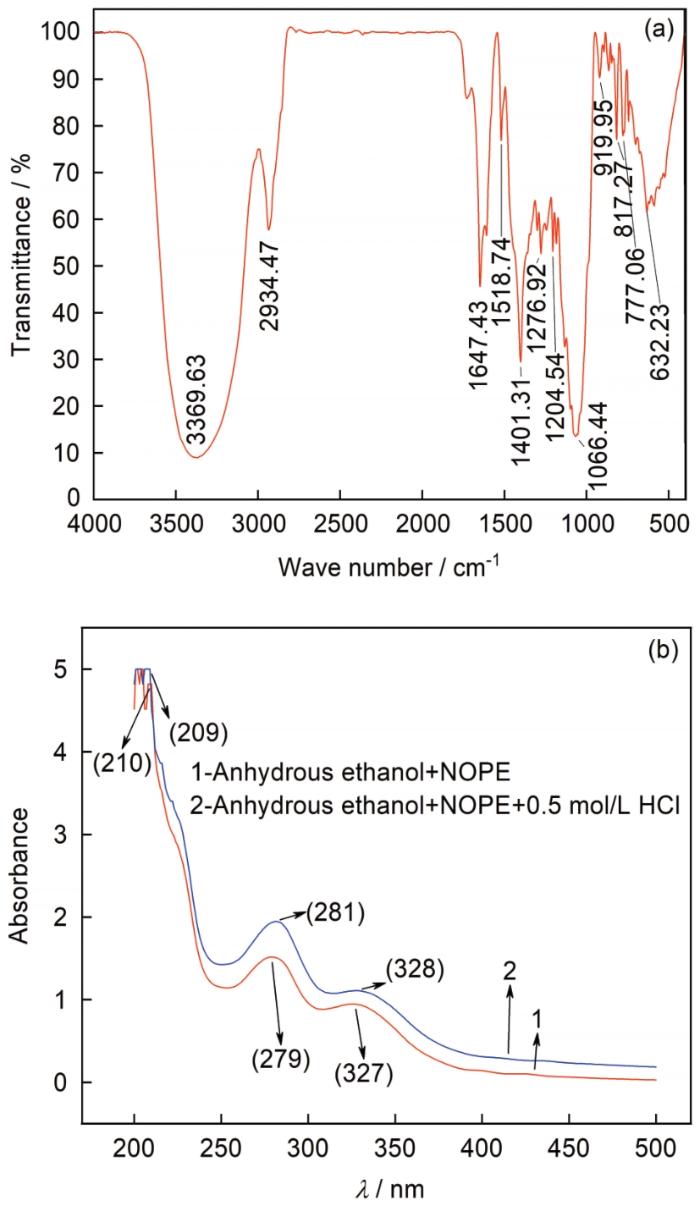
图1
NOPE的FTIR图和有无盐酸介质的UV图
Fig.1
FTIR diagram (a) of NOPE and UV diagram (b) of NOPE without and with hydrochloric acid medium
由图1b可见,两种情况下,UV-vis的吸收曲线几乎相同,说明NOPE中各组分的化学结构于0.5 mol/L HCl介质中没有发生分解。通常,黄酮类的紫外吸收在300~400 nm (I波段) 和240~280 nm (II波段) 处有两个特征吸收峰。在图1中,吸收光谱分别在209 (或210)、281 (或279) 和328 (或327) nm出现3个峰。在328 (或327) nm处的弱带 (I带) 是由肉桂酰与黄酮类化合物B环的电子跃迁引起的。在281 (或279) nm处的吸收带 (II带) 对应于黄酮类化合物苯甲酰A环的电子跃迁。值得注意的是,209 (或210) nm处的强峰是由N和O原子中的电子从n→σ*跃迁引起的 [26]。结果表明,NOPE的主要组成化合物为黄酮类化合物和其他含N或O原子的化合物。NOPE的主要成分橙皮苷结构式和黄铜基本骨架如图2所示。
图2
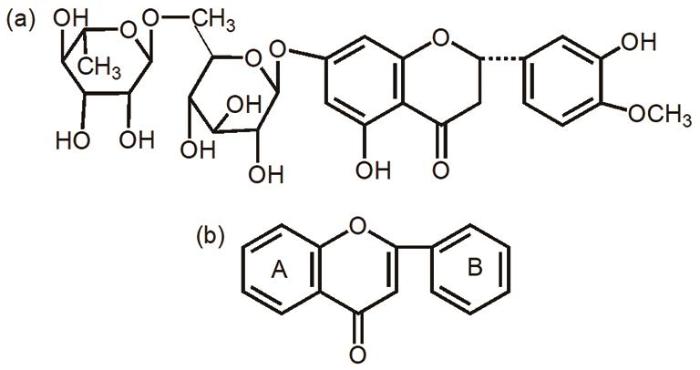
图2
NOPE中的橙皮苷与简单黄酮结构式
Fig.2
Structural formula of hesperidin (a) and flavonoid (b)
2.2 失重法研究NOPE的缓蚀性能
用静态失重法测定在0.5 mol/L HCl介质中加入和未加入NOPE对316L钢试片的V和ƞ,如表1所示。由表可知加入不同浓度的NOPE可使金属表面得到不同程度的保护。另外,温度不变,NOPE浓度越大,ƞ值越高;这是由于NOPE浓度的增大,作用在金属表面的缓蚀剂分子比也随之提高,从而良好的保护膜得以形成,可有效隔离腐蚀介质,因此V值下降[27]。当NOPE浓度不变,温度越高,ƞ值越小;这是因为缓蚀剂分子的解离吸附平衡受温度影响,温度越高,缓蚀剂分子在金属表面的吸附难度就越大,形成的保护膜变得不致密,所以缓蚀效率有所下降[28]。在303和333 K时,添加500 mg/L的NOPE,ƞi %分别为90.48%和60.52%,均有较高缓蚀效率。
表1 失重法计算得出的Vi 值和ƞi 值
Table 1
| T / K | NOPE / mg·L-1 | Vi / g·cm-2·h-1 | ƞi / % |
|---|---|---|---|
| 303 | 0 | 7.02×10⁻⁴ | - |
| 303 | 30 | 3.18×10⁻⁴ | 54.73 |
| 303 | 50 | 2.66×10--4 | 62.04 |
| 303 | 100 | 1.61×10⁻⁴ | 77.10 |
| 303 | 200 | 1.46×10⁻⁴ | 79.17 |
| 303 | 300 | 8.82×10⁻⁵ | 87.44 |
| 303 | 500 | 6.68×10⁻⁵ | 90.48 |
| 313 | 500 | 3.12×10⁻⁴ | 76.78 |
| 323 | 500 | 8.26×10⁻⁴ | 70.12 |
| 333 | 500 | 2.21×10⁻³ | 60.52 |
2.3 温度对热力学活化参数的影响
用失重的测试方法研究了在含有和不含有NOPE 0.5 mol/L HCl中温度对316L钢氧化的影响。随着温度的升高缓蚀率下降,这与表面作用率 (θ) 的减小相关联,证实了NOPE分子的物理吸附假说[29]。
腐蚀反应的表观活化能 (Ea) 可由Arrhenius公式求出:
式中:V表示腐蚀速率;A表示指前因子;T为温度;R为理想气体常数。
图3a为Arrhenius图,Ea值呈现在表2中。随着NOPE的加入,曲线斜率的变化表明氧化反应的活化能发生了变化。本实验中在0.5 mol/L HCl中加入0~500 mg/L的NOPE,Ea从58.3031 kJ/mol提高到96.5437 kJ/mol。Ea的增加表明与钢腐蚀相关的反应动力学变慢。因此,NOPE的使用提高了金属氧化反应所需要的能量,可能是由于在碳钢表面的吸附形成金属复合物阻塞了反应位点,使Ea值增加。A的值与反应物之间发生碰撞的次数直接相关,碰撞次数的增加会增大反应速率。A的值从7.56×106 mg·h-1·cm-2 (空白) 到3.32×10¹² mg·h-1·cm-2 (0.5 g/L NOPE)。尽管A值增加,但在HCl介质中存在NOPE时,碰撞有效所需的能量更高,这降低了钢的腐蚀速率。
图3
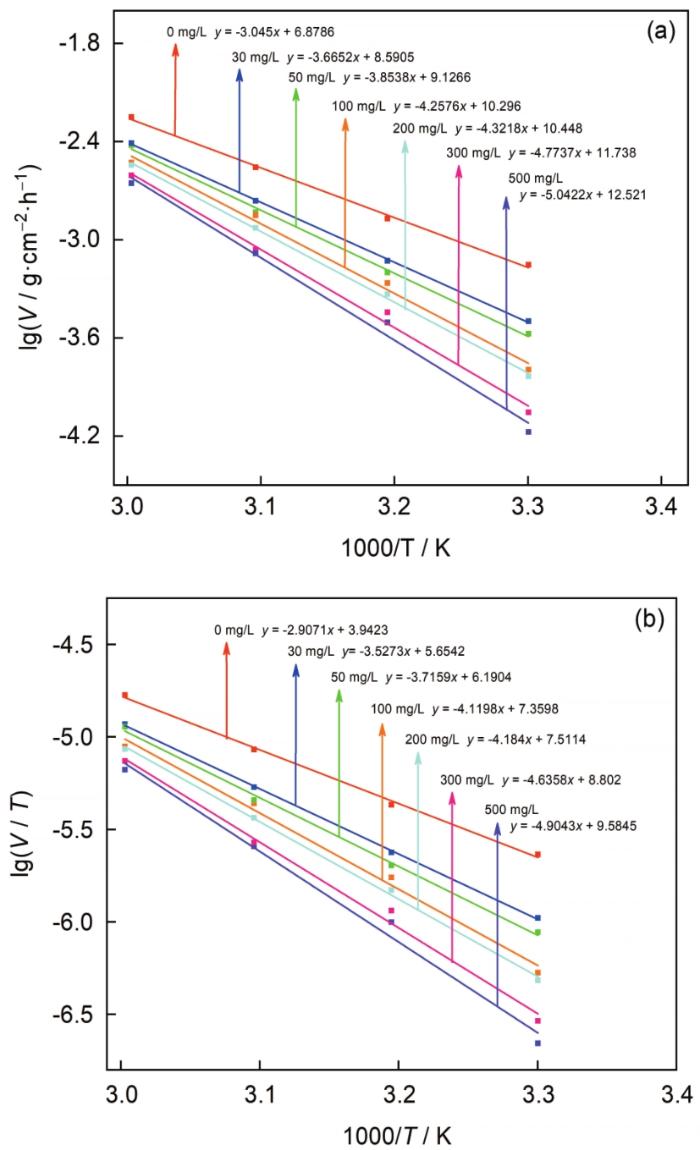
图3
316L钢在空白和含有NOPE的0.5 mol/L HCl溶液中的Arrhenius图和碳钢溶解反应的过渡态图
Fig.3
Arrhenius (a) and transition-state (b) plots for dissolution reactions of 316L steel in 0.5 mol/L HCl solutions without and with NOPE
表2 316L钢在空白和含有NOPE的0.5 mol/L HCl溶液中热力学活化参数
Table 2
| ContentCinh / mg·h-1 | Amg·h-1·cm-2 | EakJ·mol-1 | ΔH | ΔS |
|---|---|---|---|---|
| 0 | 7.56×10⁶ | 58.30 | 55.66 | -139.35 |
| 30 | 3.89×10⁸ | 70.18 | 67.54 | -89.34 |
| 50 | 1.34×10⁹ | 73.79 | 71.15 | -79.07 |
| 100 | 1.98×10¹⁰ | 81.52 | 78.88 | -56.68 |
| 200 | 2.81×10¹⁰ | 82.75 | 80.11 | -53.78 |
| 300 | 5.47×10¹¹ | 91.40 | 88.76 | -29.07 |
| 500 | 3.32×10¹² | 96.54 | 93.90 | -14.08 |
利用
2.4 吸附模型
由失重法实验数据得出NOPE在不锈钢表面的缓蚀率近似等于θ[24],θ由
吸附等温线可提供缓蚀剂与金属表面相互作用的基本信息,是判断缓蚀剂特性的标准之一。在所有的吸附等温式中,Langmiur吸附等温式是最基本的,因此首先用Langmiur吸附等温式进行了拟合计算。Langmiur吸附等温式如下:
其中,c为加入NOPE浓度,Kads为吸附过程平衡常数,通过
图4
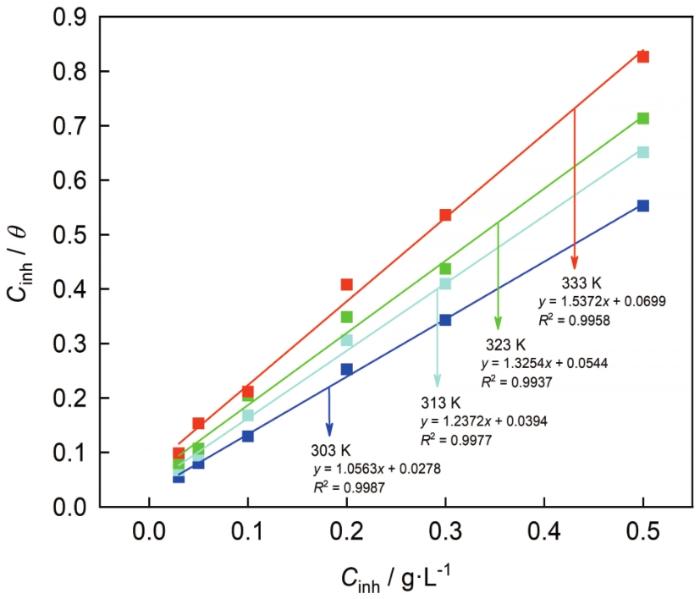
图4
NOPE在0.5 mol/L HCl溶液中对316L钢的Langmuir吸附等温线
Fig.4
Langmuir isotherm for NOPE adsorption on 316L steel in 0.5 mol/L HCl solution
平衡常数Kads的值由直线的截距计算。平衡常数与标准吸附自由能
表3 不同温度下,在0.5 mol/L HCl溶液中316L钢表面对NOPE的吸附热力学参数
Table 3
| T / K | Kads / L·g-1 | R2 | |
|---|---|---|---|
| 303 | 35.97 | 0.9987 | -26.43 |
| 313 | 25.38 | 0.9977 | -26.39 |
| 323 | 18.38 | 0.9937 | -26.37 |
| 333 | 14.31 | 0.9958 | -26.49 |
图5
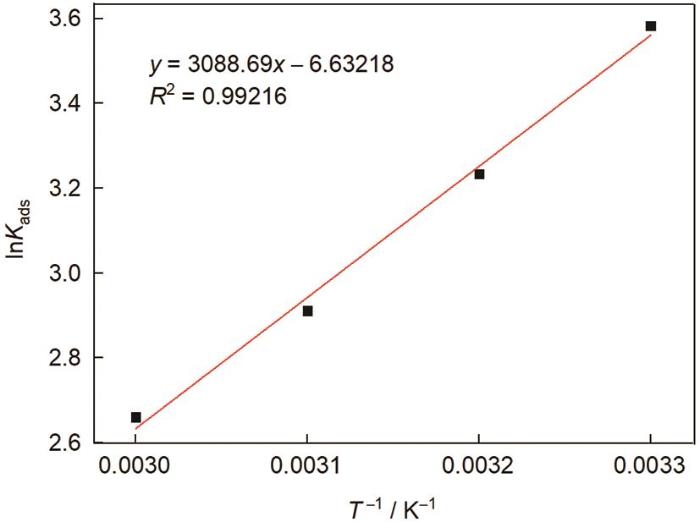
图5
在0.5 mol/L HCl中316L钢对NOPE吸附的lnKads与T-1关系图
Fig.5
lnKads vs. T-1 plot for adsorption of NOPE on 316L steel in 0.5 mol/L HCl solution
2.5 极化实验
2.5.1 开路电位
开路电位 (EOCP) 是一种简单的电化学技术,提供了发生在“金属/电解液”界面过程的初步信息。图6显示了303 K下,在不加NOPE和加了NOPE的0.5 mol/L HCl溶液中,316L钢电极的开路电位EOCP随时间的变化 (EOCP=f(t))。EOCP基本都稳定在一个恒定数值的范围内,说明测量的体系是稳定的。根据这些测量,可见EOCP在空白溶液中稳定在一个负值 (-876 mV)。这是316L钢在酸性介质中溶解的结果,也是金属表面腐蚀产物沉积的结果。在有抑制剂的情况下,与空白溶液相比,开路电位向正的电位值移动。这种偏移是由于这种天然物质对金属/溶液界面阳极位的吸附作用。腐蚀介质中萃取物浓度越高,EOCP越趋向于阳极电位[32]。因此,NOPE可能为抑制阳极为主的缓蚀剂。
图6
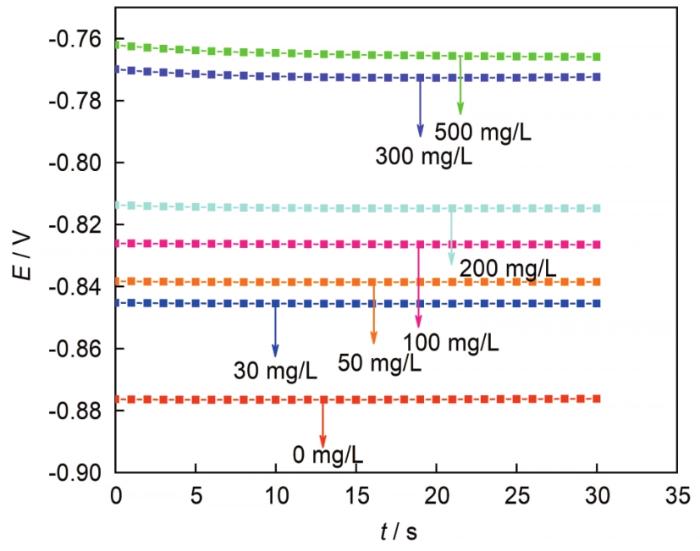
图6
316L钢在0.5 mol/L HCl溶液中加入不同浓度NOPE和不加入NOPE的EOCP-t的曲线
Fig.6
EOCP-t curves of 316L steel in 0.5 mol/L HCl solutions with various concentrations of NOPE
2.5.2 线性极化
线性极化研究得到的极化电阻 (Rp) 值列于表4。其缓蚀率由
其中,
表4 316L钢在0.5 mol/L HCl溶液中加入和不加入不同浓度的NOPE时的动态电位极化和线极化数据
Table 4
| Cinh / mg·L-1 | Ecorr / mV | Icorr / mA·cm-2 | βa / mV·dec-1 | βc / mV·dec-1 | ηPDP / % | Rp / Ω·cm² | ηLPR / % |
|---|---|---|---|---|---|---|---|
| 0 | -871 | 0.44 | 146 | 123 | - | 42.70 | - |
| 30 | -850 | 0.21 | 68.5 | 107 | 51.36 | 93.26 | 54.21 |
| 50 | -841 | 0.18 | 64.5 | 122 | 58.86 | 115.55 | 63.04 |
| 100 | -836 | 0.10 | 49.8 | 107 | 76.57 | 159.51 | 73.23 |
| 200 | -826 | 0.09 | 46.7 | 114 | 79.43 | 180.86 | 76.39 |
| 300 | -818 | 0.06 | 36.5 | 114 | 85.25 | 224.82 | 81.01 |
| 500 | -808 | 0.05 | 32.8 | 121 | 88.82 | 335.98 | 87.29 |
从表4可以看出,随着NOPE浓度的增加,Rp逐渐增加,在浓度0.5 g/L时达到最大值335.980 Ω·cm²,而空白时为42.704 Ω·cm²。有NOPE存在时极化电阻增加,表明在金属电解质界面形成了非导电的NOPE吸附膜。
2.5.3 动电位极化
通过Tafel外推法进行极化实验,分析了316L钢电极在酸性溶液中的腐蚀行为 (图7)。采用
式中,Icorr和
图7
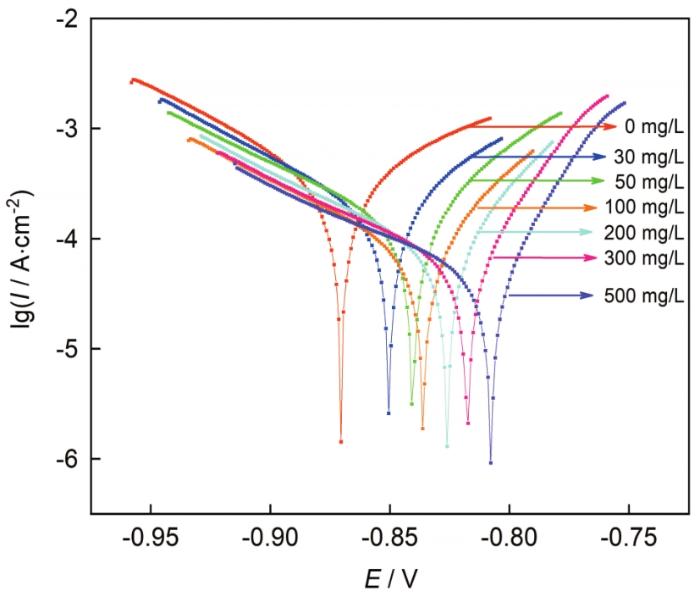
图7
316L钢在含不同浓度NOPE的0.5 mol/L HCl溶液中的动电位极化曲线
Fig.7
Potentiodynamic polarization curves of 316L steel in 0.5 mol/L HCl solutions with different concentrations of NOPE
图8
2.6 EIS实验
图9
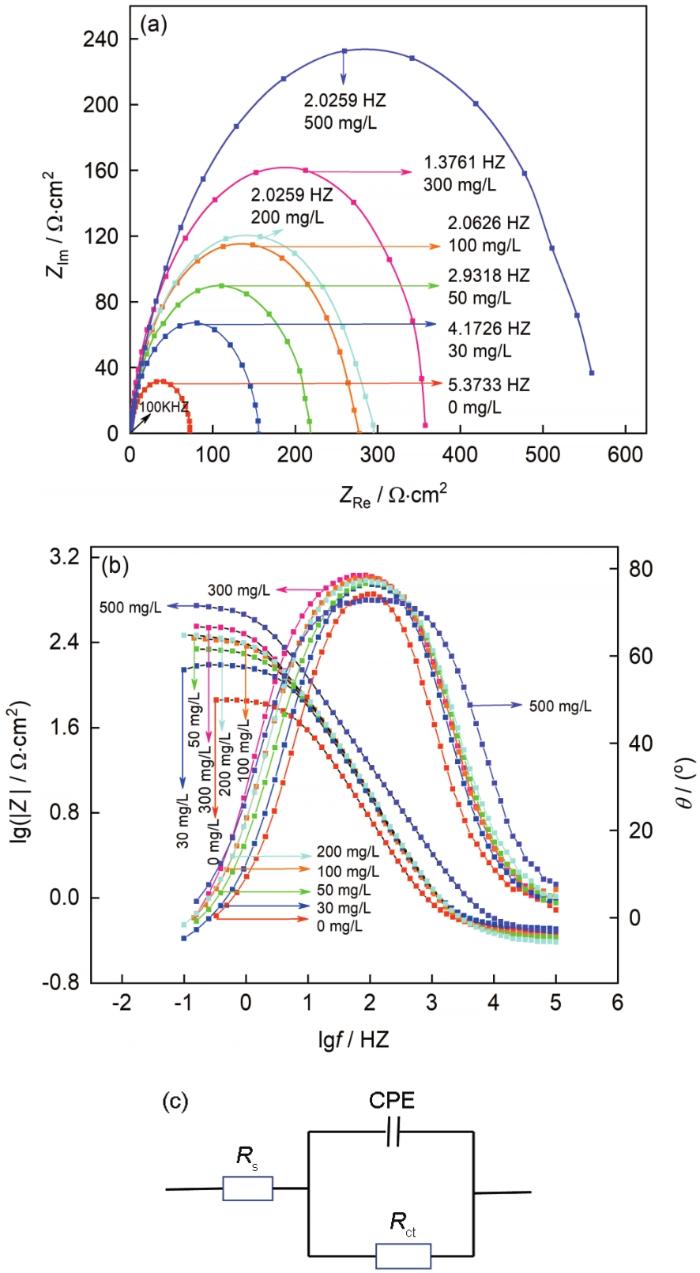
图9
316L钢在不同浓度NOPE的0.5 mol/L HCl介质中的阻抗谱及等效电路
Fig.9
Nyquist (a) and Bode (b) diagrams of 316L steel in 0.5 mol/L HCl solutions with different concen-trations of NOPE, and corresponding equivalent circuit (c)
其中Rct和R0为含及不含NOPE的电荷转移电阻。
表5 316L钢在含不同浓度NOPE的0.5 mol/L HCl介质中的EIS拟合参数
Table 5
| Cinh / mg·L-1 | Rs / Ω·cm2 | Rc / Ω·cm2 | Cd / μf·cm-2 | CPE | χ2 | η / % | |
|---|---|---|---|---|---|---|---|
| Y0 / μΩ-1·s n ·cm-2 | n | ||||||
| 0 | 0.51 | 72.22 | 410.13 | 477.36 | 0.9201 | 0.003446 | - |
| 30 | 0.53 | 151.03 | 252.55 | 297.60 | 0.9224 | 0.004160 | 52.18 |
| 50 | 0.44 | 211.01 | 257.27 | 299.70 | 0.9128 | 0.003832 | 65.77 |
| 100 | 0.46 | 266.27 | 289.79 | 303.92 | 0.9189 | 0.004109 | 72.86 |
| 200 | 0.41 | 282.91 | 277.68 | 305.98 | 0.9066 | 0.004610 | 74.47 |
| 300 | 0.45 | 361.10 | 320.29 | 308.14 | 0.9122 | 0.003260 | 80.00 |
| 500 | 0.47 | 571.48 | 137.47 | 224.62 | 0.9260 | 0.001505 | 87.36 |
CPE在数学上表示为
式中,Y0为比例因子,n为相偏移的含义。n的值代表与理想行为的偏差,它位于0到1之间。
通过χ2 值判断等效电路的拟合适合度。表5中得到的χ2 值 (0.001505-0.004610) 表明与文中的电路很好地拟合。较低的χ2 值表明拟合数据与实验数据吻合较好。随着NOPE在HCl溶液中浓度的增加,Rct值增大,CPE值减小。测试NOPE溶液浓度为0.5 g/L时,Rct值为571.480 Ω·cm2,CPE值为224.618 μΩ-1·s n ·cm-2。Rct值的增加是由于在金属/溶液界面形成了一层绝缘保护膜。界面双电容 (Cdl) 值由
其中,fmax(-ZIm(max)) 为阻抗虚分量的最大值。
随着NOPE浓度从0.03 g/L增加到0.5 g/L,Cdl从252.545降低到137.468 μf·cm-2。Cdl值的降低可能是由于局部介电常数的降低,也可能是由于双电层厚度的增加,或两者兼有,这表明NOPE分子被吸附在金属/溶液界面上。ƞ值随NOPE浓度的增加而增大,当NOPE浓度为0.5 g/L时,ƞ值达到87.363%。这些结果再次证实了NOPE在HCl条件下对316L钢具有良好的缓蚀性能。
由图9b可以看出,NOPE的加入导致界面阻抗增加,随着缓蚀剂浓度的增加,界面阻抗进一步增加。Phase图中的单一峰再次表明,在这两种情况下,金属-溶液界面的腐蚀过程只有一个单一的时间常数。峰高的增加表明,由于界面上NOPE分子的存在,界面的电容性响应更强。
NOPE的有效性可归因于其主要成分橙皮苷和黄酮在金属溶液界面的吸附。由于介质是高酸性的,橙皮苷和黄酮会以分子和质子的形式同时存在。这些物质的相对浓度取决于质子化的程度。可能通过橙皮苷和黄酮以及质子化的橙皮苷和黄酮上的氧原子的孤对电子或共轭双键,与316L钢中Fe的空d轨道相互作用而被吸附。这与失重法测量及上述3种不同的电化学测量得到的缓蚀效率是基本一致的。
2.7 表面分析
图10为腐蚀前、空白和加0.5 g/L NOPE后316L钢表面的SEM像。可以看出,在放大倍数相同的情况下,腐蚀前的316L钢表面有明显的机械打磨划痕;浸泡在空白的0.5 mol/L HCl溶液中的316L钢表面则腐蚀严重,有较多腐蚀产物和很深的腐蚀坑;加入NOPE以后,SEM形貌几乎没有出现腐蚀产物的聚集,损伤明显减少。NOPE中的有机化合物吸附在316L钢的表面,形成了一层薄薄的保护膜,阻止了腐蚀性离子 (Cl -) 的扩散,从而减少了腐蚀。这揭示了NOPE在0.5 mol/L HCl中对316L钢的保护性。
图10
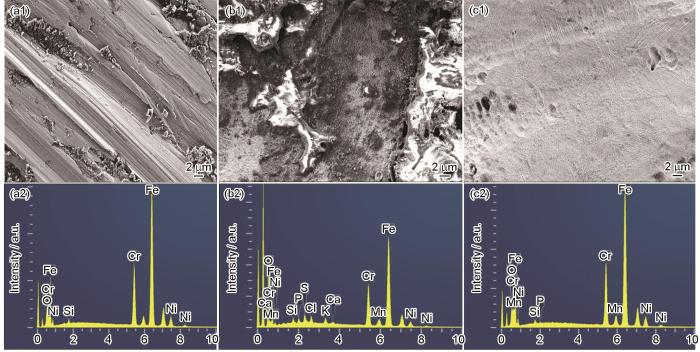
图10
316L钢试片表面的SEM照片和EDS分析结果
Fig.10
SEM surface morphologies (a1-c1) and EDS results (a2-c2) of 316L steel: (a1, a2) New, (b1, b2) Blank, (c1, c2) NOPE
由图10b2可以看出,在没有抑制剂的情况下,我们注意到Cl和O的特征峰的存在,它们是316L钢表面腐蚀产物的主要成分,这由测定结果 (73.41% C, 7.77% Fe, 0.22% Cl和14.59% O) 可以证实。另一方面,在测试溶液中存在NOPE(c1),我们观察到Cl对应的信号消失,O的特征峰减少,这在测定的结果中也有体现 (34.77% C, 41.93% Fe和5.23% O)。这些结果表明,NOPE的分子吸附在316L钢金属表面,阻止了Cl-的攻击,阻碍了腐蚀产物 (FeCl2等络合物) 的形成,使316L钢表面很好地抵抗了腐蚀环境的侵蚀,从而降低了腐蚀速率。这些结果与SEM所得结果吻合较好。
2.8 缓蚀机理
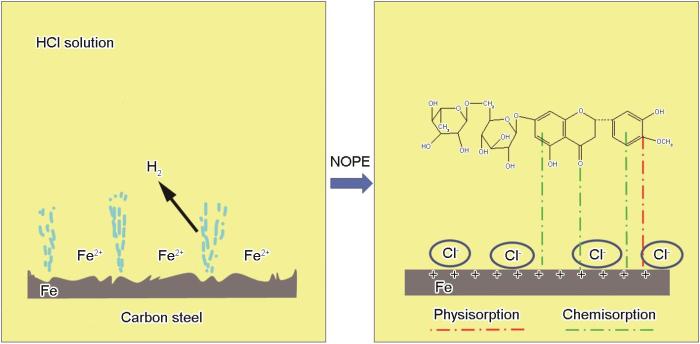
过渡态图和Arrhenius图表明,在酸性介质中,NOPE存在时,腐蚀过程的反应通过增大Ea和
图11
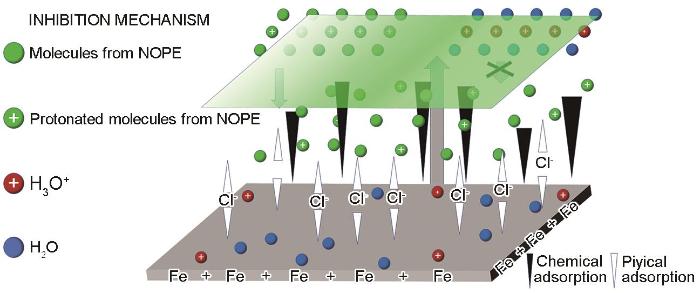
图11
316L钢在含NOPE的0.5 mol/L HC溶液中的缓蚀机理
Fig.11
Proposed corrosion inhibition mechanism for 316L steel in 0.5 mol/L HCl solution containing NOPE
静电相互作用和NOPE与铁产生的化学键作用共同在钢表面形成屏障或产生阻塞效应,从而降低了HCl的腐蚀作用。由于吸附有机分子的疏水部分形成了一层保护膜,氧化还原反应的活性位点数量因此减少,使腐蚀性物质(如水合氢离子)在合金表面的吸附变得困难,所以,NOPE在316L钢的表面是通过化学吸附和物理吸附而起到缓蚀作用的。
2.9 与其他友好型缓蚀剂的对比
表6 HCl溶液中用于钢的提取物缓蚀剂的比较
Table 6
| Extract raw material | Steel | HCl / mol·L-1 | Conc. | ηmax / % | Ref. |
|---|---|---|---|---|---|
| Winged bean | Reinforced steel | 0.5 | 1 g·L-1 | 95 | [36] |
| Lychee fruit | Mild steel | 0.5 | 0.7 g·L-1 | 93.4 | [37] |
| Robinia pseudoacacia leaves | Mild steel | 0.5 | 2 g·L-1 | 92.0 | [38] |
| Akebia trifoliate koiaz peels | Mild steel | 1 | 0.8 g·L-1 | 87.6 | [18] |
| Mimosa pudica leaves | Mild steel | 1 | 1 g·L-1 | 77.3 | [39] |
| Lavandula mairei | Mild steel | 1 | 0.4 g·L-1 | 92.0 | [40] |
| Garlic | 304 | 0.5 | 8 cc·L-1 | 83.9 | [41] |
| Thymus vulgaris plant leaves | 304 | 1 | 2% | 62.2 | [42] |
| Spinach | 316L | 0.5 | 0.5 | 90.5 | NOPE |
3 结论
(1) 在HCl介质中加入NOPE,由于水分子、离子与NOPE中有机分子的交换,使其在金属/溶液界面上起到缓蚀作用。由于钢表面活性区域的减少,这种交换导致腐蚀速率从7.0188×10-4g/(cm2·h)下降到6.6790×10-5 g/(cm2·h) (0.5 g/L NOPE)。
(2) NOPE的加入对体系的影响与混合电化学机理有关,主要是延缓阳极反应,当NOPE的加入量为0.5 g /L时,体系的缓蚀效率最高,为90.5% (失重法) 和87.3% (电化学法)。钢表面吸附层的形成受Langmuir等温线模型的控制。
(3) 与空白相比,NOPE分子在钢表面吸附形成的膜使腐蚀过程的Ea和
(4) SEM和EDS证明NOPE中有机分子 (橙皮苷和黄酮类分子) 的存在增加了钢表面的疏水性。其缓蚀机理是带电物质 (如Cl-和部分带电分子) 与在酸性介质中带正电的钢表面相互作用。混合缓蚀机理表明,NOPE在316L钢表面通过化学和物理吸附作用,形成一个屏障,阻止钢表面受腐蚀介质中离子的侵蚀。
参考文献
Research progress of corrosion inhibitor for Mg-alloy
[J].
镁合金缓蚀剂研究进展
[J].
镁化学性质活泼,在水溶液环境中腐蚀速度较快,很大程度上制约了镁合金的大规模应用。缓蚀剂是目前腐蚀与防护领域应用最广泛的一种技术,具备高效、成本低等特点,可在工业应用中大幅度提高镁合金的耐蚀性能。本文依据缓蚀剂的化学组成进行分类,概述无机、有机缓蚀剂以及复配缓蚀剂的研究进展,通过总结缓蚀机理对镁合金缓蚀剂未来的研究方向提出了展望。
Syzygium cumini leaf extract as an eco-friendly corrosion inhibitor for carbon steel in acidic medium
[J].
Green synthesis of 1-benzyl-4-phenyl-1H-1, 2, 3-triazole, its application as corrosion inhibitor for mild steel in acidic medium and new approach of classical electrochemical analyses
[J].1-benzyl-4-phenyl-1H-1,2,3-triazole was prepared using an environmental friendly and facile synthetic procedure and its performance as an organic corrosion inhibitor for mild steel in 1.0 mol L-1 HCl was investigated using four different methods. An average efficiency of 81.7% was obtained with 2.13 mmol L-1 solutions of the organic compound. A new approach to classical electrochemical analyses confirms the inhibitor adsorption on the metal surface. Temperature effect studies in the oxidation inhibition behavior as well as calculated thermodynamic parameters are consistent with a chemisorption process and Atomic Force Microscopy shows the formation of a protective film.
Ircinia strobilina crude extract as corrosion inhibitor for mild steel in acid medium
[J].The marine sponge Ircinia strobilina crude extract (ISCE) was analyzed as a corrosion inhibitor for mild steel in 1 mol L-1 HCl. The corrosion behavior was evaluated using weight loss method, potentiodynamic polarization, linear polarization resistance and electrochemical impedance spectroscopy. The results show an increase in anticorrosive efficiency as ISCE concentrations increase (from +/- 55% at 0.5 g L-1 to +/- 82% at 2.0 g L-1). The surface was examined by diffuse reflectance infrared Fourier transform spectroscopy. The composition of the crude extract was chemically characterized by liquid chromatography-high resolution mass spectrometry. The protection mechanism was discussed. (C) 2019 Elsevier Ltd.
Food spices 2, 5-dihydroxy-1, 4-dithiane as an eco-friendly corrosion inhibitor for X70 steel in 0.5 mol/L H2SO4 Solution
[J].
食用香料1, 4-二硫-2, 5-二醇环保型缓蚀剂对X70钢在0.5 mol/L H2SO4溶液中的缓蚀性能研究
[J].使用实验和理论计算方法研究了食用香料1,4-二硫-2,5-二醇 (DDD) 对X70管线钢在0.5 mol/L硫酸溶液中的缓蚀性能。结果表明,DDD能够有效的抑制X70钢在H<sub>2</sub>SO<sub>4</sub>介质中的腐蚀,在温度为298 K时,DDD的缓蚀效率可以达到93.6%;随着温度的升高,DDD依然能够展现出良好的缓蚀性能。腐蚀微观形貌观察也证明了DDD能够明显抑制X70钢的腐蚀。吸附等温模型研究结果表明,DDD在X70钢表面的吸附符合Langmuir单层吸附。采用量子化学计算和分子动力学模拟从理论层面讨论了DDD在钢表面的吸附及缓蚀机理。
Experimental and theoretical studies on the inhibition properties of three diphenyl disulfide derivatives on copper corrosion in acid medium
[J].
Corrosion inhibition of X65 steel in sulfuric acid by two food flavorants 2-isobutylthiazole and 1-(1, 3-Thiazol-2-yl) ethanone as the green environmental corrosion inhibitors: Combination of experimental and theoretical researches
[J].
Inhibition of mild steel corrosion using Magnolia kobus extract in sulphuric acid medium
[J].
Natural products as corrosion inhibitor for metals in corrosive media-A review
[J].
Caffeic acid as a green corrosion inhibitor for mild steel
[J].
Enhanced corrosion inhibition effect of tannic acid in the presence of gallic acid at mild steel/HCl acid solution interface
[J].
Green corrosion inhibitors for mild steel in H2SO4 solution: Comparative study of flavonoids extracted from gongronema latifoliunm with crude the extract
[J].
Watermelon waste products as green corrosion inhibitors for mild steel in HCl solution
[J].
Utilization of tomato peel waste from canning factory as a potential source for pectin production and application as tin corrosion inhibitor
[J].
Grape pomace extracts as green corrosion inhibitors for carbon steel in hydrochloric acid solutions
[J].
The litchi (Litchi Chinensis) peels extract as a potential green inhibitor in prevention of corrosion of mild steel in 0.5M H2SO4 solution
[J].
Corrosion inhibition effect of citrus sinensis essential oil extract on plain carbon steel in dilute acid media
[J].
Akebia trifoliate koiaz peels extract as environmentally benign corrosion inhibitor for mild steel in HCl solutions: Integrated experimental and theoretical investigations
[J].
Challenges and advantages of using plant extract as inhibitors in modern corrosion inhibition systems: Recent advancements
[J].
Electrochemical studies and surface examination of low carbon steel by applying the extract of Musa acuminata
[J].
Utilization of watermelon rind extract as a green corrosion inhibitor for mild steel in acidic media
[J].
Anti-corrosive behavior of ethanolic extract of banana peel against acidic media and their thermodynamic studies
[J].
Chemical composition and antioxidant potential of peels from three varieties of banana
[J].
Synergistic inhibition effect of walnut green husk extract and potassium iodide on corrosion of steel in citric acid solution
[J].
核桃青皮提取物与碘化钾对钢在柠檬酸中的缓蚀协同效应
[J].以农林废弃物核桃青皮为原料,采用乙醇水溶液为提取剂进行回流提取制得核桃青皮提取物 (WGHE);通过全浸失重法研究了WGHE与碘化钾 (KI) 对冷轧钢在1.0 mol/L柠檬酸 (H<sub>3</sub>C<sub>6</sub>H<sub>5</sub>O<sub>7</sub>) 溶液介质中的缓蚀协同性能,并采用动电位极化曲线探究了电化学作用机理;借助扫描电子显微镜 (SEM) 和原子力显微镜 (AFM) 研究了钢表面的微观形貌和表面粗糙度。结果表明,WGHE及KI单独使用具有中等程度的缓蚀作用,最大缓蚀率分别为67.4%和69.3%;当WGHE与KI混合复配使用后,缓蚀性能显著上升,25 ℃时缓蚀协同效应系数大于1,两者之间存在缓蚀协同效应,200 mg/L WGHE与100 mg/L KI复配后的缓蚀率高达85.3%。WGHE、KI混合使用前后在冷轧钢的表面吸附规律均遵循 Langmuir吸附等温方程式,协同缓蚀剂WGHE/KI在钢表面的吸附平衡常数 (K) 进一步增大至0.0382 L/mg,而标准吸附Gibbs自由能 (ΔG<sup>0</sup>) 降低为-28.9 kJ/mol。WGHE、KI单独使用时对阴极反应产生了抑制作用,而WGHE与KI的复配物为混合抑制型缓蚀剂。SEM和AFM分析得出WGHE与KI混合使用后更能有效减缓柠檬酸介质对钢表面的腐蚀。
Inhibition effect of orange peel extract on aluminum in hydrochloric acid solution
[J].
橙子皮提取物对HCl溶液中铝的缓蚀作用研究
[J].
Inhibition effect of bamboo leaves' extract on steel and zinc in citric acid solution
[J].
Inhibition effect of soybean meal extract on corrosion of Q235 steel in hydrochloric acid medium
[J].
豆粕提取物在盐酸中对Q235钢的缓蚀性能
[J].
Research on the extraction condition and corrosion inhibition performance of actire principle in pomelo peel
[J].
柚子皮有效成分的提取及其缓蚀性能研究
[J].
Corrosion inhibition by amitriptyline and amitriptyline based formulations for steels in simulated pickling and acidizing media
[J].
Corrosion inhibition of API 5L X80 pipeline steel in acidic environment using aqueous extract of Thevetia peruviana
[J].
Corrosion mitigation of mild steel in acidic medium using Lagerstroemia speciosa leaf extract: A combined experimental and theoretical approach
[J].
A new trend in corrosion protection of copper in acidic medium by using Jujube shell extract as an effective green and environmentally safe corrosion inhibitor: Experimental, quantum chemistry approach and Monte Carlo simulation study
[J].
Application of Hymenaea stigonocarpa fruit shell extract as eco-friendly corrosion inhibitor for steel in sulfuric acid
[J].
Studies on the inhibition Mechanism of Amino acid inhibiters in the process of Acid Cleaning
[J].
酸洗过程中氨基酸类缓蚀剂缓蚀机理研究进展
[J].
Improvement of the corrosion resistance of mild steel in sulfuric acid by new organic-inorganic hybrids of Benzimidazole-Pyrophosphate: Facile synthesis, characterization, experimental and theoretical calculations (DFT and MC)
[J].
Applicability of winged bean extracts as organic corrosion inhibitors for reinforced steel in 0.5 M HCl electrolyte
[J].
Corrosion protection for mild steel by extract from the waste of lychee fruit in HCl solution: Experimental and theoretical studies
[J].
Corrosion inhibition behavior of Robinia pseudoacacia leaves extract as a eco-friendly inhibitor on mild steel in acidic media
[J].
Corrosion inhibition potential of the methanolic crude extract of Mimosa pudica leaves for mild steel in 1 M hydrochloric acid solution by weight loss method
[J].
Evaluation of Lavandula mairei extract as green inhibitor for mild steel corrosion in 1 M HCl solution. Experimental and theoretical approach
[J].
Corrosion prevention of AISI 304 stainless steel in hydrochloric acid medium using garlic extract as a green corrosion inhibitor: Electrochemical and theoretical studies
[J].
Evaluation of Thymus vulgaris plant extract as an eco-friendly corrosion inhibitor for stainless steel 304 in acidic solution by means of electrochemical impedance spectroscopy, electrochemical noise analysis and density functional theory
[J].


